Tuesday, October 15, 2013

A Review of Swag by Elmore Leonard


Elmore Leonard died about a month ago. I’d never read any of his books. But I’d learned a lot about them after he died. Appreciations of his writing appeared in the New York Times and in the New Yorker. I read these reviews. Based on these comments, I came to the conclusion that Leonard was a writer’s writer. Many people praised his style. His economy of style.
In addition to reading all of these appreciations, I knew Leonard wrote about crime, and there is perhaps no better genre to enjoy than crime, police procedurals, detective novels, and mysteries. You learn a lot about the world, especially the underside. You’re also entertained most of the time. Based on the reviews I read and my appreciation of the genre, I decided to try a Leonard book. I read Swag.
My choice did not disappoint me. Swag is about two guys who decide to go into the business of armed robbery. Leonard’s portrayal of the two main characters is pretty much flawless. Each has about half a set of brains, and together they don’t quite make a whole. But for a while, they’re on a run. Leonards’s spare and direct style works perfectly to portray the mentality of the main protagonists. Complications occur when a bright detective, a bright prosecutor, and a dame get involved in the proceedings. And greed. And love.
Having represented a lot of criminal defendants in my time, I can only think of a couple who were genuinely bright. And at least once I represented a wiseguy and his saner, quieter partner. You can see the trouble that someone is headed toward when bluster and bravado are supposed to replace thought and judgment. Based on my experience, Leonard seems to have encountered these types of guys as well. He captures their character and ethos so well. Leonard doesn’t criticize his characters or paint them to be anything than other than what they are. A pair of guys who generate some sympathy along the way even as you see them blunder deeper down the rabbit hole.
If you enjoy crime writing at all, then I’d have a hard time thinking that you wouldn’t enjoy this Elmore Leonard novel written in the 1970s. Leonard wrote and published up to the time of his death, and there’s a large body of it I’ve yet to read. This work is different from a mystery or detective novel because the main protagonists are the criminals and not the “good guys”. He gets into the heads of these guys as well as I can imagine anyone doing, and that’s no small accomplishment. Good style or not.

Garments of Court & Palace: Machiavelli & the World That He Made by Phillip Bobbitt


We recently toured Rome and Italy, where we viewed many of the splendors of the Italian Renaissance. Works by Michelangelo, Titian, and Rafael were prominent. The spirit of Leonardo da Vinci loomed in the background. These figures and others like them are considered among the glories of the Italian Renaissance. But perhaps the most important person to emerge from the Italian Renaissance was not a painter, sculptor, or poet. He was a Florentine diplomat sent involuntarily into exile from Florence to a country estate, where he took up his pen and began writing. He drew upon his deep knowledge of ancient history and Florentine history. He drew upon his extensive practical experience from many years as a Florentine diplomat. After his death, one of his works, On Principalities, was published. Immediately, it was subject to mistranslation, misunderstanding, and abridgment. It became known as the Courtier's Koran (and this is not a compliment). Who was this person? Niccolò Machiavelli. His name has become familiar through the centuries since the publication of The Prince (as the title was misleadingly translated into English) as a purveyor of sinister political advice. Almost every major commentator addressing all him him him him him him him him the history of political thought has grappled with Machiavelli’s works and wrestled with his legacy. In this book, Philip Bobbitt enters the fray.

Philip Bobbitt is a professor of law at Columbia University with continuing ties to his original teaching position at the University of Texas. In addition, he has served in foreign-policy positions under both Republican and Democrat administrations. Finally, and most recently, he has published two major works on law, strategy, and international relations: The Shield of Achilles and War and Consent. Compared to those two books, his foray into the world of Machiavellian studies is brief and succinct. However, Bobbitt has a compelling hypothesis and makes a strong case in favor of his interpretation.

Bobbitt argues that The Prince is a short detour from Machiavelli's longer work, the Discourses on Livy, which helped create the intellectual climate that allowed the resurgence of Republicanism in the Western world. Bobbitt argues that The Prince and the Discourses should be read as one book on the state (il stato). Instead of Machiavelli writing a “mirror of princes” work like his predecessors, Machiavelli is attempting something else. In The Prince Machiavelli aims to establish a practical ethics for establishing a state (principality). After the establishment of the state, Machiavelli recommends a transition to a republican form of government. Machiavelli undertakes this intellectual project in the hope that Italy will one day unify into a single state under a republican government, a hope that was not realized until several centuries after his death. In forwarding this argument, Bobbitt does not see Machiavelli as a teacher of evil, but as an astute student of political realities that is willing to weigh the consequences of action and not pay mere lip service to ethical guidelines that don't deal with the reality of those grasping for political power.

I found Bobbitt's argument convincing. Most who read Machiavelli have to admit that he has insights into the behavior of those grasping or seeking power (i.e., all of us). His classic query is to whether it is better to be loved or to be hated, a question that has a practical ring to it for personal relations as much as for political rule. Many readers over the centuries have felt that in taking any advice from Machiavelli one was somehow lowering oneself in a dastardly way, but this is not (necessarily) so. Machiavelli tries to establish the guidelines for founding a state (or regime or scheme of power) that can be later transferred into a more stable republic.

Bobbitt's argument about Machiavelli makes a lot of sense, but it also leaves many unanswered questions. The review of the book by Garry Wills in the New York Times suggest that Bobbitt’s book tacitly approves of a powerful state that will limit civil liberties and unduly aggrandize the regime. Wills seems to believe that Bobbitt’s argument grants license to the Dick Cheneys of the world to do as they will in protection of the state. I didn't read Bobbitt as making that argument, although I am curious to go back and look more closely at The Shield of Achilles and especially Terror and Consent to learn how Bobbitt draws these lines. Bobbitt does ignore the question of when Machiavelli’s ethics of The Prince should no longer apply. In other words, a newly formed principality, according to Machiavelli and Bobbitt, must work under different set of guidelines than an established republic. However, to what extent can a republic or should a republic revert to the ethics of a principality when under threat? Indeed, history seems littered with examples of political leaders who grasp for power when external forces threaten. The identification of an external threat is the oldest trick in the playbook for extending political power. According to Machiavelli and Bobbitt, how do we sort out the legitimate expediencies that Machiavelli might consider legitimate from those that would prove harmful to a republic? Our own republic has undergone a serious decline in civil liberties under the terrorist threats of the last 20 years, and before that, under the threat of communism. Despite the warnings of people like George Kennan, throughout the Cold War the US too often mimicked our adversaries in paranoia, state security, and limitations on freethinking. The same thing can be happening in the current age, although Al Qaeda and Islamic fundamentalism don’t pose the ideological threat that Marxism once held as an attractive messianic religion.

For anyone who is remotely interested in Machiavelli and the world in which he lived and acted, I highly recommend Bobbitt's book. Bobbitt is not a Machiavelli scholar, but he has done his homework and marshaled his arguments in a way that is convincing and appealing. I hope his next book will address the application of Machiavelli and Machiavellian principles in today's world and how we can distinguish between the legitimate uses of power and their easy corruption.

Wednesday, September 11, 2013

Representative Loebsak Replies About Syria


September 11, 2013

Mr. Steve Greenleaf
345 Magowan Avenue
Iowa City, IA 52246-3515

Dear Mr. Greenleaf,

Thank you for contacting me about Syria.  I'm honored to represent you.  Your opinion is very important to me and my priority is to provide Iowa's Second District with the best representation possible.

As soon as discussions about possible use of military force in Syria began, I urged President Obama to make the case directly to the American people for involvement in the conflict and to seek authorization from Congress prior to committing U.S. military assets in Syria.   Any decision to use military force requires the public debate our Founding Fathers wisely prescribed in the Constitution. 

The use of chemical weapons against civilians and the humanitarian catastrophe in Syria is morally reprehensible and should be unequivocally condemned by the international community.  However, as a member of the House Armed Services Committee, I strongly believe that after more than a decade of war during which time our troops and military families have made great sacrifices on our behalf, we must exercise extreme caution in undertaking any military action.

The President must directly make the case to the American people for why military action in Syria is in our national interest.  This includes laying out the strategic reasoning behind military action, defining the national security reasoning for such action, and establishing an end goal and exit strategy for potential use of force, as well as laying out the broader implications of military action for the region and American interests there.  In a highly unstable area of the world, the implications of U.S. military involvement in the Syrian conflict requires significant debate and the support of the American people.  This is particularly true with our troops still deployed in Afghanistan and after our servicemembers and military families have made incredible sacrifices on our behalf over more than a decade of war.

I have received initial briefings by the White House and will continue to closely engage the Administration and our military, intelligence, and diplomatic leaders on this issue.  However, it is absolutely critical to me to know your thoughts on this issue, and I greatly appreciate you taking the time to share them with me. I also have a poll on this issue posted on my website, which I welcome you to take at
http://loebsack.house.gov/syria if you have not already.

Please be assured that as a member of the House Armed Services Committee and the Congressional Human Rights Caucus, I will continue to closely monitor the ongoing situation in Syria and promote extreme caution in the use of military force. 

Thank you again for contacting me about this important issue.  My office is here to assist you with any and all concerns you have, so please do not hesitate to contact me whenever you feel that I can be of assistance.  I encourage you to visit my website at 
www.loebsack.house.gov and sign up for my e-newsletters to stay informed of the work I'm doing for you.  I am proud to serve the Second District, and I am committed to working hard for Iowans.

Dave Loebsak
Iowa's Second District

Tuesday, September 10, 2013

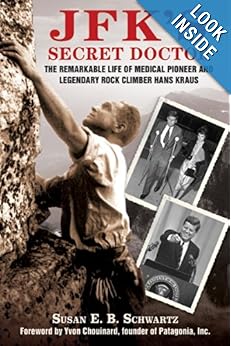
JFK’s Secret Doctor: The Remarkable Life of Medical Pioneer and Legendary Rock Climber Hans Kraus by Susan E.B. Schwartz


Two significant anniversaries are coming up soon. This November will mark the 50th anniversary of the assassination of John F. Kennedy, an event that anyone born before 1958 likely remembers. The memory of this shock is seared into the consciousness of millions of Americans with feelings of loss, vulnerability, and thoughts of what might have been if Oswald had failed.

The other anniversary arrives in less than one year from now. In August 1914, triggered by another assassination, that of the Archduke Ferdinand, heir to the throne of the Hapsburg Empire, the First World War broke out. This marked the beginning of what some have labeled The Long War that ended only in 1989 with the capitulation of the Soviet Union in Eastern Europe. During this period, the Hapsburg Empire collapsed, Germany suffered defeat, Hitler and National Socialism arose, and Germany suffered another crushing defeat. Meanwhile, millions of lives were lost and many more were displaced.

I mention these two events because of their significance in the life of Dr. Hans Kraus, a medical pioneer previously unknown to me. Kraus came from a wealthy Hapsburg Empire family that moved from Trieste, a multi-ethnic city on the Adriatic, to Vienna, the capital of the Hapsburg Empire, and finally to New York, as refugees from the coming storm led by Hitler. The Kraus family had Jewish forbearers, but­ they had the wealth and foresight to escape the tide of war and genocide that washed over their native lands.

Kraus was born at the beginning of the century, and his youth was marked by his time in the mountains, introduced to him by a domineering and demanding father. Kraus grew strong and developed a true love for the mountains: for climbing, hiking, and skiing, which provided him spiritual sustenance. But while Kraus grew up in a wealthy household, his youth was marked by two significant influences: his demanding father (similar in many ways to JFK’s demanding father) and the death of a friend during a climb they made as impetuous youths. Despite his father’s protests and derision, Kraus became a physician, and specifically, an orthopedist, in part as a way to atone after the shocking death of his friend.

Many an orthopedist that I know were athletes, and Kraus fits the mold, but his mountaineering hobby, which lasted nearly his whole life, provided him with experiences that would help change medical practice. For Kraus learned from the practical persons of the mountains, not fellow Viennese physicians, how to treat traumatic joint and muscle injuries. He learned to treat such injuries not by immobilization and bed rest, but by movement and muscular development. Over the course of a medical career spanning almost six decades, his treatment recommendations put him at odds with the medical establishment.

After emigrating to NYC, Kraus developed a very successful medical practice as well as establishing himself as a premier American rock climber. He developed a set of tests to measure susceptibility to back pain—a growing epidemic in the U.S.—and he pushed for better physical health among American children,  and by his efforts helping to create the President’s Council on Physical Fitness (for what little that was worth). However, his greatest claim to fame came from being asked to treat President John F. Kennedy for his famously bad back. Kennedy had undergone two back surgeries and extended periods of bed rest, and was nearly crippled by his back. Kennedy’s situation was aggravated by his Addison’s disease, a secret guarded as closely, if not closer, than his trysts. Kraus, at the invitation of a couple of JFK’s treating physicians, came in and took control of JFK’s back. Kraus palpated Kennedy’s muscles, tested his strength and flexibility, and then he prescribed the treatment: trigger point therapy, exercise, and relaxation. No surgery, no drugs, and no crutches. (Kraus also opposed JFK’s corset, but JFK held on to its use almost as a psychic crutch, which perhaps cost him his life (read the book).) After a couple of years of the Kraus treatment, people close to him described JFK as his healthiest in memory. JFK continued to have flare-ups of back problems, usually associated with time around family—strong stressors given his domineering father, the competitive family ethos, and his marriage—but his flare-ups were not associated with events like the Cuban missile crisis or other demanding presidential duties. Kraus, making his only exception to requiring patients to come see him in his NYC office, came when needed to help the President. By the time of JFK’s assassination, Kraus had developed a strong relationship with JFK and a high degree of admiration.

Kraus was slow to receive recognition in the medical community for his “old-fashioned” ways of palpating and manipulating patients, usually avoiding surgery, drugs, and hospital stays. In fact, the issue of the reception that Kraus’s insights and treatments received within the medical community is a great issue in this book that the author fails to fully explore. Kraus is quoted as saying “I’d be sued now” for using his ways of diagnosis and treatment, but that suggests that we lawyers are the problem. In fact, lawyers are the least important of three parties to a malpractice claim. The two most important players are patients, who, contrary to myth, are (in my experience) reluctant, frustrated by a lack of candor from treating physicians, and badly injured (or the surviving relatives). The other key players in any malpractice claim are fellow physicians, who offer opinions about the standard of care. Their opinions about the correctness of a course of treatment are the crucial element of any claim.

But step back from any consideration of outright malpractice, because an even greater issue is raised here, that of accepted practice (ortho-practice, if you will) that is actually iatrogenic—injury causing—such as bed rest and immobilization. One AMA president in the 1950s quoted in the book stated that smoking is actually probably good for you! Scientific ignorance, reasoning prejudices and biases, and economic incentives (surgery earns more money than prescribing exercises) all contribute to medical practices that can actually prove harmful, if not fatal. (See Nassim Taleb’s Antifragile for more about this.) I would like the author to have done more with this theme than simply noting Kraus’s battles for acceptance and the intransigence of the medical community toward his insights. I’m not sure that Kraus’s methods have been widely accepted—do you still use RICE (rest, ice, compression, elevation) for a sprained ankle? If so, read this book and think again!

Finally, this book is worthwhile because it can lead you to a better back. For most readers, this alone would prove the value of the book. A YouTube of a Kraus program can be found @ http://www.youtube.com/watch?v=UZziz64PNpY. (Enjoy the vintage workout clothes!)

All in all, an interesting and worthwhile book about a very interesting and little known character. A big shout-out goes to Tanta Rose for bringing this book to my attention.

About Syria & U.S. Intervention


If I’d been in the U.S. on Monday, I would not have attended a rally against U.S. airstrikes on Assad’s regime in Syria. Not because I favor such strikes, but because I don’t want to delude myself or others about what we’re doing or not doing if the U.S. were to act. For instance, the mailer from CREDO stated:


The use of chemical weapons is morally reprehensible, and it should be punished. The International Criminal Court should immediately start war crime tribunals and proceedings against those responsible for the use of chemical weapons in Syria. And the U.S. can take evidence that Assad’s regime used chemical weapons to the UN Security Council and seek a resolution against Syria. Both acts would make it far more difficult for Russia to continue defending the regime and open the door for international action to broker a ceasefire -- the only way we will stop the massacre of civilians.


Gee, why hadn’t anyone thought of these actions before? To call this attitude “spittin’ into the wind” would be an apt clichĂ©, except that we’re talking about life and death here. We’re not talking about a simple choice of war or peace. There is no peace in Syria, nor will there be for some time, regardless of U.S. actions. Whatever we do, let’s not delude ourselves. By not acting, we may embolden the regime to use chemical weapons in the future, assuming the regime—with Assad’s knowledge and consent—did make the decision to deploy the poison gas (a likely but by no means certain proposition). By not acting, we and the rest of the world may have allowed the use of chemical weapons without consequence, to the detriment of a bright line that has for the most part been recognized (although we looked the other way with Iraq when Saddam was our enemy’s enemy in the war with Iran). Finally, the President drew a bright line and if we don’t back up his word, we may reduce the credibility of the U.S. and the Obama administration. While I’m generally an Obama administration supporter, the issue isn’t whether it would hurt him and his administration (the David Gergen argument), but it’s a larger issue, larger than all of the factors that I’ve listed so far: what’s in the vital interest of the U.S. in the long haul?

Based on my perception that we do not have a compelling national interest in acting by direct military attack on Syria, we should not. It will come at a cost, as I hope that I’ve made clear above, but politics always revolves around choices, often tragic choices, life and death choices. The leader of our nation has to decide whether a compelling national interest merits the lives of those in our armed forces, the cost to our treasury, and the effects on our long-term standing in the world. I believe our (sort of) hands-off approach to Syria has been the correct stance, the despicable character of the Assad regime notwithstanding. In fact, it may be a case of the devil we know is better than the one that we don’t. If you think that you can forecast accurately the future of any potential change in regime, then I expect that you forecast the sequence and turn of events in Egypt successfully as well. Please call the President immediately with your credentials! Like Egypt, Syria has no oil and no reason (or ability) at this point to cause its neighbors further harm. The Israelis and Saudis may be nervous, but that should be their problem first and foremost, and a secondary concern (at most) to the U.S. We have to act in our national interest, not in accord with any other nation’s interest except to the extent that it accords with our own.

We have a polity will have and express different ideas about what constitutes a compelling national interest, but to me, we have to have some tangible reason for action, not merely our revulsion of murder and genocide (important as those are) nor some sense of national prestige or credibility.

At this point, I don’t see how our national interest compels us to act. The reasons for action—which I take seriously—do not outweigh the reasons to avoid taking the course of active military intervention. Let’s hope that the Russian proposal, if real, works and saves us from having to make a tough decision.

I’ll be sending this to Congressmen Loebsak and Braley along with Senators Grassley and Harkin. A “no” vote to strikes isn’t a vote against “war” or to “give peace a chance”, but a calculated decision to protect the vital national interests of the U.S. and to commit to making the world a better place in the long run, even when it hurts.  

P.S. Nicholas Kristoff wrote compelling in favor of intervening. Stephen Walt argues articulately (and convincingly, to me) against intervention, and Graham Allison provides some thoughts about alternative courses of action that seek to punish and deter without the use of airstrikes. See my Twitter feed for citations if you care to check these out.

Wednesday, August 21, 2013

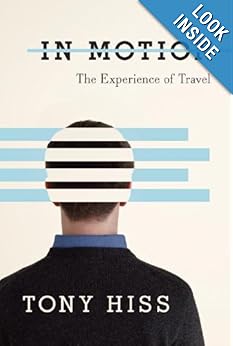
In Motion: The Experience of Travel by Tony Hiss


In Motion: The Experience of Travel by Tony Hiss defies classification. Ostensibly it’s about travel, and it is, especially about what Hiss dubs “Deep Travel”. But Hiss is a talented writer and has an inquiring mind such that his book works much like Montaigne’s Essays: wondering here and there around a common theme. In some authors, of course, this can prove irksome and off-putting, but in this book, I gladly found myself following Hiss’s detours and by-ways as we explored Deep Travel.

Hiss doesn’t ever definitely define Deep Travel, but this is another potential defect that signals that the search is still underway. As a preliminary, we can say that Deep Travel is that journey, around the corner or around the world that alters our consciousness. Our mind, in its structures and perceptions, alters as we face a new landscape. Thus, while walking home during the 2003 NYC blackout, the hyper-city of NY alters without the flow of electricity, and Hiss experiences views and perspectives that he’d never encountered before. He also draws on the work of others, such as Patrick Leigh Fermor, whose meditation from a bridge crossing a river in the Balkans provides a verbal portrait of this same type of experience. Hiss transitions from experiences of travel as such into psychology, beginning with the great fountainhead of American psychology, William James, and then drawing upon the more recent insights of the late Edward S. Reed, an “ecological psychologist”. Indeed, a list of psychologists, anthropologist, paleontologists, and other writers and thinkers could go on for some length. Hiss explores here and there ideas as they occur to him. Hiss uses places with similar abandon for launching his insights: New Jersey swamps, NYC streets, Balkan Rivers, the primeval African savannah: so many references to place and ideas makes this into a buffet of ideas.

A lot of the latter part of the book concerns human origins and how we developed our brains that allows the psychology of Deep Travel to develop. Hiss argues that along with concentrated attention, daydreaming, and flow, humans developed a “wide-angle awareness” that allows us to scan and consider our environment with the use of our bi-pedal stance and stereoscopic vision. He relates this to the way cats can leisurely pause to wait for prey to place themselves in a position of exposure; that is, not ready to pounce and not indifferent, but widely alert, something called SMR (sensorimotor rhythm). (EEG leads on cat skulls first gave us this insight—I love the image.) One riff that Hiss takes on this is that exploring for knowledge, such as of place, has a built-in pleasure reward (like sex and food) that promotes such behavior.

It’s difficult to review this work because its ideas are so many and diverse as they array around this general topic. For some, this is a hindrance (see William Dalrymple’s critique in his NYT review), but for me, with Montaigne as a model and sufficient rewards for following Hiss’s curiosity, I really enjoyed the book. I highly recommend it to anyone who has the curiosity to follow him around in this journey of a book—and who has a yen to experience Deep Travel.

Tuesday, August 20, 2013

Some Thoughts About the Law Today

This blog by Jeffrey Toobin of the New Yorker raises interesting questions about the Edward Snowden matter. I share Toobin's concern about Snowden's going rogue and his naivetĂ© about the Russians and Chinese. However, Snowden's actions, however right or however wrong, have caused prompted an important debate. The debate should become more lively and crucial with the recent actions of the Brits in detaining Glen Greenwald's domestic partner for nine hours under their terrorism act. For however we might rightly characterize Snowden and anyone working with him, they are not terrorists. You may argue that they are unwittingly aiding potential terrorists, but that's a different issue. Similarly, Snowden broke the law, but he did not "aid the enemy" because we have no "enemy". To start with, we are not at war with any country. Of course, individuals and groups want to harm us, that's a given. It's a new world in the sense that its not a nation (say like the Soviet Union or Nazi Germany) that threatens us so much as an amorphous, sometimes spontaneous phenomena of individual or small group efforts (for instance, the Boston marathon bombing brothers or the anti-technology guy who mailed bomb packages for several years). So we need to put Snowden's actions in perspective.

The Brits have really sharpened the argument with their actions. Whatever actions Greenwald and his fellows did or plan to do, it isn't terrorism, and yet the Brits detained and took items from Greenwald's partner under this pretext. This was an abuse of power. In a Tweet this I referred to John LeCarre's "paranoia": several of his recent novels have shown the Brits acting as lackeys for the Americans to perform tasks that were often stupid, illegal, and immoral. After this, I feel I owe him an apology: "I'm very sorry, John. My belief, or at least hope, that my government could not act so foolishly, callously, and immorally, let me to doubt your take on events. It's appearing more and more that you had it right". Anyone have his email?  Or, perhaps the Brits can abuse power quite in their own without any prompting by the U.S. government. Perhaps John doubts the initiative of his own government too much.

The Bill of Rights comes at a cost. Like most everything in life, these rights involve trade-offs. Free speech included in the First Amendment, for instance, allows any political fringe group, religious fanatic, or simple liars to say most anything that they want to say about our government and politics. In other words, to protect the good, we must allow the bad and sort it out later. Similarly, the provisions in the Bill of Rights about criminal procedure protect us from abuses of police power by protecting wrongdoers as well. In other words, we have to give the guilty a break (sometimes, not that often) in order to protect us all from abusive actions by the police and government. This was true in the late 18th century and it's still true in the early 21st century. But we must do more than simply point to the lovely words, we have to commit to enforcement of these rights  and take these matters most seriously. The debate should be serious and wide-ranging. The issue isn't that some would harm us: criminals domestically and hostile interests abroad have always been with us. The issue we  now should address concerns the parameters of the powers and protections that we should have under the new technological regime that we live in.

A recent article about civil forfeitures in the New Yorker provides a case in point. Civil forfeitures allow the government to take a person's property with little procedural protection if the property  might have been used or  involved in criminal wrongdoing, regardless of whether the owner of the property was involved. In a small town in Texas (I'm I surprised?) we learn of a police racketeering scheme to enrich the town and the police by bogus traffic stops and coerced forfeitures. So what happened? Nothing, no criminal charges against the police, although a civil suit did bring the practice to an end for now in that locale.

In a recent issue of Vanity Fair, Michael Lewis chronicles a frightening case of the misuse of a criminal prosecution against a former Goldman Sachs computer expert based upon slippery intellectual property laws. Reading the article, you thought it had a happy ending when the Court of Appeals (federal) reversed the conviction, only to learn that the state, apparently a the behest of a vindictive and deterrent-determined  Goldman, filed new charges on the same conduct. The matter, tried before a jury, was a fiasco given the alien nature of the Russian-born and educated computer genius and the forbidding complexity of computer code issues. If Lewis is correct--and he "re-tried" the case with real experts--we learn of a real miscarriage of justice and abuse of the system. Next to the government, how do we protect ourselves from the likes of Goldman Sachs and their ilk with unworldly financial power and clout--1% of the 1%?

I've invested 37 years of my life in our legal system. It can work well. It works imperfectly at best. We need always to challenge and criticize the system and decisions made within in it because we're human and prone to complacency, fear, and power-hunger. Look around the world and you can find beautiful words everywhere and shameful realities behind most of them. For the most part, we've avoided that, but we can lose it all in an instant if we're not vigilant. We all must constantly stand up to fear and power, our twin enemies. In this effort I consider myself not a Democrat, not a Republican, but an Actonian, after Lord Acton, the great British historian who coined the phrase that "power corrupts, and absolute power corrupts absolutely". We must constantly speak truth to power, or we will lose truth, lose democracy, and enslave ourselves to those who will prey upon our fears and weakness.

Friday, August 16, 2013

A Review of A Time to Keep Silence by Patrick Leigh Fermor


Last summer I read Tony Hiss’s In Motion (which I’m now re-reading), and he discussed and quoted from the work of Patrick Leigh Fermor. About the same time, I read an article by William Dalrymple, who also mentioned Fermor in glowing terms. Thus, when I saw the title A Time for Silence on the Prairie Lights remainder table, grabbed it. I quickly read the short work and thought it a gem. This summer, I found it on the shelf and I’d recommended it to Tanta Rose, so I re-read it. This time I admired the gem, not rushing it, but slowly turning it over to appreciate its many facets, as one might admire a gemstone, and it was time well spent. 

In the 1950’s, Fermor left the lights of Paris and headed to a Benedictine monastery in France, not as a pilgrim, but as a refugee. He wanted solitude to write, and so he came as a guest. After a couple of days of what I might call decompression, he settled into the rhythms of the monastic life and began carefully observing the ways of the monastery. In masterful, almost poetic prose (for which I now understand that he’s rightly famous), he describes this world: its history, its practices, its ambiance. 

Fermor goes on to another Benedictine monastery, one that specializes in practicing and preserving Gregorian chant, and we can sense the order of the chant and the monastery, as we read his descriptions of the stone edifices. As we read the brief history of these ancient institutions, we appreciate how complex and resilient they are. A third stop is a Cistercian monastery, where the strict practice of silence rules. Fermor finds this practice more forbidding and difficult to appreciate, yet his quiet observations never fail to inform. 
Finally, Fermor writes about the long abandoned stone monasteries of Cappadocia in Turkey, where strange looking rock formations were hewn to allow entire subterranean monasteries to exist in the remote section of that country. A Byzantine world gone underground. 

I’ve passed my copy on, so I can’t provide any quotes that might exhibit how this beautiful book works through its poetic prose and I wish I could, because my own meager words and review can’t do it justice. Assuming you get the NYRB re-print, do read the introduction by Karen Armstrong (herself once a member of a convent), which provides some context and even mild criticism of this work. It’s well worth your time as well. If you’ve ever wondered about these worlds outside the world, I can’t think of a better place to begin your exploration and appreciation than with this book.

Thursday, August 15, 2013

Story Craft: The Complete Guide to Writing Narrative Nonfiction by Jack Hart

The art of telling an effective story, whether as a matter of fiction or of non-fiction, has become increasingly celebrated and promoted as the most effective means of communicating a message. Wherever we turn for advice about communicating effectively, we're told about the power of story—or narrative, if you prefer the more hifalutin term. The reasoning is simple: we seem programmed to remember stories, tales across time involving characters who engage us in their pursuits. 


Jack Hart is a professional journalist who describes the skills needed to write an effective non-fiction story for a newspaper or magazine. The book provides many tips and explanations about how good stories are written. He also discusses the usefulness of ways of communicating other than by narrative, such as by explanation or report. But the award-winning stories that Hart's colleagues have written about all sorts of topics have enhanced their effectiveness (and one assumes their readership) by using narrative. The elements, when you reflect upon them, seem almost self-evident: characters (persons that we can care about and understand); a conflict or obstacle that presents the protagonist with a challenge; change through time (a narrative arc); carefully considered facts necessary to give life to the scenes. Like lawyers, journalists have a professional ethical obligation to "tell the truth," as problematic as that obligation is. Both professions require us to ground our narrative in some sense in "what really happened," perhaps easier for journalists because they don't (or least shouldn't) work for self-interested clients. One of Hart's main concerns is the ethics of truth-telling, including an exploration of those boundaries. 


Who might enjoy this book? Anyone who might want to tell a story, fiction or non-fiction. (The fundamentals of the two genres are not so different, and Hart draws on numerous sources that were written about fiction and playwriting.) However, I read Hart's book from the perspective of an attorney, an advocate. I’m convinced more and more that the first job of an advocate is to learn and then tell our clients’ stories in a comprehensible and engaging manner. In some cases, the law as written may prove an insurmountable road block to a remedy. But in most cases, especially in those that require a judge or a jury to resolve, making the client and the client’s plight as sympathetic as possible is an essential component of successful advocacy. Lawyers don’t write essays about “why my client should win in 500 words or less," but our briefs come close to allowing us to do that. As advocates, attorneys need to become as literate in telling a story as we are in forming an argument (which also may incorporate storytelling). Many attorneys face challenges with younger jurors and lawyers who possess a native mastery of visual storytelling that older, more logocentric persons like me lack. But I suspect that whether the story is told only in print, many of the same principles apply in visual mediums. If the book has one weakness, it’s that it's limited to exploring narratives only via the written word. Oral and visual storytelling must gain a place in the advocate’s arsenal in addition to the written word. 


But make no mistake: this is an outstanding book, well considered and well written, even if it's not written as a narrative!  Anyone with any occasion to consider writing a narrative will benefit greatly from this book