Saturday, February 6, 2021

Thoughts for the Day: Saturday 6 February 2021


1995 publication


Perhaps ideas are the single most precious miracle in human existence. For ideas determine our goals of action, our styles of art, our values of character, our religious practices and even our ways of loving.

Greek and modern physics are agreed that the most universal characteristic of this world is motion.

In the wake of Hegel and under the influence of an extremely intense interest in history, philosophy threatened to degenerate into speculation on the possibility that some kind of inherent law was manifested in history.

Machiavelli’s theory of political power, according to which the act of foundation itself—that is, the conscious beginning of something new—requires and justifies the use of violence.

Everything you do has the potential to limit what you do next. Everything you think has the potential to limit what you think next. And you won't even know that this is happening.

Reading The Human Condition: Part 1 "Prologue"


                                          The flyleaf notes that I purchased this book on 12 October 1974. I know it well--and I don't.

My copy of The Human Condition (THC) is back in service once again. During the past year, spurred on by a pandemic-created opportunity, I joined the Virtual Reading Group sponsored by Hannah Arendt Center of Bard College. After having read three of Arendt's books, Men in Dark Times (1968), Essays in Understanding 1930--1954: Formation, Exile, & Totalitarianism (2005) , and The Promise of Politics (2005), we're now turning to what I consider to be the centerpiece of Arendt's project, THC, which was published in 1958. I don't know how many times I've read it. When I purchased it, I was taking a year off from my undergraduate studies, and I assume that I read it during that period. Then, when I returned to complete my senior year, I took a course entitled "Contemporary Political Theory" that assigned THC as a required book. As I recall, before taking that class (also probably in my year away) I read Arendt's Between Past and Future: Eight Exercise in Political Thought (1961), a collection of essays about contemporary political thinking and related topics (history, education, culture). Thus, when I took the class on "Contemporary Political Thought" in the fall of 1975, I cam pre-loaded with Arendtian thoughts. The instructor, in his final evaluation, stated that he wished that my focus in the class had not centered so much on Arendt. Then, during law school, the same teacher (now on the tenure track) offered a class solely about Arendt, and he kindly allowed me to sit-in. Since then, I don't know how often I've gone back to THC and other of Arendt's works, but I did. I never lost touch with Arendt, so to speak. Then, in 2016, along with many others, I turned instinctively toward Arendt as the American republic entered a new, dangerous phase. 

So, this isn't my first THC rodeo. Perhaps it's needless to say, but I'll do so anyway: I think that there's more I can get out of this book. And in an effort to do so, I intend to write a series of essays as we read through the book in our Virtual Reading Group, hoping to spur my efforts and to share what insights that I can glean. Now, to the Prologue. 

Synopsis

In 1957 "an earth-born object made by man was launched int the universe . . . ." (1). This event was more important than the splitting of the atom and should have "been treated with unmitigated joy" except for the fear of the military and political consequences surrounding the event. (1). [The Soviets gained an upper-hand in the "space race."] But the joy accompanying this event wasn't "triumphal" or a celebration of human achievement, but one of "relief" that humankind had taken "'the first step toward escape from men's [sic] imprisonment to the earth.'" (1). Humans have kept pace with scientific and technological development, often imagining such events before they occur. The "respectable press" (2), however, hasn't kept up, while the genre of science fiction writing, which serves as an unattended vehicle of "mass sentiments and mass desires." has. (2). Although Christians and philosophers have often sensed this world as a vale of tears and the body as a prison, before this new era no one had thought of going to the moon as an escape. "Should the emancipation and secularization of the modern age, which began with the turning-away, not necessarily from God, but from a god who was the Father of men in heaven, and with an even more fateful repudiation of an Earth who was the Mother of all living creatures under the sky?" (2). 

"The earth is the very quintessence of the human condition" (2) and is, so far as we know, unique in the universe. "Human artifact" separates us from "the mere animal environment" but life is based outside of the human artifact, although scientists have been striving to create artificial life to expand the powers and length of human life. Humans seem to be rebelling against the life given to them. There is no doubt that this course of action can be followed, just as "there is no reason to doubt our present ability to destroy all organic life on earth. The question is only whether we wish to use our new  scientific and technical knowledge in this direction, and this question cannot be decided by scientific means; it is a political question of the first order and therefore can hardly be left to the decision of professional scientists or professional politicians." (3). 

But already science itself is starting to suffer a crisis. "The trouble concerns the fact that the "truths" of the modern scientific worldview, thought that can be demonstrated in mathematical formulas and proved technologically, will no longer lend themselves to normal expressions in speech and thought." (3). We humans may be condemned to live in a universe that we can never fully comprehend. "If it should turn out to be true that knowledge (in the modern sense of know-how) and thought have parted company for good, then we would indeed become the helpless slaves, not so much of our machines as of our know-how, thoughtless creatures at the mercy of every gadget which is technically possible, no matter how murderous it is." (3). 

The "situation created by sciences is of great political significance. Wherever the relevance of speech is at stake, the matter becomes political by definition, for speech is what makes man a political being." (3). We cannot "speak" with mathematical symbols, which are abstractions from reality. In science, mathematical symbols are a source of communication, but not so in the wider world. In a sense, science has lost speech and therefore its entryway into politics. To make sense of the world, to make it meaningful, it must be spoken about. "There may be truths beyond speech, and they may be of great relevance to man in the singular, that is, to man in so far as he is not a political being, whatever else he may be. Men in the plural, that is, men in so far as they live and move and act in this world, can experience meaningfulness only because they can talk with and make sense to each other  and to themselves." (4). 

Perhaps of equal significance is the advance of automation, which could reduce the demand for labor, by which the modern age has come to see society as a "laboring society." (4). And while escape from labor by most people has been much sought-after for ages (limited as it was to the elite), freed from the fetters of labor, many wouldn't know what to do with themselves. People wouldn't know how to respond to higher callings. "

Within this society, which is egalitarian because this is labor's way of making men live together, where no class left, no artistocary of either a political or spiritual nature from which a restoration of the other capacities of man could start anew. Even presidents, kings, and prime ministers think of their offices in terms of a job necessary for the life of society, and among the intellectuals, only solitary indviduals are left who consider what they are doing in terms of work and not in terms of making a living. What we are confronted with the prospect of a society of laborers without labor, that is, without the only activity left them. Surely, nothing could be worse. (5). 

Arendt offers no solution to these concerns. There is no single "answer" by any single person to such concerns and they therefore a matter of practical politics. Arendt states the purpose of this work: 

What I propose in the following is a reconsideration of the human condition from the vantage point of our newest experiences and our most recent fears. This, obviously, is a matter of thought, and thougtlessness--the heedless recklessness of hopeless confusion or complacent repetition of "truths" which have become trivial and empty--seeems to me among the outstanding characteristics of our time. What I propose, therefore, is very simple: it is nothing more than to think what we are doing.

"What we are doing" is indeed the central theme of this book. It deals only with the most elementary articulations of the human condition, with those activities that traditionally, as well as according to current opinion, are within the range of every human being. For this and other reasons, the hightest and perhaps purest activitiy of which men are capable, the activiting of thinking, is left out of these present considerations. (5). 

The book therefore will only address labor, work, and action. The final chapter deals with "the modern age," and throughout she deals with the "various constellations with the hierarchy of activities as we them from Western history." (6). 

Arendt distinguishes"the modern age" from "the modern world." Arendt states that the modern age began in the seventeenth century and ended at the beginning of the twentieth century. "The modern world" began as a political matter with the first atomic explosion. Arendt does not discuss "the modern world" in this book. Arendt sticks to the three primary characteristics of the human condition: labor, work, and action. And she will trace the historical development of "modern world alienation" that comes to include the "flight from the earth into the universe and from the world into the self . . . .to arrive at an understanding of the nature of society as it had developed and presented itself at the very moment when it was overcome by the advent of a new and yet unknown age." (6). 

Commentary

If I was given only the Prologue to read without any background and without any background knowledge, how would I know that I was written in 1958 and not 2020? Perhaps the reference to the launch of a satellite into earth orbit (Sputnik) in 1957 without mention of the moon landings by astronauts, Mars landings, and reports from satellites at the furthest edges of the solar system gives it away. But still, the Prologue continues to have a very contemporary feel to it. 

Is the exploration of outer space (I know, I date myself with this term) the most significant event of my life (b. 1953)? I don't feel that way. As a baby boomer, I grew up under the shadow of the mushroom cloud. I'm old enough to have been (roughly) aware of the Cuban Missile Crisis and the implications of a nuclear war. (I grew up an hour's drive from Offut Air Force Base, SAC headquarters. One didn't have to be a junior Einstein to know that in the event of a war, that place was a prime target if the missiles and bombers actually went where intended, and I knew that fallout knew few bounds.) In short, that threat of nuclear annihilation by instant incineration or the slow burn of fallout weighed very heavy on my mind growing up and when my classmates and I were asked this question in class I  took on Arendt. Now, I'm more worried about the slow boil of climate change. But alas, there seems to be no rule of having only one "existential risk" (a term I dislike) at a time. 

The Prologue also includes her reference to the threat of "automation" to jobs. This seems to have been a concern, of greater or lesser degrees, my entire life. The topic is again hot, as the idea of "driverless" cars and other forms of automation, using high-powered computers and AI algorithms again seem to threaten the loss of many traditional forms of labor. (See Noah Yuval Harari, for instance, in his 21 Lessons  for the 21st Century, for a widely commented upon example.) If this proves true, Arendt's fear that people won't know what to do with themselves could prove prescient. As someone who worked in a profession and is now happy to read and then scribble, scribble, scribble, this strikes me as not such a bad thing, But a society that comes to depend on bread and circuses (or junk food & Super Bowls) to occupy the under-employed seems not to be a good bet--and this assumes that these displaced workers would have sufficient income to live upon without generating resentment, which is not a certainty not a given considering our current predominant economic and cultural ideologies. 

This essay provides a useful introduction to the whole of the work. The trinity of what Arendt will later in the book dub "the vita activa," labor, work, and action, is here, along with her idea that speech is the heart of politics. Although she does not say it directly in this book as I recall; she considers many actions that we would consider "political," which involve the use of violence, threats,  and other forms of coercion, as not "politics" at all, an issue that will continue to arise from reading this and other of her works.

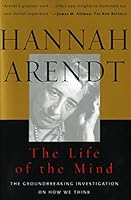
In the early 1960s. in a televised interview (the transcript of which is included in Essays in Understanding), Arendt eschewed the label of "philosopher" and preferred to call herself a "political theorist." One can respect Arendt's desire here and one can see her point in these works, but in the prologue and later in THC, one can still see Arendt the philosopher shining through. (Not to mention her first major work, her dissertation (habilitation) on the concept of love in St. Augustine and her Gifford Lectures published as The Life of the Mind on the trinity of the vita contemplativa, thinking, willing, and judging, which was the final book that she wrote (and the final section, on judging, was incomplete at the time of her death). The idea of "world alienation" and the flight from the earth and from "the world into the self" reveal her deep philosophical grounding and concerns. These tells found throughout THC and confirm Arendt's underlying calling as a philosopher and not simply as a political theorist

N.B. Arendt distinguishes "the human condition" from "human nature." She also distinguishes "thinking" (solitary, "useless") from "action" & "speech" (which are closely related.). Her ideas about "thought" & "thinking" are quite different from the use of "thought" in R.G. Collingwood, which entails all intentional human cognition (planning, strategy, theorizing, etc.) and all actions taken pursuant to such "thought." 


Friday, February 5, 2021

Thoughts for the Day: Friday 5 February 2021


1993 publication. Postman a favorite of mine


Technopoly is a state of culture. It is also a state of mind. It consists in the deification of technology, which means that the culture seeks its authorization in technology, finds its satisfactions in technology, and takes its orders from technology.


If logic is defined as the capability to press on to conclusions with a total disregard for all reality and all experience, then Hitler’s greatest gift—the gift to which he owed his success and which brought about his downfall—was one of pure logic.

Ludwig Wittgenstein said, language frames our reality so completely that “the limits of my language mean the limits of my world.”

Hoarding may feel like the rational thing for the rich, but it is against their true self-interest, which is found not in clotting but in circulation to the whole.


Thursday, February 4, 2021

Thoughts for the Day: Thursday 4 February 2021


How vulnerable is the whole texture of facts in which we spend our daily life; it is always in danger of being perforated by single lies or torn to shreds by the organized lying of groups, nations, or classes... 

— Hannah Arendt


Essences cannot be localized. Human thought that gets hold of them leaves the world of the particular and goes out in search of something generally meaningful, though not necessarily universally valid. Thinking always “generalizes,” squeezes out of many particulars—which, thanks to the de-sensing process, it can pack together for swift manipulation—whatever meaning may inhere. Generalization is inherent in every thought, even though that thought is insisting on the universal primacy of the particular. In other words, the “essential” is what is applicable everywhere, and this “everywhere” that bestows on thought its specific weight is spatially speaking a “nowhere.”

Particularly so in light of the seemingly reactionary alternative origin to the age of modern philosophy Benjamin proposes. Ultimately, for him, only God—an event as divine as the phenomenon of speech itself—can supply true salvation. Just as language—as the foundation of all meaningful access to the world—cannot in Benjamin’s view be of human origin, the healing shock of the perception of truth (in “pure language”) cannot be, either. Like Wittgenstein, Benjamin insists time and again that the miracle of language cannot be explained in language. At most, its essence can be shown through particular linguistic modes of representation.

The underlying theme of every essay in Between Past and Future is that the great Western philosophic-political tradition has been ruptured, and so definitively ruptured that its authority can never be restored.

It’s strange that in America we have not learned the lesson that hasty, unplanned development can provoke a backlash. After all, the country has experienced several, most notably the 1930s Dust Bowl, the greatest ecological disaster in North American history. The event is seared in the American imagination, depicted in novels and captured in movies. The bitter tale of desperate Dust Bowl migrants inspired John Steinbeck’s Grapes of Wrath—describing the plight of people who could be called AFarmerica’s first climate refugees. And it is a story of human action causing a natural reaction.
We just read (aloud) Grapes of Wrath this fall: a great book.

First, in human understanding, facts do not come alive until the ideas internal to them are grasped. Second, the appropriate question to ask of human activities is not whether they are true or false, but what they mean.

“The rentier class.” Keynes meant by this the people who made money simply by owning something that others needed, and charging for the use of it: this is rent in its economic meaning. Rent goes to people who are not creators of value, but predators on the creation and exchange of value. So “the euthanasia of the rentier class” was Keynes’s way of trying to describe a revolution without revolution, a reform of capitalism in his time, toward whatever subsequent post-capitalist system might follow.

If, in the selection of members of the élite, there existed a condition of perfectly free competition, so that each individual could, without any obstacle, rise just as high in the social scale as his talents and ambition permitted, the élite could be presumed to include, at every moment and in the right order, just those persons best fitted for membership in it. Under such circumstances—which [Alfredo] Pareto seems to imagine after the analogy of the theoretical free market of classical economics, or the biological arena of the struggle for survival—society would remain dynamic and strong, automatically correcting its own weaknesses. However, a condition of this sort is never found in reality. There are always obstacles, or “ties” as Pareto calls them, that interfere with the free circulation of individuals up and down the social scale.
Cf. Collingwood on "the ruling class" in his "The Three Laws of Politics."

Psychopathy is part of the so-called dark triad of traits. And as it turns out, the other two, narcissism and Machiavellianism, also seem to describe many of the traits we associate with the grifter.


Wednesday, February 3, 2021

Thoughts for the Day: Wednesday 3 February 2021


[A]nti-elitism is a reflection of the feeling of powerlessness that many people experience when navigating the modern world—one in which experts and intellectuals seem to hold the keys to knowledge and power. Reflecting on this reality decades ago, the great American historian Richard Hofstadter wrote, “Once the intellectual was gently ridiculed because he was not needed; now he is fiercely resented because he is needed too much.”

“Over more than two centuries, the United States has stirred a very wide range of feelings in the rest of the world: love and hatred, fear and hope, envy and contempt, awe and anger,” the Irish commentator Fintan O’Toole wrote in April 2020. “But there is one emotion that has never been directed towards the US until now: pity.”
(Location 2209)

The political climate in Washington always pushes policymakers toward being “tough” rather than “soft”—which is a dangerous way to frame international affairs. The real question is, can they be smart rather than stupid?

Tensions between the United States and China are inevitable. Conflict is not. We have a picture in our minds of what international politics looks like that is drawn largely from modern European history. It is of great powers jockeying for influence in a great game of realpolitik and frequently descending into war. This international system is often called “multipolar”—characterized by many great powers—and it is inherently unstable. With many countries of roughly equal strength competing, each eyeing the other suspiciously, miscalculation, aggression, and war become highly likely, which is why Europe became an arena of constant conflict for centuries. (Location 2421) 

Eisenhower spoke in language that few left-wing peaceniks would dare to employ today. “Every gun that is made, every warship launched, every rocket fired signifies, in the final sense, a theft from those who hunger and are not fed, those who are cold and are not clothed,” he said. “This is not a way of life at all, in any true sense. Under the cloud of threatening war, it is humanity hanging from a cross of iron.”

[Hans] Jonas enumerates all the advantages of sight as the guiding metaphor and model for the thinking mind. There is first of all the indisputable fact that no other sense establishes such a safe distance between subject and object; distance is the most basic condition for the functioning of vision.

“THE TRANSITORY, THE FLEETING, THE CONTINGENT,” which Baudelaire had identified as the central properties of the modern age, also fully characterized philosophy. Not all protagonists found it equally easy to welcome this new feeling of existence.


Tuesday, February 2, 2021

Thoughts for the Day: Tuesday 2 February 2021


"When people reflect on what it takes to be mentally fit, the first idea that comes to mind is usually intelligence. The smarter you are, the more complex the problems you can solve— and the faster you can solve them. Intelligence is traditionally viewed as the ability to think and learn. Yet in a turbulent world, there’s another set of cognitive skills that might matter more: the ability to rethink and unlearn.

Mental horsepower doesn’t guarantee mental dexterity. No matter how much brainpower you have, if you lack the motivation to change your mind, you’ll miss many occasions to think again. Research reveals that the higher you score on an IQ test, the more likely you are to fall for ste­reotypes, because you’re faster at recognizing patterns. And recent experiments suggest that the smarter you are, the more you might struggle to update your beliefs.

The curse of knowledge is that it closes your mind to what you don’t know. Good judgment depends on having the skill— and the will— to open your mind. A hallmark of wisdom is knowing when it’s time to abandon some of the most cherished parts of your identity."

— Adam Grant in Think Again


“The dead outnumber the living 14 to 1, and we ignore the accumulated experience of such a huge majority of mankind at our peril.”

--Niall Ferguson


"I am not at all sure that I am right in my hopefulness, but I am convinced that it is as important to present all of the inherent hopes of the present as it is to confront ruthlessly all its intrinsic despairs." — Hannah Arendt


What interests Collingwood is not history consisting of statements which can be tested against scientific criteria, but the idea of history itself.

“In the long run, we are all dead” was more than a clever turn of phrase. It distinguished Keynes from other contemporary monetarists, and those in the years to come who would affiliate themselves with right-wing politics. Like the monetarist Milton Friedman, Keynes looked to price stability as a way to shore up classical economic thinking. For the most part, he believed, laissez-faire economics worked. Supply and demand did bring society to a prosperous equilibrium. They just needed a few pieces of basic economic architecture to work: property rights, the rule of law, and price stability. But unlike Friedman, Keynes had arrived at monetarism as a creative way to expand the power of the state to fight the uncertainties and anxieties of postwar life.

What, as a thinking subject closed in behind the brain’s pane of glass, do any of us know about what is really going on inside anyone else? What storms rage within them? Or perhaps there is nothing at all happening in there—is there really complete and permanent calm?

Conservatives were facing the difficult truth that, as the American scholar Harvey Mansfield put it, they were “no longer the hardy few.” Used to presenting themselves as intellectual outs, conservatives were now the ins. How, though, would conservatives know who they were and what they stood for without an orthodoxy to oppose? Who was the right to argue with?

Using the border situations as his point of departure, he [Karl Jaspers] attempts to develop a new type of philosophizing based on Kierkegaard and Nietzsche. The primary mission of this philosophizing is not to instruct; it consists of a “perpetual agitation, a perpetual appeal [author's italics] to the life force in oneself and in others.” This is Jaspers’s way of participating in that revolt against philosophy with which modern philosophy began. He attempts to transform philosophy into philosophizing and to find ways by which philosophical “results” can be communicated in such a way that they lose their character as results.


Monday, February 1, 2021

Thoughts for the Day: Monday 1 February 2021


Insofar as ideological thinking is independent of existing reality, it looks upon all factuality as fabricated, and therefore no longer knows any reliable criterion for distinguishing truth from falsehood.

Education is the point at which we decide whether we love the world enough to assume responsibility for it and by the same token save it.
--Hannah Arendt
What is most difficult is to love the world as it is, with all the evil and suffering in it.
--Hannah Arendt
(HT to @Samantha RoseHill for sharing the above two quotes.)

Multa stultitia regnat mundus—how much stupidity now hangs over the world.

Remember our rule of thumb: The more scared we are of a work or calling, the more sure we can be that we have to do it.

Thus the New York Times expends its editorial might promoting transgender rights, the concern of a tiny minority, while Fox News rants in opposition to them. So climate change and other vital concerns for the society as a whole get pushed to the media margins.

It comes back, then, to the question of the self-image. Miseries, humiliations, embarrassments, accidents, have the effect of creating partial self-images—self-images which, since they present themselves as complete, are bound to be false. Consciousness narrows, and my self-image becomes as false and distorted as if I was seeing myself in a trick mirror at a fairground. But a trick mirror at least shows you your whole self, from head to foot; the partial self-image is a pocket-size distorting mirror.