Sunday, January 6, 2013

Source: The Inner Path of Knowledge Creation by Joe Jaworski

The business book section of your local bookstore is always an interesting place. A lot of the titles are variations on how to become rich, while others focus on the latest management techniques or reports on successful enterprises. I suppose in the end its like most sections of the store: many titles with only a few worthwhile. But in this business section, we do sometimes come across some interesting ideas. After all, one thing that contemporary business aims for is a competitive advantage, and to that end some authors can dig very deeply for worthwhile answers, or a least suggestions. They tend to be long on practical application, but they take the basis research and theory seriously, as well they should. Given that most of us spend the majority of our days and lives in various business ventures, as owners, employees, or even as householders, we should indeed consider these issues very carefully. All of this is a lead in to my recent completion of this book:

Source: The Inner Path of Knowledge Creation (Bk Business) 
The Source: The Inner Path of Knowledge Creation by Joe Jaworski (2011). This title takes up Jaworski's very interesting and personal story where it left off in his book Synchronicity: The Inner Path of Leadership (1997). Jaworski, the son of Watergate special prosecutor Leon Jaworski, and a very successful lawyer in his own right, finds himself pulled or called (both intentionally provocative words to which I don't think that he would object) to leaving his practice and entering the realm of business through a sense of intrigue about leadership and how we can enhance and improve our world. 

In The Source, Jaworski reports his pursuit of ideas and interests that were ignited by his acquinatance, both personal and intellectual, with physicist David Bohm. Bohm's ideas about the nature of reality, the "implicate order" capture Jaworski's imagination, and even after Bohm's death, Jaworski continues to pursue Bohm's line of thinking and related topics. He goes into consulting and works with persons such as Peter Senge and Otto Sharmer, both of MIT Sloan Business School, to develop ideas about personal and organizational development that are on the edge; indeed, some would suggest the work "fringe" might prove more apt. But Jaworski presses on with his quest for understanding and insight. He comes to two major beliefs: first, there is a "source" or "implicate order" or whatever, that if we tap into it, enhances our abilities as human beings. Second, based on work by scientists such as Robert Jahn at Princeton and William Tiller at Stanford, as well as numerous others, we can enhance our ability to tap into this Source to enhance our individual and collective well-being. Jaworski gives examples of qi gong, yoga, and nature quests as avenues of enhancing our ability to tap into the Source. 

Nonsense? Well, for most of human history, what Jaworski says would be considered a  matter of common sense, which certainly doesn't vouch for its truthfulness or usefulness in our world, but it should help us to avoid dismissing what he says out-of-hand. As someone who's obviously quite intelligent and capable, and as someone who left a what appears to have been a very successful career as a lawyer to pursue a whole new set of endeavors, I have to give his search some credibility. The issue becomes, of course, of whether we can replicate his findings and incorporate them into our lives and world. 

Saturday, January 5, 2013

Tarquin Hall: The Case of the Deadly Butter Chicken: A Vish Puri Mystery


Since learning that we’d be coming to India to live, I’ve tried to read a great deal about this vast nation. The amount written about this country is immense, and given that I’m a promiscuous reader wanting to master several topics at once, I’ve only made a dent in learning what I can about India. Thus, while I have completed relatively few books, I have read a good deal or learned vicariously from IG and her reading. Amartya Sen, William Dalrymple, Shashi Thoroor, Andre Betielle, Richard Sorabji, Pankraj Mishra, Kathryn Boo (via IG), NYT articles, The Economist, and so on have served as very enlightening guides. I’ve made a dent, anyway. However, now I’ve made a breakthrough: I’ve completed The Case of the Deadly Butter Chicken: A Vish Puri Mystery by Tarquin Hall. 

Hall is a Brit, married to an Indian, and living near Delhi. His skill as a writer combines with his insider/outsider status to give me some delightful insights into India. In fact, I’d posit that the standard detective novel, the “who dun it?” may prove the perfect vehicle to learn about a new society or culture. In this case goes a long way in supporting that proposition. 

Vish Puri, a former Army intelligence officer turned private detective, with a caring (if occasionally bothersome) wife and meddling “mummy-ji”, assited by a stable of colorfully nick-named stable of helpers (labor is cheap in India), gets called into work on the death of a prominent Pakistani. The death involves two subjects of great emotional valance in India: cricket and Pakistan. The decedent is involved with cricket, the national game here, and (I think) in Pakistan as well. His investigation of the murder leads Puri to Pakistan, which, before these events, had simply been “the enemy” to Puri. But as Puri learns, the two nations share a great deal, including a troubling and sad history that still holds the memory of many wrongs on both sides of the border. Puri expands his horizons in the course of his investigation, while he’s also dodging or ignoring the dietary constraints that his wife wants him to follow. His nickname isn’t “Chubby” for nothing. 

This book caught my eye because the front cover displayed a favorable blurb from Alexander McCall Smith.  I discovered that Hall’s creation matches many of the attributes that makes Smith’s No.1 Ladies Detective Agency and Isabel Dalhousie series so successful: an endearing main character--not a super-hero, hard-boiled type, or super-sleuth--but a wonderfully fallible character deeply immersed in the culture around  her. So for shear enjoyment while learning a great deal about this vast country, and with the highest compliment in comparing this book to one of McCall Smith’s books, I suggest you put this in your reading pile, whether you come to India or only want to explore from your armchair. I don’t think that you’ll be disappointed.

Thursday, December 20, 2012

Presentation Zen by Garr Reynolds

I'm interrupting my Top 20 countdown to catch up on some more recent books that I've completed. Among them is Garr Reynold's Presentation Zen, his book about . . . you guessed it: presentations! 

Presentation Zen: Simple Ideas on Presentation Design and Delivery (2nd Edition) (Voices That Matter)

Actually, it's a fine book. Its main goal is to prevent Death by Powerpoint, perhaps the No. 1 health threat to the educated classes. Consider how many boring presentations you've been forced to sit through, presentations that, as delivered, ruin the ability to convey any useful information that the presenter may have to convey. Reynolds, a native of the U.S.  now residing in Japan, aims to help correct this threat to our sanity and welll-being. He does so through this book and his other writings. Reynolds uses the Zen aesthetic of minimalism to demonstrate to us how presentations don't need to bore us with too many words and too many bullet points. If you're a careful writer or speaker, none of his ideas should prove alien to you: brevity, clarity, and simiplicity are you're watchwords anyway. Nevertheless, it's good to have reminders, plus the aid of his eye for the visual. As a wordy guy myself, his pointers about using the visual for maximum effect--and we live in an increasingly visual world--are well worth the time, effort, and cost of the book. 

If you ever give a presentation, I highly recommend that you read this book before giving your next talk. I'll wager that both you and your audience will emerge the happier for your having done so. 

Favorites 5/20: Moral Man & Immoral Society

Moral Man And Immoral Society: A Study in Ethics and Politics


Moral Man and Immoral Society by Reinhold Niebuhr (1936). While Arendt presents a view of politics that arises out of her German existenz philosophy training with Heidegger and Jaspers, as well as her plight as a German-Jewish refugee and American émigré, Niebuhr is a homegrown American theologian (Lutheran) that provides an analysis of politics that I found captured my ascent and has maintained it. Niebuhr is rightly categorized as a political realist, but as you would expect from a Christian minister, his concern for fundamental values is not diminished. Indeed, his tragic view of politics has led me to re-read this book as an anchor about how to think of some of the great issues in our times. (I recall specifically re-reading it at the time of the first Iraq War.)

Favorites 4/20: The Human Condition


Product Details   The Human Condition by Hannah Arendt (1956). This isn’t the firstArendt I read, I think that designation goes to Between Past and Future, which I have an image of reading in Cedar Falls the first year we were married. However, The Human Condition is probably the closest that Arendt came to laying out a systematic presentation of her very unique way of thinking about politics. Her ideas both fascinate and frustrate me, but then that’s what great books should do: push us to think. I haven’t read any Arendt in a while, but during my undergraduate and law school days, I had a real intellectual crush on her! 


Favorites 3/20: Moby Dick


Product Details    Moby Dick, by Herman Melville (1851). Fiction is under-represented on my list, and so are audiobooks,  and I've enjoyed both categories greatly, but this one belongs unquestionably. Melville is to my (limited) mind the greatest American novelist, and this book is the greatest American novel. Like ZAMM, it’s nominally about a journey, a quest, whaling, and so on, but when you put it all together, it’s a great tale, endlessly fascinating. 

Favorites 2/20: Nixon Agonistes


Nixon Agonistes: The Crisis of the Self-Made Man     NixonAgonistes: The Crisis of the Self-Made Man, by Garry Wills (1972). I owe a shout-out to political science (theory and philosophy) professor John S. Nelson for assigning this to an introduction to American politics class. I didn’t take the class, but I saw the book in the bookstore, and I’d taken other classes from him and found his selections sound. Well, this was more than sound. It combines the eye of a reporter with the analytic mind of a classicist (perhaps by necessity among the most versatile of scholars) in what is a classic of American political reporting the workings of American politics. If you had to read one book about American politics, this might be it. 

Intro & 1/20 Favorites: ZAMM

Having just finished reading ZAMM again, it led me to reflect on what other books belong on my all-time favorites list. I’ve done this with authors, but not with particular books (at least that I can remember). Of course, I have end-of-the-year lists of books and music that I should be attending to, and, of course, I worry that I’ll leave off some really great books (especially since I don’t have my library here in front of me). But even with all of these reasons not to attempt this, I’m going to do it anyway. What follows is in no particular order, just how they came to me as I started thinking and jotting my list about the subject. So for what it’s worth, here goes! 


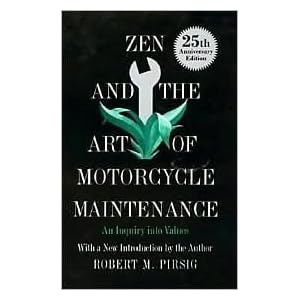
Zen and the Art of Motorcycle Maintenance Publisher: William Morrow     Zen and the Art of Motorcycle Maintenance: An Inquiry into Values, by Robert Pirsig (1974; with a new introduction and postscript in later editions). One could go on at length about this book, but my most recent prior post will have to suffice for now. 


I'll continue posting until I have all 20 selections posted. Blogspot doesn't want to do 20 at once, it seems ("it's a piece of s**t" to borrow a turn of phrase). In any event, I will not be deterred.

Robert Pirsig’s Zen & the Art of Motorcycle Maintenance


If you haven’t read ZAMM, how should I describe it to you? It’s a travelogue, a father-son story, a ghost story, a journey story, a series of essays about topics philosophical and practical—I could go on, but for me it’s one of the best books that I’ve ever read (now for the third or fourth time), which I consider to be a high compliment indeed. 


This novel (perhaps too limiting a designation) created quite a sensation at the time of its publication in 1974. It reached bestseller status quickly, and it frequently appeared on college bookstore shelves, where I first saw it. I never had it assigned as a text, but a political science professor I had (John S. Nelson) assigned it in classes & often posted quotes from it (on 5/8 cards outside of  his Schaeffer Hall office). I don’t recall when exactly I first read it, but it immediately struck me as a great read. 


This time I happened to see it in a bookstore during a recent trip to Delhi, and I instinctively popped for it. Unlike many books that have to look at me for an extended period before I pick them up & read them, I didn’t let this one sit long before I plunged into it. It had been long enough since I’d last read it that I found it fresh, and, coincidentally, it proved topical because I’ve been working with young lawyers on their writing skills. The narrator taught rhetoric and composition, and he discusses teaching this topic as a part of the book. Indeed, a passing comment from a colleague while teaching rhetoric gave rise to this designation of “quality”, which becomes the key concept in the book. While “Chautauquas” (entertaining talks) on topics like teaching, motorcycle maintenance, and Quality (it quickly rises to the level of a proper noun) create an interesting part of the book, we also have the story of the narrator and his son Chris continuing their trek from Minnesota to San Francisco on the narrator’s motorcycle. A great number of poignant meetings and confrontations, with persons past and present and between father and son (past and present) mark this aspect of the story. 


I’m going to stop here because as I write this I'm frustrated by the fact that I can’t really do justice to this book. It has too many things going on for me to do justice to it. I suppose that the best thing that I can say is that I’ve never forgotten this book and I hope to read it again.  

Saturday, December 15, 2012

I Hate Writing This Blog

In our compound, a young mother worries about her 2-year-old with a slight fever back in the U.S. with his dad. Iowa Guru & I anxiously await the arrival of our quite adult & capable daughters: just two drops in an ocean of concern and love that parents hold for their children. And then I read the news flash here in India about the shootings in Connecticut (Sandy Hook Elementary School in Newtown). I could not bear to look at the list of names & ages on the front page of the NYT this morning; it's too horrible

So horrible, so awful. President Obama's comments, here in video, display the common anguish that we all must feel. But after the shock and horror, which has become all too common, we must do something. 

Garry Wills in his blog post following this outrage puts our plight in biblical terms: we have our own Moloch--the gun. His refection on the outrage in Newtown, and repeated too many times before, captures my sense of despair at the idolatry that we practice in this country towards guns (among other things). We as a nation need to repent. 

This article by Nicholas Kristoff provides some thoughtful reflection and suggests changes that should prove politically feasible. I hope that he's only one of a flood of voices that creates a groundswell of action to address the issue of gun violence. I've set forth my opinions here and here. But I will not stop because this is too crazy. We, as a body politic, are crazy not to take practical and reasonable steps to limit gun violence. 

So as I write this and listen to Christmas music playing the background that celebrates the Nativity--the human joy of a new beginning with the birth of a child-- let me suggest a Christmas gift for me, you, and all of us: write the President, your senators, and your congressman, and tell them in no uncertain terms that we need to regulate firearms in an effective and reasonable manner. Let them know that you will hold them to account until we have a nation and as a state enact legislation that will truly work to prevent these all too common occasions of murder and mayhem.  


Wednesday, November 28, 2012

Movie Review: Coriolanus


This production of Shakespeare's Coriolanus  is the first production that I've seen, nor had I read it before. (By the way, this link is useful; also, it comforted me that  the great Shakespearean scholar A.C. Bradley and other agree with my sense of this play.) Directed and starring Ralph Fiennes in the title role, its an intense but not especially revealing drama. Similar to the Richard III filmed starring Ian McKellen from several years ago, it "updates" Shakespeare by using a contemporary setting. Indeed, as both films revolve around characters who make their mark in battle (and by general violence, with Richard), they are quite similar in this regard. Both reference fascist and militarist props--costumes, set design, and lots of guns & tanks--to set the scene. All of this works reasonably well, which is reassuring, because some contemporary settings for Shakespeare fizzle for me. One does, however, have to set aside the fact that until the advent of guns,  most fighting in both military and day-to-day situations was done hand-to-hand. (Okay, okay, I haven't forgotten Agincourt, but you get my point.) Guns take away this immediacy, but this production worked around this issue fairly well. 

Fiennes is a dynamic, raging, and proud Coriolanus, one that seems to fit the bill. Vanessa Redgrave as his mother, hautily proud, domineering, and ambitious for her son, provides a very compelling figure. Throw in Gerard Butler as Auffidius, the nemisis of Coriolanus, Brian Cox as Coriolanus' would-be mentor, and a pair of tribunes who play the roles of political hacks wonderfully, and you have a very sound production. 

In the end, Coriolanus isn't as compelling as Shakespeare's great tragedies, even of those about grasping for power, like Macbeth, but it does give us a strong image of the world of militarism, caesarism, mobacracy that we can still find in our world today. For this, it is worth seeing.