Friday, December 13, 2019

#Impeachment: A Fair Trial?

A couple of items related to #impeachment from @SteveVladeck on Twitter:

"The Party seeks power entirely for its own sake. We are not interested in the good of others; we are interested solely in power. ... Power is not a means, it is an end. ... The object of power is power. ... There will be no loyalty, except loyalty towards the Party."

— 1984

The oath that each Senator will take at the trial:

“I solemnly swear ... that in all things appertaining to the trial of the impeachment of Donald J. Trump, now pending, I will do impartial justice according to the Constitution and laws: So help me God.” (via Lawfare lawyer Benjamin Wittes).

So, when the judges (as such) are working with the defendant (as it were) to conduct the trial, how is that "impartial justice?" In my 40 years as a lawyer, I've never encountered this type of proceeding. Of course, it is unique, neither fish (civil) nor fowl (criminal) in nature, but still, I don't read that the oath allows for this level of collusion--the aptest word, no?--between the impeached president and those who will try him.

In the Stalin era, the Soviets conducted "show trials," that were farcical spectacles that supposedly legitimated the judicial murder of a defendant or, if so "lucky," confinement to the Gulag in Siberia. In the present impeachment (if the House so votes), McConnell is suggesting a "no trial." So why bother if an acquittal is a foreordained conclusion, right? (NO! Not right at all!) The president has no defense and has kept the most knowledgeable witnesses from testifying. But Trump wants a show trial--the man can resist a platform and the opportunity to fire-up the base. But McConnell is much smarter than Trump and knows that the optics of such a display could prove fatal to their venture. A real trial would mean examining the evidence and opening the possibility that the American people might tune-in to what Trump did and how he operates. (Although I know, many just don't care.)


Thursday, December 12, 2019

Heather Cox Richardson, Mein Kampf, Big Lies, "They Hate Us," & Rene Girard

This post (below, by Heather Cox Richardson) really hit me in a couple of ways. First, the rant by Rep. Doug Collins, the ranking (Republican) member of the Judiciary Committee and his apparently non-ironic use of the "Big Lie" theory of Adolf Hitler. I quote from Cox's article:
In Mein Kampf, his autobiography, Hitler talked about the power of what he called “the big lie.” He wrote that people were more likely to believe a giant lie than a little one, because they were willing to tell small lies in their own lives, but they “would be ashamed to resort to large-scale falsehoods. Since they could not conceive of telling “colossal untruths, they would not believe that others could have the impudence to distort the truth so infamously.” He went on: “Even though the facts which prove this to be so may be brought clearly to their minds, they will still doubt and waver and will continue to think that there may be some other explanation.”
The US Office of Strategic Services picked up on this when it described Hitler’s psychological profile. It said “His primary rules were: never allow the public to cool off; never admit a fault or wrong; never concede that there may be some good in your enemy; never leave room for alternatives; never accept blame; concentrate on one enemy at a time and blame him for everything that goes wrong; people will believe a big lie sooner than a little one, and if you repeat it frequently enough people will sooner or later believe it.
Hmm, sound familiar? I took the (painful) time to watch Trump speak at Hearsey PA yesterday. Not a pleasant experience, but instructive in the way that seeing someone whom you know to be a preditor (and I don't mean just sexual) acts and speaks when he feels at home in his domain.

The other issue is the statement by Rep. Jim Jordan(R) that "they hate us." Who's is "they" (reference quote above) and who are "us?" Note the vagueness of the language, most useful in demagoguery, advertising, and hypnosis. It creates an Other to hate. It promotes scapegoating. Rene Girard persuasively argues that the heart of the message of the Cruxification--the heart of the Christian message--was to de-legitimate scapegoating, the sacrifice of an innocent to alleviate social conflict. Yet Trump and his minions thrive on scapegoating. Is the Gospel message too antiquated? Certainly scapegoating continued long after the Gospel message destroyed its legitimacy, and we see it even today in anti-Semitism and racism and other forms of blaming and disparaging others. But its continued use by Trump and his ilk here and abroad doesn't make it right.
Rene Girard (1923-2015)

(A brief introduction to Girard's thought
here. A couple of other posts re Girard here & here.)

Trump referenced Lincoln in his rally yesterday. Perhaps Trump should visit the Lincoln Memorial and read the words inscribed there from Lincoln's Second Inaugural Address about, in the midst of the Civil War, Lincoln called for "malice toward none & charity for all." For Trump to reference Lincoln in his speech struck me as a form of blasphemy.

At a more personal level, Jordan's accusation strikes at me as one who (by conventional standards) would be labeled a "liberal" (now coastal, no less). But neither I nor any liberals I know "hate" Jordan's "us." I can't claim to pray for Trump as does Nacy Pelosi (someone who apparently takes her Christianity seriously), but I don't wish Trump or any of his minions ill. I see Trump as a lonely, fundamentally empty figure, really quite pathetic. And while I "hate" or "deplore" his sins, many as they are, I "love" the sinner--or at least I hope for his redemption and the alleviation of his suffering and ours. I also know that many who voted for him did so out of a genuine sense of grievance and loss. And I agree that both Democrats and Republicans have acquiesced (Democrats) and promoted (Republicans) the policies that have hit middle Americans very hard. This has been continuing since the late 1970s and has led to stagnation and even decline in the quality of life for too many Americans. I appreciate the frustration with the status quo, the feeling of being cheated and ill-treated that led many to vote for Trump, even after having previously voted for Obama (in Iowa, for example). But voting for Trump was seeking a cure from a snake-oil salesman. The standard diagnosis and treatment offered by our doctor-politicians have ignored the seriousness of the symptoms and proved ineffectual, but there certainly are more legitimate and thoughtful ways to address our collective woes rather than trashing our republic. Trump is the fever, the sense of loss and fears of far too many in our nation (and around the world) constitute the disease. But as we now see in many places around the globe. demagogues-turned-despots are abounding and the common people are being sold out.

So enough of Jim Jordan's appalling demagoguery and calumny against me, my friends, and the American people.

Wednesday, December 11, 2019

Impeachment Round-up 12.11.19

Below are posts from yesterday about impeachment or related topics not previously posted here on my blog. I'm going to do this every day or two so that those who don't follow me on Facebook can have the benefit of my observations. (Restrain your joy, please.) My purpose is to raise the level of conversation. I hold many strong opinions, but I welcome thoughtful criticisms and suggestions or new perspectives on the conversation. 


Better Know the Impeachment Process 12.11.19 "Is Impeachment a Criminal Proceeding?"


IS IMPEACHMENT, WITH TRIAL THEREON, A “CRIMINAL PROCEEDING”?  
The president is impeachable for “Treason, Bribery, and other high Crimes and Misdemeanors.” Treason is a crime. Bribery is a crime. It would seem that a “high Crime” must in some sense be a crime. What about a “misdemeanor” or “high misdemeanor”? It seems unlikely that such a phrase, in such a string, abruptly changes the subject. Nevertheless, some have contended that impeachment, and Senate trial, are not criminal proceedings at all.
 . . . .
It makes no difference whether we call impeachment a “criminal” proceeding or not, any more than it makes any difference whether we call it a “judicial” proceeding or not. What does make a difference is ascertaining those things in the impeachment process that should be treated like the same things in a criminal trial, and what things need not be. On this question, or set of questions, much can usefully be said. 
Let us take first the question of proper attitude toward the facts, and toward the problems of proof, and of burden of proof. As a simple, and typical, factual question, let us take, “Did the president, on a given day, and at a given time, say ‘X’ or ‘Y’?”

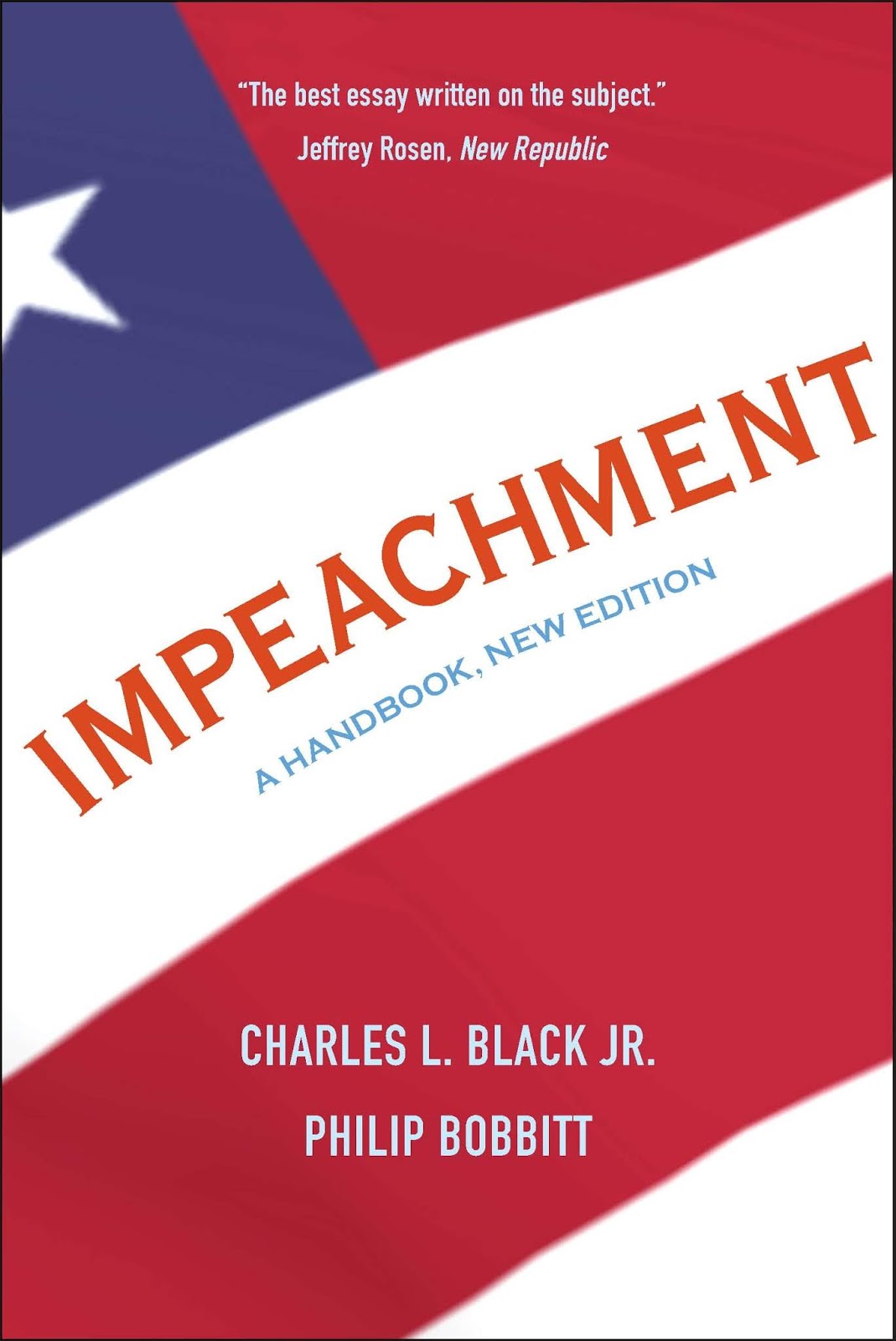
Black, Charles L., Jr. & Bobbitt, Philip, Impeachment: A Handbook, New Edition (p. 15). Yale University Press. Kindle Edition. 

Tuesday, December 10, 2019

Better Know the Impeachment Process 12.10.19 "Later Criminal Prosecution & Two Questions: Facts & Significance"


Two topics today, since I've been off of posting (guests) but things are happening. 
No “further” punishment of any kind may be imposed, though the removed officer, including an ex-president, may later be tried and punished in the ordinary courts, for the very offenses that were grounds of removal. 

First, if the Senate votes in favor of removal from office, can further steps be taken? In short, but the Senate and Congress, "no," but by the courts after removal, "yes." This must weigh quite heavily on Trump's mind, to the extent that he can think that far ahead and strategically. 

On a different topic, and going back a step in the process, here are the two key questions that each senator will be called upon to answer. In some sense, it's simple. But as we go forward, we'll dive more deeply into "high crimes and misdemeanors," although the "bribery" provision may apply in Trump's case in dealing with Ukraine. (As we'll learn from other sources, the distinction between bribery and extortion is not an easy one to draw, and to some extent, they are flip sides of the same coin.)  
In voting on each Article of Impeachment, each senator, acting in a capacity combining those of judge and jury, is registering his best judgment “on the facts” and “on the law.” This means that he is answering two questions together: “Did the president do what he is charged in this Article with having done?” “If he did, did that action constitute an impeachable offense within the meaning of the constitutional phrase?”

Black, Charles L., Jr. & Bobbitt, Philip,  Impeachment: An Handbook, New Edition (p. 14). Yale University Press. Kindle Edition. 

Saturday, December 7, 2019

Garry Wills: Congress & the Presidency are NOT Equal Branches! (Impeachment Relevant)

Garry Wills: classicist & American historian
Garry Wills takes issue with Adam Schiff and some other Democrats about the relationship of Congress and the President. Wills argues that the branches are NOT "co-equal" (why not just "equal"?). Congress is meant to be the dominant power in our tripartite governmental scheme. His argument is grounded in the text of the Constitution and the Federalist Papers. Few know the era of the Founding and their ways of thinking and speaking than does Wills. He's an expert in American history, abetted by his training as a classicist--advanced education in the languages of ancient Greeks and the New Testament and Latin and their culture. The Greek and Roman traditions were the oldest springs from which the Founders drew their inspiration to found a republic. And Wills is a very careful, learned reader.
NYBOOKS.COM
Congress is not a “co-equal” branch of government with the presidency. It is by far the superior branch. James Madison made that clear for all time with his lapidary sentence in Federalist No. 51: “In republican government, the legislative authority, necessarily, predominates.” Necessarily. ...

Wednesday, December 4, 2019

Better Know the Impeachment Process 12.04.19 " Counting the Votes & Passing Power"


After all evidence and argument have been heard, the Senate must vote. The vote is separate on each Article of Impeachment. If no Article registers a two-thirds vote for conviction, a judgment of acquittal is pronounced and recorded. If one or more Articles of Impeachment receive a vote of two-thirds or more, then the president is convicted, and judgment of conviction and removal is pronounced by the chief justice. 

Black, Charles L. Jr. & Bobbitt, Philip, Impeachment: A Handbook, New Edition (p. 13). Yale University Press. Kindle Edition. 
 So if the Senate approves a single article of impeachment--by a two-thirds (66/100) vote--then the Chief Justice would pronounce conviction and removal. While in the current circumstances it seems unlikely that enough Republicans would vote to convict, if this should happen (and what's now impossible in politics?), then what would happen to the office of the presidency? Would the vice-president wait outside the Senate chamber to take the oath from the Chief Justice? What would constitute an orderly transfer of power? Of course, all the talk of a "coup" is horse-hockey. The vice-president is selected by the president and is also a Republican. But still, Trump has no sense of party loyalty or continuity, unlike Richard Nixon, who did not hesitate (at least publically) about allowing Gerald Ford to become president without any question about Ford's legitimacy to ascend to the office. 


Tuesday, December 3, 2019

Better Know the Impeachment Process 12.03.19 "Here Comes the Judge"


John Roberts, Chief Justice of the United States

On any procedural question, including admissibility of evidence, the chief justice will make a ruling, but that ruling may be reversed by a majority vote of the senators present. After all evidence is in, argument will take place. 
Black, Charles L., Jr..& Bobbit, Philip, Impeachment: A Handbook, New Edition (p. 13). Yale University Press. Kindle Edition. 
Two crucial points here. First, how will Chief Justice Roberts conduct himself in the anticipated impeachment trial of Trump? I wager that he'll try to make himself as inconspicuous as possible. He's never been a trial judge, and here we're talking about a trial as opposed to oral arguments before an appellate tribunal. Trials can be wild and wooly; appeals much less so. However, I do think that Roberts, despite his conservative pedigree and disposition, will strive to appear fair and impartial. He's shown in the past his concern for the Supreme Court as an institution and for the rule of law in general, so I have some hopes for him. However, remember that I had similar thoughts about William Barr and how misinformed those hopes were. 

Second, no matter what Roberts might rule, in the end, Mitch McConnell runs the show. He and a (Republican) majority can vote to override a ruling by the Chief Justice. For instance, suppose that Republicans want to bring in Hunter Biden and Joe Biden to try to connect them to Ukranian corruption, the dearth of evidence in support of such a finding notwithstanding. (Facts haven't been getting in the way of Republicans of late, following the example of their Dear Leader.)  In a normal trial (and this ain't gonna be no normal trial), a judge would likely exclude such evidence as irrelevant. The Chief Justice could rule that such evidence is not relevant to the issue of whether President Trump acted wrongly in attempting to coerce an investigation of the Bidens regardless of what they'd done or not done. (A correct and sensible ruling, in my opinion.) But Mitch and the gang could overrule the CJ. Would they? I'd never accuse McConnell of being shy about unending norms and grabbing power. So this will be something to watch. 

Monday, December 2, 2019

Better Know the Impeachment Process 12.02.19


Each Senator sitting in judgment at the trial of articles of impeachment must take an oath as provided by Senate Impeachment Rules of March 2, 1868 (involving President Andrew Johnson). If President Trump is impeached by the House, each Senator will pledge to act in accord with this oath: 

Form of oath to be administered to the members of the Senate sitting in the trial of impeachments: I solemnly swear (or affirm, as the case may be,) that in all things appertaining to the trial of the impeachment of ______________, now pending, I will do impartial justice according to the Constitution and laws: so help me God.
While I'm confident that each senator will take the oath, I fear that too few will honor its requirement. 

Sunday, December 1, 2019

Better Know the Impeachment Process 12.01.19


Here's where it gets tricky; where the ideals of the Founders clash with the realities of our foibles, especially pronounced at this time. Black writes: 

The Constitution says, in Article III (the Judiciary Article), that “the trial of all Crimes, except in Cases of Impeachment, shall be by Jury . . .”; the implication is that the impeachment trial is a “trial” much like others, except that a jury is not to be used. The special oath which senators take has already been mentioned. The Senate is to “try” all impeachments, not simply vote on them; the word “try” is a word used almost invariably in regard to judicial trials. Political good sense points the same way; a judicial or quasi-judicial trial is simply one that inquires into the facts and the law, without partisan or narrow political bias, and proceeds to judgment accordingly—these things are obviously what we want in impeachment proceedings. In function, then, the “trial” in the Senate is, as its name implies, at least quasi-judicial. The important thing is not the name given but the thing desired—total impartiality, at least resembling that of a faithful judge or juror.
Here a difficulty arises—one which can be solved only by great and self-insightful integrity. It must almost always be the case that many senators find themselves either definitely friendly or definitely inimical to the president. In an ordinary judicial trial, persons in such a position would of course be disqualified to act, whether as judges or as jurors. It cannot have been the intention of the Framers that this rule apply in impeachments, for its application would be absurd; a great many senators would inevitably be disqualified by it, and it might easily happen that trial would be by a quite small remnant of the Senate. The remedy has to be in the conscience of each senator, who ought to realize the danger and try as far as possible to divest himself of all prejudice. I see no reason why this cannot produce a satisfactory result. [Emphasis added.]


Black, Charles L., Jr. & Bobbitt, Philip, Impeachment: A Handbook, New Edition (pp. 11-12). Yale University Press. Kindle Edition.