Showing posts with label John Tierney. Show all posts

Monday, October 12, 2020

Thoughts of the Day: Monday 12 October 2020


No matter what you want to achieve, playing offense begins by recognizing the two basic lessons from chapter 1: Your supply of willpower is limited, and you use the same resource for many different things. Each day may start off with your stock of willpower fresh and renewed, at least if you’ve had a good night’s sleep and a healthy breakfast. But then all day things chip and nibble away at it. The complexity of modern life makes it difficult to keep in mind that all these seemingly unrelated chores and demands draw on the same account inside of you.
The problem with a purely material and rational society is captured by two well-known Biblical sayings: “Man shall not live by bread alone,” and “Where there is no vision, the people perish.”
Premise 8: The project of evolving consciousness through services of goodness, teachings of truth, and creations of beauty is facilitated and empowered through the use of evolution’s own method of development—the ongoing dialectical synthesis of existential polarities.
Just because you don’t immediately, or perhaps ever, see the virus of behavior leap from host to host doesn’t mean it isn’t leaping. It is, relentlessly. Most people are wired for strong reciprocity, which means we repay good with good and bad with bad, and are willing to repay bad with bad even at some personal cost, just to reinforce group norms.
Sextus describes the work of collecting and opposing arguments as a therapy used to cure the disease of opinions. He was a medical doctor as well as a philosopher, and his view of philosophy was essentially therapeutic. He was a professional purveyor of Skeptic remedies, a practicing Skeptic doctor, who engaged in philosophy not to seek the truth, but to help people see the limitations of their points of view.
And Hannah Arendt for the finale:
Kant’s famous categorical imperative—“Act in such a way that the maxim of your action could become a universal law”—indeed strikes to the root of the matter in that it is the quintessence of the claim that the law makes upon us. This rigid morality, however, disregards sympathy and inclination; moreover, it becomes a real source for wrongdoing in all cases where no universal law, not even the imagined law of pure reason, can determine what is right in a particular case.


Sunday, October 30, 2011

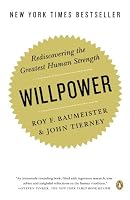
Willpower: Rediscovering the Greatest Human Strength by Roy Baumeister & John Tierney

Social psychologist Baumeister and science journalist Tierney have teamed up to provide a popular account of type of academic work that Baumeister and his colleagues have conducted. This body of research has given us a new perspective on the age-old problem of the will. Actually, as scholars as diverse as Hannah Arendt and Garry Wills have written about the fact that St. Augustine developed the idea of the will in Western culture, a concept that the Greeks never really developed (although they were quite concerned with issues of self-control and self-regulation). Augustine was trying to understand why he didn’t always do as he would have himself do, a problem explored in Greek culture (witness Odysseus binding himself to the mast, Aristotle on habit, and St. Paul on why he does what he would not), but never directly addressed. No writer until Augustine addressed this topic head-on. In any event, having perceived myself as suffering a weak will, I’ve certainly read on the topic, and I find this book a welcome and useful addition to this literature.

The authors do a good job of mixing the findings of academic research with reports on contemporary and historical individuals as exemplars of willpower. David Blaine, the magician and stunt artist (which I do not intend as a derogatory term), David Allen (of GTD fame), Eric Clapton (recovering alcoholic), Oprah (dieting victim), and Stanley (of “Dr. Livingstone, I presume” fame), all provide true stories of individuals dealing with particular problems of will. This mix of reporting academic research with real-life examples works well (although how their findings and conclusions fit with Victorian willpower isn’t as completely explored as I would like).

The takeaway: we have a certain amount of willpower (which can increase with training), but which declines with use (thus drawing on the some ideas of Freud as the ego as a fixed reserve). Interestingly, researchers have found that a dose of sugar (energy) works to increase willpower when it begins to flag. In addition, dieting, as the “perfect storm” for challenging willpower, gets an interesting chapter to itself. Think about it: you’re exerting extra willpower and you’re short on energy, so the brain orders (loudly) “eat!”. That’s why it’s important to develop life-long good habits.

One other area that they don’t explore is the Buddhist mindfulness tradition and other traditions (Gurdjieff, for instance) and how the academic research might fit with spiritual and philosophical ideas of willpower. Indeed, many religious traditions contain examples of extraordinary self-control and awareness. How does this all fit in? I suggest that we have to write that chapter ourselves.

In the end: a fun, interesting, and useful book. Recommended.