Showing posts with label willpower. Show all posts

Wednesday, October 21, 2020

Thoughts of the Day: Wednesday 21 October 2020


The individual life was seen in the past as more than just a line leading to – what? Its shape had the qualities of a circle: in my end is my beginning, and in my beginning is my end. Like many complex and apparently paradoxical dispositions to the world, this belief is better expressed in music than in words.

No matter what you want to achieve, playing offense begins by recognizing the two basic lessons from chapter 1: Your supply of willpower is limited, and you use the same resource for many different things. Each day may start off with your stock of willpower fresh and renewed, at least if you’ve had a good night’s sleep and a healthy breakfast. But then all day things chip and nibble away at it. The complexity of modern life makes it difficult to keep in mind that all these seemingly unrelated chores and demands draw on the same account inside of you.

Once upon a time, every literate person was versed in the techniques Ed was about to teach me.  Memory training was considered a centerpiece of classical education in the language arts, on par with grammar, logic, and rhetoric. Students were taught not just what to remember, but how to remember it. In a world with few books, memory was sacrosanct.
And a guest deeper dive from Alan Watts:

“Well now really when we go back into falling in love. And say, it’s crazy. Falling. You see? We don’t say “rising into love”. There is in it, the idea of the fall. And it goes back, as a matter of fact, to extremely fundamental things. That there is always a curious tie at some point between the fall and the creation. Taking this ghastly risk is the condition of there being life. You see, for all life is an act of faith and an act of gamble. The moment you take a step, you do so on an act of faith because you don’t really know that the floor’s not going to give under your feet. The moment you take a journey, what an act of faith. The moment that you enter into any kind of human undertaking in relationship, what an act of faith. See, you’ve given yourself up. But this is the most powerful thing that can be done: surrender. See. And love is an act of surrender to another person. Total abandonment. I give myself to you. Take me. Do anything you like with me. See. So, that’s quite mad because you see, it’s letting things get out of control. All sensible people keep things in control. Watch it, watch it, watch it. Security? Vigilance Watch it. Police? Watch it. Guards? Watch it. Who’s going to watch the guards? So, actually, therefore, the course of wisdom, what is really sensible, is to let go, is to commit oneself, to give oneself up and that’s quite mad. So we come to the strange conclusion that in madness lies sanity.”

— Alan Watts

Sunday, October 30, 2011

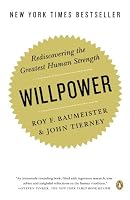
Willpower: Rediscovering the Greatest Human Strength by Roy Baumeister & John Tierney

Social psychologist Baumeister and science journalist Tierney have teamed up to provide a popular account of type of academic work that Baumeister and his colleagues have conducted. This body of research has given us a new perspective on the age-old problem of the will. Actually, as scholars as diverse as Hannah Arendt and Garry Wills have written about the fact that St. Augustine developed the idea of the will in Western culture, a concept that the Greeks never really developed (although they were quite concerned with issues of self-control and self-regulation). Augustine was trying to understand why he didn’t always do as he would have himself do, a problem explored in Greek culture (witness Odysseus binding himself to the mast, Aristotle on habit, and St. Paul on why he does what he would not), but never directly addressed. No writer until Augustine addressed this topic head-on. In any event, having perceived myself as suffering a weak will, I’ve certainly read on the topic, and I find this book a welcome and useful addition to this literature.

The authors do a good job of mixing the findings of academic research with reports on contemporary and historical individuals as exemplars of willpower. David Blaine, the magician and stunt artist (which I do not intend as a derogatory term), David Allen (of GTD fame), Eric Clapton (recovering alcoholic), Oprah (dieting victim), and Stanley (of “Dr. Livingstone, I presume” fame), all provide true stories of individuals dealing with particular problems of will. This mix of reporting academic research with real-life examples works well (although how their findings and conclusions fit with Victorian willpower isn’t as completely explored as I would like).

The takeaway: we have a certain amount of willpower (which can increase with training), but which declines with use (thus drawing on the some ideas of Freud as the ego as a fixed reserve). Interestingly, researchers have found that a dose of sugar (energy) works to increase willpower when it begins to flag. In addition, dieting, as the “perfect storm” for challenging willpower, gets an interesting chapter to itself. Think about it: you’re exerting extra willpower and you’re short on energy, so the brain orders (loudly) “eat!”. That’s why it’s important to develop life-long good habits.

One other area that they don’t explore is the Buddhist mindfulness tradition and other traditions (Gurdjieff, for instance) and how the academic research might fit with spiritual and philosophical ideas of willpower. Indeed, many religious traditions contain examples of extraordinary self-control and awareness. How does this all fit in? I suggest that we have to write that chapter ourselves.

In the end: a fun, interesting, and useful book. Recommended.