Showing posts with label Max Scheler. Show all posts

Sunday, August 7, 2022

Our Own Worst Enemy: The Assault from Within on Modern Democracy by Tom Nichols

    
Should have received more publicity on publication


The end of democracy will come not with mobs burning the Capitol, or food riots, or juntas of national salvation, or demagogues leading the peasants to burn the castles of the rich. It will end, instead, with highly educated, technically proficient, otherwise decent men and women with families and children and mortgages and car payments who will decide that uninformed, spoiled, irascible voters simply can’t produce coherent demands other than “just get it for us,” and they will act accordingly.


This will not happen after a revolution, or a disaster, or a landmark court case—or even after a pandemic. It will happen as part of a million small decisions made every day without the input of the common citizen, as the fulfillment of an unspoken agreement between technocratic elites and the working and middle classes. Rights and participation and transparency will be shelved—as they too often were during the Cold War in the name of national security—as luxuries simply too expensive to indulge. The population will not be impoverished proles, but reasonably educated, comfortable people who have decided that “democracy” means a certain standard of living.

Nichols, Thomas M., Our Own Worst Enemy (pp. 214-215). Oxford University Press. Kindle Edition.


As we Americans attempt to deal with the crisis of our democracy, we are blessed to have many capable individuals addressing our plight. In no particular order: Anne Applebaum, David Frum, Thomas Edsall, Francis Fukuyama, Yousha Mounk, Max Boot, Tim Miller (and others in The Bulwark crowd), Steve McIntosh, George Packer, and others whose names escape me for the moment. Suffice it to say that there are many continuing efforts to better understand our plight. 


And, oh, yes, there’s Tom Nichols. Like Applebaum and Frum, Nichols also writes for The Atlantic. And like Frum and Applebaum and several of the others, Nichols published a book about this topic in 2017, The Death of Expertise. I haven’t read that book, but I became familiar with Nichols around that time and have followed his work since then. This includes frequent contributions to The Atlantic and podcast interviews with Charlie Sykes on the Bulwark podcast. And, to my surprise, I learned that Nichols had published a book in August 2021, Our Own Worst Enemy: The Assault from Within on Modern Democracy (OUP).  In fact, there’s a bit of an embarrassing story about how I discovered this book, which I detail at the end here.* Suffice it to say that while a year late to the party, I’m glad that I finally arrived. In fact, it may prove to be the best “party” that I’ve attended about this topic. 


Nichols's argument is straightforward: the greatest problems facing the U.S. and other established democracies come from within, not from abroad. The electorate in the U.S. (and I’ll focus on the U.S., as Nichols does) has been chronically unhappy with elites and the course of the nation. Why is this so? Our situation (at least our material situation) is really pretty good, notwithstanding the challenging events of the first fifth of the twenty-first century: the 9/11 attacks and related events of radical Islamic terrorism; the wars in Iraq and Afghanistan; the crash of 2008; mounting domestic terrorism; the COVID-19 pandemic and the related economic crash—all these events were indeed traumatic and cost precious lives and huge amounts of treasure. But for most Americans living in August 2022, life is nevertheless quite good. Again, not to minimize the pain and death associated with the events listed (and others), but Nichols (and I) agree with former Presidents Obama’s statement that there’s never been a better time to be alive. One must acknowledge that our material well-being, as measured by the amount of stuff we have and the quality of life that we can enjoy, is beyond the dreams of even the wealthiest who lived as recently as less than a century ago.


So, what's eating at us? Nichols summarizes his answer in three words: “narcissism, anger, and resentment.”


In pursuing this line of thought, Nichols distinguishes himself from others who’ve attempted to diagnose our malaise, including popular opinion. Nichols acknowledges that elites have indeed made mistakes, but then they always do, and the magnitude of those mistakes doesn’t justify the magnitude of the malaise claimed by so many.


To arrive at his diagnosis, Nichols, instead of using a searchlight, uses a mirror. 


Among the unholy triumvirate of narcissism, anger, and resentment, the anger (and resulting grievance) aspect has received the most attention from many commentators. This line of thought goes a long way in explaining the reactions of those who've suffered direct hits to their well-being by way of job losses and declining communities. Many of these losses are rightly attributable to jobs going overseas and to automation (the latter, I think, being the more significant problem regarding jobs). But the number of Trumpists and sympathizers who have suffered these severe losses is rather small. A full explanation of the approximately 40% of the U.S. electorate who vote for Trumpists requires a deeper, more sweeping explanation. 


Of course, anyone who knows much about American politics knows that most citizens, including most voters, are shockingly ill-informed about candidates, policies, and how our political institutions function. It’s a fool’s errand to place an articulated, rational set of reasons for the outcome of any election. It’s most often like trying to draw a detailed picture using just black and white (Yes or No? Candidate A or B?) and beginning the picture from a Rorschach ink blob. Nichols illustrates the problems with a couple of tales from my native Iowa: 


The Los Angeles Times reporter Matt Pearce, for example, spoke to a woman who caucused for Sanders in 2016 and then voted for Trump. In 2020, she initially settled on Pete Buttigieg, the mayor of South Bend, Indiana, as her choice. If Buttigieg didn’t win the nomination, however, she would move from the young, progressive, gay, once-married Buttigieg back to the elderly, right-wing, serially adulterous, thrice-married bigot Trump—a kaleidoscopic change in preferences that only makes sense as a search for a tailored set of narrow promises that would meet her personal satisfaction, rather than the selection of a candidate who must govern across a range of issues. Location 1306)

. . . . 

Another Iowan told the media that she had voted both for Barack Obama and for Donald Trump, “just to shake up Washington, to be honest.” (This is sometimes called the “OOT” voter, the person who voted Obama-Obama-Trump in 2008, 2012, and 2016, respectively.) Had Trump not been available in 2016, she said, she might have gone for—of course—Bernie Sanders. “We’ve just been in a rut so long,” she sighed. (Location 1311)


Even as a native and resident of Iowa most of my life (and as a long-time observer of its politics), this makes my head spin. I migrated from Booker to Buttigieg to Biden (I do like those Bs, I guess), but jump to Trump? How can any mind make that leap? But then it wasn’t the mind so much as the emotions that motivated these voters. 


Narcissism and resentment (and its manifestation on steroids, ressentiment—thank you, Nietzsche) both reach beyond the surface rationalizations and reasons to reveal the motivating emotional core. I suspect that social scientists tend to shy away from such broad and amorphous concepts that can’t be easily quantified, but happily, Nichols (a Ph.D. in political science and retired college professor) doesn’t shy away from these depths. 


In his discussion of narcissism, Nichols draws on the work of American historian and social critic Christopher Lasch. Lasch was active roughly from the 1960s until his death in 1994, and he’s perhaps most remembered for his 1970 work, The Culture of Narcissism. Nichols cites this work and others in his review of contemporary manifestations of narcissism. One wonders what Lasch would make of our situation today. (N.B. Nichols, like me and others, believes Lasch went too far in his criticisms near the end of his career.) Related to narcissism, Nichols draws on the work of political scientist Edward Banfield to note that when the chips are down, individuals often hunker down into the confines of family rather than seeking out and pursuing the common good. Banfield saw this phenomenon demonstrated in a poor Italian village in the 1950s; Nichols sees this increasingly in contemporary America. Nichols quotes Hannah Arendt to capture the implications of the two different potentials exhibited here: 


The idiot is one who lives only in his own household and is concerned only with his own life and its necessities. The truly free state, then—one that not only respects certain liberties but is genuinely free—is a state in which no one is, in this sense, an idiot: that is, a state in which everyone takes part in one way or another in what is common. (Location 974)


But while there’s plenty of evidence in support of the anger-grievance and narcissism aspect of our current malaise, it’s the resentment aspect that may manifest the most potent motivating and explanatory power to our current malaise. Let me introduce this topic with an extended quote from Nichols: 


Resentment in politics is the externalization of envy. If there is one thing authoritarian governments do especially well, it is the way in which they mobilize resentment as a weapon. Democracy, on principle, is based on the public’s acceptance of regular cycles in which winners and losers exchange places, sometimes unexpectedly. Authoritarians, by contrast, promise stability and equality. They offer placidity by promising, without favor or exception, to make losers of everyone outside of the ruling group. By reducing all citizens to the same miserable condition, they build a constituency among those who are willing to endure oppression as long as the people they hate have to endure it as well. Resentment is about leveling rather than leadership, about vengeance rather than virtue.

(Location 1733)

. . . . 


Resentment, like narcissism, undermines the civic virtues of tolerance, cooperation, and equal justice, because it fuels demands for rewards and punishments based on jealousy and unhappiness rather than reason or impartial justice.

(Location 1739)


And if you thought that mere garden variety resentment seems quite enough to invade and perhaps destroy the garden of democracy, then there’s resentment on steroids: ressentiment.


Again, Nichols provides an informative overview:


There is a more evocative word, ressentiment (imported from French by the philosopher Friedrich Nietzsche), that captures this vague but powerful envy of others. Mere “envy” or “resentment” isn’t enough to express the lasting toxicity of ressentiment. As the writer Joseph Epstein has explained, ordinary resentment is a “quick, stabbing thing, set off by an act of ingratitude or injustice, but that can, fairly quickly, melt away.” But ressentiment is of greater endurance, has a way of insinuating itself into personality, becoming a permanent part of one’s character. Ressentiment, then, is a state of mind, one that leaves those it possesses with a general feeling of grudgingness toward life. . . . So much so that those suffering ressentiment come almost to enjoy the occasions for criticism that their outlook allows them.

(Location 1741)

. . . . 

...philosopher Ian Buchanan describes ressentiment as a “vengeful, petty-minded state of being that does not so much want what others have (although that is partly it) as want others to not have what they have.”

(Location 1754)

. . . . 

...in the words of the German philosopher Max Scheler, it is existential envy “directed against the other person’s very nature,” and thus unresolvable: “I can forgive everything, but not that you are—that you are what you are—that I am not what you are—indeed that I am not you.”

(Location 1758)


And if the citations to Nietzsche, Epstein, Buchanan, and Scheler seem too highbrow, here Nichols provides the comment of an American voter as an exemplar: 


[A]more prosaic example of this kind of resentment in modern America is the voter in Florida who was furloughed from her public sector job during a 2019 budget impasse between the White House and Congress. Initially a supporter of President Trump, she turned on her candidate in helpless anger. “I voted for him, and he’s the one who’s doing this,” she said. “I thought he was going to do good things. He’s not hurting the people he needs to be hurting” (emphasis added).

(Location 1801)


After addressing the issue of resentment, Nichols touches on nostalgia, the tendency to idealize and attempt to recover an imagined past. The answer to malaise becomes time-travel; escape to the past when things were “better.” But time travel isn’t an option, time’s arrow flies only in one direction. And even if some aspects of the past were in some measure “better,” they can only be re-created, not re-captured. 


Nichols also notes that democracy and liberalism often prove boring. There’s no Le Mis celebrating the endless wrangling of a congress, legislature, or city council. The flag waving and drama of January 6 proved dramatic, even cinematic, but was not democracy, not the rule of law, and not a future that any sane person would want. Again, reason takes a backseat to the emotional engines that prompt some form of salvation through mindless acts expressing inarticulate dissatisfaction with the status quo. (Fascism, anyone?)


This work of Nichols is the most convincing, comprehensive assessment of our current democratic dis-ease that I’ve read to date (although there are many works out there on this topic that I haven’t yet gotten to). Nichols has the analytical mind of a political scientist that he combines with a keen, appreciative eye for the contemporary American scene. He reports coming from a modest background, and while he’s critical of his fellow Americans, he’s not dismissive or despairing of them. He wants us, our nation, to succeed, but he realizes the realities of our (largely) self-imposed self-destructive traits. Nichols has no magic wand, no simple answers; I imagine he hopes, like an experienced physician, that the first step forward in alleviating the malady is to properly identify it. 


There are many aspects of the book that I haven’t addressed here, and there are some avenues that I would like to have seen Nichols explore (for instance, the work of Rene Girard, whose insights about rivalry, memetic desire, envy, jealousy, resentment, and scapegoating, seem to me to be likely quite applicable who what Nichols is exploring. (But in fairness, I’ve only dipped into Girard to date, although I’m planning a deep dive. But we can’t know everything all at once.) Perhaps it’s best to close with a couple of more brief quotes from Nichols: 

Can we regain this Athenian sense of honor, civic pride, love of community, self-sacrifice, and deep confidence in our way of life? Or are these virtues now to be lost in a dark sea of grievance, resentment, and envy? (Location 3414)
. . . .  
“It cannot come from abroad,” Lincoln warned. “If destruction be our lot, we must ourselves be its author and finisher. As a nation of freemen, we must live through all time, or die by suicide.” (Location 3425)


*And now for my big faux pas: Nichols posted a thread on resentment in contemporary American politics. I "liked" the threat and suggested that he write up his perspective in an Atlantic article. His reply:  "(said much more in a book)" My humble pie response to that revelation was "My bad! I've now obtained a copy of OUR OWN WORST ENEMY & will seek to rectify my ignorance. Appreciate very much your commentary & analysis." I hope that this review has in some manner rectified my having missed the boat earlier!


Monday, January 10, 2022

Thoughts 10 Jan. 2022


Love opens the world to us, as it opens ourselves to the world, whereas hate, for [Max] Scheler, was a closing off, a shrinking away from things (it is unclear if Scheler ever read Swedenborg, but this seems very similar to Swedenborg’s distinction between the ‘saved’ and the ‘damned’ mentioned earlier).
N.B. Max Scheler was highly praised by Ortega y Gassett, Heidegger, and later Pope John Paul II, and is not cited by Iain McGilchrist.

Complexity and simplicity are relative terms. However, complexity is surely, we imagine, a more unusual state of affairs arising out of the agglomeration of more simple elements – isn’t it? I believe that this is a mistake – one all too understandable, given our world view, but a mistake nonetheless. Rather, complexity is the norm, and simplicity represents a special case of complexity, achieved by cleaving off and disregarding almost all of the vast reality that surrounds whatever it is we are for the moment modelling as simple (simplicity is a feature of our model, not of the reality that is modelled)..

Frederick Douglass, who was born a slave, knew what he was talking about when he said in 1860, after an angry mob broke up an abolitionist meeting in Boston: “Slavery cannot tolerate free speech. Five years of its exercise would banish the auction block and break every chain in the South.” (He added, significantly: “To suppress free speech is a double wrong. It violates the rights of the hearer as well as those of the speaker.”)


I’d learned something about how the brain and nervous system encode sensations and emotions together. I now know that neural symbols are the underlying building blocks for everything that I think and experience. But I don’t have a new practice to put that knowledge into action. I want a technique that’s easy to learn but also triggers enough of a response that it keeps me attentive.

The three main building blocks of human experience are time, emotion and sensation. The brain must account for all three factors in order to encode information from the outside world.
Time strikes me as the odd man out, so to speak, in these three characteristics. The traditional third would be "intellect" or "reason." However, this is not to denigrate the function of time as a fundamental attribute of human experience. Cf. Iain McGilchrist on time in The Matter with Things.

The ‘so-called bodily pleasures’ are (ibid.) the pleasures of eating, drinking, and sex. Now these according to Plato himself (Rep. 580 E) are the pleasures, or some of the pleasures, of ‘The Acquisitive’; and ‘The Acquisitive’ is one of the three ‘forms’ (εἴδη) or ‘parts’ (μέρη) which go to make up the mind (ψνχή).

“Destroying rainforest for economic gain is like burning a Renaissance painting to cook a meal.”
― E. O. Wilson
RIP December 26, 2021 (from Tim Ferriss)

All this was inspired by the principle – which is quite true within itself – that in the big lie there is always a certain force of credibility; because the broad masses of a nation are always more easily corrupted in the deeper strata of their emotional nature than consciously or voluntarily; and thus in the primitive simplicity of their minds they more readily fall victims to the big lie than the small lie, since they themselves often tell small lies in little matters but would be ashamed to resort to large-scale falsehoods.

It would never come into their heads to fabricate colossal untruths, and they would not believe others could have the impudence to distort the truth so infamously. Even though the facts which prove this to be so may be brought clearly to their minds, they will still doubt and waver and will continue to think there may be some other explanation. For the grossly impudent lie always leaves traces behind it, even after it has been nailed down, a fact which is known to all expert liars in this world and to all who conspire together in the art of lying.— Adolf Hitler, Mein Kampf, vol. I, ch. X


“Democracies have ever been spectacles of turbulence and contention; have ever been found incompatible with personal security or rights of property,” said James Madison in Federalist Paper No. 10. John Adams echoed the sentiment: ““Remember, democracy never lasts long. It soon wastes, exhausts, and murders itself.”

The best, in fact the only, way I can think of to get hold of the question is to look for a model, an example of a thinker who was not a professional, who in his person unified two apparently contradictory passions, for thinking and acting—not in the sense of being eager to apply his thoughts or to establish theoretical standards for action but in the much more relevant sense of being equally at home in both spheres and able to move from one sphere to the other with the greatest apparent ease, very much as we ourselves constantly move back and forth between experiences in the world of appearances and the need for reflecting on them.

Feeling is one of the seven universal mental factors. The other six are contact, perception, attention, concentration, life force, and volition.


Thursday, September 22, 2016

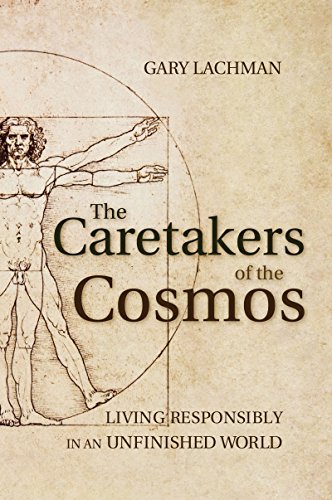
The Caretakers of the Cosmos by Gary Lachman

Another Lachman was on deck
At the end of my review of Gary Lachman’s Beyond the Robot, I joked that I now had a conundrum to resolve: whether to read another Lachman book next or one by Wilson. As it turned out, I had Lachman’s The Caretakers of the Cosmos: Living Responsibly in an Unfinished World (2013) on my Kindle, so it got the nod. Upon plunging in, I realized that I’d read it before, rather hurriedly, probably right after completing A Secret History of Consciousness. I hadn’t reviewed it, and my enthusiasm spurred by an appreciation of Beyond the Robot, I dove back in. I glad that I did.

As he demonstrated in Beyond the Robot and The Secret History of Consciousness, Lachman is a master of exposition, gathering and summarizing the thinking of scientists, philosophers, artists, and occultists with an exemplary thoroughness and economy. He conveys the message of those with whom he disagrees as well as he does for those he promotes. But in addition to the admirable exposition of thinking and history that I’ve quickly come to expect from Lachman, this is not the primary value of his book. For in addition to its exposition of a variety of thinkers and thinking about our place in the cosmos, Lachman has also written a manifesto. To sum up his manifesto in a sentence, I suggest the banner: “It’s our cosmos now, and we ought to do right by it.”

Early in the book, Lachman identifies examples of thinkers whom he believes don't do right by our (human) place in the cosmos. He singles out the French biologist Jacques Monod and the British philosopher John Gray for a more thorough consideration. And later in the book he identifiesSteven Pinker, James Lovelock, Steven Weinberg, Stephen Hawking, Bertrand Russell, Daniel Dennett, and John Searle as those who undervalue, if not deprecate, the role of human agency.   (These are just the names that I recognized, Lachman discusses others, too.) Each of these thinkers in some manner deprecates human agency (conscious decision-making entailing meaningful choice) by emphasizing chance or causal determinism or genetics or entropy or our physical insignificance. But as Lachman points out, if we human are so puny, insignificant, and determined, why do they spend so much time and effort trying to convince us of this? Is it worth the effort? Can you rationally persuade such determined creatures? (I will say that it can be damned hard.). What Lachman is pointing at is a performative contradiction: you contend for a proposition that your actions in making the case negate. Lachman later in the books makes the same point about extreme cultural relativism: how can one argue for all cultural values being equally valid without positing a value that entails negating cultural values that say “our way the only way”? We living, breathing human beings—not chance, genes, or some scientific principle—must make value judgments and choices that affect our world. We humans, as individuals and as a society, are the most complex entities in the known universe. I agree with Lachman: I think we’re pretty damned special. (And also often quite a wreck of a species.)

In distinction from those who hold a pinched view of the role of humans in the cosmos (a term that Lachman unpacks early in the book), Lachman details many examples of those who defend humanity’s unique position. From the myth0-poetic realm, Lachman provides examples both familiar and occult. Among the better-known accounts of humanity’s crucial role in the cosmos comes from the Jewish tradition of Kabbala.  In short, creation is purposely flawed, and humans are dispatched by God to work to set it aright by tikkun, a healing function. This line of thought, this metaphor for the imperfection manifest in the world in which we humans find ourselves, is similar that that found in the Hermetic tradition dating back to the early period of Western culture. In this tradition, Man (used traditionally as including both sexes) is part material and part spiritual and must work diligently to resolve the rift that creation has allowed to occur. Healing this rift gives humankind a divine mission. But what of those who poo-poo such accounts as the stuff of children and want good, sound science and logic? Lachman attends to these as well.

Philosopher-scientists like Henri Bergson, William James, and Alfred North Whitehead, to name three of the more well known among those mentioned, all see the cosmos and the human role as alive with consciousness and possibility in distinction from their more staid peers. Whitehead, it seems, is of particular importance because of his ideas about ‘prehension’ (a measure of experience applying even to inanimate objects) and the contrast between ‘presentational immediacy’ and ‘causal efficacy.' But perhaps of even greater value is Lachman’s reclamation of “philosophical anthropology” in the work of three now largely neglected 20th-century philosophers, Max Scheler (1874–1928), Ernst Cassirer (1874–1945), and Nikolai Berdyaev (1874–1948). Each of these philosophers worked in a different philosophical tradition, but each them grounded the dignity of humanity in its agency (i.e., consciousness) in addition to its biological origins. What all of these thinkers have in common is their appreciation of the importance of consciousness for apprehending the human condition and project.

Two scholars merit attention because of the importance that Lachman attaches to their work. The first is Abraham Maslow. Maslow’s identification of the hierarchy of needs, ranging up from those associated with the physical survival of the organism through those of sociability and esteem, finally up to the level of self-actualization. Maslow’s hierarchy grounds an account of human life on a narrative of an upward arc that endows life with significance and rewards. Maslow’s view contrasts with those others mentioned at the beginning of Lachman’s book (and this review) who tend to ignore or downplay the role of human striving. In writing about Maslow, Lachman also addresses one critique of Maslow: that Maslow’s emphasis on “self-actualization” comes at the expense of concern for society. On one hand, the criticism can be quickly dismissed to the extent that it assumes that self-actualization comes at the expense for regard for others; quite the contrary. Those self-actualized have a greater capacity for helping others. But a stickier problem presents itself: not everyone reaches the panicle of self-actualization. Why not? Many are called; few are chosen. To some, this is an affront to their conviction that all men [sic] are created equal and that inequality arises solely as a result of social and political failure. Lachman slights this perspective. A more nuanced approach is appropriate. Both Plato and Marx are right. Social and political injustices outside of their immediate control play a role in people’s lives. And gifts of genetic endowment and their early environment allow some individuals to climb higher on the ladder of self-actualization and to attain even spiritual heights that most people, even the wealthiest, just don’t aspire to. Lachman reports how Maslow struggled with this issue (which I’d not been aware of before), and Lachman does so as well. The conflict is a real one, especially in a time of rampant demagoguery (you know of whom I speak). The resentment, anxiety, and fear that fuels the lurch toward easy, populist policies is irrelevant—and often detrimental—to traveling the steep road of deepening and expanding consciousness. (Such policies and candidates also are almost always short-sighted if not utterly foolish.) The problem of inequality is one that goes back to Plato (and probably well before), and that does not admit to a fool-proof solution. (For recognizing and exploring the complicated relationship between social-political injustice and individual frailty (sin), I find no better guide that Reinhold Niebuhr.)

The other guide that receives (and deserves) particular attention from Lachman is Iain McGilchrist, the literature professor turned psychiatrist, and author of The Master and His Emissary: The Divided Brain and the Making of the Modern World. In McGilchrist’s work Lachman has a scientist who explores the cultural attitudes that allow us to fall into what Colin Wilson described as “the fallacy of insignificance.” McGilchrist’s scientific background allows him to identify and explain the structural and functional differences in the brain that endow humans with two very different modes of perceiving the world and that can easily come into conflict. Indeed, the humanist side of McGilchrist demonstrates how the history of Western civilization can be seen as a contest between these two perspectives that, when balanced, can provide explosions of artistic inventiveness and human consciousness, but when out of balance, cause suffering and dislocation. Alas, all too much of the 20th century, on into the 21st, has been marked by an imbalance that encourages the fallacy of insignificance and promotes intellectual defeatism and widespread anxiety. Thus, while McGilchrist doesn’t speak directly to the cosmic significance of the human project as do other thinkers discussed by Lachman in this book, McGilchrist’s grounding in science gives his work a unique value when looking at the most immediate realm of current life.

Finally, while realizing I’m leaving out a great deal of the figures and topics that Lachman addresses in this combination of exploration and manifesto, I want to note Lachman’s reference to the work of Owen Barfield. Lachman is no new-comer to Barfield, as I mentioned in my review of A Secret History of Consciousness, Lachman gave Barfield a lot of attention in that earlier work. In this book, Barfield’s ideas about “participation” receive attention. Barfield believes that humans have undergone—are undergoing—an “evolution of consciousness.” Early humans, arising out of the natural world, went from a sense of “direct participation” in the greater environment to the perspective of a detached observer. Now, Barfield suggests that humanity is in a position to obtain “final participation,” which reunites human consciousness with the phenomenal world. This can all seem so abstract, but in using language or in attempting to appreciate history, we find that if we cultivate our awareness of an environment and allow it to sink in, the greater the sense of the situation that we’re contemplating and participating in. John Lukacs's essay, “Putting Man Before Descartes,” uses ideas expounded by his friend Owen Barfield, and he draws upon both history and 20th-century physics, arguing that knowledge can never be “objective” or its converse, “subjective,” but it  is always “personal” and “participant.” Lukacs writes:

Knowledge, which is neither objective nor subjective, is always personal. Not individual: personal. The concept of the individual has been one of the essential misconceptions of political liberalism. Every human being is unique, but he does not exist alone. He is dependent on others (a human baby for much longer than the offspring of other animals); his existence is inseparable from his relations with other human beings.

But there is more to that. Our knowledge is not only personal; it is also participant. There is—yet there cannot be—a separation of the knower from the known. We must see further than this. It is not enough to recognize the impossibility (perhaps even the absurdity) of the ideal of their antiseptic, objective separation. What concerns—or should concern—us is something more than the inseparability; it is the involvement of the knower with the known. That this is so when it comes to the reading, researching, writing, and thinking of history should be rather obvious. Detachment from one’s passions and memories is often commendable. But detachment, too, is something different from separation; it involves the ability (issuing from one’s willingness) to achieve a stance of a longer or higher perspective. The choice for such a stance does not necessarily mean a reduction of one’s personal interest, of participation—perhaps even the contrary.

Indeed, Lukacs goes on:
           
And now a last step: We must recognize, contrary to all accepted ideas, that we and our earth are at the center of our universe. We did not create the universe, but the universe is our invention, and it is, as are all human and mental inventions, time-bound, relative, and potentially fallible.
Because of this recognition of the human limitations of theories, indeed, of knowledge, this assertion of our centrality—in other words, of a new, rather than renewed, anthropocentric and geocentric view of the universe—is not arrogant or stupid. To the contrary: it is anxious and modest. . . .

The known and visible and measurable conditions of the universe are not anterior but consequent to our existence and to our consciousness. The universe is such as it is because in the center of it there exist conscious and participant human beings who can see it, explore it, study it. (For those readers who believe in God: the world and this earth were created by Him for the existence and consciousness of human beings.) This insistence on the centrality and uniqueness of human beings is a statement not of arrogance but of humility. It is yet another recognition of the inevitable limitations of mankind.
Id.

(Some good news: Lukacs has a new book scheduled for release next month, We Are at the Center of the Universe, which, judging by its title and the publisher’s website, will further develop his thoughts on this topic.)

Thus, through the musings of another great thinker, Barfield’s insights gain new credence and application.


In the end, as a formal matter, I take the position of agnostic on the issue of the ultimate or cosmic significance of my life and that of my fellow humans,  past, present, and future. Such an ultimate conclusion, like some of the greatest issues confronting human existence, may be unknowable, at least to a limited, fallible, and spiritually myopic person such as me. However, drawing on Pascal and William James, I shan’t let this stop me. From Pascal, I’ll take the idea of a wager; not on the existence or non-existence of God or of heaven and hell, but on a more immediate issue: the value of a significant versus an insignificant life. Is a life informed by a sense of significance, whether emanating from the love of family and friends and community—even without cosmic significance—better than a life without significance and meaning? I can’t have read and attempted to digest so much of Gary Lachman or Colin Wilson—to name just two immediate culprits—not to answer with a resounding, affirmative “Yes!” And from William James, I take the will to believe. James, in the midst of a disabling ennui, chose to believe in free will and in his ability to make choices and improve—and he did. Thus, we can opt to say “Yes” to life, to meaning and significance even without an assurance of an ultimate guaranty. We can endow life—even the quotidian affairs of daily life—with meaning and significance that will give us the ability to carry on, and perhaps find even more meaning and significance emerge in our lives. The emergence of meaning and significance is the story of humankind (which Lachman addresses and I’ve shortchanged here). Humans have become more significant, more free, and more vital over the course of human civilization. Progress? In some measure, certainly; guaranteed? Not in the least. But in the end, I think Lukacs is right: we humans—frail, sinful, ignorant (chose your term) are at the center of the world, even the Universe, and we should get to it.