Showing posts with label 2022. Show all posts

Wednesday, September 14, 2022

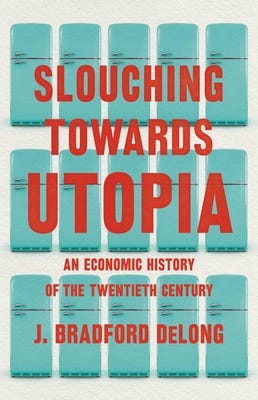
Slouching Towards Utopia: An Economic History of the Twentieth Century by Brad DeLong (and a Big Change)

 Big Announcement! (Sort of): I'm moving my blogging to Substack. This review & my review immediately preceding that--plus any occasional essays or whatever--will be posted on Substack. You can find me here. I'll keep this site open, but soon I won't post anything here. And, although I didn't necessarily intend it, everything (so far as I can tell) that I've ever posted there is now on my Substack feed. But for old-time's sake, here's my review of Brad DeLong's Slouching Towards Utopia. Enjoy here now; then subscribe at Substack. 

Slouching Towards Utopia: An Economic History of the Twentieth Century

By J. Bradford DeLong


This book provides a comprehensive narrative of a “long twentieth century” (1870-2010) that further informed my thinking about this era. An outstanding work of narrative history should work like a strong magnet among iron filings, pulling diverse pieces (facts) into a coherent pattern without distorting the given shape (reality) of those diverse pieces. And this is what DeLong has accomplished in this work. He draws together into a discernible pattern (to wit, a story) about the intersection of unprecedented economic realities (improvements, mostly) and their effect on national and international politics, and how various thinkers and political leaders responded to these new realities.


Back (well, way back) in the day when I was a political science and history major, I learned a lot about nineteenth and twentieth-century history from some fine professors and reading prominent historians writing about this era. But I realize now that economic history as a sub-discipline and political-economy as a whole were mostly overlooked. The economics of this period of extraordinary economic development and innovation was more or less taken for granted as the backdrop for the political and social history that dominated my curriculum. Until now, has there been a book that has filled this void? If so, I missed it. Columbia historian Adam Tooze has addressed several big chunks of this period quite admirably, but again, no one that I’ve read provides such an informed, comprehensive narrative of the economic and political-economic history of this era.
Another merit of this book comes from a point that DeLong makes about himself; that is, he considers himself both an economist and a historian. I assumed his merits as an economist; he’s worked in the Treasury Department and as a professor of economics at Berkley. And at the beginning of the book, there are facts and figures about economic development over the course of human history and about how economic development skyrocketed beginning about 1870 with the advent of business corporations, modern research labs, and cheaper, more efficient transportation and communication systems. But on the whole, the book is surprisingly light on figures, tables, charts, and formulas; you know, the stuff you’d expect to see from an economist. The flip side (the historian side, if you will) of this is DeLong’s narrative skill in recounting the course of events and thinking of this period. DeLong’s prose has a light touch that avoids economics jargon and avoids falling into ponderous academic prose. Indeed, DeLong’s prose includes a certain playfulness, such as his repeated touch phrase “the market giveth, the market taketh away, blessed be the name of the market.” Another instance of this light touch is his seemingly alternating designation of Hayek as both “genius” and “idiot” and as a Jekyll and Hyde. (Designations that seem spot-on from my perspective in the cheap seats. ) DeLong also frames much of his history as a yin and yang between Hayek’s market mania and Karl Polanyi’s emphasis on traditional rights and communities. And while these two deities of modern political-economic thought and their acolytes receive a lot of attention, John Maynard Keynes—the appropriate reverence seems to demand the full name—presides like Zeus or Thor over these two lesser gods. And as the high-god, Keynes seeks to impose order on the economic universe in the course of a continuing struggle against economic chaos left in the wake of the lesser gods (including old Marx). DeLong describes Keynes as brokering a marriage of the insights of Hayek and Polyani. If it’s a marriage that could be made to last, it will no doubt remain fruitful, but in these times, nothing seems stable. And, I should note that not only has DeLong confirmed by priors about Hayek (and the market in general), he has also confirmed my priors about Keynes as one of the great figures of the twentieth century. (My assessment was established after reading Zachery Carter’s work on Keynes, The Price of Peace: Money, Democracy, and the Life of John Maynard Keynes (2020).)

I want to also note that I’m impressed with DeLong the historian. Not only does he write an engaging and informed narrative, but he also displays insights into the nature of the historical enterprise. For instance, toward the end of the book, while discussing the Great Recession of 2008, he compares his take with that of Adam Tooze in Tooze’s book, Crashed: How a Decade of Financial Crises Changed the World (2018). DeLong considers how events in that era (as an example) balance between contingency and necessity; choice and structure. Tooze is more a proponent of structure and necessity; DeLong of contingency and choice. DeLong, however, concedes that future historians may come down closer to Team Structure-Necessity. Perhaps, but then we always wonder, don’t we: what if the Archduke had not been assassinated?

I could go on further at great length about the contents of this book, perhaps in a later essay. But I might find such an exercise futile and genuinely counter-productive. I can’t write as authoritatively or with as much felicity as DeLong about these events. Ergo, you should go immediately to his book and read it. I’m confident that you’ll find it well worth your time and enjoyably spent.


Sunday, August 7, 2022

Our Own Worst Enemy: The Assault from Within on Modern Democracy by Tom Nichols

    
Should have received more publicity on publication


The end of democracy will come not with mobs burning the Capitol, or food riots, or juntas of national salvation, or demagogues leading the peasants to burn the castles of the rich. It will end, instead, with highly educated, technically proficient, otherwise decent men and women with families and children and mortgages and car payments who will decide that uninformed, spoiled, irascible voters simply can’t produce coherent demands other than “just get it for us,” and they will act accordingly.


This will not happen after a revolution, or a disaster, or a landmark court case—or even after a pandemic. It will happen as part of a million small decisions made every day without the input of the common citizen, as the fulfillment of an unspoken agreement between technocratic elites and the working and middle classes. Rights and participation and transparency will be shelved—as they too often were during the Cold War in the name of national security—as luxuries simply too expensive to indulge. The population will not be impoverished proles, but reasonably educated, comfortable people who have decided that “democracy” means a certain standard of living.

Nichols, Thomas M., Our Own Worst Enemy (pp. 214-215). Oxford University Press. Kindle Edition.


As we Americans attempt to deal with the crisis of our democracy, we are blessed to have many capable individuals addressing our plight. In no particular order: Anne Applebaum, David Frum, Thomas Edsall, Francis Fukuyama, Yousha Mounk, Max Boot, Tim Miller (and others in The Bulwark crowd), Steve McIntosh, George Packer, and others whose names escape me for the moment. Suffice it to say that there are many continuing efforts to better understand our plight. 


And, oh, yes, there’s Tom Nichols. Like Applebaum and Frum, Nichols also writes for The Atlantic. And like Frum and Applebaum and several of the others, Nichols published a book about this topic in 2017, The Death of Expertise. I haven’t read that book, but I became familiar with Nichols around that time and have followed his work since then. This includes frequent contributions to The Atlantic and podcast interviews with Charlie Sykes on the Bulwark podcast. And, to my surprise, I learned that Nichols had published a book in August 2021, Our Own Worst Enemy: The Assault from Within on Modern Democracy (OUP).  In fact, there’s a bit of an embarrassing story about how I discovered this book, which I detail at the end here.* Suffice it to say that while a year late to the party, I’m glad that I finally arrived. In fact, it may prove to be the best “party” that I’ve attended about this topic. 


Nichols's argument is straightforward: the greatest problems facing the U.S. and other established democracies come from within, not from abroad. The electorate in the U.S. (and I’ll focus on the U.S., as Nichols does) has been chronically unhappy with elites and the course of the nation. Why is this so? Our situation (at least our material situation) is really pretty good, notwithstanding the challenging events of the first fifth of the twenty-first century: the 9/11 attacks and related events of radical Islamic terrorism; the wars in Iraq and Afghanistan; the crash of 2008; mounting domestic terrorism; the COVID-19 pandemic and the related economic crash—all these events were indeed traumatic and cost precious lives and huge amounts of treasure. But for most Americans living in August 2022, life is nevertheless quite good. Again, not to minimize the pain and death associated with the events listed (and others), but Nichols (and I) agree with former Presidents Obama’s statement that there’s never been a better time to be alive. One must acknowledge that our material well-being, as measured by the amount of stuff we have and the quality of life that we can enjoy, is beyond the dreams of even the wealthiest who lived as recently as less than a century ago.


So, what's eating at us? Nichols summarizes his answer in three words: “narcissism, anger, and resentment.”


In pursuing this line of thought, Nichols distinguishes himself from others who’ve attempted to diagnose our malaise, including popular opinion. Nichols acknowledges that elites have indeed made mistakes, but then they always do, and the magnitude of those mistakes doesn’t justify the magnitude of the malaise claimed by so many.


To arrive at his diagnosis, Nichols, instead of using a searchlight, uses a mirror. 


Among the unholy triumvirate of narcissism, anger, and resentment, the anger (and resulting grievance) aspect has received the most attention from many commentators. This line of thought goes a long way in explaining the reactions of those who've suffered direct hits to their well-being by way of job losses and declining communities. Many of these losses are rightly attributable to jobs going overseas and to automation (the latter, I think, being the more significant problem regarding jobs). But the number of Trumpists and sympathizers who have suffered these severe losses is rather small. A full explanation of the approximately 40% of the U.S. electorate who vote for Trumpists requires a deeper, more sweeping explanation. 


Of course, anyone who knows much about American politics knows that most citizens, including most voters, are shockingly ill-informed about candidates, policies, and how our political institutions function. It’s a fool’s errand to place an articulated, rational set of reasons for the outcome of any election. It’s most often like trying to draw a detailed picture using just black and white (Yes or No? Candidate A or B?) and beginning the picture from a Rorschach ink blob. Nichols illustrates the problems with a couple of tales from my native Iowa: 


The Los Angeles Times reporter Matt Pearce, for example, spoke to a woman who caucused for Sanders in 2016 and then voted for Trump. In 2020, she initially settled on Pete Buttigieg, the mayor of South Bend, Indiana, as her choice. If Buttigieg didn’t win the nomination, however, she would move from the young, progressive, gay, once-married Buttigieg back to the elderly, right-wing, serially adulterous, thrice-married bigot Trump—a kaleidoscopic change in preferences that only makes sense as a search for a tailored set of narrow promises that would meet her personal satisfaction, rather than the selection of a candidate who must govern across a range of issues. Location 1306)

. . . . 

Another Iowan told the media that she had voted both for Barack Obama and for Donald Trump, “just to shake up Washington, to be honest.” (This is sometimes called the “OOT” voter, the person who voted Obama-Obama-Trump in 2008, 2012, and 2016, respectively.) Had Trump not been available in 2016, she said, she might have gone for—of course—Bernie Sanders. “We’ve just been in a rut so long,” she sighed. (Location 1311)


Even as a native and resident of Iowa most of my life (and as a long-time observer of its politics), this makes my head spin. I migrated from Booker to Buttigieg to Biden (I do like those Bs, I guess), but jump to Trump? How can any mind make that leap? But then it wasn’t the mind so much as the emotions that motivated these voters. 


Narcissism and resentment (and its manifestation on steroids, ressentiment—thank you, Nietzsche) both reach beyond the surface rationalizations and reasons to reveal the motivating emotional core. I suspect that social scientists tend to shy away from such broad and amorphous concepts that can’t be easily quantified, but happily, Nichols (a Ph.D. in political science and retired college professor) doesn’t shy away from these depths. 


In his discussion of narcissism, Nichols draws on the work of American historian and social critic Christopher Lasch. Lasch was active roughly from the 1960s until his death in 1994, and he’s perhaps most remembered for his 1970 work, The Culture of Narcissism. Nichols cites this work and others in his review of contemporary manifestations of narcissism. One wonders what Lasch would make of our situation today. (N.B. Nichols, like me and others, believes Lasch went too far in his criticisms near the end of his career.) Related to narcissism, Nichols draws on the work of political scientist Edward Banfield to note that when the chips are down, individuals often hunker down into the confines of family rather than seeking out and pursuing the common good. Banfield saw this phenomenon demonstrated in a poor Italian village in the 1950s; Nichols sees this increasingly in contemporary America. Nichols quotes Hannah Arendt to capture the implications of the two different potentials exhibited here: 


The idiot is one who lives only in his own household and is concerned only with his own life and its necessities. The truly free state, then—one that not only respects certain liberties but is genuinely free—is a state in which no one is, in this sense, an idiot: that is, a state in which everyone takes part in one way or another in what is common. (Location 974)


But while there’s plenty of evidence in support of the anger-grievance and narcissism aspect of our current malaise, it’s the resentment aspect that may manifest the most potent motivating and explanatory power to our current malaise. Let me introduce this topic with an extended quote from Nichols: 


Resentment in politics is the externalization of envy. If there is one thing authoritarian governments do especially well, it is the way in which they mobilize resentment as a weapon. Democracy, on principle, is based on the public’s acceptance of regular cycles in which winners and losers exchange places, sometimes unexpectedly. Authoritarians, by contrast, promise stability and equality. They offer placidity by promising, without favor or exception, to make losers of everyone outside of the ruling group. By reducing all citizens to the same miserable condition, they build a constituency among those who are willing to endure oppression as long as the people they hate have to endure it as well. Resentment is about leveling rather than leadership, about vengeance rather than virtue.

(Location 1733)

. . . . 


Resentment, like narcissism, undermines the civic virtues of tolerance, cooperation, and equal justice, because it fuels demands for rewards and punishments based on jealousy and unhappiness rather than reason or impartial justice.

(Location 1739)


And if you thought that mere garden variety resentment seems quite enough to invade and perhaps destroy the garden of democracy, then there’s resentment on steroids: ressentiment.


Again, Nichols provides an informative overview:


There is a more evocative word, ressentiment (imported from French by the philosopher Friedrich Nietzsche), that captures this vague but powerful envy of others. Mere “envy” or “resentment” isn’t enough to express the lasting toxicity of ressentiment. As the writer Joseph Epstein has explained, ordinary resentment is a “quick, stabbing thing, set off by an act of ingratitude or injustice, but that can, fairly quickly, melt away.” But ressentiment is of greater endurance, has a way of insinuating itself into personality, becoming a permanent part of one’s character. Ressentiment, then, is a state of mind, one that leaves those it possesses with a general feeling of grudgingness toward life. . . . So much so that those suffering ressentiment come almost to enjoy the occasions for criticism that their outlook allows them.

(Location 1741)

. . . . 

...philosopher Ian Buchanan describes ressentiment as a “vengeful, petty-minded state of being that does not so much want what others have (although that is partly it) as want others to not have what they have.”

(Location 1754)

. . . . 

...in the words of the German philosopher Max Scheler, it is existential envy “directed against the other person’s very nature,” and thus unresolvable: “I can forgive everything, but not that you are—that you are what you are—that I am not what you are—indeed that I am not you.”

(Location 1758)


And if the citations to Nietzsche, Epstein, Buchanan, and Scheler seem too highbrow, here Nichols provides the comment of an American voter as an exemplar: 


[A]more prosaic example of this kind of resentment in modern America is the voter in Florida who was furloughed from her public sector job during a 2019 budget impasse between the White House and Congress. Initially a supporter of President Trump, she turned on her candidate in helpless anger. “I voted for him, and he’s the one who’s doing this,” she said. “I thought he was going to do good things. He’s not hurting the people he needs to be hurting” (emphasis added).

(Location 1801)


After addressing the issue of resentment, Nichols touches on nostalgia, the tendency to idealize and attempt to recover an imagined past. The answer to malaise becomes time-travel; escape to the past when things were “better.” But time travel isn’t an option, time’s arrow flies only in one direction. And even if some aspects of the past were in some measure “better,” they can only be re-created, not re-captured. 


Nichols also notes that democracy and liberalism often prove boring. There’s no Le Mis celebrating the endless wrangling of a congress, legislature, or city council. The flag waving and drama of January 6 proved dramatic, even cinematic, but was not democracy, not the rule of law, and not a future that any sane person would want. Again, reason takes a backseat to the emotional engines that prompt some form of salvation through mindless acts expressing inarticulate dissatisfaction with the status quo. (Fascism, anyone?)


This work of Nichols is the most convincing, comprehensive assessment of our current democratic dis-ease that I’ve read to date (although there are many works out there on this topic that I haven’t yet gotten to). Nichols has the analytical mind of a political scientist that he combines with a keen, appreciative eye for the contemporary American scene. He reports coming from a modest background, and while he’s critical of his fellow Americans, he’s not dismissive or despairing of them. He wants us, our nation, to succeed, but he realizes the realities of our (largely) self-imposed self-destructive traits. Nichols has no magic wand, no simple answers; I imagine he hopes, like an experienced physician, that the first step forward in alleviating the malady is to properly identify it. 


There are many aspects of the book that I haven’t addressed here, and there are some avenues that I would like to have seen Nichols explore (for instance, the work of Rene Girard, whose insights about rivalry, memetic desire, envy, jealousy, resentment, and scapegoating, seem to me to be likely quite applicable who what Nichols is exploring. (But in fairness, I’ve only dipped into Girard to date, although I’m planning a deep dive. But we can’t know everything all at once.) Perhaps it’s best to close with a couple of more brief quotes from Nichols: 

Can we regain this Athenian sense of honor, civic pride, love of community, self-sacrifice, and deep confidence in our way of life? Or are these virtues now to be lost in a dark sea of grievance, resentment, and envy? (Location 3414)
. . . .  
“It cannot come from abroad,” Lincoln warned. “If destruction be our lot, we must ourselves be its author and finisher. As a nation of freemen, we must live through all time, or die by suicide.” (Location 3425)


*And now for my big faux pas: Nichols posted a thread on resentment in contemporary American politics. I "liked" the threat and suggested that he write up his perspective in an Atlantic article. His reply:  "(said much more in a book)" My humble pie response to that revelation was "My bad! I've now obtained a copy of OUR OWN WORST ENEMY & will seek to rectify my ignorance. Appreciate very much your commentary & analysis." I hope that this review has in some manner rectified my having missed the boat earlier!



Thursday, July 21, 2022

Faith & Reason: Essays in the philosophy of religion by R.G. Collingwood. Edited with an introduction by Lionel Rubinoff


Early Collingwood on religion & philosophy


The essays in this book focus on pieces written by Collingwood early in his career. It borrows extensively from his first two books, Religion and Philosophy (1916) and Speculum Mentis (1924). The essays included were also written during this time period.
 
Rather than attempt an exposition of Collingwood’s thoughts manifest in this collection, I’ll simply proffer some observations. Having completed this collection, I’m now diving into Religion and Philosophy, which is the only work of philosophy by Collingwood that I haven’t yet read. My excuse for my tardiness is that it was an early work that commentators have generally slighted. However, my first observation is that it presages many of the themes that Collingwood will go on to explore in greater depth throughout his career. The several portions of Religion & Philosophy included in this collection reveal Collingwood’s concern with “forms of consciousness;” the mind as its activity; the importance of thought; distinctions between disciplines (art, religion, natural science, and history); and the relation of those disciplines to philosophy. We are also introduced to Collingwood addressing idealism and “the Absolute” more directly than what I recall in his later works. (“Realism,” on the other hand, while mentioned in these snippets from Religion and Philosophy and Speculum Mentis, gets a more consistent (critical) treatment throughout his career.)

Now for some more random observations and questions.

  1. Collingwood reveals a significant depth of knowledge and appreciation of Christian theology in his writings. How much of this did he receive at Oxford in classes and seminars, and how much of it came from his reading on his own?
  2. In reading Collingwood, one obtains the sense that these matters are not strictly a matter of professional interest and curiosity. And from probably the best single introduction to Collingwood now available, Fred Inglis’s History Man, we know that young Collingwood made a deliberate entry (Baptism and Confirmation) into the Anglican fold while a student at Rugby. I suspect this religiosity drives his formidable intellect in addressing the issues of God, existence, Atonement, the Absolute, and other theological and philosophical terms he considers in these selections.
  3. Collingwood addresses philosophical idealism more directly here than in any work I’d read previously. In the late 1930s, Collingwood bristled at being labeled an idealist by Gilbert Ryle. (The accusation really riled up Collingwood.)
  4. Collingwood refers to “the Absolute” on various occasions in this collection of works. It seems to me that the Italians, Croce, Gentile, and De Ruggiero, display their greatest influence on Collingwood during this early period. So far as I can discern, talk of “the Absolute” as a working term fades from Collingwood’s vocabulary after the early 1920s.
  5. Collingwood’s reluctance to be caught up in dichotomies is revealed early in his career. Although it's not until Speculum Mentis that I think that he overtly references a dialectical method for this thinking, I find the seedlings of this attitude are on display here. Yet, while he avoids easy dichotomies, he also reveals his penchant for sharp distinctions. For instance, distinctions between thought and feeling; will and thought; art, religion, science, and history; and so on. Collingwood wields his logical scalpel to reveal distinctions, without intending to sunder relationships that constitute the reality he’s investigating. Collingwood uses anatomy to enhance our understanding of the more important physiology.

I will stop here, as I’ve already begun my plunge into Religion and Philosophy for a complete, careful reading. I intend to provide a more careful consideration of Collingwood’s ideas set forth in that book (and then, I think, back for a second reading and consideration of Speculum Mentis). Before closing, I should say that Rubinoff has done an important service by providing this introduction to Collingwood’s early work at the intersection of religion and philosophy. This collection and commentary enhances our appreciation of Collingwood’s life-long project, and it provides deep insights into philosophy, religion, and Christianity.

Monday, July 4, 2022

The Paranoid Style in American Politics by Richard Hofstadter: An Appreciation & Reflection for July 4, 2022


From a piece first published in Harper's in 1964

I like to celebrate July 4, Independence Day, by reading ( or most often re-reading) a great work in American history. This year, I re-read Richard Hofstader's essay "The Paranoid Style in American Politics." Now whatever might have led me to choose this particular essay for this time, you might ask--if you've been living in a cave far from any inkling about contemporary American politics. And note the original publication date: 1964. This date might not mean much to you, but for me, it marked the start of a political coming of age story. In that year, my father, a life-long Republican party loyalist got in the midst of the battle for the soul of the Republican Party. He was a "moderate" Republican in the year when Barry Goldwater and his more radical (so-called "conservative") supporters sought to gain the Republican presidential nomination and take over the party. My dad took a leave from his regular job (in a public opinion research firm) to work for the campaign of Gov. William Scranton (R-PA), who became the leading moderate candidate after the collapse of Gov. Nelson Rockefeller's campaign for the nomination. As a result of his position with the Scanton campaign, my dad went to San Francisco to the Republican National Convention, and he took my mom and I with him. My mom had lived and worked in San Francisco during and after the war before returning to her small hometown in Iowa to marry and raise four kids, thus, this was a great treat for a wife and mother. And me? As the oldest of their four kids, it was really a part of an ongoing apprenticeship in politics. And, in the course of the education, I learned a bit about Goldwater, Phyllis Shafley (Not a Choice But an Echo), and John Stormer's None Dare Call It Treason. Not that I read these books (I was neither that nerdy nor that bright), but I had a sense of how whacky these folks were. Yet, in the spirit of full disclosure, I must inform you that my dad, as a loyal Republican, worked on behalf of the Republican ticket that year in which LBJ crushed Goldwater. (Goldwater only carried his home state of Arizona and the Deep South.) I, as the young apprentice, debated on behalf of the right-wing Goldwater against a classmate for a mock election in my 6th-grade class. LBJ crushed Goldwater in our mock election even worse than in the national popular vote--in a town and county that Goldwater carried! An inauspicious start to my career in advocacy, to say the least. In sum, it's all very personal. 

But to return to the point, Hofstader's essay is not just informative, but it takes me back and allows me to appreciate the fact that the "paranoid style in American politics" is nothing new, although now it has now developed into an acute, life-threatening variant. Can we learn something from the foray into American history? Indeed we can. 

(N.B. I will quote liberally from Hofstadter's essay: he makes his case better than I can explain it, and given that most readers won't go read the entire original, you can at least get the Cliff Notes version here (with more quotes that Cliff Notes can print). 

Hofstader opens his essay with these terms and observations: 

Behind such movements [referring to the "far right wing" in 1964] there is a style of mind, not always right-wing in its affiliations, that has a long and varied history. I call it the paranoid style simply because no other word adequately evokes the qualities of heated exaggeration, suspiciousness, and conspiratorial fantasy that I have in mind. . . It is the use of paranoid modes of expression by more or less normal people that makes the phenomenon significant. . . .In the paranoid style, as I conceive it, the feeling of persecution is central, and it is indeed systematized in grandiose theories of conspiracy.

I trust that from these three opening quotes you can appreciate the reason that I find this topic and this essay so pertinent to today. In short, what we're experiencing currently isn't so unique, though I have to say that the threat from the paranoid right is much greater then it was even then. 

[T]here is a vital difference between the paranoid spokesman in politics and the clinical paranoiac: although they both tend to be overheated, oversuspicious, overaggressive, grandiose, and apocalyptic in expression, the clinical paranoid sees the hostile and conspiratorial world in which he feels himself to be living as directed specifically against him; whereas the spokesman of the paranoid style finds it directed against a nation, a culture, a way of life whose fate affects not himself alone but millions of others. (Location 58)
Indeed, clinical paranoia is an individual phenomenon; political paranoia is a political phenomenon. The greatest question, in either instance, is the source of this disorder. Is it deeply rooted in all humans and only waiting to emerge, or is it an emergent phenomenon that is dependent upon circumstances and perceptions? I'd venture (and I don't believe that Hofstader would disagree) that it's a combination of both human "nature" and the human situation.
Style has to do with the way in which ideas are believed and advocated rather than with the truth or falsity of their content. (Location 68) [Emphasis added.]
In other words, and as Hofstader states specifically, the paranoid style can be found on both the extreme right and the extreme left. It's a style, not a substance; or at least not a substance that's an articulated political stance anchored in a coherent rational argument.
[T]he paranoid style has had a consummatory triumph [that] occurred not in the United States but in Germany. It is a common ingredient of fascism, and of frustrated nationalisms, though it appeals to many who are hardly fascists and it can frequently be seen in the left-wing press. The famous Stalin purge trials incorporated, in a supposedly juridical form, a wildly imaginative and devastating exercise in the paranoid style.
(Location 94)

Thus, regardless of its place on the political spectrum from left to right (if we choose to use this popular but limited metaphor), the paranoid style can emerge. Again, it's not a set of beliefs so much as a style.

A distorted style is, then, a possible signal that may alert us to a distorted judgment, just as in art an ugly style is a cue to fundamental defects of taste. What interests me here is the possibility of using political rhetoric to get at political pathology. One of the most impressive facts about the paranoid style, in this connection, is that it represents an old and recurrent mode of expression in our public life which has frequently been linked with movements of suspicious discontent and whose content remains much the same even when it is adopted by men of distinctly different purposes. (Location 83) [Emphasis added.]

As I emphasized in the quote, Hofstadter finds the "political pathology" revealed in the "political rhetoric." In the course of the essay, Hofstader will range widely over the history of the Republic to identify and explore instances of this pathology. Without directly saying so, Hofstadter demonstrates the old adage that history never repeats itself, but it often rhymes. Or in the words of the Bible, there's nothing new under the sun. ("The thing that hath been, it is that which shall be; and that which is done is that which shall be done: and there is no new thing under the sun. Is there any thing whereof it may be said, See, this is new? it hath been already of old time, which was before us." Eclessiastes 1:9-10 (KJV).) This is why we read history: not out of mere curiosity, but out of a need to understand ourselves; for self-knowledge, collectively and individually.

The following quote, drawing upon the insights of his American contemporary, the sociologist Daniel Bell, captures the essence of what we're seeing today from the radical right:

But the modern right wing, as Daniel Bell has put it, feels dispossessed: America has been largely taken away from them and their kind, though they are determined to try to repossess it and to prevent the final destructive act of subversion. The old American virtues have already been eaten away by cosmopolitans and intellectuals; the old competitive capitalism has been gradually undermined by socialist and communist schemers; the old national security and independence have been destroyed by treasonous plots, having as their most powerful agents not merely outsiders and foreigners but major statesmen seated at the very centers of American power. Their predecessors discovered foreign conspiracies; the modern radical right finds that conspiracy also embraces betrayal at home. (Location 320) 

Hofstadter goes on:

For the vaguely delineated villains of the anti-Masons, for the obscure and disguised Jesuit agents, the little-known papal delegates of the anti-Catholics, for the shadowy international bankers of the monetary conspiracies, we may now substitute eminent public figures like Presidents Roosevelt, Truman, and Eisenhower, Secretaries of State like Marshall, Acheson, and Dulles, justices of the Supreme Court like Frankfurter and Warren, and the whole battery of lesser but still famous and vivid conspirators headed by Alger Hiss. (Location 329)

Of course, the choice item in this list is Alger Hiss, whom we now know, upon the opening of the Soviet archives, was in a fact an active Soviet agent. In short, Whittaker Chambers and Richard Nixon were actually on to something, which goes to show you (forgive me), but even paranoids have enemies. But as the list above indicates, Joe McCarthy, Robert H. Welch, Jr. and his John Birch Society and their ilk were off their rockers.

After completing a tour of American history with examples of the paranoid style, Hofstadter provides us with a summing-up:

LET US NOW ABSTRACT the basic elements in the paranoid style. The central image is that of a vast and sinister conspiracy, a gigantic and yet subtle machinery of influence set in motion to undermine and destroy a way of life. One may object that there are conspiratorial acts in history, and there is nothing paranoid about taking note of them. This is true. All political behavior requires strategy, many strategic acts depend for their effect upon a period of secrecy, and anything that is secret may be described, often with but little exaggeration, as conspiratorial. The distinguishing thing about the paranoid style is not that its exponents see conspiracies or plots here and there in history, but that they regard a “vast” or “gigantic” conspiracy as the motive force in historical events. History is a conspiracy, set in motion by demonic forces of almost transcendent power, and what is felt to be needed to defeat it is not the usual methods of political give-and-take, but an all-out crusade. The paranoid spokesman sees the fate of this conspiracy in apocalyptic terms—he traffics in the birth and death of whole worlds, whole political orders, whole systems of human values. He is always manning the barricades of civilization. He constantly lives at a turning point: it is now or never in organizing resistance to conspiracy. Time is forever just running out. Like religious millenarians, he expresses the anxiety of those who are living through the last days and he is sometimes disposed to set a date for the apocalypse. . . . .

The apocalypticism of the paranoid style runs dangerously near to hopeless pessimism, but usually stops short of it. Apocalyptic warnings arouse passion and militancy, and strike at susceptibility to similar themes in Christianity. Properly expressed, such warnings serve somewhat the same function as a description of the horrible consequences of sin in a revivalist sermon: they portray that which impends but which may still be avoided. They are a secular and demonic version of adventism. . . . Since what is at stake is always a conflict between absolute good and absolute evil, the quality needed is not a willingness to compromise but the will to fight things out to a finish. Nothing but complete victory will do. Since the enemy is thought of as being totally evil and totally unappeasable, he must be totally eliminated—if not from the world, at least from the theater of operations to which the paranoid directs his attention. This demand for unqualified victories leads to the formulation of hopelessly demanding and unrealistic goals, and since these goals are not even remotely attainable, failure constantly heightens the paranoid’s frustration. Even partial success leaves him with the same sense of powerlessness with which he began, and this in turn only strengthens his awareness of the vast and terrifying quality of the enemy he opposes.

This enemy is clearly delineated: he is a perfect model of malice, a kind of amoral superman: sinister, ubiquitous, powerful, cruel, sensual, luxury-loving. Unlike the rest of us, the enemy is not caught in the toils of the vast mechanism of history, himself a victim of his past, his desires, his limitations. He is a free, active, demonic agent. He wills, indeed he manufactures, the mechanism of history himself, or deflects the normal course of history in an evil way. He makes crises, starts runs on banks, causes depressions, manufactures disasters, and then enjoys and profits from the misery he has produced. The paranoid’s interpretation of history is in this sense distinctly personal: decisive events are not taken as part of the stream of history, but as the consequences of someone’s will.
Hofstader goes on the identify the importance of converts who have defected from the side of the enemy--the Free Masons, the Catholics, the Communists, and have converted to the side of righteousness. Hofstadter comments

Another recurring aspect of the paranoid style is the special significance that attaches to the figure of the renegade from the enemy cause. The anti-Masonic movement seemed at times to be the creation of ex-Masons; it certainly attached the highest significance and gave the most unqualified credulity to their revelations. Similarly anti-Catholicism used the runaway nun and the apostate priest, anti-Mormonism the ex-wife from the harem of polygamy; the avant-garde anti-Communist movements of our time use the ex-Communist. In some part the special authority accorded the renegade derives from the obsession with secrecy so characteristic of such movements: the renegade is the man or woman who has been in the secret world of the enemy, and brings forth with him or her the final verification of suspicions which might otherwise have been doubted by a skeptical world. But I think there is a deeper eschatological significance attached to the person of the renegade: in the spiritual wrestling match between good and evil which is the paranoid’s archetypal model of the world struggle, the renegade is living proof that all the conversions are not made by the wrong side. He brings with him the promise of redemption and victory. In contemporary right-wing movements a particularly important part has been played by ex-Communists who have moved rapidly, though not without anguish, from the paranoid left to the paranoid right, clinging all the while to the fundamentally Manichean psychology that underlies both.

Thus, for instance, the infatuation of the anti-Communists with someone like Whittaker Chambers and the loathing of his evil doppleganger, Alger Hiss (who really was of the devil's party).

Hofstader next turns to the elaborate "proofs" undertaken by those working in the paranoid style:

One of the impressive things about paranoid literature is precisely the elaborate concern with demonstration it almost invariably shows. One should not be misled by the fantastic conclusions that are so characteristic of this political style into imagining that it is not, so to speak, argued out along factual lines. The very fantastic character of its conclusions leads to heroic strivings for “evidence” to prove that the unbelievable is the only thing that can be believed. Of course, there are highbrow, lowbrow, and middlebrow paranoids, as there are likely to be in any political tendency, and paranoid movements from the Middle Ages onward have had a magnetic attraction for demi-intellectuals [e.g., Steve Bannon]. But respectable paranoid literature not only starts from certain moral commitments that can be justified to many non-paranoids but also carefully and all but obsessively accumulates “evidence.” . . . .

The typical procedure of the higher paranoid scholarship is to start with such defensible assumptions and with a careful accumulation of facts, or at least of what appear to be facts, and to marshal these facts toward an overwhelming “proof” of the particular conspiracy that is to be established. It is nothing if not coherent—in fact, the paranoid mentality is far more coherent than the real world, since it leaves no room for mistakes, failures, or ambiguities. It is, if not wholly rational, at least intensely rationalistic; it believes that it is up against an enemy who is as infallibly rational as he is totally evil, and it seeks to match his imputed total competence with its own, leaving nothing unexplained and comprehending all of reality in one overreaching, consistent theory. It is nothing if not “scholarly” in technique. McCarthy’s 96-page pamphlet McCarthyism contains no less than 313 footnote references, and Mr. Welch’s fantastic assault on Eisenhower, The Politician, is weighed down by a hundred pages of bibliography and notes. The entire right-wing movement of our time is a parade of experts, study groups, monographs, footnotes, and bibliographies.

          . . . .  

What distinguishes the paranoid style is not, then, the absence of verifiable facts (though it is occasionally true that in his extravagant passion for facts the paranoid occasionally manufactures them), but rather the curious leap in imagination that is always made at some critical point in the recital of events.

            . . . . 

What is missing is not veracious information about the organization, but sensible judgment about what can cause a revolution.

            . . . . 

The singular thing about all this laborious work is that the passion for factual evidence does not, as in most intellectual exchanges, have the effect of putting the paranoid spokesman into effective two-way communication with the world outside his group—least of all with those who doubt his views. He has little real hope that his evidence will convince a hostile world. His effort to amass it has rather the quality of a defensive act which shuts off his receptive apparatus and protects him from having to attend to disturbing considerations that do not fortify his ideas. He has all the evidence he needs; he is not a receiver, he is a transmitter.

What triggers the paranoid style. Hofstadter weighs this question and ventures an answer after having noted Norman Cohen's The Pursuit of the Millenium, which documents extreme religious and political movements in medieval times: 

The recurrence of the paranoid style over a long span of time and in different places suggests that a mentality disposed to see the world in the paranoid’s way may always be present in some considerable minority of the population. But the fact that movements employing the paranoid style are not constant but come in successive episodic waves suggests that the paranoid disposition is mobilized into action chiefly by social conflicts that involve ultimate schemes of values and that bring fundamental fears and hatreds, rather than negotiable interests, into political action. Catastrophe or the fear of catastrophe is most likely to elicit the syndrome of paranoid rhetoric. (Location 522) 
Are we now in fear of catastrophe? For different reasons and with varying degrees of probability, we are (and in some instances should hold such fears).
As much as I've quoted from Hofstadter's essay, there's a good deal more to it (although it's not very lengthy). Reading and reflecting on this essay reinforces my intuition that it would prove relevant (if I may use that 60s term) to our own times.


. . . .


. . . .