Showing posts with label economics. Show all posts

Wednesday, September 14, 2022

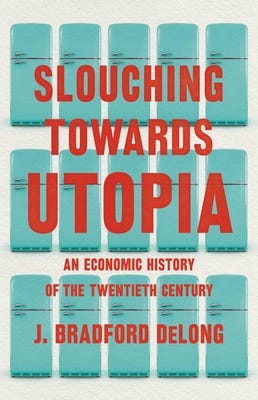
Slouching Towards Utopia: An Economic History of the Twentieth Century by Brad DeLong (and a Big Change)

 Big Announcement! (Sort of): I'm moving my blogging to Substack. This review & my review immediately preceding that--plus any occasional essays or whatever--will be posted on Substack. You can find me here. I'll keep this site open, but soon I won't post anything here. And, although I didn't necessarily intend it, everything (so far as I can tell) that I've ever posted there is now on my Substack feed. But for old-time's sake, here's my review of Brad DeLong's Slouching Towards Utopia. Enjoy here now; then subscribe at Substack. 

Slouching Towards Utopia: An Economic History of the Twentieth Century

By J. Bradford DeLong


This book provides a comprehensive narrative of a “long twentieth century” (1870-2010) that further informed my thinking about this era. An outstanding work of narrative history should work like a strong magnet among iron filings, pulling diverse pieces (facts) into a coherent pattern without distorting the given shape (reality) of those diverse pieces. And this is what DeLong has accomplished in this work. He draws together into a discernible pattern (to wit, a story) about the intersection of unprecedented economic realities (improvements, mostly) and their effect on national and international politics, and how various thinkers and political leaders responded to these new realities.


Back (well, way back) in the day when I was a political science and history major, I learned a lot about nineteenth and twentieth-century history from some fine professors and reading prominent historians writing about this era. But I realize now that economic history as a sub-discipline and political-economy as a whole were mostly overlooked. The economics of this period of extraordinary economic development and innovation was more or less taken for granted as the backdrop for the political and social history that dominated my curriculum. Until now, has there been a book that has filled this void? If so, I missed it. Columbia historian Adam Tooze has addressed several big chunks of this period quite admirably, but again, no one that I’ve read provides such an informed, comprehensive narrative of the economic and political-economic history of this era.
Another merit of this book comes from a point that DeLong makes about himself; that is, he considers himself both an economist and a historian. I assumed his merits as an economist; he’s worked in the Treasury Department and as a professor of economics at Berkley. And at the beginning of the book, there are facts and figures about economic development over the course of human history and about how economic development skyrocketed beginning about 1870 with the advent of business corporations, modern research labs, and cheaper, more efficient transportation and communication systems. But on the whole, the book is surprisingly light on figures, tables, charts, and formulas; you know, the stuff you’d expect to see from an economist. The flip side (the historian side, if you will) of this is DeLong’s narrative skill in recounting the course of events and thinking of this period. DeLong’s prose has a light touch that avoids economics jargon and avoids falling into ponderous academic prose. Indeed, DeLong’s prose includes a certain playfulness, such as his repeated touch phrase “the market giveth, the market taketh away, blessed be the name of the market.” Another instance of this light touch is his seemingly alternating designation of Hayek as both “genius” and “idiot” and as a Jekyll and Hyde. (Designations that seem spot-on from my perspective in the cheap seats. ) DeLong also frames much of his history as a yin and yang between Hayek’s market mania and Karl Polanyi’s emphasis on traditional rights and communities. And while these two deities of modern political-economic thought and their acolytes receive a lot of attention, John Maynard Keynes—the appropriate reverence seems to demand the full name—presides like Zeus or Thor over these two lesser gods. And as the high-god, Keynes seeks to impose order on the economic universe in the course of a continuing struggle against economic chaos left in the wake of the lesser gods (including old Marx). DeLong describes Keynes as brokering a marriage of the insights of Hayek and Polyani. If it’s a marriage that could be made to last, it will no doubt remain fruitful, but in these times, nothing seems stable. And, I should note that not only has DeLong confirmed by priors about Hayek (and the market in general), he has also confirmed my priors about Keynes as one of the great figures of the twentieth century. (My assessment was established after reading Zachery Carter’s work on Keynes, The Price of Peace: Money, Democracy, and the Life of John Maynard Keynes (2020).)

I want to also note that I’m impressed with DeLong the historian. Not only does he write an engaging and informed narrative, but he also displays insights into the nature of the historical enterprise. For instance, toward the end of the book, while discussing the Great Recession of 2008, he compares his take with that of Adam Tooze in Tooze’s book, Crashed: How a Decade of Financial Crises Changed the World (2018). DeLong considers how events in that era (as an example) balance between contingency and necessity; choice and structure. Tooze is more a proponent of structure and necessity; DeLong of contingency and choice. DeLong, however, concedes that future historians may come down closer to Team Structure-Necessity. Perhaps, but then we always wonder, don’t we: what if the Archduke had not been assassinated?

I could go on further at great length about the contents of this book, perhaps in a later essay. But I might find such an exercise futile and genuinely counter-productive. I can’t write as authoritatively or with as much felicity as DeLong about these events. Ergo, you should go immediately to his book and read it. I’m confident that you’ll find it well worth your time and enjoyably spent.


Sunday, July 25, 2021

The Importance of Semantics: Fees with a Dividend--Not a Tax


Dumping carbon into the atmosphere we all share

We need to appreciate the importance of semantics when we discuss the economics of carbon pricing. For example, we pay for municipal services and amenities such as garbage, water, sewer, and electricity. We recognize that our payments for these products and services are fees, not taxes. We pay fees for the specific goods and services that we receive, whether from the government or from business. Taxes, not the other hand, are compulsory payments to fund the operations of government at all levels. Taxes aren't based on the provision of particular goods and services to individuals and families. Taxes fund the common defense, schools, roads and bridges, research, social security, and other government programs. (Some public goods operate on a mix of user fees and taxes, such as national parks and mass transit.)

A "carbon fee" (or a "price on carbon") combined with a dividend, such as envisioned by the Energy Innovation and Carbon Dividend Act, is not a tax. In fact, it's hard to know what exactly to call it. The fees collected will be returned to the American people by way of regularly scheduled dividend payments. The revenue collected won't be used to fund government operations. There's not currently any government program quite like this that I can think of. 

Thus, a carbon fee functions like a sewer or garbage fee, except that it will be charged directly to producers, such as fossil fuel companies that extract and sell products that produce carbon emissions. At present, after we burn fossil fuels we effectively dump the remaining carbon into the atmosphere, where the excess carbon creates the familiar "greenhouse effect." In short, industrialized economies have treated the atmosphere as a garbage (carbon) dump for a couple of hundred years. But now the dump is full. A carbon fee puts a price on the use of our atmosphere as a carbon dump, and that fee will discourage use. Consumers of fossil-fueled products will see increased costs passed on to us, and we consumers will be able to compare the prices of products and services produced with more or less carbon pollution. Of course, consumers can use the carbon dividend to offset increased costs. But we can expect that most of us who have to watch our budgets will begin to look for less expensive (i.e., less carbon-intensive) alternatives. In fact, the dividends will prove a net gain for low and middle-income families. 

We should be conscious of this distinction when discussing any monetary implications associated with the production and use of carbon. The mention of a carbon tax is not only inaccurate; it also closes doors quickly and distracts many from any understanding of the benefits of a carbon fee. Thus, those who don't want to see a reduction of carbon pollution will refer to any price as a "tax" to try to trigger a reflexive, negative response. So if someone tries to talk to me about a "carbon tax," I readily agree that a carbon tax is a bad idea. But then I quickly pivot to say that a fee for carbon dumping with funds collected returned to Americans as a dividend is a great idea that we should all support and adopt immediately. 

Please join us (Citizens Climate Lobby) in promoting this fair and efficient approach to reducing our carbon dumping. Let's act to clean up our acts. 

Thursday, November 5, 2020

Thoughts of the Day: Thursday 5 November 2020


There is an interesting parallel here with the science of economics as developed by Adam Smith, Ricardo and Malthus, which seemed to demonstrate with rigorous logic that the ‘laws of production’ doom our civilisation to final ruin. At this juncture, John Stuart Mill pointed out (in Principles of Political Economy) that although we cannot evade the rigid laws of production—which lead to overpopulation and the ‘rat race’—there is no law of distribution: we can do what we like with the wealth, once it has been created, and use it to build a less self-destructive society.


Enthusiasm is very contagious, and one filled with the right quality, kind and degree of it unconsciously communicates his interest, earnestness and expectations to others.

For example, metaphysicians have been heard to say ‘the world is both one and many’; and critics have not been wanting who were stupid enough to accuse them of contradicting themselves, on the abstractly logical ground that ‘the world is one’ and ‘the world is many’ are mutually contradictory propositions. A great deal of the popular dislike of metaphysics is based on grounds of this sort, and is ultimately due to critics who, as we say, did not know what the men they criticized were talking about; that is, did not know what questions their talk was intended to answer; but, with the ordinary malevolence of the idle against the industrious, the ignorant against the learned, the fool against the wise man, wished to have it believed that they were talking nonsense.

It is hardly necessary to stress the fact that the ability to love as an act of giving depends on the character development of the person. It presupposes the attainment of a predominantly productive orientation; in this orientation, the person has overcome dependency, narcissistic omnipotence, the wish to exploit others, or to hoard, and has acquired faith in his own human powers, courage to rely on his powers in the attainment of his goals. To the degree that these qualities are lacking, he is afraid of giving himself—hence of loving.

Wednesday, March 21, 2018

Economyths by David Orrell

When I first took a course in Economics in college as a sophomore, 6E:1 “Introduction to Microeconomics,” I was quite taken with the subject. Unlike my major subjects, history and political science, it was so neat, so tidy. You could plot supply and demand curves and arrive at a price. Of course, there were monopolies and externalities and the like, but those were flies in the ointment of economic rationality. Of course, macro got messier, and by the time I took my third course, Public Finance, I lost my infatuation with the subject. All of what at first seemed so neat and clean now appeared rather messy, not at all tidy. (And I didn’t get as good a grade). As it turns out, the neat and tidy represented a degree of unreality while the messy and frustrating was much closer to reality.

I’ve known and thought for some time that economics, once hailed as the king of the social sciences, was an emperor with no clothes. Okay, that’s unfair, but I will say that it is arrayed in tattered rags rather than regal robes. Over the years, my innate, naïve disenchantment with economics has been articulated by persons more qualified than me to articulate and identify the problems. The “Nobel” prize for economics has implicitly recognized flaws in the discipline by presenting its awards of late to a political scientist (Elinor Ostrom), a psychologist (Daniel Kahneman), and to two behavioral economists, Robert Schiller and Richard Thaler, among other less mainstream, math-oriented recipients.

Thus, with some background in the flaws of economics, and appreciating its importance, I read David Orrell’s Economyths: How the Science of Complex Systems is Transforming Economic Thought (2010). Like many of the most trenchant critics of the economics discipline, Orrell didn't train as an economist. He is a Ph.D. mathematician. Orrell argues that economics is (still) primarily built on an outdated conception based on 19th-century physics and its equilibrium-based mathematics.  Economics became the royalty of the social sciences because of its mathematical models, which often worked well—but not very well if you’re in a pinch. And in fact, we’re almost always in a pinch.

Reviewing the field from a variety of perspectives (equity, happiness, gender, stability, etc.), Orrell finds that the prevailing models of economics don’t mesh well with economic realities. Of course, writing in 2010, he needn’t direct his reader any further back than the crash of 2008 to find an enormous and consequential gap between the prevailing theories of economics and the reality that we all faced. Put simply; economic models depend upon rationality and equilibrium (and therefore) a stability that does not—cannot—exist. Human societies, human economies, especially those in the contemporary world, are dynamic and fluctuating and varied in ways that no simple math of equilibrium or postulates of (presumed) human rationality can capture. Of course, everything is fine on a sunny day, but the theories failed when the storms hit. We now have models for complex systems that can deal more realistically with all of the inherent turbulence of a vast economic system, although not at all perfectly when it comes to prediction. (We need to adjust our understanding and expectations.) We need to deploy these models.

Orrell writes quite well. And while quite sophisticated in his mathematical ability, even a math simpleton like me could follow him. He doesn’t overwhelm us with complexity and math. He writes in a manner that any interested layperson can follow. Orrell’s project follows a path laid down by Eric Beinhocker in The Origin of Wealth (2005) (which Orrell cites and that I’m now going to complete). And Orrell's perspective is also well-represented by writings found at the Evonomics: The Next Evolution of Economics Blog, directed by David Sloan Wilson, a biologist turned economics student. These fellows, among many others, from outside of the formal economics community, are pointing the way to a more sophisticated understanding of economics, one that recognizes the contexts of ecology, sociology, and politics in which the economy is embedded.


By the way, I came to know of Orrell through an essay that he published in Aeon entitled “Economics is Quantum,” which I found quite instructive. He has a book along the same lines coming out early this fall. The article is an excellent place to start if you just want to dip your toe into his project.

Monday, August 3, 2015

A Toast to Capitalism--And Now Junk It


David Brooks: defender of capitalism & yet conservative

I want to take up David Brooks’s challenge set forth in his column “Two Cheers for Capitalism”. But let me first state my opening position:

Capitalism is the best form of economic system—ever. And it needs to be replaced. Starting now.

Brooks argues in defense of capitalism that its better than socialism. He doesn’t use the word “socialism”, but it’s implied when he writes “government planners are not smart enough to plan complex systems”. True but trivial. Centralized planning as an alternative to markets lost long ago. No serious commentator wants to restore central planning.

Brooks ignores the extent that business and government are  intertwined in early 21st century consumer capitalism. We delude ourselves in believing that mainstream economics, which provides the intellectual infrastructure for capitalism, could ever escape political economics. An economy is always nested within political and cultural systems. The most important intertwining of politics and government in the U.S. today has to do with regulatory capture, not regulatory restraint. Big government today is controlled by Big Money. Big Money includes individuals (yes, think Koch) and aggregates (trade organizations, corporations, etc.). Adam Smith, the intellectual godfather of capitalism, pegged it when he observed that when two or more merchants meet, the conversation would inevitably turn to restraint of trade. We could add "politicians" to any merchant or private interest, and we'd get the same effect. This happens--often--and we ordinary folks suffer for it. (For an enlightening—and frightening—discussion of regulatory capture and flaws in economic thinking, read Dr. Robert H. Lustig’s Fat Chance: Beating the Odds Against Suger, Processed Food, Obesity and Disease (2012) (review forthcoming)).

Brooks is correct that capitalism has lifted more people out of poverty than any time in history. As one currently living in China, I see proof everywhere of the power of consumer, market capitalism (for good and ill). But will it last?

Here I come to my greatest critique of contemporary capitalism: can this ride last? I do not (now) fear the backlash of resentment that growing inequality can spawn. Only a little of this has occurred yet. Humans are not the biggest challenge to the system, although this could change quickly. Rather, Mother Nature is the ultimate judge of capitalism.

I know that you’re thinking, “Yea, yea, and you forget the Ehrlich-Simon bet and how Ehrlich lost it—big time.” No, I don’t. Ehrlich lost within the time frame set for the debate, but Mother Nature doesn't recognize such puny time frames.

Every economic system extracts energy from the environment and returns entropic waste. Contemporary capitalism and its civilization do this more effectively than any other civilization. According to Dr. Joseph Trainer, Dr. Thomas Homer-Dixon, Dr. Jared Diamond, and Dr. William (Patrick) Ophuls, among others, no civilization has escaped the limits of the environment and entropy. It’s a social and environmental-economic challenge that capitalism has met better than any other system by using industrialization, rationalization, and technology. But no system—not even contemporary capitalism—can negate these limits. We’ve known about these limits in the form of global warming from dumping waste into our environment for over 20 years, but we've attempted to ignore it. Even the Pope, head of an organization not known for its embrace of cutting-edge science, has recognized the problem. (Pope Francis and his predecessors have long-recognized the corrosive social costs of capitalism.)

John Stuart Mill wrote about the need for a steady-state economy in the mid-19th century, well ahead of his time. We need to address these issues now. Endless acquisition and endless growth don’t square with the limits placed upon us by the natural world—the world of our atmosphere, our oceans, our lands, and our societies.

The hope I have is not for a revolution (or  rather only one seen only in the rearview mirror in slow motion). Nor am I a Luddite. Rather, we need to improve our lives by using what we have, consolidating our gains, and re-thinking some of our fundamental beliefs. This will be an immense challenge, but it’s a project that conservatives, like David Brooks (to the extent he’s really a conservative), should embrace. Not the factory, but the garden should serve as our guiding metaphor: we prune and graft and cultivate with the seasons, we don’t lay waste and move on. This is how capitalism must become something new. If grafted and cultivated along with democracy—real democracy—it could become something of lasting value. 

Wednesday, June 3, 2015

The Future Ain’t What It Used to Be

The Master: John Maynard Keynes

Niall Ferguson, a Scot @ Harvard
Robert "Baron" Skidelsky


A short while ago I wrote about Jeff Sachs’s criticisms of Paul Krugman on fiscal stimulus. Since then, in an intellectual volley worthy of a Wimbledon final (all Brit, no less) pits Niall Ferguson on behalf of Cameron-Osborne austerity against Robert Skidelsky representing proponents of Keynesian stimulus. The two have squired off at in order: Ferguson 1, Skidelsky May 19, Ferguson May 19, Skidelsky May 28,  Ferguson June 1 ). As I set forth in my Sachs-Krugman post, I’m more persuaded by the Keynesian position. Following Ferguson, I agree that Keynes indeed was an austerian when austerity was appropriate (around the wars). But a Keynes quote cited by Ferguson—hoping to hoist Keynes biographer Skidelsky on his own petard—captured my attention. Ferguson writes, quoting Keynes: 

Responding to some early critics of his General Theory, Keynes showed that he recognized the importance of uncertainty in economic life, and consequently the difficulty of making predictions. “The whole object of the accumulation of wealth,” he wrote, “is to produce results, or potential results, at a comparatively distant, and sometimes at an indefinitely distant, date.” 


But, Keynes continued, “our knowledge of the future is fluctuating, vague, and uncertain.” There are simply too many things – from the “prospect of a European war” to the “price of copper and the interest rate 20 years hence” – about which “there is no scientific basis on which to form any calculable probability whatever.” 


Ferguson doesn’t mention it, but Keynes wrote about probability and uncertainty in his A Treatise on Probability. Keynes was a complex and deep thinker, perhaps muddled? Did he contradict himself by writing the above about uncertainty while (at times) recommending active government intervention in the economy by way of fiscal stimulus? I think not. And this brings us to the crux of my concern. 

While Keynes at times recommended stimulus and at other times austerity, there is no reason to believe that his appreciation of the uncertainty about the future and the consequences of any current course of action upon the future changed with his policy recommendations. Yet even in the face of acknowledged uncertainty, he acted. He chose (or recommended) courses actions that he believed would most likely bring about a desired result. Was he certain of either cause or effect? No, but as any decision-maker, he was confronted with choices to spend or not to spend, to provide only one example. He or any policymaker could, of course, chose to do nothing, but barring ignorance or negligent indifference, that too is a choice. So with any economic decision. We don’t very often have the luxury of knowing for certain that our choices will bring about the results that we intend. That’s been the downfall of many an economic prediction. Thus, when we make economic decisions, we have (but do not necessarily know) a range of probabilities that our choice will bring about a desired effect, much like a weather forecast (“a 50% chance of rain today”). If we cut the price of our widgets, we’ll probably sell more. Probably. If we invest in Acme Corporation, we may make money, or we may find out that the market for widgets has collapsed, and with it our investment. Only rarely can we act with a sense of certainty, especially in a complex system like the economy.

I think that wise decision-makers put faith—and money—on the soundness of the decision-making process and not on theories about results. Repeated experience is the best guide, but it’s often only available by analogy. History can provide many lessons, but it’s easy to apply the wrong lesson to a problem. And history never—exactly—repeats itself. (“History does not repeat itself, but it does rhyme”—attributed to Mark Twain.) We judge by analogies. Humans, societies, governments, and economies: all are complex organisms that defy consistent mechanical interpretation and manipulation. Human culture mutates too quickly to pin too much certainty on a mechanical prediction of action. We can gain some insight into behavior demonstrated by large numbers, but even that method is subject to change. 

So when Ferguson says to Skidelsky and Krugman that you can’t prove  that the British economy would have performed better with a fiscal stimulus instead of austerity, he’s correct in a limited but inconsequential sense. Ferguson is talking about an alternate course of history, a counter-factual, as Ferguson has used and practiced the concept. (See his Virtual History, a book of counter-factual essays that he edited and contributed to.) The only path we know with (some) certainty is the path taken—and even then the contours of that path are hard to discern, as the Ferguson-Skidelsky war of stats shows. 

The NYT recently published a feature on Paul Ehrlich’s The Population Bomb that predicted social and economic collapse with rising population within a decade or so of its publication. It didn’t happen. Ehrlich was wrong—but how wrong? Is Ehrlich wrong because there are no limits to the carrying capacity of Earth to support any human population? I don’t suspect many knowledgeable people will support this conclusion. If so, at some point, over-population could trigger a catastrophic decline in human well-being. (If you don’t believe that an over-stressed environment could lead to civilizational collapse, then you should brush up on your Diamond (here under Social Science and here via Stephen Walt), Tainter, Homer-Dixon (here and here), Ophuls, Mark Buchanan,  and Ferguson*, for starters.) We can conclude that Ehrlich’s initial predictions were inaccurate, but we can’t conclude that his basic premise (limits to human population) is unfounded. 

This leads us to territory explored by Nassim N. Taleb, who has argued along lines I believe appropriate. Because we don’t know the magnitude or probability of some risks, we should not take the risks. That is to say, we are in a territory marked by uncertainty, no probability. We should not run some experiments where, if the experiment turns out badly, N=1 because we are no longer able to repeat the experiment. For instance, how much do we want to experiment with nuclear war? How many times could humanity run a nuclear war experiment?  Taleb argues that genetically modified foods and human-caused global warming should be addressed with the acknowledgement that we don’t know with any real certainty the potential consequences or the likelihood of a catastrophic (or slow motion) event. Without referring to it directly, Taleb seems to follow a negligence theory that judges behavior by the magnitude of the risk of harm (perhaps measurable, probably not) times the likelihood of the occurrence of the risk (perhaps measurable, probably not) to decide whether a particular course of action should be undertaken. (Taleb would add “skin the game” as well: consequences if the wrong choice is made. But in some of our examples, we’d all suffer the consequences.) The difference of course from a court of law (one of many) is that this formula can be applied to judge what action to take (or not) prospectively to avoid loss instead of using it to apportion loss retroactively. (I’ve written more on this general topic in this earlier blog post, “Thinking Like a Lawyer and Antifragility”.)

In both economics and population predictions, the other wild card variable is human action, which is responsive and strategic. Did Paul Ehrlich’s cry of wolf affect the wolf and not just the villagers? (And this assumes that population is not a problem; based on personal observation from living almost three years in India and China, I’m not willing to concede that population density doesn’t remain a crucial challenge.) Does the possibility of stimulus or austerity change the calculations of innumerable economic decisions? Certainly, and you can observe that most easily in markets. But what you see may surprise you and upset your expectations, for instance, some—like Ferguson—have not seen the high interest rates and inflation that they predicted with lose monetary policy from the Fed and a bit of fiscal stimulus. Even the common benchmarks can fail. Krugman, on the other hand, has called it right on the inflation issue.

So what are we left with? Educated guesses, uncertainty, caution, and a need for resilience when things don’t turn out as we hoped. The public dialogue can at its peril ignore risks and probabilities, but we do so to our detriment. We should specify our judgments about likelihoods of benefits and harms and our standards of proof. Voters, unlike jurors, get a second bite at the apple, and we should keep a track record of those who seek to guide and lead the public. And decision-makers and those who advise them would do well to become more sophisticated in this perspective. Our future depends upon it.

*This article by Ferguson displays a lot about Ferguson. The first part draws upon a deep ground of historical knowledge and sheds light on  the phenomena of collapse by applying current thinking about complexity. Thus, as Ferguson argues, “declines” are less dangerous than precipitous “falls”. In a complex system, including financial systems, a system can collapse very quickly, or as Ferguson’s felicitous prose describes it, there can be a “sudden shift from a good equilibrium to a bad mess”. Financial collapses and regime changes, such as the French Revolution, Ming China, the fall of the Hapsburg and Ottoman Empires, and the disintegration of the Soviet Union, happened quickly and to widespread surprise. Although Ferguson doesn’t make the point, such examples should provide some measure of humility in making predictions. However, he goes on to suggest that the Obama Administration and the Fed in spending and printing money might trigger a financial collapse (this was published in 2010). His forecast is vague but ominous. Once again, Ferguson the historian gets sidetracked by Ferguson the political hack. But I must say overall, the article is well argued and perceptive when it sticks to history and avoids forecasting.