Showing posts with label history books. Show all posts

Wednesday, September 14, 2022

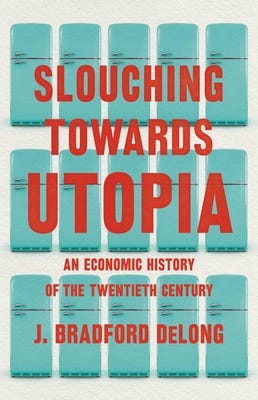
Slouching Towards Utopia: An Economic History of the Twentieth Century by Brad DeLong (and a Big Change)

 Big Announcement! (Sort of): I'm moving my blogging to Substack. This review & my review immediately preceding that--plus any occasional essays or whatever--will be posted on Substack. You can find me here. I'll keep this site open, but soon I won't post anything here. And, although I didn't necessarily intend it, everything (so far as I can tell) that I've ever posted there is now on my Substack feed. But for old-time's sake, here's my review of Brad DeLong's Slouching Towards Utopia. Enjoy here now; then subscribe at Substack. 

Slouching Towards Utopia: An Economic History of the Twentieth Century

By J. Bradford DeLong


This book provides a comprehensive narrative of a “long twentieth century” (1870-2010) that further informed my thinking about this era. An outstanding work of narrative history should work like a strong magnet among iron filings, pulling diverse pieces (facts) into a coherent pattern without distorting the given shape (reality) of those diverse pieces. And this is what DeLong has accomplished in this work. He draws together into a discernible pattern (to wit, a story) about the intersection of unprecedented economic realities (improvements, mostly) and their effect on national and international politics, and how various thinkers and political leaders responded to these new realities.


Back (well, way back) in the day when I was a political science and history major, I learned a lot about nineteenth and twentieth-century history from some fine professors and reading prominent historians writing about this era. But I realize now that economic history as a sub-discipline and political-economy as a whole were mostly overlooked. The economics of this period of extraordinary economic development and innovation was more or less taken for granted as the backdrop for the political and social history that dominated my curriculum. Until now, has there been a book that has filled this void? If so, I missed it. Columbia historian Adam Tooze has addressed several big chunks of this period quite admirably, but again, no one that I’ve read provides such an informed, comprehensive narrative of the economic and political-economic history of this era.
Another merit of this book comes from a point that DeLong makes about himself; that is, he considers himself both an economist and a historian. I assumed his merits as an economist; he’s worked in the Treasury Department and as a professor of economics at Berkley. And at the beginning of the book, there are facts and figures about economic development over the course of human history and about how economic development skyrocketed beginning about 1870 with the advent of business corporations, modern research labs, and cheaper, more efficient transportation and communication systems. But on the whole, the book is surprisingly light on figures, tables, charts, and formulas; you know, the stuff you’d expect to see from an economist. The flip side (the historian side, if you will) of this is DeLong’s narrative skill in recounting the course of events and thinking of this period. DeLong’s prose has a light touch that avoids economics jargon and avoids falling into ponderous academic prose. Indeed, DeLong’s prose includes a certain playfulness, such as his repeated touch phrase “the market giveth, the market taketh away, blessed be the name of the market.” Another instance of this light touch is his seemingly alternating designation of Hayek as both “genius” and “idiot” and as a Jekyll and Hyde. (Designations that seem spot-on from my perspective in the cheap seats. ) DeLong also frames much of his history as a yin and yang between Hayek’s market mania and Karl Polanyi’s emphasis on traditional rights and communities. And while these two deities of modern political-economic thought and their acolytes receive a lot of attention, John Maynard Keynes—the appropriate reverence seems to demand the full name—presides like Zeus or Thor over these two lesser gods. And as the high-god, Keynes seeks to impose order on the economic universe in the course of a continuing struggle against economic chaos left in the wake of the lesser gods (including old Marx). DeLong describes Keynes as brokering a marriage of the insights of Hayek and Polyani. If it’s a marriage that could be made to last, it will no doubt remain fruitful, but in these times, nothing seems stable. And, I should note that not only has DeLong confirmed by priors about Hayek (and the market in general), he has also confirmed my priors about Keynes as one of the great figures of the twentieth century. (My assessment was established after reading Zachery Carter’s work on Keynes, The Price of Peace: Money, Democracy, and the Life of John Maynard Keynes (2020).)

I want to also note that I’m impressed with DeLong the historian. Not only does he write an engaging and informed narrative, but he also displays insights into the nature of the historical enterprise. For instance, toward the end of the book, while discussing the Great Recession of 2008, he compares his take with that of Adam Tooze in Tooze’s book, Crashed: How a Decade of Financial Crises Changed the World (2018). DeLong considers how events in that era (as an example) balance between contingency and necessity; choice and structure. Tooze is more a proponent of structure and necessity; DeLong of contingency and choice. DeLong, however, concedes that future historians may come down closer to Team Structure-Necessity. Perhaps, but then we always wonder, don’t we: what if the Archduke had not been assassinated?

I could go on further at great length about the contents of this book, perhaps in a later essay. But I might find such an exercise futile and genuinely counter-productive. I can’t write as authoritatively or with as much felicity as DeLong about these events. Ergo, you should go immediately to his book and read it. I’m confident that you’ll find it well worth your time and enjoyably spent.


Thursday, October 6, 2016

Thinking the Twentieth Century by Tony Judt with Timothy Snyder

Listening in to a great conversation
A study of the history of opinion is a necessary preliminary to the emancipation of the mind. 
John Maynard Keynes (opening epigraph)


Reading Thinking the Twentieth Century by Tony Judt with Timothy Snyder (2012) was like eavesdropping on a fascinating conversation between two very erudite gentlemen who happen to be discussing a topic in which you hold a keen interest. But this unusual book—as an extended conversation—arose from an unusual and sad course of events. Tony Judt was a historian who had risen to prominence based on his longer works and on widely admired (and sometimes criticized) pieces in prestigious publications such as The New York Review of Books. In 2005, he published his acclaimed Postwar:  A History of Europe Since 1945. But then in 2008, Judt was diagnosed with amyotrophic lateral sclerosis (ALS), also known as Lou Gehrig's Disease. The diagnosis is a slow motion death warrant. Yet Judt worked until his death in August 2010. After learning of his diagnosis, instead of writing a large, intended study, he decided to use recorded conversations with Snyder, a fellow historian, as the vehicle for sharing his insights. In fact, the unusual format of an extended conversation works quite well, serving to add a feel of intimacy to the work that it would not have enjoyed if it Judt had written it in the usual manner. Of course, this wouldn’t have worked were it not for Judt’s erudition and facility with words, nor would it have worked without the matching knowledge and insight of Snyder. Both men are professional historians, and both shared an interest in 20th-century European history, history as a discipline, and the application of historical knowledge and insight to current affairs. And perhaps of greatest significance, they both exhibit a profound ethical commitment.

The Berlinian [Isaiah Berlin] lesson most pertinent to daily political analysis and debate is the reminder that all political choices entail real and unavoidable costs. The issue is not whether or not there is a right or wrong decision to be taken, nor even whether you face a choice such as the "right" decision consists in avoiding the worst mistakes. Any decision–including any right decision–entails forgoing certain options: depriving yourself of the power to do certain things, some of which might well have been worth doing. In short, there are choices that we are right to make but which implicitly invoke rejecting other choices whose virtues it would be a mistake to deny. In the real world of politics, as in most other arenas of life, all worthwhile decisions entail genuine gains and losses. (196)

The conversation contained in each chapter begins with a consideration of Judt’s personal and professional history. Following E.H. Carr’s dicta, “Before you study the history, study the historian” and “and before you study the historian, study his background and environment”—dicta that John Lukacs considers a “half-truth”, but which must suffice at present—Snyder has Judt recount his background as the son of Eastern European Jewish immigrants to London growing up in the 1950s (Judt was born in 1948). From there, the story continues to Cambridge, Israel, Paris, Berkeley, and eventually to New York City. Each portion of Judt’s biography serves as a springboard for a discussion of topics in 20th-century history (centered on Europe and the U.S.). For instance, early on, especially relevant in light of Judt’s Eastern European Jewish heritage, the discussion turns to the role of Judaism and anti-Semitism in European culture. The discussion is enlightening, for one can’t understand 20th-century history and political thought without grasping the importance of “the Jewish question." (I learned this as an undergraduate in modern history and contemporary political science. I hailed from a small town in Iowa where there was only one Jew—that I knew of—in the town, and his living there was no big deal.  The better side of growing up in such a sheltered environment was that most ethnic and racial prejudices, while existent, were of little importance because, except for seasonal migrant workers (“Mexicans”), there were no racial or ethnic minorities (unless you count the single Jewish merchant in town). And I have my parents to thank for discouraging such nonsense if it did come up. But when it came to understanding the place of Jews and anti-Semitism in the modern world, I was at a bit of a not unwelcome disadvantage.)

Some samples: 

It is perhaps worth reminding ourselves that this [the Reagan-Thatcher view that the right to make any amount of money unhindered by the state is part of an unbroken continuim with the right of free speech] is not what Adam Smith thought. And it is certainly not the view of most neoclassical economic economists either. It would simply never have occurred to them to suppose a necessary and permanent relationship between the forms of economic life and all other aspects of human existence. They treated economics as benefiting from internal laws as well as the logic of human self interest; but the notion that economics alone could supply the purposes of human existence on earth would have struck them as peculiarly thin gruel. (247)

It's terribly important for an open society to be familiar with its past. It was a common feature of the closed societies of the 20th century, whether of the Left or the Right, that they manipulated history. Reading the past is the oldest form of knowledge control: if you have power over the interpretation of what went before (or simply lie about it), the present and the future are at your disposal. So it is a simple democratic prudence to ensure that the citizenry are historically informed. (265)

By the beginning of Chapter 6, my pencil came out. I’d read the beginning of the book with pleasure and profit, but in Chapter 6, I started marking comments that I found especially revealing or with which I agreed, celebrating the identification of kindred thinkers. (I’ve spread some of these quotes throughout my review and at the end.) Judt and Snyder not only talk about events, beliefs, and actors in the twentieth century, but they also remark upon how those events and beliefs are manifest in our world today. They also provide some insightful comments on the history profession, journalism, the relation of memory to history, and the teaching of history that I found exceptionally well-considered. (And—again—they were making these observations via a conversation, not via a carefully crafted essay.) By the end of the book, I’d marked the book with more red pencil marks than I imagined I had available.

Nature doesn't mind paths [ways of understanding historical events], but nature abhors a vacuum. We have taken remembering events in a vacuum. Accordingly, we invoke them in isolation: "never again," Munich, Hitler, Stalin and so forth. But how can anyone make sense of such invocations and labels? In American and European high schools today, it is not uncommon for students to graduate having just taken one course in World coupled History: typically this will be either the Holocaust, World War II, totalitarianism or some comparably excerpted were from mid-20th- century Europe. However well taught, however sensitively sourced and discussed, such a course emerges from nowhere and, inevitably, leads nowhere. What possible pedagogical purpose can it serve? (273)

For anyone interested in the history of Europe and America, especially from the perspective of incisive commentary on social and political thought, this will prove an exhilarating read. As a lifelong student of history and as a firm believer in the value of history as a way of knowing and understanding the world, one could not ask for a more worthwhile example of the practice and culture of historical thinking and how it applies to our world. At a time when U.S. democracy and values are threatened by demagoguery unparalleled in my memory, taking (silent) part in the conversation of these two extraordinary historians reminds me that there are those out there who are shining their lights into the darkness. I’m with them. (Keep reading below--the best parts of this post!)

The Churchillian dictum that democracy is the worst possible system except for all the others has some – but limited – truth. Democracy has been the best short-term defense against undemocratic alternatives, but it is not a defense against its own genetic shortcomings. The Greeks knew that democracy was not likely to fall to the charms of totalitarianism, or authoritarianism or oligarchy; it's much more likely to fall to a corrupted version of itself.
 . . . . Democracies corrode quite fast; they corrode linguistically, or rhetorically, if you like – that's the Orwellian point about language. They corrode because most people don't care very much about them. . . . Democracy is neither a necessary nor a sufficient condition for a good, open society. I don't want to come across as excessively skeptical about democracy: as someone having a preference for the aristocratic, liberal societies of the 19th century. But I do want to make a (Isaiah) Berlinian point. We seem to have simply have to acknowledge that some earlier nondemocratic societies were in certain respects better the late democracies. (306;308)

I profoundly believe in the difference between history and memory; to allow memory to put replace history is dangerous. Where as history of necessity takes the form of a record, endlessly rewritten and re-tested against old and new evidence, memory is keyed to public, non-scholarly purposes: a theme park, a memorial, a museum, a building, a television program, an event, a day, flag. Such pneumonic manifestations of the past are of necessity partial, brief, selective; those who arrange them are constrained sooner or later to tell partial truths or even outright lies – sometimes with the best of intentions, sometimes not. In either event, they cannot substitute for history. (278) 
Remember that in Europe above all, those who have been most successful in mobilizing such fears--fears of strangers, of immigrants, of economic uncertainty or violence–are primarily the conventional, old-fashioned demagogic, nationalist, xenophobic politicians. The structure of American public life makes it harder for people like that to get a purchase on the government as a whole, one of the ways in which the US has been uniquely fortunate. But the contemporary Republican Party has begun to mobilize just these fears in recent times and may well ride them to power.(386) 

This last quote, remember, was written before the rise of Trump and Trumpism.


Sunday, January 18, 2015

“Selma”, the Movies & History: Victories & Casualties


MLK facing a police mob at Edmund Pettis Bridge

C & I saw Selma last night, and it was a fine film in many ways. It celebrates a break-through in the quest for civil rights for all Americans. It celebrates the battles and sacrifices that success required in the face of the deep racism of Alabama and across the Deep South. (Attention to those problems in the North would come later.) David Oyelowo's portrayal of Rev. Dr. Martin Luther King, Jr., the hero of the film and true hero in American history, was very well performed.(I haven’t most of the other best actor nominees this year, but it is hard to see how he could have missed out. The Golden Globes were certainly right to nominate him.) Playing a historical character of such charisma as Dr. King presents a terrific challenge, and he met that challenge very well. Tom Wilkinson portrayed President Lyndon Johnson, which, on a trivial note, raises the question of why two Brits play the must play the roles of these two seminal American figures. (This is an ongoing phenomenon. Wilkinson has portrayed Ben Franklin and former Secretary of State James Baker, while Daniel Day Lewis portrays Lincoln. Meryl Streep as Margaret Thatcher hardly seems even the balance of trade.) Wilkinson’s acting captured LBJ only moderately well, but the portrayal of LBJ’s larger-than-life persona was the least of the problems. The greatest problem with the film is betrayal of truth in history. 

I almost didn’t write this blog because Maureen Dowd in the New York Times, David Kaiser in Time, and Elizabeth Drew in the New York Review of Books have all written appropriate criticisms of the misrepresentation of LBJ’s role in these events. I was first alerted to the problem by this NYT article. I recommend all of these for your consideration. LBJ worked with King and the civil rights movement. These two leaders weren’t pals—each wary of the other (and eventually a deep rift developed over King’s criticism of the war in Vietnam). But in this cause, they were very much on the same team, working from different perspectives, but the contribution of each was crucial. LBJ was not an obstacle, but a player. And as the film portrays—and as any sense of reality dictates—differences of opinions and clashes of personalities and organizations (such as SCLC and SNCC) are inevitable and provide their own drama within the movement. Some defend the decision to portray LBJ as an impediment with the claim that a dramatic foil was needed, but the demagogue George Wallace and Alabama racists provided more than enough in the way of genuine bad guys to create the appropriate dramatic conflict. This libel (or would a film be a slander?) of LBJ is unnecessary and disheartening. LBJ is a figure of enormous complication and titanic flaws, but we don’t need to enhance his flaws nor pass over his great accomplishments in civil rights. In addition to making him an obstacle of civil rights, the film suggests that Johnson approved the use of Hoover’s salacious material about King. False. This material—an audio tape—was delivered to SCLC in December 1964 without Johnson’s knowledge or approval. Johnson, like Kennedy before him and Nixon after him, feared J. Edgar Hoover. The extent that Hoover exercised such a free hand was based on the fear these presidents felt about the material Hoover might have on them or their associates with which he could harm them.

Does this distortion of history (the truth) matter? Isn’t this just Hollywood? Yes, it does matter. And yes, Hollywood distorts history on a regular and continuing basis. But here, as in many cases before, to distort history not only does a disservice to unwary viewers (most viewers), it diminishes the film by suggesting that the film has an agenda. In this instance, the film, seems a reaction to Mississippi Burning and others like it that over emphasized white leadership in civil rights. In that light, this film seeks to portray the black actors as paramount and the whites as resistant, from those whites passive like LBJ to those aggressive like Wallace and the Alabama racists. To the extent that the distortion of Johnson’s role diminishes the film—and it does—it diminishes our appreciation of this crucial time and great accomplishment in American history. Hollywood does teach (oh, heaven help us!), and when a film of this gravity and significance fails in this regard—even partially, as the film gets a lot right—it rends the garment of our shared history and national life. No film, no book, can capture reality totally and with complete accuracy. But in the this film, the deviation is all the more disheartening because of the importance of the story told and the available historical record. 
 
The Politician & the Prophet celebrate a collaboration that resulted in the signing of the Voting Rights Act into law on August 6, 1965.


Will filmmakers learn? Not as long as the money keeps rolling in. In reading about Selma, I came upon discussions of another Oscar nominee, The Imitation Game, the biopic about the British genius and gay man, Alan Turing. As this NYRB article demonstrates, Hollywood (which really messes with reality in biopics) couldn’t tell the fascinating true story of this hero, either. This review, by Alex von Tunzelmann in The Guardian, points out that the film portrays Turing as committing treason (by failing to reveal a Soviet spy at Bletchley Park), when he most certainly did not know the man or of any such spying. As von Tunzelmann puts it: “Were the makers of The Imitation Game intending to accuse Alan Turing, one of Britain’s greatest war heroes, of cowardice and treason? Creative licence is one thing, but slandering a great man’s reputation – while buying into the nasty 1950s prejudice that gay men automatically constituted a security risk – is quite another.” Why these inventions? Apparently, screenwriters believe themselves more capable and interesting than history. 

The truth of history really is quite dramatic if you give it a try, Hollywood.

Saturday, June 1, 2013

A Review of India Summer: The Secret History of the End of an Empire by Alex Von Tunzelmann


One of the benefits of reading history is that you don’t have to be an academic historian to succeed in the field. Indeed, from Herodotus and Thucydides to Gibbon, Macaulay, Carlyle, Parkman, and Henry Adams, up through many successful and worthwhile practitioners writing today, we have a wealth of non-academic historians who enlighten and entertain us with graceful prose. (I realize one might argue about Adams, since he taught Medieval History at Harvard for a while, but I don’t believe that his major works were written while in the academy or for the academy.) Our move to India led me to discover William Dalrymple, who writes beautifully about contemporary India and the Middle East, as well as having written very highly regarded histories set in India and Afghanistan. In fact, via a piece that he wrote for the wonderful Five Books site, I discovered Alex Von Tunzelmann’s Indian Summer: The Secret History of the End of an Empire

The title might prove misleading, since the “secret”, as the author notes within her work, was not so much a secret as a little-known or little-discussed (but not completely unnoticed) situation. The “secret” was that the wife of the last British Viceroy, Lord Mountbatten, had a love affair with the first Indian Prime Minister, Jawaharlal Nehru. Of course, this love affair (the details of intimacy remain unknown) unfolded against the huge historic panorama of Independence and Partition. As Dalrymple notes in his remarks about Von Tunzelmann, in focusing on these three actors, she tells the immensely complicated story of Independence and Partition in manner that provides a sense of the immensity of the problems and undertakings without enmeshing us in details that would overwhelm most readers. In addition to focusing on the triangle formed by the Mountbattens and Nehru, she also deals deftly with other significant players such as Gandhi, Jinnah, and Patel in India, and with Churchill, Attlee, and others back in Britain. 

Von Tunzelmann does an excellent job of setting the scene for the momentous events of Independence and Partition by first establishing the biographies of the main players. Lord Mountbatten, for instance, is from a German family that married into the British aristocracy. Mountbatten, known to friends like such as two British kings and Noel Coward, as “Dickie”, appears in some ways the embodiment of an upper-class British twit. His naval career is in some ways a disaster (such as running a ship aground and having one sunk from underneath him), but it nevertheless leads him to the position of Allied Commander for Southeast Asia during WWII. While inept in some ways, and enamored of pomp, circumstance, genealogies, and medals, he’s also quite charming and persuasive. And, lest you think him a poor cuckold, his marriage to Lady Mountbatten, Edwina, is an “open marriage” from near the beginning. Both carried on rather open affairs and had a complex relationship, to say the least. Edwina, especially in her youth, couldn’t help reminding me of Princess Diana: a rather repressed young woman whose marriage to a much more sedate man seems to have released a rather marked free-spiritedness. But like Lady Di (after demotion), Edwina found a serious and very successful calling helping out in London during the Blitz and maintaining a very active, hands-on roll in India and Pakistan dealing with the human misery found here both before and after Partition. The third person of our triumvirate, Nehru, had morphed from a young, Indian-British dandy (Cambridge and all) into a national leader. He underwent an arranged marriage and never seemed very happy about it. His wife, an apparently pious woman in contrast to his militant (if publicly restrained) atheism, died relatively young, so that Nehru was a widower at the time he came to know Edwina in the mid-1940s. 

Von Tunzelmann keeps her narrative moving, weaving the personal lives of the Mountbattens and Nehru together to meet in the momentous years of 1947 and 1948 and then apart again. In addition, she keeps the big picture in focus. Her passing remarks and judgments, such as how Gandhi’s peculiarities, irrelevancies, and standing in world opinion alternately retarded and forwarded the cause of independence and Hindu-Moslem relations, leaves one wanting more, but not at all disatistfied. (Gandhi’s life and role in all of this, of course, fills volumes.) She also remarks on the irony that I noticed immediately upon coming to India: Gandhi’s likeness adorns all denominations of rupee notes. A rather ironic honor for an ascetic who thought all India should follow his austere example. 

Von Tunzelmann writes with a light but perceptive hand. She deftly manages the many facts, or where evidence lacks, caution and restraint marks her prose. She also displays a light sense of irony appropriately deployed. In this description of the Indian Assembly at the turn of midnight that marked Independence, she writes: 


            As the chimes sounded and the unexpected blast from a conch shell startled the delegates in the chamber of the Constituent Assembly, a nation that had struggled for so many years, and sacrificed so much, was freed at last from the shackles of empire.
            Yes, Britain was finally free. 


She’s not being cute or coy here: her narrative has established the draining demands of Empire upon the war-impoverished Brits such that most—except Churchill and a few other die-hards—realized and wanted desperately to unload the burden that India and Empire represented. 

If one enjoys reading a history that interweaves the personal into the grant narratives of empires, nations, and peoples, as many a great novel as done, then you can’t expect to find a more engrossing account of the extraordinary people and events portrayed here. An outstanding work. 

Interesting note: The cover photos on my copy of the book purchased here in India shows the Mountbattens standing together with Gandhi; in the U.S. editions, they are pictured on the cover with Nehru, who's laughing.