Showing posts with label Thomas Jefferson. Show all posts

Wednesday, February 2, 2022

Thoughts 2 Feb. 2022


This division of attention [between the two hemispheres of the brain] works to our advantage when we use both. However, it is a handicap – in fact, it is a catastrophe – when we use only one.

Surely we all use our brains as a whole, not just one hemisphere? Naturally, this is almost invariably the case. My point is a different one: that each hemisphere has inevitably a distinctive ‘take’ on the structure of the world, which is why we have two hemispheres at all. And each ‘take’ appears, when pondered in the abstract, strictly speaking incompatible with the other. They are each internally consistent, but mutually incompossible.

[I]n 2017, 25 years after the original warning, 15,364 scientists from 184 countries signed World Scientists’ Warning to Humanity: A Second Notice. It’s message was blunt: industrial civilization was courting catastrophe and needed a total makeover.

As [Ivan] Illich warned, industrial man has become a slave to his energy slaves, totally addicted to the industrial production of goods and services and unable to envision any other way of life.

The essential meaning of entropy for human life was well stated by Carl Jung: “Everything better is purchased at the price of something worse.”

Like so many others, I had become preoccupied with the Anthropocene, a transformation driven by capitalist economic growth that puts in question the very separation between natural and human history.

Ockham is now best known for the principle of economy in reasoning known as Ockham’s Razor. This is a misnomer for two reasons. First, he did not originate it; there is the inevitable origin in Aristotle. The phrase “We consider it a good principle to explain the phenomena by the simplest hypotheses possible” is in Ptolemy. Formulations like “It is vain to do with more what can be done with fewer” and “A plurality is not to be posited without necessity” are Scholastic commonplaces from the early thirteenth century. Second, though he does repeat these ideas frequently, Ockham’s own contribution is more to restrict the operation of the principle, in the interests of God’s absolute power: “God does many things by means of more which He could have done by means of fewer, simply because He wishes it, and no other cause is to be sought. From the very fact that He wishes it, it is done suitably, and not in vain.”

“Historians,” he writes, “instinctively stop the backward search for the ultimate cause at the point where the state of affairs, whose alteration they seek to explain, flourished.”19 This is a rather clumsy way of stating, for history, a principle paleontologists have more elegantly called punctuated equilibrium.

We do not accept a false choice between individual rights and collective responsibility. We say you can have both. You can’t have either unless you have both. And to win, you must have both. With inalienable rights come inalienable responsibilities.

“Conscious evolution” is a term that can be used in many different ways, but [Barbara Marx] Hubbard captures the broad strokes of its meaning in what she calls “the three C’s:”—new cosmology, new crises, and new capacities.

I have shown that into every act of knowing there enters a passionate contribution of the person knowing what is being known, and that this coefficient is no mere imperfection but a vital component of his knowledge.

A third group that could object to the forging of a national unity is made up of those who do not want one of the perquisites of that, a strong federal government. These may be the most vociferous of all, since they think of themselves as Jeffersonian in a sense that denies all but local authority. They may feel betrayed, like the crestfallen fan: "Say it ain't so, Joe." Jefferson is not supposed to have done what he did. That was, in fact, John Randolph's refrain much of the time. But Jefferson's large vision could not be contained in the little boxes of his first commitment. The finally liberating thing about Jefferson is that he was not a Jeffersonian in that initial (one may call it that Albert Jay Nock) sense. Like most great figures, he was larger than his devotees would like.
And, one may add, that he was larger than his detractors would like. Jefferson was a very complex and often internally contradictory individual.


Friday, March 19, 2021

Thoughts for the Day: Friday 19 March 2021


2014 publication from MIT Press


As Whitehead noted, exalting the scientific over the aesthetic was a “disastrous error” that left us caught “between the gross specialized values of the mere practical man, and the thin specialized values of the mere scholar”—that is, between Wall Street and the Ivory Tower—without a solid or realistic basis for making critical decisions.


In terms of politics, nature had taught Hitler only two “laws.” One was the “trampling to death” of alien species “to maintain [one’s own] species.” The other was “not to value the individual life too highly,” that is, it was all right to trample to death individuals of one’s own species. The latter principle he even considered a “divine law,” the only one in which he was inclined to believe. He demonstrated the dispensation of God with the example of—flies.

It has often been said that the British acquired their empire in a fit of absent-mindedness, as consequence of automatic trends, yielding to what seemed possible and what was tempting, rather than as a result of deliberate policy. If this is true, then the road to hell may just as well be paved with no intentions as with the proverbial good ones.

If violence is the midwife of history and violent action therefore the most dignified of all forms of human action, what will happen when, after the conclusion of class struggle and the disappearance of the state, no violence will even be possible? How will men be able to act at all in a meaningful, authentic way? Finally, when philosophy has been both realized and abolished in the future society, what kind of thought will be left?

It is no truism to stress that the hard-right vote is a right-wing vote. The hard right has grown out of a conservative electorate.

The very simple assumption underlying the LCHF/ketogenic diet is that it’s the carbohydrate-rich foods we eat that make us unhealthy: both fat and sick.

“Thomas Jefferson explained the power of language with the help of an analogy: “He who receives an idea from me, receives instruction himself without lessening mine; as he who lights his taper at mine, receives light without darkening me.”30”


Tuesday, January 26, 2021

Thoughts for the Day: Tuesday 26 January 2021


The freedom rampant in the West, which it wants to export, [contemporary Russian writer Alexander] Dugin sees, is only a freedom from some constraint or other. It has no positive value; it is not freedom for some purpose or goal. As Nietzsche said, “many lost what was best in them when they lost their chains,” meaning that without an aim or purpose, freedom is merely license—or, as existentialists like Jean-Paul Sartre saw, a burden.

“Where every man is a sharer in the direction of his ward-republic … and feels that he is participator in the government of affairs, not merely at an election one day in the year, but every day … he will let the heart be torn out of his body sooner than his power be wrested from him by a Caesar or Bonaparte.”---Thomas Jefferson

Unlike the class of the intellectuals, who offer their services either to the state as experts, specialists, and officials, or to society for diversion and instruction, the hommes de lettres always strove to keep aloof from both the state and society. Their material existence was based on income without work, and their intellectual attitude rested upon their resolute refusal to be integrated politically or socially. On the basis of this dual independence they could afford that attitude of superior disdain which gave rise to La Rochefoucauld’s contemptuous insights into human behavior, the worldly wisdom of Montaigne, the aphoristic trenchancy of Pascal’s thought, the boldness and open-mindedness of Montesquieu’s political reflections. It cannot be my task here to discuss the circumstances which eventually turned the hommes de lettres into revolutionaries in the eighteenth century nor the way in which their successors in the nineteenth and twentieth centuries split into the class of the “cultured” on the one hand and of the professional revolutionaries on the other.

“Newton could hold a problem in his mind for hours and days and weeks until it surrendered to him its secret. Then being a supreme mathematical technician he could dress it up, how you will, for purposes of exposition, but it was his intuition which was pre-eminently extraordinary….The proofs, for what they are worth, were, as I have said, dressed up afterwards—they were not the instrument of discovery.”--John Maynard Keynes

Then he asks me if I’ve ever heard of George Catlin. Indeed I had; lately, Catlin has had a bit of a resurgence among a certain breed of biohackers who look to evolution for answers to human health. Born in 1796, Catlin was a renowned explorer, painter and ethnographer who spent much of his life traveling among indigenous tribes of North and South America. He traveled with William Clark (of Lewis and Clark) on explorations of the Missouri River and had the opportunity to meet tribes and communities who had never encountered white men before. Toward the end of his career, Catlin began to wonder why it was that nearly all of the tribes he encountered had incredibly low instances of chronic diseases.

Monday, November 16, 2020

Thoughts for the Day: Sunday 15 November 2020


[Quoting Thomas Jefferson] "I am convinced that those societies (as the Indians) which live without government enjoy in their general mass an infinitely greater degree of happiness than those who live under European governments. Among the former, public opinion is in the place of law, and restrains morals as powerfully as laws ever did any where. Among the latter, under pretence of governing they have divided their nations into two classes, wolves and sheep."


So the question is not whether we will experience turmoil and suffering as the crisis unfolds, only how bad they will be.
Broadly speaking, working with the immune system and our inner worlds means paying more attention to the bounty of sensations that are available to us. This includes the five main senses—sight, smell, touch, taste and sound—but also the interoceptive sense that we develop when we quiet the outside world and look inward.
Only in two periods of its long history—the Greek period from about 600-300 B.C. and the Modern period since the Enlightenment (with its promulgation of democratic constitutions, an autonomous middle class, and the goal of perfection attained through social engineering), the Industrial Revolution (with its suggestion of social perfection aided by technology), and the revolution in physics early in this century (with its promise of unimaginable power for whatever purpose)—can the West claim to be conspicuously progressive. And indeed its “progressiveness” has come very close to destroying the world as it careened on its course. This “progress” may not be something the rest of the world should covet.

Wednesday, October 14, 2020

Apologies to the Grandchildren: Reflections on Our Ecological Predicament, Its Deeper Causes, and Its Political Consequences by William (Patrick) Ophuls


                                                                Published in 2018


Civilization is, by its very nature, a long-running Ponzi scheme. It lives by robbing nature and borrowing from the future, exploiting its hinterland until there is nothing left to exploit, after which it implodes. While it still lives, it generates a temporary and fictitious surplus that it uses to enrich and empower the few and to dispossess and dominate the many. Industrial civilization is the apotheosis and quintessence of this fatal course. A fortunate minority gains luxuries and freedoms galore, but only by slaughtering, poisoning, and exhausting creation. So we bequeath you a ruined planet that dooms you to a hardscrabble existence, or perhaps none at all.  
Ophuls, William. Apologies to the Grandchldren: Reflections on Our Ecological Predicament, Its Deeper Causes, and Its Political Consequences (p. 1). Kindle Edition.

I first read this book in March 2019, as soon as I became aware of it. It only took me a couple of days to read it. This fast reading was the result of several factors: first, it's relatively short (140 pages); second, I'd read several other books by Ophuls, and this book is more a less a summary of his work; and third, it was compelling. I gave it five-star ratings on Amazon and Goodreads. However, because of some travel and other commitments, I didn't get around to reviewing it then. But now I've been prompted to return to it and do it full justice. This short book is indeed a summary of Ophuls's work in the field of politics, ecological scarcity, and their effects on human life and well-being. Also, another prompt was my recent reading of Thomas Homer-Dixon's most just-published book, Commanding Hope: The Power We Have to Renew a World in Peril (link to my review).  Indeed, I will consider Ophuls's book by comparing and contrasting his outlook and work with that of Homer-Dixon. Between the two of them, I believe we have two of the savviest and most worthwhile thinkers about the economic, social, and political consequences of our ecological predicament. (I.e., it's greater than "just" climate change.) I'll start with some brief biography of these two scholars.

The following is a brief biography of Ophuls taken from a book he wrote under his given name, Patrick Ophuls, Buddha Takes No Prisoners: A Meditator's Survival Guide (2012) (link to my review):

Patrick Ophuls graduated in 1955 from Princeton University with a degree in Near Eastern area studies and obtained a PhD from Yale in political science in 1973. He joined the U.S. Foreign Service in 1959, was a political analyst on the Afghanistan desk at the State Department, and was also posted to American embassies in Abidjan, Ivory Coast, and Tokyo, Japan, as a personal aide to two ambassadors. Leaving the Foreign Service in 1967, he became a professor of political science at Northwestern University. Patrick Ophuls has practiced insight meditation intensively for over 30 years. He began sitting with the Thai teacher Dhiravamsa in 1974, graduating from his teacher training program in 1977 and going on to assist him during several retreats in 1978. He began studying with Insight Meditation Society founders Jack Kornfield, Joseph Goldstein and Sharon Salzberg in the late seventies, an association that continues to this day.

Ophuls (b. 1934) is a generation older than Homer-Dixon (b. 1956). Ophuls, after completing college in 1955 spent time in both the U.S. Coast Guard and the U.S. Foreign Service before attending Yale to receive a Ph.D. in political science in 1973. But after this, Ophuls served only a brief stint in academia before becoming what he describes as an independent scholar. By the early 1970s, Ophuls was publishing works about environmental issues, and he's continued writing about this topic--and especially its implications for economic and political life--ever since then. Of course, there are a lot of questions that arise from this brief biography, such as the influences that his experiences in the Coast Guard and the Foreign Service had on his outlook about the environment, political life, and his interest in Buddhist meditation practice. Also, I wonder about the reasons for his relatively brief tenure in academia while nevertheless writing some very learned and provocative books aimed at readers with a high level of sophistication. And, does Ophuls have grandchildren?

Homer-Dixon's biography is a bit more conventional, at least in the field of academic life. But part of the charm of Homer-Dixon's works, which are aimed at a general but sophisticated audience, arises from his sharing bits of his personal biography along the way. Born and raised in British Columbia (western Canada), he had a lot of exposure to nature, as his father was a forester. Time in nature and knowledge about nature came early to Homer-Dixon. He traveled as a young man, and he worked in the Canadian oilfields for a while. Since completing his doctoral work at MIT in political science in 1989, he's held academic positions in Canada. He began his career focusing on issues of international conflict arising from environmental scarcity, and he then expanded his research into a variety of other areas concerned with environmental issues, complexity theory, and related topics. In reading Commanding Hope and Homer-Dixon's two prior works intended for the general public, I find Homer-Dixon relying a great deal on social scientific research to guide his thoughts about political and economic issues and--especially in Commanding Hope--thinking about how to persuade the general populace about the need for a new economic-political paradigm. Ophuls, on the other hand, while acknowledging social scientific research, chooses to base his arguments and perspectives on the classics of political thought (in addition to his emphasis on the basics of natural science that underlies ecological thinking). Plato, Rousseau, Jefferson, and Thoreau figure most prominently in Ophuls thinking, along with many others counted among the classics of political thought. He also acknowledges the importance to his outlook from 20th-century thinkers like Jung, Lippmann, Niebuhr, and Arendt, to name but a few of those he acknowledges in his excellent bibliographical essays. But now let me turn to what may be the most interesting contrast between these two thinkers about our future. And here I refer to the issue of "hope," which both thinkers address in the most recent books.

The second chapter of Ophuls's work is entitled "What Can Give Us Hope?" and it begins with this sentence: "Industrial civilization is in a hopeless position, an impasse from which there is no visible avenue of escape." Id., p.25. Not an encouraging thought, I must say. He goes on to argue that industrial civilization can't stand still (stop growing) because this would halt "progress," the religion upon which the last two-hundred-plus years have been based. Such a change would "crush morale" and destroy the "American dream" (and the Chinese Dream and all of the other variants of dreams of material wealth in the world today). Ophuls rejects both the hope that "renewable energy" will allow industrial civilization to continue on course, and he rejects technological miracles such as "the Singularity." Ophuls comes to this conclusion about any attempt to maintain the status quo:

We face a stark choice. We can expend our waning stocks of fossil fuels, our scarce capital, and our limited political will in a vain attempt to maintain industrial civilization as it exists, or we can use those same resources to effect a necessary transition to a radically different type of civilization. But we cannot do both, and we must choose reasonably soon. For if we follow the line of least political and societal resistance and wager everything on an attempt to preserve our energy-intensive, mass-consumptive way of life, we will go bankrupt energetically. Without the resources to make the transition, deep collapse will become inescapable. Id., p. 30.

Lest one believe that we can change course simply by sounding a clarion call to reason and rationality, Ophuls reminds us that

It is abundantly clear that scientific evidence and rational arguments, no matter how weighty or well formulated, are not enough to overcome sheer inertia, vested interests, ideological blinders, the shortcomings of the human mind, or the extent to which we are all increasingly entangled in the trappings of modern life. Thus industrial civilization seems destined to continue on its current trajectory until one or more of the limits bites so deeply as to precipitate collapse. Id., pp.30-31.

He continues:

As industrial civilization begins to implode, we will witness an upsurge of prophecy of all kinds—fantastic, salvational, millenarian, apocalyptic, and reactionary. Id., p. 31.

According to Ophuls, fantasies about "the Singularity" are simply a new variation on the more traditional reactions he lists above. Silicon Valley won't be our salvation. At this point, the reader is approaching the end of the chapter and is probably wondering, as I did, where is the hope? And in the closing lines of this chapter Ophuls provides us with this tantalizing observation:

But the prophetic madness attending the death throes of industrial civilization will also contain a small but significant ray of hope: out of the welter of false prophets there may arise one whose message will effect the metanoia that is the only real way out of the impasse. For only by transcending our obsession with material power and progress and recovering a deep empathic connection to the planet and the life it bears can we hope to reconstruct civilization to be sane, humane, and ecological. Id, p. 32.

 "Metanoia." It's a term that I used in my review of Homer-Dixon's Commanding Hope, although Homer-Dixon didn't use this term. Ophuls refers to it as a "change of heart" as in a religious conversion, while I defined it in my review of Commanding Hope as a change of the "heart-mind," but this is a quibble. "Metanoia" is the term used in the New Testament about the effect of Jesus' teachings that has been translated also as "conversion," "finding salvation," and such. Later in this book, Ophuls suggests that this is his "hope":

Thus I would expect (or hope) that a future religion would transcend tribalism and take a more cosmic stance, expounding a universalist teaching that offers abundant spiritual succor and moral support without having recourse to the Grand Inquisitor’s miracle, mystery, and authority. An inkling of such a teaching is perhaps to be found in the Upanishads or the Tao Te Ching. All this is to take a very long view, but living sub specie aeternitatis is exactly what is needed now. Crises tend to rob us of everything except ego’s immediate fears and needs and to create a climate of desperation. That is why the shadow flourishes during a time of troubles. Only the long view will save us. For twenty years a Japanese Zen master tirelessly taught retreats, ordained priests, and established centers, not only in the U. S. but also in other parts of the world. Yet when asked how Buddhism was faring in the West, he replied, “Ask me in 500 years.” Id., p. 104.

 If you've received the impression that Ophuls doesn't promote hope liberally, you'd be correct. The attitude of Ophuls seems to be "yeah, maybe," without much encouragement beyond that. Again, to compare Ophuls's take with that of Homer-Dixon, Homer-Dixon takes a great deal more time and effort in Commanding Hope to make hope both legitimate and yet grounded in the face of the same ecological perils that both writers identify. Perhaps some of the difference is that Homer-Dixon writes about (and for) his children (ages 15 and 12 at the time of his writing), while Ophuls, a generation older, is writing to "the grandchildren."

Another point to know about Ophuls is that his analysis spares no one perspective. He not only critiques contemporary industrial-consumer capitalism, but also democracy, liberalism, tribalism, the media, elites, libertarianism,  and modernity. In short, he pulls no punches. Whether you're a liberal, conservative, reactionary, a leftist--whatever--you can find something that Ophuls has written that challenges your fundamental assumptions. Homer-Dixon, despite his "Dr. Doom" nickname, remains within academia and wants (I surmise) to remain restrained enough not to become totally foreclosed from the public (political) conversation. Thus, Homer-Dixon goes easy on the political particulars of policy prescriptions. Homer-Dixon argues in a more rhetorically restrained mode, while Ophuls uses a much blunter, more prophetic rhetoric. Both rhetorical voices are valid and useful, and I'd deploy one or the other depending on the audience and occasion, although at my point in life--just three years older than Homer-Dixon but with adult children and therefore grandparent-eligible, I tend to favor the more prophetic mode. But, again, given a particular audience, I might soften the blows.

Apologies to the Grandchildren provides a summary of the project that Ophuls has pursued since the 1970s. It's not the book that I'd recommend if one was just beginning to read Ophuls. I'd nominate Plato's Revenge (2011)  (link to my review) for most readers. Nor is it his most comprehensive work (Requiem for Modern Politics: The Tragedy of the Enlightenment and the Challenge of the New Millennium (1997) (link to my review) would be my choice for a top-to-bottom view. But if you want to start with an executive summary (of sorts) that entails a minimum of any doubt or hesitation, you can begin with this work of prophecy. And note well, prophecy isn't about predicting the future, it's about the consequences of choices that we make that create our future. In my book, Ophuls is a true prophet. And I wouldn't mind at all if, in the passage of time and with luck, he's proven even just a bit wrong!

P.S. Here's the blurb that Thomas Homer-Dixon provided for Ophuls's Plato's Revenge

For decades, William Ophuls has been among the world's most original thinkers about the implications of our global ecological crisis for freedom, democracy, and political order. In Plato's Revenge, he goes to the essence of this crisis: the deep, tacit, and widespread beliefs that nature and society are nothing more than machines, that the state should play no role in cultivating citizens' virtue, and that self-interested individuals should rely solely on reason to guide their lives. Ophuls weaves together the ideas of some of history's greatest thinkers to argue that humankind's future lies in small, simple republics that cultivate their citizens' virtue through natural law. In doing so, he shreds conventional wisdom and invigorates our conversation about the kind of world we intend our grandchildren to inherit.

Thomas Homer-Dixon

University of Waterloo, author of The Upside of Down: Catastrophe, Creativity, and the Renewal of Civilization


Thursday, August 27, 2015

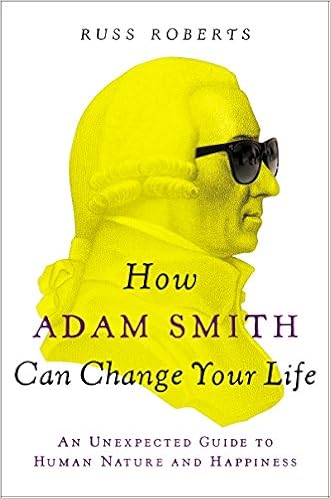
How Adam Smith Can Change Your Life by Russ Roberts

First, an apologia. I haven’t completed reading Adam Smith’s The Theory of the Moral Sentiments. I’m reminded of this when I log into goodreads and it inquires about how I’m progressing. (It’s annoying. "I know, I know.") Right now, it’s on the backburner. But it’s not there because it’s not worthwhile (it is), nor because it’s poorly written (it’s not), but because, as Roberts mentions, it’s written in 18th century prose that—for all its beauty—can prove challenging to those of us living in the Age of Twitter. 

In addition to all of that, Smith’s Theory of the Moral Sentiments is only one of many of the Great Books that I haven’t completed. I read a lot, but sometimes it seems like climbing an endless mountain. One must cast aside so many worthy candidates to delve into one. If I’m reading The Theory of the Moral Sentiments, I’m not reading Smith’s more famous An Inquiry into the Nature and Causes of the Wealth of Nations.

All of this brings me to an important point: secondary works, commentaries that riff off the original, provide a valuable service when we can’t manage a complete St. John’s-style—original texts only—reading diet. Is reading a commentary as good as delving into the original? No. But it’s better than no exposure at all. It reminds me of going to the Uffizi Gallery in Florence this summer. I did the audio tour, skipping careful examination of many great works, but with limited time—the ultimate scarce resource—it was the way to go. Thus, with secondary works (more than Cliff Notes, of course) you can follow someone like Roberts as he explores Smith’s work. The quality of the guide can vary. But it’s clear that Roberts has put in the time to qualify as our docent.

So why Adam Smith’s Theory of the Moral Sentiments and why via Russ Roberts? First, Smith.

A sketch of Adam Smith facing to the right
Smith without sunglasses, not in profile
Most recognize Smith as the intellectual father of modern economics via The Wealth of Nations. The “invisible hand” and all that. But The Wealth of Nations was just one end of the spectrum for Smith. His first and last book (in that he revised it up to near the time of his death) is Moral Sentiments. At appears that Smith considered this the more important of the two books. Moral Sentiments deals foremost with our life in face-to-face social circles and how we interact with one another through emotions (“sentiments”). The Wealth of Nations, at the other end, deals more with markets, those places where strangers (at least initially) come together to “truck, barter & exchange”. These insights make Smith one of the founders not just of modern economics, but also of modern social theory that deals with more than just markets.

Russ Roberts, The EconTalker
The other reason that I listened to this book was Russ Roberts. I’ve listened to many episodes of EconTalk that Roberts hosts, and I enjoy it very much. Roberts is a Chicago-trained economist who knows his econ, but he’s also a gracious and inquiring interviewer (his podcast consists of guest interviews). Roberts does a good job, even with guests with whom he disagrees. Not afraid to raise a point of contention, he’s also willing to hear the answer. He provides thoughtful conversation, not entertainment (if you can call people talking past one another entertaining). I sometimes disagree with Roberts, such as on the usefulness of government action (its flaws notwithstanding), on the ability of civil society along to deal appropriately with the mega-institutions of contemporary global capitalism, and on the wisdom and efficacy of sensible Keynesianism*. But I have a strong sense that if we sat down for a chat about politics and economics, we’d both benefit from the conversation, finding more points of agreement than disagreement. Disagreeing without being disagreeable. It’s refreshing.

As to the book itself, it’s a reflection on Smith’s insights into human nature and sociability. Roberts puts Smith’s insights into contemporary contexts and idioms. Smith, despite his bachelor life, developed some terrific insights into how society worked, how people work (their sentiments, emotions), and how people interact. In fact, along with his friend Hume and other members of the Scottish Enlightenment, Smith helped develop theories of sociability and morality that deserve greater consideration. (For the influence of the Scottish Enlightenment on Jefferson’s Declaration of Independence, read Garry Wills’s Inventing America. These Scots, more than Locke, provided the intellectual foundations of Jefferson’s thought.) Smith was not an ideologue of individualism—far from it. Instead, he always located the individual within his or her interactions with others. Roberts explores these themes, teasing out their contemporary manifestations and applications. It’s a well-written, entertaining, and enlightening introduction to this neglected aspect of Smith’s work.

My guilt at not having read Moral Sentiments is assuaged by the fact that Roberts, well into a career as an econ professor, admits to having read the work only relatively recently. And now with his book, Roberts has helped take a bit more of my sting of shame away.

Postscript: I listened to this book instead of having read it. It was on my reading list (such a long list and still growing!), but serendipity struck by way of a sale offer on Audible. Listening works well for this book, but I have to say that despite the fine reading, I was disappointed not to have Roberts reading it. After having listened to so many of his podcasts, and with his relaxed manner—not as folksy as Garrison Keillor—but still with an inviting air, it would have been good to have Roberts read it. But as it was, I simply substituted his voice in my head as I listened.

*For a fun example of Roberts’s fairness, watch the brilliant videos of Keynes and Hayek that (among other things) poke fun at the perpetual sense of inferiority that Hayek and Hayekians feel about Keynes, Hayek’s Nobel notwithstanding.

(That is what’s going on, right?)