Showing posts with label Descartes. Show all posts

Saturday, March 13, 2021

Thoughts for the Day: Saturday 13 March 2021


And the post-world is coming!


Keynes also worried that with the decline of work, all that free time would be a problem because people were not good at leisure. He noted that the indolence of much of the aristocracy, which already faced this problem, was a gloomy omen of what might come to the larger public eventually.

When you want to hurry something, that means you no longer care about it and want to get on to other things.

Heidegger rightly points out: “Descartes himself stresses that the sentence [cogito ergo sum] is not a syllogism. The I-am is not a consequence of the I-think but, on the contrary, the fundamentum, the ground for it.”

Beneath Montesquieu’s distinction between the nature of government (that which makes it what it is) and its moving or guiding principle (that which sets it into motion through actions) lies another difference, a problem which has plagued political thought since its beginning, and which Montesquieu indicates, but does not solve, by his distinction between man as a citizen (a member of a public order) and man insofar as he is an individual.

In discussing Renaissance law and its impact, it should be kept in mind that the law was then much less an esoteric specialization than it is today. Such unlikely people as Alberti and Copernicus were actually doctors of canon law, while almost all of the founders of mathematical probability had some legal connection: Fermat was a professional lawyer, Cardan and Pascal were the sons of lawyers, Huygens was a doctor of civil and canon law....

In this book I argue that all progress, both theoretical and practical, has resulted from a single human activity: the quest for what I call good explanations.


Thursday, November 12, 2020

Thoughts of the Day: Thursday 12 November 2020


What is wrong with Scientism is not that it is ‘material’ but that it is too abstract, too much in love with the hunt for the simplest formula, which today takes the form of a ‘theory of everything’. To be effective science must limit the part of reality that it deals with to what is relevant for its purposes. Because of this, as [Jacques] Barzun tells us, ‘the realm of abstraction, useful and far from unreal, is thinner and barer and poorer than the world it is drawn from’.
To abstract means to ‘extract’ or ‘remove’ something, whether it is an ‘abstract’ of a scientific paper you are interested in – that is, a brief description of it – or your idea of ‘tree’ from all the many, different ‘real’ trees you have encountered. One of the great sleights of hand that Scientism has pulled off is to convince the unthinking public that the thin, bare, poor world that it abstracts from – i.e. ‘pulls out of’ – our thick, luxuriant, rich world is the ‘really real’ world, the one that ‘objectively exists’, while the one we encounter and love and struggle with is a kind of subjective illusion, housed within our individual island consciousness. It manages this trick solely because of the practical effectiveness it provides.
My review of Lost Knowledge of the Imagination. Compare what Lachman says here with what Iain McGilchrist writes below:

As things become dulled and inauthentic, they become conceptualised rather than experienced; they are taken out of their living context, a bit like ripping the heart out of a living body. Heidegger called this process that of Gestell, or framing, a term which suggests the detachment of seeing things as if through a window (as in a famous image of Descartes's), or as re-presented in a picture, or, nowadays, framed by the TV or computer screen. Inherent in it is the notion of an arbitrarily abrupted set of potential relationships, with the context – which ultimately means the totality of Being, all that is – neatly severed at the edges of the frame. Because reality is infinitely ramified and interconnected, because its nature is to hide, and to recede from the approach of logical analysis, language is a constantly limiting, potentially misdirecting and distorting medium. Yet it is necessary to Heidegger as a philosopher. In its tendency to linearity it resists the reticulated web of Heidegger's thought, and his writing espouses images and metaphors of paths that are circuitous and indirect . . . suggesting threading one's way through woods and fields. It is interesting that Descartes's philosophy was half-baked while he slept in a Bavarian oven, the metaphor of stasis and self-enclosure revealing, philosophy and the body being one, the nature of the philosophy; whereas Heidegger was, according to Steiner, ‘an indefatigable walker in unlit places’: solvitur ambulando. Truth is process, not object.

Understanding, as distinguished from having correct information and scientific knowledge, is a complicated process which never produces unequivocal results. It is an unending activity by which, in constant change and variation, we come to terms with and reconcile ourselves to reality, that is, try to be at home in the world.
I'm writing a piece about Arendt's ideas concerning understanding, thinking, and how these concepts differ from knowledge, and how her ideas compare in some ways to those of R.G. Collingwood. (But it's not done yet; this is space exploration for the mind!)

“Many of these complex systems are governed by feedbacks, and if stressed too much they can move to radically new equilibria. The feedbacks often allow Earth’s biosphere to operate as a control, as a thermostat if you like, on interactions between the atmosphere, land, and oceans.”
We can't learn and think too much about the environment. This is Mother Nature, Mother Earth we're talking about. Father Sky can stand down for a while. P.S. My review of this book is on deck.


Tuesday, September 1, 2015

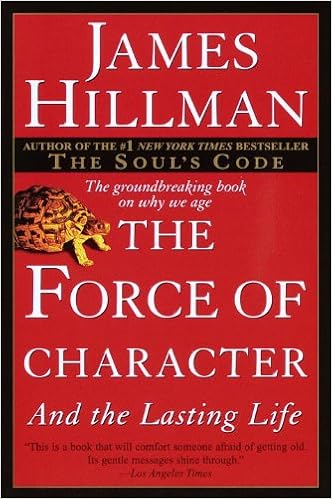
The Force of Character: And the Lasting Life by James Hillman

I’ve recently sang the praises of James Hillman in my review of Kinds of Power, so I won’t repeat that here. This book deals another big topic: aging. Like power, we sometimes wish it would go away and we try to ignore it. But remember: only the lucky get to age.

Hillman looks at aging through his unique lens, paying heed to the literal but focusing upon the figurative—the images of aging. And as he often does, he provides us with a fresh perspective on this age-old topic. In the end, it may not make you happy about aging, but you’ll realize that it has its benefits, prerogatives, and even some blessings.  

Without further fanfare, and in the style of Brain Pickings, below is an array of quotes with comments that should provide you with opportunities for reflection and a taste of the book.

It is not old age as such, but the abandonment of character that dooms later years to ugliness. We can’t imagine aging’s beauty because we look only through the eyes of physiology. As Aristotle said, “The soul’s beauty is harder to see than beauty of the body.” 
Hillman, James (2012-11-07). The Force of Character: And the Lasting Life (Kindle Locations 558-560). Random House Publishing Group. Kindle Edition.

The further back you can reach in imagination, the more extended you become. 
Id. 743-744

This, I think, is the value of history: it extends our thinking, ourselves, back in time; imagination extends us forward in time. But because of its reality, history provides the more secure anchor.

Her character must consist in several characters—“ partial personalities,” as psychology calls these figures who stir your impulses and enter your dreams, figures who would dare what you would not, who push and pull you off the beaten track, whose truth breaks through after a carafe of wine in a strange town. Character is characters; our nature is a plural complexity, a multiphasic polysemous weave, a bundle, a tangle, a sleeve. That’s why we need a long old age: to ravel out the snarls and set things straight. 
Id. 819-822

Hillman established archetypal psychology, a descendant of Jung's project, with an emphasis on images and “polytheism”. This view highlights the multiplicity of reality, including the multiplicities in us and outside of us.

Access to character comes through the study of images, not the examination of morals. 
Id. 847-848

This is why the idea of character is so needed in a culture: It nourishes imagination. Without the idea we have no perplexing, comprehensive, and long-lasting framework to ponder; instead we have mere collections of people whose quirks have no depth, whose images have no resonance, and who are distinguishable only in terms of collective categories: occupation, age, gender, religion, nationality, income, IQ, diagnosis. 
Id. 921-926

Old is one of the deepest sources of pleasure humans know. Part of the misery of disasters like floods and fires is the irrecoverable loss of the old, just as one of the causes of suburban subdivision depression— and aging and death— is the similar loss of the old, exchanged for a brand-new house and yard. 
Id. 959-961

As the owner and occupant of a house for a quarter of a century  that approached its centenary by the time we sold it, and now as the first occupant of a new apartment, I can attest to the difference, even as we’ve tried to old this apartment.

Time is not only destructive; it toughens as well as weakens. Time lasts; it keeps on going and going and going and therefore is no enemy of age or of old. But time is indeed destructive to youth, which it eats away and finally stops dead. So when we hear of the corruption caused by time, we are listening to youth speaking, not age. 
Id. 1031-1033
 Certainly you know of someone that you'd describe as a "tough old bird". 

In old age, interest shifts from information to intelligence. By this I mean that information brings news, while intelligence searches it for insight. 
Id. 1164-1165

You just have to hope that the insight doesn’t come too late.

The words describing our approach will change: instead of “explanation,” “understanding”; instead of “new studies,” “old texts”; instead of “improvement,” “necessity”; instead of “health,” “soul”; instead of “experiment” and “statistic,” “philosophy”; instead of “information,” “intelligence,” “insight,” and “vision”; and instead of “empowerment” and “entitlement,” “idiosyncrasy,” “passion,” and “folly”. 
Id. 1235-1240

I don’t believe that Hillman is a scientific Luddite—not at all—but he perceives the limits of our scientific worldview. Where most of the culture followed Descartes, Hillman hearkens us back to the alternate path pointed out by Vico (among others).

All human evil comes from this, man’s inability to sit still in a room.
Pascal 
Id. 1477-1478

Dry souls are wisest and best.
Heraclitus
 Id. 1514-1515

“It seems, as one becomes older, / That the past has another pattern, and ceases to be a mere sequence,” wrote T. S. Eliot. Four Quartets, which meditates on time, age, and memory, goes on to say, “We had the experience but missed the meaning, / And approach to the meaning restores the experience / In a different form, beyond any meaning.” 
Id. 1602-1606

Anyone quoting and appreciating Pascal, Heraclitus, and Eliot is on the right track.

The willful amnesia afflicting the sciences in general contrasts sharply with the importance given to memory by the humanities. Literature, philosophy, politics, and the visual arts, including photography and filmmaking, feed on memory. Practitioners of the humanities need memory to deepen and refine their thinking. 
Id. 1630-1632

St. Augustine (via Hannah Arendt): Sedis anima est in memoria (The seat of the mind [soul] is in the memory.) Science deludes and cripples itself when operates without an appreciation of history. It lacks depth.

Memory is always first of all imagination, secondarily qualified by time. 
Id. 1645

All the while we are losing acuity, we are intensifying Yeats’s “fantastical eye.” We can spin out from one wild strawberry a whole northern summer, from one tasty tea cake a vast French novel. 
Id. 2033-2035
 Robert Butler, the eminent researcher of old age, makes this telling point about heightened aesthetics in last years: “The elemental things in life— children, plants, nature, human touching (physical and emotional), color, shape— may assume greater significance as people sort out the more important from the less important.” Importance does not result from sensation only, or from simplicity. If it did, we would still prefer sugary childhood candies and the salty goo of fast-food pizza to the subtleties concocted by multistarred chefs. “Importance,” which Alfred North Whitehead placed among the first principles for understanding all human endeavors, governs our choices among values. “Importance is derived from the immanence of infinitude in the finite.”
 Id. 2068-2073
 
Contrition redeems no faults. It is wholly an inward act, relieving guilt to the past by reliving guilt for the past, an appeasement of ghosts. It is not the past that is tempered by contrition, but the gnawing guilt about it. 
Id. 2198-2200

I like the way my favorite philosopher, Plotinus, makes the contrast, because his metaphysical speculations are more psychological. Plotinus says that “the forward path is characteristic of the body”; “the body tend[ s] toward the straight line.” The soul, however, moves in circles. It circles “towards itself, the movement of self-concentrated awareness, of intellection, of the living of its life, reaching to all things so that nothing shall lie outside of it, nothing anywhere but [is] within its scope.” Because of these different kinds of movements, the soul “restrains” the body’s forwardness, says Plotinus. 
Id. 2244-2249

I think that this Plotinus/Hillman insight quite accurate. In my thoughts and interests, I seem to keep circling around something, something that I can’t quite make out, but which acts with a gravitational attraction.

As our bodies shrivel, we become our faces. Feet, hams, arms, and shoulders lose their shapeliness, while the face gains distinction, even beauty. The old naked body is unsightly, yet its naked face is a subject for long contemplation. 
Id.2410-2412
Image result for Image: rembrandt self-portrait
Exhibit A: Rembrandt self-portrait

Have you ever contemplated a late Rembrandt self-portrait?

“After a certain age,” said Proust, “the more one becomes oneself, the more obvious one’s family traits become.” Owning our own faces = becoming more individualized = owning our ancestry. 
Id. 2518-2519

As I’ve aged I’ve often experienced a shock of recognition the mirror. In my youth I looked a lot like my maternal grandfather in his youth, but now I glimpse myself and see more of my father in his old age. How strange and yet revealing.

To be left. This possibility haunts any intimate union, especially the close friendships that marriages often become. 
Id. 2648-2649

Yes.

I think the true agenda of the old is the agenda of the left: more fairness and less profit; more restoration and less development; community care, not more prescriptions; restoration of nature, not more harvesting from it; less wrangling over Medicare and more genuine nursing; more public transportation, fewer private enclaves; investment in schools to teach the young, not prisons that let them languish; more friendliness with people rather than user-friendly electronics; and peace, not guns. 
Id. 2694-2697
I long ago turned away from my Republican youth. And now I  have less patience with all types of nonsense. Fear drives so much of what we do and believe. Fear of loss of guns –fear of impotency? Fear of taking risks—“Iran might cheat”. Fear of changing the system even a little. Fear of reality—"climate change is irrelevant”—Republican flavor-of-the-week presidential candidate Ben Carson. How dreary!

In [character’s] place a bevy of substitutes appeared: the will, the individual, the subject, the personality, the ego. Each is a way of speaking about a characterless, unified subjective agent. This Objective Observer is what we believe to be our center of consciousness. The substitutes for character come empty. They are deliberately abstract, whereas the old idea of character presented rich and recognizable traits, a crowd of qualities. 
Id. 2760-2763

The one death that has caused so much death in the past century is the death of character. — The corpse invites an autopsy. It is hard, however, to isolate a single cause of death. 
Id. 2775-2777
This is a mighty tall statement, but one that demands careful investigation. If found true, it demands serious change. 

Current deficiencies of character, both as an idea and in behavior, result from epistemology, the study of how we know. If the character of the knower is irrelevant to knowing, or even interferes with truest knowing, then character does not belong within philosophy’s purview. Then knowledge and the methods of gaining knowledge can proceed unhampered by the character of the knower and by issues of value that are inescapably implied by the idea of character. Result: knowledge without value; valueless knowledge, which is euphemistically dubbed “objectivity.” 
Id. 2795-2799

To know the world “out there,” philosophy constructed a knowing subject “in here.” As the world was conceived to be, ultimately, a characterless abstraction of space, time, and motion, so the knower had to be equally transcendent and objectified, that is, shorn of characteristics. The method of knowing the world had to be purified; otherwise our human observations would be all-too-human, qualified by individual subjectivity, merely anecdotal, therefore unreliable, therefore untrue. The ideal human as knower of truth must be a vacant mirror of purified consciousness. 
Id. 2803-2807

Compare the last two quotes with the John Lukacs’s essay “Putting Man Before Descartes” and OwenBarfield's idea of “participation”. I think that all three thinkers are on the same (correct) page.

Adjectives and adverbs are the actual forces at work in perceiving the world and in our behavior. Our speech would return to a correspondence with the world, which does not show a sheer unqualified cloud, a shrub, a mouse, but each cloud shaped, still or moving, related to the land below and to other clouds; each shrub a species and one of a kind; that particular mouse doing its thing in its singular way. Language would be creatively imagined to equal the imagination of the creation. 
Id. 2839-2842

But Stephen King and writing software like Hemingway counsel us to junk the adverbs! Perhaps this is an instance of the (borrowed) injunction: “When you meet the Rule on the road, slay him!” Or perhaps it shows the value of knowing the history of expression. Compare the richness of language and images in Dante and Shakespeare to most contemporary authors, even knowledgeable ones like King. P.S. Brain Pickings shares a piece by Stephen King--using adverbs! 

“The most salient characteristic of most of the languages of the North American Indians is the care they take to express concrete details which our languages leave understood or unexpressed.” 
Id. 2856-2857

This thought is beautifully displayed by meditations on American Indian language contained in Robert Pirsig’s Lila: An Inquiry into Morals.

In keeping with a characteristically American priority— judgment before curiosity— we still declare a phenomenon good or bad before we become interested in it. This shelters our innocence from deeper engagement. 
Id. 2917-2919

American Innocence! When will our nation moved beyond adolescence? Not soon enough, I fear. The current election process (vastly extended out from a real election) does not bode well for maturity.

“Grandmothers empowered the human species to become the planet’s dominant animal,” writes Theodore Roszak in his exposition of the “grandmother hypothesis.”  They also carry cultural knowledge.
Id. 3090-3092

Amen. 

Saturday, November 29, 2014

Thoughts & Quotes, No. 1

Below is a new venture. I'm attempting to keep track of some random quotes or thoughts that I think worth sharing and to post them on a monthly basis. I will attempt to keep them short, but as you'll see with one article by John Lukacs, I just couldn't relent from taking a number of quotes from an essay that he wrote. Unless otherwise attributed, what I'll refer as "thoughts" are my own, although I'm not sure I ever think any truly original thoughts. Fortunately, I'm not too carried away with the anxiety of influence. I can't afford to be.


10.16.14

Purification is the key to development of Equanimity. Get rid of the junk & the “Buddha Mind" will appear. It’s hidden beneath the grime of existence (karma). 

And purification requires renunciation (forgoing some things you enjoy). 

Fangfu: “Freedom results from having no desires.” Socrates Code @ 2005 (Kindle location). Extreme. 

What’s the point of meditation?

[M]any years of intensive spiritual practice had succeeded in clearing [Buddha’s] mind, and one day an early childhood memory bubbled up. Left to himself under a tree by the side of a field in which his father was supervising the ritual plowing, Siddhartha had relaxed into a state of pure presence— a condition of open, amplified awareness in which he saw everything perfectly, just as it was. Feeling with his whole body and mind the clarity, grace, and power of that remembered state, Siddhartha knew he had found the way forward at last.

Patrick Ophuls, The Buddha Takes No Prisoners, p. 8.

How to get good at meditation: 

So practice is everything . Whatever your talent for meditation, you cannot succeed without practicing ; whatever your lack of talent, you can succeed by practicing. If you produce the perspiration, the inspiration will come— 

Patrick Ophuls, The Buddha Takes No Prisoners, p. 50.

A real nugget about politics:

How Things Should Be is the central question and struggle of politics. . . .  

Tim Kreider, “Our Greatest Political Novelist?”, New Yorker

10.20.14

Everything that we do, we do to change our state of consciousness. ~Sam Harris

“Energy is eternal delight”—William Blake
 
11.18.14

But isn’t objectivity an ideal? No: because the purpose of human knowledge—indeed, of human life itself—is not accuracy, and not even certainty; it is understanding.

Below is a case of my getting carried away with quotes from a single article, but it’s John Lukacs, so I’m sure you’ll indulge me (or more likely ignore it). Anyway, I’m leaving it in for your edification. 

John Lukacs, “Putting Man Before Descartes”, American Scholar, December 2008

Can we expect a Jewish man to be objective about Hitler? Perhaps not. Yet we may expect him or anyone to attempt to understand. And that attempt must depend on the how, on the very quality of his participation, on the approach of his own mind, including at least a modicum of understanding of his own self. After all, Hitler and Stalin were human beings, so they were not entirely or essentially different from any other person now thinking about them.

The ideal of objectivity is the antiseptic separation of the knower from the known. Understanding involves an approach to bring the two closer. But there is, there can be, no essential separation of the knower from the known.

Words are not finite categories but meanings—what they mean to us. They have their own histories and lives and deaths, their magical powers and limits.

Historical knowledge—indeed, any kind of human knowledge—is necessarily subjective. That is what I tended to think in my early 20s. Soon I found that I was wrong. Subjectivity is merely the obverse side of objectivism and objectivity; there is something wrong with the entire Cartesian coin, of a world divided into object and subject, because subjectivism as much as objectivism is determinist.

According to subjectivism I can think and see in only one (my) way; he in another (his) way. This is wrong, because thinking and seeing are creative acts coming from the inside, not the outside. Which is why we are responsible both for how and what we do or say as well as for how and what we think and see (or, for what we want to think and for what we want to see).

This is how and why the history of ideas is almost always woefully incomplete: not what but when it is that people are finally willing to hear something.

the more objective our concept of the mountain, the more abstract that mountain becomes.

What will, what must endure is the piecemeal recognition that the division of the world into objects and subjects belongs to history, as does every other human creation: that whatever realities objectivity and its practical applications contained and may still contain, they are not perennial, not always and not forever valid.

Knowledge, which is neither objective nor subjective, is always personal. Not individual: personal. The concept of the individual has been one of the essential misconceptions of political liberalism. Every human being is unique, but he does not exist alone. He is dependent on others (a human baby for much longer than the offspring of other animals); his existence is inseparable from his relations with other human beings.

Our knowledge is not only personal; it is also participant. There is—yet there cannot be—a separation of the knower from the known. We must see further than this. It is not enough to recognize the impossibility (perhaps even the absurdity) of the ideal of their antiseptic, objective separation. What concerns—or should concern—us is something more than the inseparability; it is the involvement of the knower with the known.

Detachment from one’s passions and memories is often commendable. But detachment, too, is something different from separation; it involves the ability (issuing from one’s willingness) to achieve a stance of a longer or higher perspective. The choice for such a stance does not necessarily mean a reduction of one’s personal interest, of participation—perhaps even the contrary.

Did—does—matter exist independent of the human mind? It did and it does; but, without the human mind, matter’s existence is meaningless—indeed, without the human mind, we cannot think of its existence at all. In this sense it may even be argued that mind preceded and may precede matter (or what we see and then call “matter”).

Causality—the how and why—has varied forms and meanings (Aristotle and St. Thomas Aquinas listed four); but for centuries the terms of mechanical causality have dominated our world and our categories of thinking. All of the practical applications of science, everything that is technical, inevitably depend on the three conditions of mechanical causality: (1) the same causes must have the same effects; (2) there must be an equivalence of causes and effects; (3) the causes must precede their effects. None of this necessarily applies to human beings, to the functioning of their minds, to their lives, and especially to their history.

In life, in our histories, there are effects that may, at times, even precede causes. For instance the fear or anticipation that something may or may not happen may cause it to happen (a view of “a future” may cause “a present”).

mechanical causality is insufficient to understand the functioning of our minds and consequently of our lives—and even the sense and the meaning of our memories. Every human action, every human thought is something more than a reaction. (That is how and why history never repeats itself.) The human mind intrudes into and complicates the very structure of events.
It is arguable that the two greatest intellectual achievements of the now-ended age of 500 years have been the invention (invention, rather than discovery) of the scientific method and the development of historical thinking.

Consider how the natural (natural here means instinctive but not insightful) ability to operate devices is normal for young, sometimes even very young, people who do not at all mind comparing or even imagining themselves as akin to machines, unaware as they are of the complexity and the uniqueness of human nature.

Machines may make people’s physical lives easier, but they do not make their thinking easier. I am writing not about happiness or unhappiness but about thinking. It is because of thinking, because of the inevitable mental intrusion into the structure and sequence of events, that the entire scheme of mechanical causality is insufficient.

How much more timely is Wendell Berry’s warning in 1999, exactly 250 years later: “It is easy for me to imagine that the next great division of the world will be between people who wish to live as creatures and people who wish to live as machines.”

At this stage of my argumentation, someone may ask: Are these not merely the opinions of an old-fashioned humanist? A poet or even a historian of a particular kind may see the realities of the world otherwise from how (and why) a natural scientist may see them. They represent Two Cultures, a humanistic and a scientific one. . . . There may be dualities in our reactions, but—more important—there is increasing evidence that, ever since Descartes and others, the dual division of the world into objects and subjects, into known and knower, is no longer valid. And such evidence is not only there in the so-called humanities, but, during the general crisis at the end of the 20th century, in physics, too, involving the very study of matter.


Energy may be transformed into matter or heat or light; but energy is a potentiality. An accurate definition or a measurement of the temperature of an atom is impossible, because its very existence is only a probability.

But in history, unlike in law, events and men may be tried and judged again and again. History is subject to multiple jeopardy; it is potentially revisionable.

The historian must always keep in mind the potentiality that this or that may have happened otherwise.

the condition that every historical actuality includes a latent potentiality (also, that human characteristics, including mental ones, are not categories but tendencies).

What science amounts to is a probabilistic kind of knowledge with its own limits, because of the limitations of the human mind, including the mental operations and the personal character of scientists themselves, which could range from sublime to fallible. There is only one kind of knowledge, human knowledge, with the inevitability of its participation, with the inevitable relationship of the knower to the known, of what and how and why and when a man knows and wishes to know.


At the beginning of the modern age, some five centuries ago, Bacon wrote: “Knowledge is power.” Near the end of this age, we know, or ought to know, that the increase of power—including mental power—tends to corrupt.

Because of this recognition of the human limitations of theories, indeed, of knowledge, this assertion of our centrality—in other words, of a new, rather than renewed, anthropocentric and geocentric view of the universe—is not arrogant or stupid. To the contrary: it is anxious and modest.

The known and visible and measurable conditions of the universe are not anterior but consequent to our existence and to our consciousness. The universe is such as it is because in the center of it there exist conscious and participant human beings who can see it, explore it, study it.

Keep in mind that all prevalent scientific concepts of matter, and of the universe, are models. A model is man-made, dependent on its inventor. A model cannot, and must not, be mistaken for the world.

History (and our knowledge of the world) swings back, but not along the arc where it once was. Because of our present historical and mental condition, we must recognize, and proceed from a chastened view of ourselves, of our situation, at the center of our universe. For our universe is not more or less than our universe. That has been so since Adam and Eve, including Ptolemy, Copernicus, Galileo, Newton, Einstein, Heisenberg, and my own dual, because human (opinionated as well as humble), self.

Our thinking of the world, our imagination (and we imagine and see together) anthropomorphizes and humanizes everything, even inanimate things, just as our exploration of the universe is inevitably geocentric. “Know Thyself” is the necessary fundament of our understanding of other human beings, but we can never go wholly outside of ourselves, just as we can never go outside the universe to see it.

The arguments of creationism against evolutionism entirely miss this essential matter. The language of those creationists and anti-Darwinists who proclaim the existence of an Intelligent Design is ludicrous: it reduces God to a role model of a rocket scientist or of a brilliant computer programmer. The matter is the unavoidable contradiction not between Evolution and Creation but between evolution and history. History, because in the entire universe we are the only historical beings. Our lives are not automatic; we are responsible for what we do, say, and think. The coming of Darwinism was historical; it appeared at a time of unquestioned progress. But its essence was, and remains, antihistorical. It elongated the presence of mankind to an ever-increasing extent, by now stretching the first appearance of man on this earth to more than a million years—implying that consequently there may be something like another million years to come for us. Ought we not to question this kind of progressive optimism, especially at a time when men are capable of altering nature here and there and of destroying much of the world, including many of themselves?
 
11.30.2014

Man … has no nature,” wrote the Spanish philosopher José Ortega y Gasset. “[W]hat he has is …history… . Man … finds that he has no nature other than what he has himself done.”

“The error of the old doctrine of progress lay in affirming a priori that man progresses toward the better.”

            Jose Ortega y Gasset, quoted in the Introduction to The Remembered Past, “a collection of Lukacs’s greatest writings on history, historians, and historical knowledge”.