Showing posts with label Heraclitus. Show all posts

Wednesday, February 17, 2021

Reading The Human Condition: Part 2 "The Vita Activa"


SNG Synopsis (my comments in italics):

I. The Human Condition

1. Vita Activa and the Human Condition

The three fundamental human activities are labor, work, and action, all are fundamental to life on earth. Labor addresses the biological processes necessary to maintain life. Work concerns the "unnaturalness of human existence" that creates the "artificial world of things" and establishes "worldliness." Action is the "only activity that goes on directly between men [plural of Man] without the intermediary of things or matter and corresponds to the human condition of plurality."

All three aspects of the human condition "are somehow related to politics." (Here's one of many places where I wish Arendt had been more specific or elucidated her statement. As I read her book as whole, I come away with the belief that politics--or at least "real" poltics--involves only action. Work and labor don't and shouldn't have a role in politics, at least as Arendt idealizes politics based on Athenian democracy.)

Natality (birth) and mortality (death) are two characteristics of the human condition, along with plurality. Arendt cites Genesis for the image of "male and female he created them." 

A polity (political body) establishes a framework for history as remembrance. 

Labor, work, and action all relate to natality, the fact that there are constant newcomers to the world. And these newcomers represent the start of something new. (Arendt draws on St. Augustine here; he's one of the key influences upon her work.

"Since action is the political activity par excellence, natality, and not mortality, may be the central activity of political, as opposed to metaphysical, thought. (9) 

Men are "conditioned beings." The things we make condition us as well as the general conditions of human life (e.g., natality, plurality, mortality, equality). 

The "human condition" is not the same as human nature. The most radical change in the human condition would be travel (and life) on another planet. Arendt cites Augustine: "A question have I become to myself." Augustine (and Arendt) contend we can't know our own nature. It's a matter of "who am I?" versus "what am I?" Arendt also seems to doubt that the human condition gives us a complete view of ourselves. She asserts "conditions of human existence--life itself, natality and mortality, worldliness, plurality, and the earth--can never explain what we are or answer the question of who we are for the simple reason that they never condition us absolutely." (10) And she notes that we now see ourselves differently than previously because we can now see ourselves from the perspective outside the earth, even as we (then) remained earthbound. 

2. The Term Vita Activa

The tradition of political thought in the West arises from the trial of Socrates and the difference between philosophy and politics. This tradition ends with Marx. Aristotle gives us the bios politikos, Augustine the via negotiosa (or actiosa) as designations of a life devoted to public-political matters. Aristotle sees three paths in life for freedom, all of which exclude labor and work. All three of the "free" paths involve a concern for the "beautiful:" 1) concern for beautiful bodily pleasures, 2) concern for beautiful deeds in the polis, and 3) contemplation of the beautiful eternal entities of philosophy. 

We need action (praxis) to sustain the world of human affairs. Thus, the despot, acting essentially alone, is not free. The world of the city-state populated by political actors--citizen--was last observed by Augustine. (14) After Augustine, politics became involved with necessity. 

All three aspects of the vita activa (labor, work, and action) are "unquiet" in both the Greek and Christian worldviews. The "Truth of Being" (Greek) or of God (Christian) can be appreciated only in stillness. The Greeks make a distinction between physei (existing of themselves; "natural") and nomo (man-made). All exists in the kosmos. Theoria equates with contemplation and is different from thought and reasoning. (How do these distinctions fit with Arendt's ideas about "thinking," especially as she explores this concept in her final work, The Life of the Mind?)

The Greek and Christian emphasis on the value of contemplation relegated the vita activa to an inferior undertaking. Marx and Nietzche reversed this tradition. Arendt refuses to take a position upon the issue of the relative value of the vita contempletiva versus the vita activa or on the issue of truth as revelation versus truth of coming from what Man has made himself. 

3. Eternity vs. Immortality

"Immortality" is "deathless, timeless on earth," the prerogative of the gods. (18) Mortality of the hallmark of the Greeks. See the line of the individual human life against the cycles of nature. Humans produce "works and deeds and words." (19) The aristoi (elites) "prefer immortal fame to moral things. (Heraclitus)." 

Socrates-Plato established the "eternal" as the center of philosophical thought. Arendt, citing the example of Socrates, contends that anyone who writes their thoughts is not concerned with eternity. (She might also have cited Jesus for this proposition. Why not?)

Plato emphasized the difference between concern with immortality as opposed to eternity. Philosophy became associated with death because of its focus on eternity. There is no activity in eternity. After the fall of Rome established the falsehood of claims of immortality. Christianity filled this void with a concern for the eternal and made the vita activa and bios politikos handmaids to the life of contemplation. Even the modern reversal of the labor-work-action triad by Marx and Nietzche was not enough to save the value of striving for immortality, which had once been the driving motive of the vita activa


Tuesday, September 1, 2015

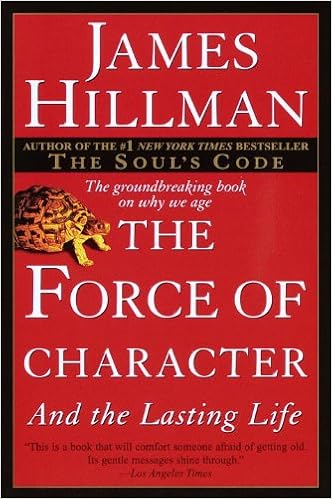
The Force of Character: And the Lasting Life by James Hillman

I’ve recently sang the praises of James Hillman in my review of Kinds of Power, so I won’t repeat that here. This book deals another big topic: aging. Like power, we sometimes wish it would go away and we try to ignore it. But remember: only the lucky get to age.

Hillman looks at aging through his unique lens, paying heed to the literal but focusing upon the figurative—the images of aging. And as he often does, he provides us with a fresh perspective on this age-old topic. In the end, it may not make you happy about aging, but you’ll realize that it has its benefits, prerogatives, and even some blessings.  

Without further fanfare, and in the style of Brain Pickings, below is an array of quotes with comments that should provide you with opportunities for reflection and a taste of the book.

It is not old age as such, but the abandonment of character that dooms later years to ugliness. We can’t imagine aging’s beauty because we look only through the eyes of physiology. As Aristotle said, “The soul’s beauty is harder to see than beauty of the body.” 
Hillman, James (2012-11-07). The Force of Character: And the Lasting Life (Kindle Locations 558-560). Random House Publishing Group. Kindle Edition.

The further back you can reach in imagination, the more extended you become. 
Id. 743-744

This, I think, is the value of history: it extends our thinking, ourselves, back in time; imagination extends us forward in time. But because of its reality, history provides the more secure anchor.

Her character must consist in several characters—“ partial personalities,” as psychology calls these figures who stir your impulses and enter your dreams, figures who would dare what you would not, who push and pull you off the beaten track, whose truth breaks through after a carafe of wine in a strange town. Character is characters; our nature is a plural complexity, a multiphasic polysemous weave, a bundle, a tangle, a sleeve. That’s why we need a long old age: to ravel out the snarls and set things straight. 
Id. 819-822

Hillman established archetypal psychology, a descendant of Jung's project, with an emphasis on images and “polytheism”. This view highlights the multiplicity of reality, including the multiplicities in us and outside of us.

Access to character comes through the study of images, not the examination of morals. 
Id. 847-848

This is why the idea of character is so needed in a culture: It nourishes imagination. Without the idea we have no perplexing, comprehensive, and long-lasting framework to ponder; instead we have mere collections of people whose quirks have no depth, whose images have no resonance, and who are distinguishable only in terms of collective categories: occupation, age, gender, religion, nationality, income, IQ, diagnosis. 
Id. 921-926

Old is one of the deepest sources of pleasure humans know. Part of the misery of disasters like floods and fires is the irrecoverable loss of the old, just as one of the causes of suburban subdivision depression— and aging and death— is the similar loss of the old, exchanged for a brand-new house and yard. 
Id. 959-961

As the owner and occupant of a house for a quarter of a century  that approached its centenary by the time we sold it, and now as the first occupant of a new apartment, I can attest to the difference, even as we’ve tried to old this apartment.

Time is not only destructive; it toughens as well as weakens. Time lasts; it keeps on going and going and going and therefore is no enemy of age or of old. But time is indeed destructive to youth, which it eats away and finally stops dead. So when we hear of the corruption caused by time, we are listening to youth speaking, not age. 
Id. 1031-1033
 Certainly you know of someone that you'd describe as a "tough old bird". 

In old age, interest shifts from information to intelligence. By this I mean that information brings news, while intelligence searches it for insight. 
Id. 1164-1165

You just have to hope that the insight doesn’t come too late.

The words describing our approach will change: instead of “explanation,” “understanding”; instead of “new studies,” “old texts”; instead of “improvement,” “necessity”; instead of “health,” “soul”; instead of “experiment” and “statistic,” “philosophy”; instead of “information,” “intelligence,” “insight,” and “vision”; and instead of “empowerment” and “entitlement,” “idiosyncrasy,” “passion,” and “folly”. 
Id. 1235-1240

I don’t believe that Hillman is a scientific Luddite—not at all—but he perceives the limits of our scientific worldview. Where most of the culture followed Descartes, Hillman hearkens us back to the alternate path pointed out by Vico (among others).

All human evil comes from this, man’s inability to sit still in a room.
Pascal 
Id. 1477-1478

Dry souls are wisest and best.
Heraclitus
 Id. 1514-1515

“It seems, as one becomes older, / That the past has another pattern, and ceases to be a mere sequence,” wrote T. S. Eliot. Four Quartets, which meditates on time, age, and memory, goes on to say, “We had the experience but missed the meaning, / And approach to the meaning restores the experience / In a different form, beyond any meaning.” 
Id. 1602-1606

Anyone quoting and appreciating Pascal, Heraclitus, and Eliot is on the right track.

The willful amnesia afflicting the sciences in general contrasts sharply with the importance given to memory by the humanities. Literature, philosophy, politics, and the visual arts, including photography and filmmaking, feed on memory. Practitioners of the humanities need memory to deepen and refine their thinking. 
Id. 1630-1632

St. Augustine (via Hannah Arendt): Sedis anima est in memoria (The seat of the mind [soul] is in the memory.) Science deludes and cripples itself when operates without an appreciation of history. It lacks depth.

Memory is always first of all imagination, secondarily qualified by time. 
Id. 1645

All the while we are losing acuity, we are intensifying Yeats’s “fantastical eye.” We can spin out from one wild strawberry a whole northern summer, from one tasty tea cake a vast French novel. 
Id. 2033-2035
 Robert Butler, the eminent researcher of old age, makes this telling point about heightened aesthetics in last years: “The elemental things in life— children, plants, nature, human touching (physical and emotional), color, shape— may assume greater significance as people sort out the more important from the less important.” Importance does not result from sensation only, or from simplicity. If it did, we would still prefer sugary childhood candies and the salty goo of fast-food pizza to the subtleties concocted by multistarred chefs. “Importance,” which Alfred North Whitehead placed among the first principles for understanding all human endeavors, governs our choices among values. “Importance is derived from the immanence of infinitude in the finite.”
 Id. 2068-2073
 
Contrition redeems no faults. It is wholly an inward act, relieving guilt to the past by reliving guilt for the past, an appeasement of ghosts. It is not the past that is tempered by contrition, but the gnawing guilt about it. 
Id. 2198-2200

I like the way my favorite philosopher, Plotinus, makes the contrast, because his metaphysical speculations are more psychological. Plotinus says that “the forward path is characteristic of the body”; “the body tend[ s] toward the straight line.” The soul, however, moves in circles. It circles “towards itself, the movement of self-concentrated awareness, of intellection, of the living of its life, reaching to all things so that nothing shall lie outside of it, nothing anywhere but [is] within its scope.” Because of these different kinds of movements, the soul “restrains” the body’s forwardness, says Plotinus. 
Id. 2244-2249

I think that this Plotinus/Hillman insight quite accurate. In my thoughts and interests, I seem to keep circling around something, something that I can’t quite make out, but which acts with a gravitational attraction.

As our bodies shrivel, we become our faces. Feet, hams, arms, and shoulders lose their shapeliness, while the face gains distinction, even beauty. The old naked body is unsightly, yet its naked face is a subject for long contemplation. 
Id.2410-2412
Image result for Image: rembrandt self-portrait
Exhibit A: Rembrandt self-portrait

Have you ever contemplated a late Rembrandt self-portrait?

“After a certain age,” said Proust, “the more one becomes oneself, the more obvious one’s family traits become.” Owning our own faces = becoming more individualized = owning our ancestry. 
Id. 2518-2519

As I’ve aged I’ve often experienced a shock of recognition the mirror. In my youth I looked a lot like my maternal grandfather in his youth, but now I glimpse myself and see more of my father in his old age. How strange and yet revealing.

To be left. This possibility haunts any intimate union, especially the close friendships that marriages often become. 
Id. 2648-2649

Yes.

I think the true agenda of the old is the agenda of the left: more fairness and less profit; more restoration and less development; community care, not more prescriptions; restoration of nature, not more harvesting from it; less wrangling over Medicare and more genuine nursing; more public transportation, fewer private enclaves; investment in schools to teach the young, not prisons that let them languish; more friendliness with people rather than user-friendly electronics; and peace, not guns. 
Id. 2694-2697
I long ago turned away from my Republican youth. And now I  have less patience with all types of nonsense. Fear drives so much of what we do and believe. Fear of loss of guns –fear of impotency? Fear of taking risks—“Iran might cheat”. Fear of changing the system even a little. Fear of reality—"climate change is irrelevant”—Republican flavor-of-the-week presidential candidate Ben Carson. How dreary!

In [character’s] place a bevy of substitutes appeared: the will, the individual, the subject, the personality, the ego. Each is a way of speaking about a characterless, unified subjective agent. This Objective Observer is what we believe to be our center of consciousness. The substitutes for character come empty. They are deliberately abstract, whereas the old idea of character presented rich and recognizable traits, a crowd of qualities. 
Id. 2760-2763

The one death that has caused so much death in the past century is the death of character. — The corpse invites an autopsy. It is hard, however, to isolate a single cause of death. 
Id. 2775-2777
This is a mighty tall statement, but one that demands careful investigation. If found true, it demands serious change. 

Current deficiencies of character, both as an idea and in behavior, result from epistemology, the study of how we know. If the character of the knower is irrelevant to knowing, or even interferes with truest knowing, then character does not belong within philosophy’s purview. Then knowledge and the methods of gaining knowledge can proceed unhampered by the character of the knower and by issues of value that are inescapably implied by the idea of character. Result: knowledge without value; valueless knowledge, which is euphemistically dubbed “objectivity.” 
Id. 2795-2799

To know the world “out there,” philosophy constructed a knowing subject “in here.” As the world was conceived to be, ultimately, a characterless abstraction of space, time, and motion, so the knower had to be equally transcendent and objectified, that is, shorn of characteristics. The method of knowing the world had to be purified; otherwise our human observations would be all-too-human, qualified by individual subjectivity, merely anecdotal, therefore unreliable, therefore untrue. The ideal human as knower of truth must be a vacant mirror of purified consciousness. 
Id. 2803-2807

Compare the last two quotes with the John Lukacs’s essay “Putting Man Before Descartes” and OwenBarfield's idea of “participation”. I think that all three thinkers are on the same (correct) page.

Adjectives and adverbs are the actual forces at work in perceiving the world and in our behavior. Our speech would return to a correspondence with the world, which does not show a sheer unqualified cloud, a shrub, a mouse, but each cloud shaped, still or moving, related to the land below and to other clouds; each shrub a species and one of a kind; that particular mouse doing its thing in its singular way. Language would be creatively imagined to equal the imagination of the creation. 
Id. 2839-2842

But Stephen King and writing software like Hemingway counsel us to junk the adverbs! Perhaps this is an instance of the (borrowed) injunction: “When you meet the Rule on the road, slay him!” Or perhaps it shows the value of knowing the history of expression. Compare the richness of language and images in Dante and Shakespeare to most contemporary authors, even knowledgeable ones like King. P.S. Brain Pickings shares a piece by Stephen King--using adverbs! 

“The most salient characteristic of most of the languages of the North American Indians is the care they take to express concrete details which our languages leave understood or unexpressed.” 
Id. 2856-2857

This thought is beautifully displayed by meditations on American Indian language contained in Robert Pirsig’s Lila: An Inquiry into Morals.

In keeping with a characteristically American priority— judgment before curiosity— we still declare a phenomenon good or bad before we become interested in it. This shelters our innocence from deeper engagement. 
Id. 2917-2919

American Innocence! When will our nation moved beyond adolescence? Not soon enough, I fear. The current election process (vastly extended out from a real election) does not bode well for maturity.

“Grandmothers empowered the human species to become the planet’s dominant animal,” writes Theodore Roszak in his exposition of the “grandmother hypothesis.”  They also carry cultural knowledge.
Id. 3090-3092

Amen. 

Sunday, December 8, 2013

Philosophy for Life and Other Dangerous Situations: Ancient Philosophy for Modern Life by Jules Evans


Serendipity once again rode to my rescue in a chaotic Indian bookstore (actually, the pretty good Modern Book Centre here in Trivandrum). I spied Philosophy for Life, by an author unknown to me. A quick perusal of the TOC revealed that it addressed Stoicism, Epicureanism, Heraclitus, Pythagoras, Skepticism, Cynicism, Plato, Aristotle, Plutarch, and of course, the godfather of them all, Socrates. One can surmise from the all-star cast that it couldn’t help but to prove worthwhile. It did.
Evans tells an interesting story. His book isn’t just an exposition of ancient wisdom (for wisdom is the purpose of these philosophies and philosophers), but it relates each tradition to our world through his own story and those of others. Evans reports that as a young man he was plagued with anxiety and depression until he discovered Cognitive Behavior Therapy (CBT), developed by Albert Ellis and Aaron Beck. Put simply, CBT attacks “stinkin’ thinkin’” (a term of art I borrow from elsewhere). Indeed, CBT, as Evans discovered, draws from the tradition of Stoicism. Stoicism addresses the veracity of our beliefs and the fundamental choices that we have about our emotional reactions to those beliefs (and the events that trigger those beliefs). The help that Evans received from CBT drew him into the world of ancient philosophy and an exploration of the way in which philosophy can become a way of life. Each chapter address a particular thinker or tradition, weaving together contemporary practitioners within that tradition with the original, helping to bring to life the value of each.
Evans not only provides very sound expositions of the basic tenants of each tradition and the contemporary manifestations of each, but he also provides sound critiques. Indeed, after going through this buffet of a book (and based on some earlier reading that I’ll detail below), one might want to treat each of these traditions as a course at a meal: each dish appropriate to a particular moment in life. Stoicism helps arm us against life’s tribulations, defeats, and losses. But should we remain a Stoic all of the time? It seems too harsh. Even the warriors who often draw upon it must need some break from its implicit asceticism. Epicureanism, on the other hand, with its appreciation of pleasure and desire to avoid pain and anxiety, seems the attitude to take when enjoying a glass of wine and a fine meal--savoring the moment, as Evans dubs it. It also counsels us not to worry about that which we cannot control.
Heraclitus teaches us to appreciate the flux of life; Protagoras the benefit of reminding ourselves of ideals through memorization and incantation. Skeptics teach us to question and doubt—what I might call the Missouri method: “Show me. I’m not buyin’ until you do.” Diogenes and the Cynics, surely the most far out of the traditions, teach us the value of street theatre and radical questioning.
Evans moves on to the Big Three of Ancient Philosophy: Plato, his student Aristotle, and the master of the whole tradition (and Plato’s teacher), Socrates. Plato compels us to consider justice and the proper order of things, while his more earthy student Aristotle teaches us about friendship, politics, and all manner of earthly (and metaphysical) concerns. Aristotle serves as an antidote the Epicurean and Stoic tendency to retreat from the public space. Finally, Socrates teaches us about the value of questioning and facing death.
This book serves as an excellent introduction to this ancient tradition. Evans’ critiques are thoughtful and balanced. He looks to take the fruit of that lies within rather than rejecting the whole because of any surface imperfection. Evans touches upon the tradition’s relationship with Buddhism and the Chinese traditions, something, especially concerning Buddhism, that I’d like to see further developed. (The similarities between Buddhism and Stoicism seem to me almost patent. Nassim Taleb touches on the issue in a footnote in Antifragile: “For those readers who wonder about the difference between Buddhism and Stoicism, I have a simple answer: A Stoic is a Buddhist with attitude, one who says “f*** you” to fate”. (153). I think that this is a bit too simple, but it’s making the connection.)
Evans gratefully acknowledges those scholars whose work he draws upon for his examination of the ancient traditions. Some of them I’ve read and can recommend if you  want to dig deeper: Pierre Hadot’s Philosophy as a Way of Life (and anything else by Hadot); Martha Nussbaum’s The Therapy of Desire: Theory and Practice in Hellenistic Ethics and Upheavals of Thought: The Intelligence of the Emotions (her effort at an improved and expanded appreciation of the Stoic view of the emotions); Alain de Botton’s Consolations of the Philosophy (not limited to the ancients); and Richard Sorabji’s Gifford Lectures, Emotion and Peace of Mind: From Stoic Agitation to Christian Temptation.
Finally, Evans’ website www.philosophyforlife.org is an excellent resource for further exploration of these issues.