Sunday, November 13, 2016

Some First Thoughts

I'm slowly recovering my mojo after the election, and as I would do after a losing jury trial, I'd move past my emotional bender and begin to perform an autopsy. What went wrong? What should I have done differently? Why didn't I anticipate X? Why on earth didn't those morons agree with me! (With the last statement I realize that I have to back off into clinical mode.)  It's a slow, painful process, but a necessary one. In fact, my reading and thoughts will be mulling over this election and the reality surrounding it for some time. The good news? If you don't care about this stuff (or my take on it), you can stop reading. Relief is just a click away. 

The following is a Comment (which I rarely post) on a blog post entitled "It's Not About Hillary." The blog is provocative (to me), written by a Brit ex-pat I've met here in Bucharest. What follows is my first serious reflection on events after the election, following commiserating with friends and relatives. (I've changed just a few words; I can't resist endless tinkering with my prose.)

You're right: it wasn't about Clinton. Regardless of her perceived faults, from full-blown Clinton Derangement Syndrome to her patent mistakes and faults, anyone with any modicum of political judgment knows that she was a landslide loser in the faults category. The president-elect is a liar, a bullshitter, a tax-and-draft dodger, a misogynist, and a racist who promotes violence. He has the temperament of a spoiled, petulant little boy, the character of a huckster, and the experience of a used car salesman. (He is a terrific salesman. He sells baloney and people buy it. Once.) He has no real friends, only toadies and cronies. Who admires Donald Trump? (Envy? Yes.) He is a man of low character, without a moral compass, a sociopath. I wish none of this were true! If this had been a loss to Mitt Romney, character and moral compass would not be the topics of discussion. Trump is sui generis in American politics. 

The sui generis aspect of Trump is that U.S. electoral college system (not the voters) have elected a classic demagogue. A nation that followed FDR and refused the blandishments of Father Coughlin, Huey Long, and other crackpot demagogues in the Great Depression now succumbs to this? A nation that put aside Joe McCarthy and George Wallace surrenders to this huckster? This is like a second fall, a loss of innocence, the end of American exceptionalism.  

How do we account for this? Going back to the original point, it's not about Hillary Clinton. She’s a Methodist do-gooder who developed political savvy and power through mastery of the material and the system--surely intimidating to the weak-minded males. The smart, hard-working girl who left behind the lackadaisical boys like Donald Trump. But Trump had inherited wealth and privilege, but his voters, especially the less educated white males that voted as a minority group (which they increasingly are), don't have this cushion. The class clown and bully just beat the smart, ambitious girl for class president--and that's about how seriously many voters thought about this election. Clinton had to have grave character faults--A liar! A crook! Benghazi! Emails!--because Trump voters needed justification for their license, their willingness to set aside tradition and civic decorum to vote for this monster from their damaged ids and egos. 

But why take this reckless risk? That’s the deeper question. I agree with those who see this vote like Brexit, only this choice will have more tangible, significant consequences. But the common thread is that the herd is spooked. What is making them so restless, so willing to trample the Establishment? Voters act as if they were young French radicals eager to "Épater la bourgeoisie!" But these people want the good life, the middle-class--if not fabulously wealthy--life. The establishment has made mistakes and has ignored the festering problems of working class America, but this willingness to risk the political order to express grievances is classic, but not rational. The cost of the balm will very soon exceed the temporary satisfaction. The hangover will become apparent soon. 

If you think that the media was unfair to Trump, you're wrong. The media created Trump—a classic television "celebrity.” He received a free ride early because he drove ratings higher by his antics. Only later--much later--did conservatives who take political principles seriously raise a hue and cry, and they work mostly in print. Only two general newspapers endorsed Trump, and many prominent conservative intellectuals spoke out against Trump. But who was heeding them? The degree of Establishment (elite) unity opposing Trump was impressive, but the voters were out to goose the elites, come what may.  

I’m headed back into the books, deeper into history and political thought. Arendt, Niebuhr, Lukacs, Lippmann, Ophuls--those who've lived and written about dark times. The American body politic is ill and needs serious and sustained attention. But first, we must know the disease and follow the lead of the those who have identified the symptoms and chronicled the outbreaks. 

In response to the Reply, I wrote the following: 

Despite the fact that I'm an older white male from small town Iowa, I have a hard time picturing myself the member of an oppressed minority. However, I do understand that much of middle America has been left behind for a variety of reasons, and that elites, Democrat & Republican, have been negligent in addressing these simmering problems. The Republicans, the worst offenders, but that's an apparent point. See, e.g., Kansas.  

Neither Krugman or I really care that whites (however defined) become a minority. Defining Americans by race or ethnicity is a habit, but not a good one. Nativism is an atavistic response by the ignorant (sorry, I can't sugar-coat this) to perceived loss of status. (Read Richard Hofstadter). It's true that too much immigration taxes the ability of society to incorporate new arrivals, and the U.S., is--perhaps more than any other nation--"a nation of immigrants". 

The tribalism that Trump plays upon is truncated, small-minded form of community. Christianity and Islam met their success--and for the Catholic Church, continues to have surprising success--because of their universality. The liberal tradition inherited and seeks to expand this outlook. The American experiment has extended the idea of universality with its "novus ordo seculorum", but it regresses at times. My only hope that the election of this demagogue, this man with all the markings of a would-be despot, doesn't ruin the noble experiment. 

And in response to another Reply that asked "Atavistic and ignorant are just insults. Please can you explain why nativism is bad?", I wrote: 

"Nativism is an atavistic response by the ignorant (sorry, I can't sugar-coat this) to perceived loss of status."  

No, these are not intended as insults, but as descriptions, although I realize that the connotation of each is negative. 
Nativism, in U.S. history & in U.S. political discourse is anti-immigrant sentiment. I suspect my Puritan ancestors may have opposed my Irish Catholic ancestors, but these tides come and go as assimilation occurs and economic circumstances vary. Nativism is not based on reasoned argument about the effects of immigration, but the perceived need for scapegoats based on social and religious prejudice. Immigrants are different, and different is hard for most folks to deal with. Nativism is atavistic because by definition atavism is appeal to a more primitive form of social allegiance, the tribe of native born Americans (excluding, of course, the first native born Americans (i.e., American Indians). While civil society is a must, tribalism is a regression on social and political organization and belief.  

Ignorant has a pejorative connotation, and I intended that, but the plain truth here (and I'm revealing my conservative bona fides here) is that most of the electorate is ignorant--lacks knowledge of and about--what goes on in the political economy. They feel those effects exquisitely, but they look for scapegoats rather than causes (of which there are many). Of course, this is true for all of us (I'm one who believes strongly in the reality of human finitude), but we are not all equally endowed to comprehend different aspects of the world. E.g., don't ask me to fix your car. Indeed, a pressing problem, one long known (centuries?) is that most of the voting public is abysmally ignorant about government and political affairs and are prone to believing the ridiculous. (Obama a Muslim or foreign-born, the most recent manifestations.) 

The U.S. has for for all of the 20th and 21st centuries placed limits on immigration, which have been difficult to enforce, mainly because the American southwest has always been marked by Hispanic culture and families. Culturally and ethnically, the Rio Grande has never been a real divider. The net flow of immigrants is in recent years turned back south, but it's a problem that the U.S. can (and has) lived with for decades. 


Thursday, November 10, 2016

Andrew Sullivan Haunts Me

Last spring I posted a discussion of an article by veteran political commentator Andrew Sullivan about Donald Trump as a classic demagogue. The article was on target, citing Trump's features as a would-be despot based on insights from Plato to Eric Hoffer. After that article in New York Magazine, as far as I could tell, Sullivan went silent on the topic. Then, on November 3, he published this article, "America and the Abyss". I read through it quickly a couple of days or so after publication, and at that point it appeared that Clinton would win. I didn't ponder it deeply, feeling the anticipated relief of an iminent reprieve. 

Today, feeling stronger, I went back and began the autopsy. Like millions of Americans, I was stunned, confused, angry, and mortified that so many Americans would fall for this con man. In  reading Sullivan's article, I felt the trauma anew. He prayed that he was wrong, that this would not come to pass, that his worst fears were the rantings of a deluded man. If he is deluded, so am I. However, I believe that he--and many others like him--are Cassandras whose foresight goes unheeded, leading to the ruin of many. I hope that he and I and others like us are wrong, that Trump will not wreck the republic, that at worst he will only pursue policies that I find counter-productive, not unconstitutional, and that all of his decisions will be rational; that my troubled sight is a mere mirage that does not reveal a rough beast. But I don't believe that this leopard will change his spots. 

Sullivan opens his piece: 

The most frustrating aspect of the last 12 months has been the notion that we have been in a normal, if truly ugly, election cycle, with one extremely colorful and unpredictable figure leading the Republican Party in an otherwise conventional political struggle over policy. It has been clear for months now, it seems to me, that this is a delusion. A far more accurate account of the past year is that an openly proto-fascist cult leader has emerged to forge a popular movement that has taken over one of the major political parties, eroded central norms of democratic life, undermined American democratic institutions, and now stands on the brink of seizing power in Washington. 

After addressing the possiblity that his fears are overblown, Sullivan continues with this appraisal of Trump:

Donald Trump is the first candidate for president who seems to have little understanding of or reverence for constitutional democracy and presents himself as a future strongman.This begins with his character — if that word could possibly be ascribed to his disturbed, unstable, and uncontrollable psyche. He has revealed himself incapable of treating other people as anything but instruments to his will. He seems to have no close friends, because he can tolerate no equals. He never appears to laugh, because that would cede a recognition to another’s fleeting power over him. He treats his wives and his children as mere extensions of his power, and those who have resisted the patriarch have been exiled, humiliated, or bought off.  
Sullivan concludes his indictment of Trump's deficiencies and breaches of the mores of demcracy with this conclusion: 

We are told we cannot use the term fascist to describe this. I’m at a loss to find a more accurate alternative.

I, too, have avoided the "f-word", and I've stuck with "demagogue", an older, more generic term, but I don't know that my distinction holds up well up scrutiny. Sullivan also decries the duplicity of the Republican Party in attempting to ride this rough beast, a choice that has an all too errie precedent: 

[The Republican] party, like the conservative parties in Weimar Germany, has never seen fit to anathematize him, only seeking to exploit his followers in the vain and foolish delusion that they can control him in the future in ways they have not been able to in the past. 
This man has no friends, no confidants, only toadies and those with whom he can deal by domination. 

I differ with Sullivan's harsh judgment of the Democrats and the Clinton campaign in highlighting Clinton's vanilla competance. But he does raise a troubling issue: How can the Democrats succeed by "advancing a bloodless rationalism that has never been a match for the tribal national passions of the right."? This presents a deeply troubling ethical and practical dilemma. How can the rational, the prosaic, that gets things done, contend for the minds of those for whom simple and emotionally compelling answers  are most persuasive? Is humankind to remain a "2,000,000 year old man", as Jung (quoted by Ophuls) describes humanity? For now, that is certainly true. How to fight fire with fire when you know the fire will burn you? 

Sullivan references a precedent that I thought consoling, but he deflates my hopes with this comment: "Even the criminal Richard Nixon was eventually restrained and dispatched by a Republican Establishment that still knew how to run the country and had a loyalty to broader American institutions. Such an Establishment no longer exists. " The Republican Establishment now is a far cry from that of the 1970s,  when many, if not most, were genuinely shocked at Nixon's abuses of power. But I fear Sullivan is correct, the current Republican Establishment lacks the moral courage to stand up to this man. A few have, but far too few. 

Like Sullivan, I never believed that this could happen, that a large enough group (but not even a plurality of voters) could bring this type of politics to America. This marks the end of American exceptionalism. Sullivan writes: 

I have long had faith that some version of fascism cannot come to power in America. The events of the past year suggest deep reflection on that conviction. A political hurricane has arrived, as globalization has eroded the economic power of the white working classes, as the cultural left has overplayed its hand on social and racial issues, and as a catastrophic war and a financial crisis has robbed the elites of their credibility. As always in history, you still needed the spark, the unique actor who could deploy demagogic talent to drag an advanced country into violence and barbarism. In Trump, America found one for the ages. 
So I'll end the same way Sullivan ends his piece, even though Election Day has passed: "Do what you can."  


Wednesday, November 9, 2016

Quotes from Ophuls, Pt. 6

A day ago, I thought I'd write a post-election blog today. But I don't have the heart to write something now. So continuing the quotes from Ophuls, with their insights and provocations to deeper thought, must suffice.
[T]o use Marxist language to make a point contrary to Marx, the state, not the private capitalist, was the true expropriator, and increased national and state power was both the end and the means of this expropriation.This is one powerful reason, among many others, why the Marxist solution to the problems of Hobbesian political economy has failed so badly: by appealing to the original agent of expropriation for salvation, it puts the fox in charge of the chickens. Seizure of the means production by the state does not alter the fact of expropriation; rather, it  replaces one class of exploiters, the monopoly capitalis ts and their political lackeys, with a "new class"of appartchiks and commissars, such as the corrupt nomenclatura that ran the former Soviet Union. 111

The free market is therefore an ideological fiction. Not only did the market system have to be created by the government in the first place, but it can continue only to operate with continuous government intervention and support thereafter. However, because of the disproportionate power of corporations, the economic tail wags the political dog. The upshot is the worst of both worlds: a top-heavy and heavy-handed state bureaucracy layered over a distorted and somewhat corrupt market economy. 118
An especially pertinent point:
Ironically, the supposed "conservatives" of American politics, that complain the loudest about many of these changes, especially moral decay, are the most laissez-faire with respect to the economic enterprise and technological innovation that produce them. In return for higher levels of production, we have to pay the price in lost social cohesion and political autonomy, as the values of "efficiency" and "exchange" implicit in achieving greater productivity have invaded the sociopolitical realm. (The supposed "liberals" of American politics are just as deluded as the "conservatives": equally addicted to material progress, they also want to conquer nature with technology; but they foolishly believe that economic production as possible without economic power, that ordinary citizens can call the political and social tune when, in fact, it is economic and technological enterprise that pays the piper. In short, with the collaboration of all parties, the technological servant has become the political master.) 171

Monday, November 7, 2016

Quotes from Ophuls, Pt. 5


The quotes today from Requiem for Modern Politics all concern television. When reading these quotes, ask yourself: would Donald Trump be a candidate for president if television as a medium didn't exist?

Television is not an informative medium at all, but a dramatic one: it transmits images, not ideas; it evokes emotions, not thoughts; and it arouses passion, not deliberation. Indeed, at its worst, it is frankly inflammatory. 81
 

Reading is active: the reader translates printed words on a page into mental images, which takes imagination and thought. Viewing television is passive: the viewer absorbs ready-made images, which takes neither thought nor imagination. Because reading exercises the mind, whereas television entrances and even stupefies it, citizens no longer deliberate but instead respond to events with raw emotion. Television is theIf refore antithetical to the traditional understanding of politics and citizenship in the liberal tradition. 82
 

Finally, if the goal of civilization is greater consciousness, a position held in one form or another by virtually everyone from Plato to Freud, then television is indeed the enemy of civilization: to use Fruedian language, it fosters more id and less ego, more unconscious emotional reaction and less of the reality principle. In effect, television is psychoanalysis in reverse. 86 [Italics mine]

"If the goal of civilization is greater consciousness": Is this the goal of civilization? If not, what is? What creates "greater consciousness"? 

Friday, November 4, 2016

Quotes from Ophuls, Pt. 4


 William Ophus, sage

N.B. Please read the quotes for today and consider the circumstances of the current election season.

More participation, for example, is often put forward as the panacea for our political ills. But this is a singularly inappropriate remedy – unless those who participate do so in a responsible and public spirited fashion, which is less and less the case. 68

Our myth, of course, is that in partisan debate "the marketplace of ideas" will result in good ideas driving out bad. But the actuality seems to be that all marketplaces, including those including that of political discourse, are dominated by Gresham's law. So slogans and symbols have driven out reasoned discussion; and systemic mendacity has largely preempted reasonable argument. Public discourse in a hyper pluralistic polity therefore generates heat, not light. In fact, that is the real purpose, for the winners of the political struggle are those who build the hottest fires under the politicians feet. 69-70

In effect, politics is now a spectator sport: the moral and social vacuum left by the decay of Lockean society has been filled by an ersatz media community. 78

Thursday, November 3, 2016

Quotes from Ophuls, Pt. 3

The drama of modern politics is a tragedy in which the hero, his supposed enlightenment being but another name for hubris, has become the author of his own impending doom. 54


The inexorable tendency of all forms of polity based on liberal premises, as Hobbes himself made explicit, is to compensate for the decline in civic virtue of the individual by increasing the political power of the state – the story of modern politics in a nutshell. 55

The so-called American revolution was, in fact, a rebellion, reluctantly undertaken only after much brooding and many efforts to obtain a redress of grievances. Thus it was fought not to overturn colonial society but to overthrow Royal authority. Nor did the American aristocracy ever abandon its cultural and philosophical allegiance to the mother country or to European civilization in general. In fact, the Founding Fathers exemplified (and were seen by their European contemporaries as exemplifying) the best of the Enlightenment civilization, combining philosophical learning and high principles derived from natural religion with practical reason and political skill. 58

Wednesday, November 2, 2016

Quotes from Ophuls, Pt. 2

Despotism may govern without faith, liberty cannot. Religion is much more necessary in the republic which they set forth in glowing colors than in the monarchy which they attack; it is more needed in democratic republics than in others. How is it possible that society should escape destruction if the moral ties not strengthened in proportion as the political tie is relaxed? And what can be done with the people who are their own masters if they are not submissive to the deity?

Alexi de Tocqueville 29

[M]arx, as much biblical prophet as political philosopher, brokes decisively with Hobbes and the Enlightenment mainstream by brining religion back into politics. The Marxist sovereign has the duty to . . . end the class domination and social oppression that has marred all previous history. When this overweaning objective is joined to the general enlightenment drive for social perfection, the result is an ideological crusade for an earthly paradise – in effect, a secular religion. By resurrecting the eschatological element that Hobbbes had tried to exclude from politics, Marx unleased a new era of quasireligous warfare, both withing and between states. . . . As a political doctrine, Marxism therefore combines the autoritariansim of Hobbes with the very worst aspect of premodern politics: the religious element that Hobbes tried so hard to get rid of. 42


The usual way of putting it is to say that women have escaped an anomalous and inferior status to take their rightful place in the modern world. But it would probably be more accurate to say that capitalism has finally succeeded incorporating the last major class to resist the blandishments of the market system. 52

Sunday, October 30, 2016

Quotes from Ophuls, Pt. 1

All quotes are taken from Requiem for Modern Politics by William Ophuls. All quotes are his unless otherwise indicated. I'll post a few quotes each time with the intention that they will act as thought seeds. Is this guy nuts or is he on to something? 

The major advances in civilization are processes which all but wrecked the societies in which they occur.

Alfred North Whitehead (xv)

Of course, all political paradigms contain inherent contradictions and therefore generate problems that must be solved.The job of the statesman, as opposed to the mere politician, is to preserve the paradigm by dealing effectively with these problems. However, if political wisdom and skill are lacking or if the contradictions are very deep, small problems eventually coalesce into a large problemmatique that challenges the old paradigm. At this point, more reform, however well conceived, no longer suffices and may even make matters worse, so pressure builds up for a fundamental change in regime. (26)

The challenge is to find a way of going beyond a moral individualism without losing the individual along the way. (27)

Thursday, October 27, 2016

Requiem for Modern Politics: The Tragedy of the Enlightenment & the Challenge of the Next Millennium by William Ophuls

When I took a course entitled “Introduction to Political Theory” as a freshman at the University of Iowa in 1972, the course reading  requirements included Plato’s Republic, Machiavelli’s The Prince, John Stuart Mill’s On Liberty, a selection of Karl Marx that included The Communist Manifesto and The Eighteenth Brumaire of Louis Napoleon, and Theodore Roszak’s The Making of a Counter-Culture: Reflections on the Technocratic Society and Its Youthful Opposition. You may notice that one of the assigned authors was not like any of the others. Roszak’s book was only published in 1969, and he was not then (nor is he now) among the pantheon of great political thinkers. But the book was as important and influential on me as any of the others. As an ardent young Republican, this book introduced me to a way of thinking about politics and the contemporary world that I’d not been exposed to before (which was true of the other authors as well, but I at least had heard of them). Roszak discussed thinkers such as Herbert Marcuse, Paul Goodman, Norman O. Brown, and Lewis Mumford. What this book did was to critique the liberal consensus of American politics. And back then at least, this included both Republicans and Democrats. In later courses in contemporary political thought (with Lane Davis and John Nelson), the critiques of modernity, industrialism and technology, and liberalism (as a system of thought) became more distinct. I never wanted to throw out the liberal system (in this way I’m very much a conservative), but I appreciate these critiques and regard them (to some extent) as better templates than our current system. And now, with Requiem for Modern Politics: The Tragedy of the Enlightenment and the Challenge of the New Millennium by William Ophuls (1997) I’ve encountered a sustained and summary critique that captures all most everything that I’ve found suspect in social, economic, and political thought and action in the modern world.

For any reader of this blog, my affinity for this book should come as no surprise. In 2014 I had the good fortune to read both Plato’s Revenge and Immoderate Greatness, briefer, more recent books by Ophuls that focus on a vision of a new politics (Plato’s Revenge) and the inevitability of civilizational decline (Immoderate Greatness). Requiem follows his initial work, Ecology and the Politics of Scarcity Revisited (1992; earlier version 1977)(on my to-read list). Ecology focuses a great deal on ecological issues and less on the political and social theory, while Requiem is very much a work in political, social, and economic theory. (Can these three realms be separated? Not really.) In fact, Ophuls dispenses with most of contemporary social science, finding what he needs in the works of Plato, Aristotle, Hobbes, Locke, Rousseau, Jefferson, Tocqueville, Lippmann, and others among the pantheon of great political and historical thinkers. There is no mention of John Rawls in this book. His self-imposed limitation does not impede his argument—it strengthens it. However, he does make one decisive move that distinguishes his work from that of his august forbearers in this field: he bases his work in the science of ecology, something that he emphasizes in all of his works. And, in conjunction with ecology, he necessarily incorporates thermodynamics, complexity theory, and evolution in his explanation of how we humans exist in nature.

His work can be described as one long diatribe (not intending a negative connotation here) against liberalism, and all that has flowered from it: capitalism, industrialism, scientism, and excessive rationalism. The root of Ophuls’s account starts with Hobbes and continues, with modifications, to Locke, and then the tradition blossoms out into a wider array of thinkers. Put simply: liberal culture, which seeks to maximize the liberty of the individual and free him or her from the constraints of tradition in politics, religion, family relations, and economics, is a parasite that destroys its host. In politics and society, liberalism feeds off of family, civil society, and mythic traditions; capitalism feeds off of traditional values, and industrialism feeds off the of environment. In each of these realms, I write “feed,” but the relationship is parasitic, not symbiotic. All of these parasitic systems weaken and will eventually destroy the hosts upon which they depend. Now lest you think Ophuls a fire-breathing radical (I believe he is best described as a prophet), he is careful to base his arguments on traditional commentators and well-supported facts. Nothing that he writes here hasn’t been said before, but nowhere in a single work have I found the critique so thoroughly and convincingly expounded. (Although I must say that he mostly ignores Hegel, although he recognized Fukuyama’s riff on Hegel as a prominent alternative perspective.)

When reading this work, anyone other than the most committed intellectual radical will find something shocking in Ophuls’s contentions. Ophuls castigates the entire liberal tradition, which at least until populism—a profoundly anti-intellectual, non-rational movement that took over the Republican Party—was the basis of all American political assumptions. America is, and always has been the liberal society, par excellence. One can quibble about this observation or that, but Ophuls’s critique is radical in the most basic sense of the word: he strikes at the root. Ophuls doesn’t want to make the mistake of many radicals—destroying that which is valuable in the dominant liberal tradition. The recognition of the dignity and human rights of the individual are values that Ophuls recognizes and wants to preserve. (Ophuls gets down to the details of governance in his book Sane Polity: A Pattern Language (2012) (review forthcoming).

Some of the criticisms that Ophuls levels are not unique to liberalism or modernity. The creep of government, the liability to fall from youthful idealism to crotchety despotism—the Roman historians, Ibn Khaldun,  and Gibbon all described these conditions centuries ago. (And Francis Fukuyama has updated them in his most recent book, Political Order and Political Decay: From the Industrial Revolution to the Globalization of Democracy (2014)). And not every fault is equal. An argument exists that the U.S. government is too big, too expensive, and too intrusive, but who wants to surrender the feed bag? The military, science, the middle class, the poor (who receive the smallest piece of the pie)? And is the intrusion, at least in economic affairs, so great? Some intervention is needed to protect consumers from corporations and to preserve the integrity and viability of markets. So while these are real concerns, they don’t rise to the level of his more fundamental critiques.

Ophuls has performed a great service with this book: he has criticized some of the key assumptions of our most cherished ideas; he has questioned the very nature of our collective enterprise, and he has done so without rancor and with a sincere care for the values worth preserving and further cultivating. This work is a profoundly mature and thoughtful work. The work is fundamental, and he describes it at the beginning:

I envision a politics of consciousness deeply rooted in a renewed erotic connection to nature and to the mysterious and sacred realm out of which both man and nature arise. But destruction is the precondition of creation. We must therefore begin by examining modernity on its funeral pyre, for it is from the ashes of the old order that the phoenix of the new will rise. (xv)


In the coming days, I’ll post some quotes from Ophuls, hoping to plant seeds of thought in interest readers.  

Thursday, October 6, 2016

Thinking the Twentieth Century by Tony Judt with Timothy Snyder

Listening in to a great conversation
A study of the history of opinion is a necessary preliminary to the emancipation of the mind. 
John Maynard Keynes (opening epigraph)


Reading Thinking the Twentieth Century by Tony Judt with Timothy Snyder (2012) was like eavesdropping on a fascinating conversation between two very erudite gentlemen who happen to be discussing a topic in which you hold a keen interest. But this unusual book—as an extended conversation—arose from an unusual and sad course of events. Tony Judt was a historian who had risen to prominence based on his longer works and on widely admired (and sometimes criticized) pieces in prestigious publications such as The New York Review of Books. In 2005, he published his acclaimed Postwar:  A History of Europe Since 1945. But then in 2008, Judt was diagnosed with amyotrophic lateral sclerosis (ALS), also known as Lou Gehrig's Disease. The diagnosis is a slow motion death warrant. Yet Judt worked until his death in August 2010. After learning of his diagnosis, instead of writing a large, intended study, he decided to use recorded conversations with Snyder, a fellow historian, as the vehicle for sharing his insights. In fact, the unusual format of an extended conversation works quite well, serving to add a feel of intimacy to the work that it would not have enjoyed if it Judt had written it in the usual manner. Of course, this wouldn’t have worked were it not for Judt’s erudition and facility with words, nor would it have worked without the matching knowledge and insight of Snyder. Both men are professional historians, and both shared an interest in 20th-century European history, history as a discipline, and the application of historical knowledge and insight to current affairs. And perhaps of greatest significance, they both exhibit a profound ethical commitment.

The Berlinian [Isaiah Berlin] lesson most pertinent to daily political analysis and debate is the reminder that all political choices entail real and unavoidable costs. The issue is not whether or not there is a right or wrong decision to be taken, nor even whether you face a choice such as the "right" decision consists in avoiding the worst mistakes. Any decision–including any right decision–entails forgoing certain options: depriving yourself of the power to do certain things, some of which might well have been worth doing. In short, there are choices that we are right to make but which implicitly invoke rejecting other choices whose virtues it would be a mistake to deny. In the real world of politics, as in most other arenas of life, all worthwhile decisions entail genuine gains and losses. (196)

The conversation contained in each chapter begins with a consideration of Judt’s personal and professional history. Following E.H. Carr’s dicta, “Before you study the history, study the historian” and “and before you study the historian, study his background and environment”—dicta that John Lukacs considers a “half-truth”, but which must suffice at present—Snyder has Judt recount his background as the son of Eastern European Jewish immigrants to London growing up in the 1950s (Judt was born in 1948). From there, the story continues to Cambridge, Israel, Paris, Berkeley, and eventually to New York City. Each portion of Judt’s biography serves as a springboard for a discussion of topics in 20th-century history (centered on Europe and the U.S.). For instance, early on, especially relevant in light of Judt’s Eastern European Jewish heritage, the discussion turns to the role of Judaism and anti-Semitism in European culture. The discussion is enlightening, for one can’t understand 20th-century history and political thought without grasping the importance of “the Jewish question." (I learned this as an undergraduate in modern history and contemporary political science. I hailed from a small town in Iowa where there was only one Jew—that I knew of—in the town, and his living there was no big deal.  The better side of growing up in such a sheltered environment was that most ethnic and racial prejudices, while existent, were of little importance because, except for seasonal migrant workers (“Mexicans”), there were no racial or ethnic minorities (unless you count the single Jewish merchant in town). And I have my parents to thank for discouraging such nonsense if it did come up. But when it came to understanding the place of Jews and anti-Semitism in the modern world, I was at a bit of a not unwelcome disadvantage.)

Some samples: 

It is perhaps worth reminding ourselves that this [the Reagan-Thatcher view that the right to make any amount of money unhindered by the state is part of an unbroken continuim with the right of free speech] is not what Adam Smith thought. And it is certainly not the view of most neoclassical economic economists either. It would simply never have occurred to them to suppose a necessary and permanent relationship between the forms of economic life and all other aspects of human existence. They treated economics as benefiting from internal laws as well as the logic of human self interest; but the notion that economics alone could supply the purposes of human existence on earth would have struck them as peculiarly thin gruel. (247)

It's terribly important for an open society to be familiar with its past. It was a common feature of the closed societies of the 20th century, whether of the Left or the Right, that they manipulated history. Reading the past is the oldest form of knowledge control: if you have power over the interpretation of what went before (or simply lie about it), the present and the future are at your disposal. So it is a simple democratic prudence to ensure that the citizenry are historically informed. (265)

By the beginning of Chapter 6, my pencil came out. I’d read the beginning of the book with pleasure and profit, but in Chapter 6, I started marking comments that I found especially revealing or with which I agreed, celebrating the identification of kindred thinkers. (I’ve spread some of these quotes throughout my review and at the end.) Judt and Snyder not only talk about events, beliefs, and actors in the twentieth century, but they also remark upon how those events and beliefs are manifest in our world today. They also provide some insightful comments on the history profession, journalism, the relation of memory to history, and the teaching of history that I found exceptionally well-considered. (And—again—they were making these observations via a conversation, not via a carefully crafted essay.) By the end of the book, I’d marked the book with more red pencil marks than I imagined I had available.

Nature doesn't mind paths [ways of understanding historical events], but nature abhors a vacuum. We have taken remembering events in a vacuum. Accordingly, we invoke them in isolation: "never again," Munich, Hitler, Stalin and so forth. But how can anyone make sense of such invocations and labels? In American and European high schools today, it is not uncommon for students to graduate having just taken one course in World coupled History: typically this will be either the Holocaust, World War II, totalitarianism or some comparably excerpted were from mid-20th- century Europe. However well taught, however sensitively sourced and discussed, such a course emerges from nowhere and, inevitably, leads nowhere. What possible pedagogical purpose can it serve? (273)

For anyone interested in the history of Europe and America, especially from the perspective of incisive commentary on social and political thought, this will prove an exhilarating read. As a lifelong student of history and as a firm believer in the value of history as a way of knowing and understanding the world, one could not ask for a more worthwhile example of the practice and culture of historical thinking and how it applies to our world. At a time when U.S. democracy and values are threatened by demagoguery unparalleled in my memory, taking (silent) part in the conversation of these two extraordinary historians reminds me that there are those out there who are shining their lights into the darkness. I’m with them. (Keep reading below--the best parts of this post!)

The Churchillian dictum that democracy is the worst possible system except for all the others has some – but limited – truth. Democracy has been the best short-term defense against undemocratic alternatives, but it is not a defense against its own genetic shortcomings. The Greeks knew that democracy was not likely to fall to the charms of totalitarianism, or authoritarianism or oligarchy; it's much more likely to fall to a corrupted version of itself.
 . . . . Democracies corrode quite fast; they corrode linguistically, or rhetorically, if you like – that's the Orwellian point about language. They corrode because most people don't care very much about them. . . . Democracy is neither a necessary nor a sufficient condition for a good, open society. I don't want to come across as excessively skeptical about democracy: as someone having a preference for the aristocratic, liberal societies of the 19th century. But I do want to make a (Isaiah) Berlinian point. We seem to have simply have to acknowledge that some earlier nondemocratic societies were in certain respects better the late democracies. (306;308)

I profoundly believe in the difference between history and memory; to allow memory to put replace history is dangerous. Where as history of necessity takes the form of a record, endlessly rewritten and re-tested against old and new evidence, memory is keyed to public, non-scholarly purposes: a theme park, a memorial, a museum, a building, a television program, an event, a day, flag. Such pneumonic manifestations of the past are of necessity partial, brief, selective; those who arrange them are constrained sooner or later to tell partial truths or even outright lies – sometimes with the best of intentions, sometimes not. In either event, they cannot substitute for history. (278) 
Remember that in Europe above all, those who have been most successful in mobilizing such fears--fears of strangers, of immigrants, of economic uncertainty or violence–are primarily the conventional, old-fashioned demagogic, nationalist, xenophobic politicians. The structure of American public life makes it harder for people like that to get a purchase on the government as a whole, one of the ways in which the US has been uniquely fortunate. But the contemporary Republican Party has begun to mobilize just these fears in recent times and may well ride them to power.(386) 

This last quote, remember, was written before the rise of Trump and Trumpism.


Tuesday, October 4, 2016

If You Want to Write by Brenda Ueland

Published in 1938, still timely
Reading Brenda Ueland’s If You Want to Write: A Book about Art, Independence and Spirit recreated for me the experience of sitting in the classroom of a wise teacher. In my imagination she’s older, has a bit of extra weight, and is dressed appropriately for the 1930s (when this book was published), looking a bit of the stereotype of the schoolmarm. Well, that’s my imagination; in fact, this early 20th-century feminist, Barnard College graduate, and writer was not at all dowdy when she wrote this book.  (I think, because of similarities of tone and vocabulary, my image merged into that of Dorothy Sayers.) Ueland did, however, live an active life until her death at age 93!

But a mistaken image of Ms. Ueland’s appearance is not so great a mistake as thinking that this book is only for “Writers.” It’s not, it’s for writers, those who don’t (necessarily) earn their living by the pen or aspire to popular acclaim. Instead, it’s aimed at those who want to express themselves—amateurs, like me. Another mistake would be to assume that her work only applies to fiction writers, but good writing and the ingredients it requires, applies to all writing, even legal briefs! So whether you’re aiming for the New Yorker or just a post on Goodreads, this book will help guide and inspire you.

The first benefit of this book is that of a pep talk, and for her guidance, she relies primarily on the great English poet of the Imagination, William Blake. Blake, along with the painter Van Gogh, provide Ueland with statements about the Imagination that she commends to her readers. Blake, with support from other such as Plotinus and George Bernard Shaw, serve as inspirational guides. But the great Russians, Tolstoy, Dostoyevsky, and Chekov are her models for writing compelling stories. All of this she shares with her readers with an infectious enthusiasm, as well she should if following the example of Blake. But while she encourages, she does not compel or prescribe. She respects the genius in each of us and advises writers that we cannot force the imagination. Diligence, yes; compulsion, no. So it’s not a cookbook or a guidebook, it’s an inspirational book with lots of models and insight about the process of writing.


Since this is a short book, I’ll keep my review short. But if you’re a writer, even a casual one, or an artist in any medium, this book can provide you with inspiration and guidance that will be well worth your time and which I anticipate that you will enjoy. 

Brenda Ueland undated photo
Dorothy Sayers undated photo
While these women don't look so much alike, both published in the 1930s, and both wrote about creativity and imagination and referred these qualities to the Holy Ghost.

Wednesday, September 28, 2016

Democracy and Populism: Fear and Hatred by John Lukacs

The past as a lens on our present
I first read John Lukacs’s Democracy and Populism: Fear and Hatred (2005) in 2006 and then again in 2009. I’ve gone back to it before for some quotes (herehere & here), but for obvious reasons I’ve returned to it again this election season. Lukacs is a sage; not infallible, but certainly wise. There are comments that he makes with which I disagree, but his breadth of knowledge and depth of insight make any disagreements tolerable and call into question my suppositions; a very good thing.

Democracy as a form of rule—rule by the people, or in the name of the people—is a relatively new phenomenon, especially on the scale of the nation-state as it developed in the 19th and 20th centuries. Before this, the people could influence rule by mob actions or rebellions, but they were not granted any formal voice in affairs. Now, as Tocqueville so presciently described, we live in an age of democracy. (And Tocqueville is Lukacs’s most important source on this topic.) Along with the rise of democracy, we see the development of (classical) liberalism and conservatism (or reaction), depending on the temper of the times and individuals. With the French Revolution, we get the idea of Left and Right, which, according to Lukacs, retains more validity than do current classifications of “liberal” or “conservative.” Conservatives today in the Republican Party are those who promote (at least until this election cycle) rampant capitalism and free-market economic ideology and tend to deplore government (military functions excepted). Liberals (Democrats) favor capitalism with a welfare state; capitalism-lite, the unwanted calories being taken out by a social safety net. But with the rise of Trumpism to the national stage in the form of a demagogue with all the markings of a huckster, we have to consider populism. And here is where Lukacs excels. For populism and nationalism have become two of the most common forms of political belief of that marked the 20th century and now the 21st.

Worthy of Tocqueville, Burkhardt & Huizinga
Lukacs draws upon his vast knowledge of 20th-century history, to distinguish different political movements. The nationalist socialism of Adolf Hitler was the most important and nearly triumphed in Europe. Lukacs explains the difference between nationalism and patriotism (not at all alike) (quote), and he essays the implications of ideas about popular sovereignty, public and popular opinion, snobbery, class distinctions, and the difference between fear and hatred that allow us to appreciate these phenomena.

Here I’ll stop and let Lukacs speak. His sentences, even in the midst of paragraphs, pages, and chapters, have aphoristic quality to them that beg for consideration on a sentence-by-sentence basis:


Is democracy the rule of the people, or, more precisely: rule by the people? No: because it is, really and actually, rule in the name of the people. (5) 

[P]erspective is an inevitable component of reality; and all perspective is, at least to some extent, historical, just as all knowledge depends on memory. (7)  

The “Right,” by and large, feared and rejected the principle of popular sovereignty. The “Left” advocated or supported or at least would propose democracy. It still does. The “Right,” for a long time, was not populist. But now often it is – which is perhaps a main argument of this book. (18)  

Hitler, for one, was an idealist not a materialist: an idealist of a dreadfully German and frightfully deterministic variety, and a believer in the power of ideas over matter. These men know how to appeal to the masses – something that would have filled Maistre with horror. They knew (as did Proudhon but not Marx) that people are moved by (and at times even worship) evidences of power, rather than propositions of social contracts. (24)  

Marx and Marxism failed well before 1989 – not in 1956 and not in 1919 but in 1914. For it was then that internationalism and class consciousness melted away in the heat of nationalist emotions and beliefs. (43)  

[Marx] entirely failed to understand what nationalism (beginning to rise all around him) was. His heavy, clumsy prose droned and thundered against Capitalism and against the State. Hardly a word about the Nation; and, of course, not even the slightest inkling (true, alas, of most political scientists even now) that State and Nation are not the same things. (43)  

This brings us to what is perhaps the fundamental Marxist (and also economic; and often liberal) misreading of human nature. This is the – alas, still near-universally prevalent – belief that the world and its human beings consist of matter, and what the latter think and believe is but the superstructure of material “reality.” But the opposite is true. (45)  

What a governs the world (and especially in the Democratic age) is not the accumulation of money, or even of goods, but the accumulation of opinions. “Opinion governs the world”: a profound truth, uttered by Pascal, more than three hundred and fifty years ago, in the age of the absolutist monarchy of Louis XIV. (45)  

That opinions can be molded, formed, falsified, inflated has always been true. But it is the accumulation of opinions the governs the history of states and of nations and of democracies as well as dictatorships in the age of popular sovereignty. (46)  

Every human event has multiple causes; and the cause-effect relationship in human events does not accord with the cause-effect relations in mechanical causality. And it is really not enough to ascertain the pathogenesis of events (as, too, in the case of physical illness); we must now attempt to find something about their etiology. (78)  

[T]he history of ideas (indeed of all human thought) is inseparable from the history of words. (117)  

Freedom and freedoms; restrictions of freedoms, the wish – or appetite – for freedom, indifference to freedoms – these are difficult and problematic matters, and perhaps especially during the democratic epoch. To regard freedom simply as an emancipation from chains, as an absence of restrictions is of course insufficient. Aristotle knew that it is more difficult to be free than not to be free. That political freedom does not exhaust the meaning of freedom ought also to be obvious. (129-130)  

That there were, after all, only a small minority of communists worldwide is but one proof of the melancholy human condition: the unwillingness of most people to change their minds, even within the site of clear and definite evidence. (133)  

I put “conservatism” within quotation marks – because there was (and still is) so much in American “conservatism” that it was (and is) not conservative at all. (151)  

As the former liberal meaning of democracy devolves toward populism, the danger of tyranny by the majority arises. . .. The majority is not inherently right for having been a properly elected majority; a majority, like an aristocratic minority, or like a monarch, may be right or wrong; and when it is wrong, to change it or its consequences may be long, arduous, while seeming hopeless. (176)  

[T]he term “P.R.” has become a part of the American vocabulary – and soon a part of many other languages. Ever since then the functioning and the “measuring” of “public opinion” and of its simulation, or manufacture, began to overlap – as in more than one instance the purposes of public relations agents and the pollsters: the generating of publicness, even more than that of “opinion.” Thus the second transportation transformation of the American political system, from popularity contests to publicity contests, had begun. (187)  

In the life of man the decline of his powers in old age more often results in his reversion to infantile habits, to a weakening of physical, and sometimes mental, controls. There may be something similar in the devolution of a people. Again the wisdom of Johan Huizinga, the worthy successor of Tocqueville and of Burkhardt is telling. “Puerileism,” he wrote in the 1920s, is “the attitude of the community whose behavior is more immature than the state of its intellectual and critical faculties would warrant, which instead of making the boy into a man adopts the conduct of that of the adolescent age.” Lamentably enough this is not an imprecise description of recent American presidents – and then some. (191)  

In our times (I wrote for than 20 years ago), toward the end of the Modern Age, the difference – indeed, the increased discrepancy – between frame and honor has become so large that in the characters of presidents and in those of most public figures in all kinds of occupation, the passion for fame has just about obliterated the now remote and ancient sense of honor. (192)  

[A]ll thinking, including imagination, involves and depends on reconstruction; because perception inevitably depends on memory; because all cognition involves, and depends on, recognition. “We live forward; but we can only think backward” (Kierkegaard). (197) 
We have seen that, among other things, “conservative” and “liberal” have lost much, almost all, of their meanings. But “Right” and “Left,” in their widest and deepest sense, still remain with us, especially at their extremes. And now let me state something that may be startling. One of the fundamental differences between extremes of Right and Left is this: in most instances hatred moves the former; fear the latter. (203)  

We have seen that sometime after 1870 that came a change. Nationalism was replacing the older forms of patriotism, and it proved to be an even stronger and more lasting bond for masses people than their consciousness about the struggle of classes. It’s extreme representations and incarnations involve more than a dislike of foreigners. It included a contemptuous hatred of people within their own countries whom such nationalists saw as being insufficiently or even treasonably nonnationalist. This is no longer an aristocratic or even a conservative phenomenon but a populist one. It appeared in a great variety of nations and states; it attracted many revolutionary young; and their opponents soon clear learned to fear them. (204) 
But while hatred amounts to a moral weakness, it can be, alas, often, and at least in the short run, a source of strength. Hence the advantage of the Right over the Left – especially in an age of democratic populism. (209)  

Bernanos: “In the spirit of revolt there is a principle of hatred or contempt for mankind. I’m afraid that the rebel will never be capable of bearing as much love for those he loves as he bears hatred for those he hates.” (As true of elements of the Left is of the Right.) (209)

I’ll stop here, although there’s much more that I could add. But the better course is for you to read the book.


Thursday, September 22, 2016

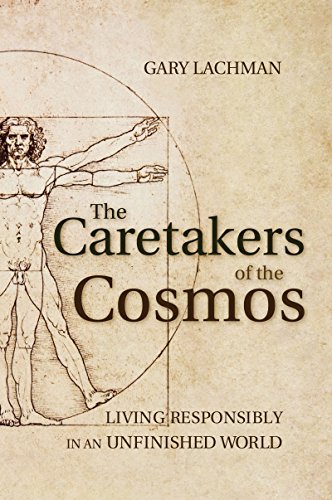
The Caretakers of the Cosmos by Gary Lachman

Another Lachman was on deck
At the end of my review of Gary Lachman’s Beyond the Robot, I joked that I now had a conundrum to resolve: whether to read another Lachman book next or one by Wilson. As it turned out, I had Lachman’s The Caretakers of the Cosmos: Living Responsibly in an Unfinished World (2013) on my Kindle, so it got the nod. Upon plunging in, I realized that I’d read it before, rather hurriedly, probably right after completing A Secret History of Consciousness. I hadn’t reviewed it, and my enthusiasm spurred by an appreciation of Beyond the Robot, I dove back in. I glad that I did.

As he demonstrated in Beyond the Robot and The Secret History of Consciousness, Lachman is a master of exposition, gathering and summarizing the thinking of scientists, philosophers, artists, and occultists with an exemplary thoroughness and economy. He conveys the message of those with whom he disagrees as well as he does for those he promotes. But in addition to the admirable exposition of thinking and history that I’ve quickly come to expect from Lachman, this is not the primary value of his book. For in addition to its exposition of a variety of thinkers and thinking about our place in the cosmos, Lachman has also written a manifesto. To sum up his manifesto in a sentence, I suggest the banner: “It’s our cosmos now, and we ought to do right by it.”

Early in the book, Lachman identifies examples of thinkers whom he believes don't do right by our (human) place in the cosmos. He singles out the French biologist Jacques Monod and the British philosopher John Gray for a more thorough consideration. And later in the book he identifiesSteven Pinker, James Lovelock, Steven Weinberg, Stephen Hawking, Bertrand Russell, Daniel Dennett, and John Searle as those who undervalue, if not deprecate, the role of human agency.   (These are just the names that I recognized, Lachman discusses others, too.) Each of these thinkers in some manner deprecates human agency (conscious decision-making entailing meaningful choice) by emphasizing chance or causal determinism or genetics or entropy or our physical insignificance. But as Lachman points out, if we human are so puny, insignificant, and determined, why do they spend so much time and effort trying to convince us of this? Is it worth the effort? Can you rationally persuade such determined creatures? (I will say that it can be damned hard.). What Lachman is pointing at is a performative contradiction: you contend for a proposition that your actions in making the case negate. Lachman later in the books makes the same point about extreme cultural relativism: how can one argue for all cultural values being equally valid without positing a value that entails negating cultural values that say “our way the only way”? We living, breathing human beings—not chance, genes, or some scientific principle—must make value judgments and choices that affect our world. We humans, as individuals and as a society, are the most complex entities in the known universe. I agree with Lachman: I think we’re pretty damned special. (And also often quite a wreck of a species.)

In distinction from those who hold a pinched view of the role of humans in the cosmos (a term that Lachman unpacks early in the book), Lachman details many examples of those who defend humanity’s unique position. From the myth0-poetic realm, Lachman provides examples both familiar and occult. Among the better-known accounts of humanity’s crucial role in the cosmos comes from the Jewish tradition of Kabbala.  In short, creation is purposely flawed, and humans are dispatched by God to work to set it aright by tikkun, a healing function. This line of thought, this metaphor for the imperfection manifest in the world in which we humans find ourselves, is similar that that found in the Hermetic tradition dating back to the early period of Western culture. In this tradition, Man (used traditionally as including both sexes) is part material and part spiritual and must work diligently to resolve the rift that creation has allowed to occur. Healing this rift gives humankind a divine mission. But what of those who poo-poo such accounts as the stuff of children and want good, sound science and logic? Lachman attends to these as well.

Philosopher-scientists like Henri Bergson, William James, and Alfred North Whitehead, to name three of the more well known among those mentioned, all see the cosmos and the human role as alive with consciousness and possibility in distinction from their more staid peers. Whitehead, it seems, is of particular importance because of his ideas about ‘prehension’ (a measure of experience applying even to inanimate objects) and the contrast between ‘presentational immediacy’ and ‘causal efficacy.' But perhaps of even greater value is Lachman’s reclamation of “philosophical anthropology” in the work of three now largely neglected 20th-century philosophers, Max Scheler (1874–1928), Ernst Cassirer (1874–1945), and Nikolai Berdyaev (1874–1948). Each of these philosophers worked in a different philosophical tradition, but each them grounded the dignity of humanity in its agency (i.e., consciousness) in addition to its biological origins. What all of these thinkers have in common is their appreciation of the importance of consciousness for apprehending the human condition and project.

Two scholars merit attention because of the importance that Lachman attaches to their work. The first is Abraham Maslow. Maslow’s identification of the hierarchy of needs, ranging up from those associated with the physical survival of the organism through those of sociability and esteem, finally up to the level of self-actualization. Maslow’s hierarchy grounds an account of human life on a narrative of an upward arc that endows life with significance and rewards. Maslow’s view contrasts with those others mentioned at the beginning of Lachman’s book (and this review) who tend to ignore or downplay the role of human striving. In writing about Maslow, Lachman also addresses one critique of Maslow: that Maslow’s emphasis on “self-actualization” comes at the expense of concern for society. On one hand, the criticism can be quickly dismissed to the extent that it assumes that self-actualization comes at the expense for regard for others; quite the contrary. Those self-actualized have a greater capacity for helping others. But a stickier problem presents itself: not everyone reaches the panicle of self-actualization. Why not? Many are called; few are chosen. To some, this is an affront to their conviction that all men [sic] are created equal and that inequality arises solely as a result of social and political failure. Lachman slights this perspective. A more nuanced approach is appropriate. Both Plato and Marx are right. Social and political injustices outside of their immediate control play a role in people’s lives. And gifts of genetic endowment and their early environment allow some individuals to climb higher on the ladder of self-actualization and to attain even spiritual heights that most people, even the wealthiest, just don’t aspire to. Lachman reports how Maslow struggled with this issue (which I’d not been aware of before), and Lachman does so as well. The conflict is a real one, especially in a time of rampant demagoguery (you know of whom I speak). The resentment, anxiety, and fear that fuels the lurch toward easy, populist policies is irrelevant—and often detrimental—to traveling the steep road of deepening and expanding consciousness. (Such policies and candidates also are almost always short-sighted if not utterly foolish.) The problem of inequality is one that goes back to Plato (and probably well before), and that does not admit to a fool-proof solution. (For recognizing and exploring the complicated relationship between social-political injustice and individual frailty (sin), I find no better guide that Reinhold Niebuhr.)

The other guide that receives (and deserves) particular attention from Lachman is Iain McGilchrist, the literature professor turned psychiatrist, and author of The Master and His Emissary: The Divided Brain and the Making of the Modern World. In McGilchrist’s work Lachman has a scientist who explores the cultural attitudes that allow us to fall into what Colin Wilson described as “the fallacy of insignificance.” McGilchrist’s scientific background allows him to identify and explain the structural and functional differences in the brain that endow humans with two very different modes of perceiving the world and that can easily come into conflict. Indeed, the humanist side of McGilchrist demonstrates how the history of Western civilization can be seen as a contest between these two perspectives that, when balanced, can provide explosions of artistic inventiveness and human consciousness, but when out of balance, cause suffering and dislocation. Alas, all too much of the 20th century, on into the 21st, has been marked by an imbalance that encourages the fallacy of insignificance and promotes intellectual defeatism and widespread anxiety. Thus, while McGilchrist doesn’t speak directly to the cosmic significance of the human project as do other thinkers discussed by Lachman in this book, McGilchrist’s grounding in science gives his work a unique value when looking at the most immediate realm of current life.

Finally, while realizing I’m leaving out a great deal of the figures and topics that Lachman addresses in this combination of exploration and manifesto, I want to note Lachman’s reference to the work of Owen Barfield. Lachman is no new-comer to Barfield, as I mentioned in my review of A Secret History of Consciousness, Lachman gave Barfield a lot of attention in that earlier work. In this book, Barfield’s ideas about “participation” receive attention. Barfield believes that humans have undergone—are undergoing—an “evolution of consciousness.” Early humans, arising out of the natural world, went from a sense of “direct participation” in the greater environment to the perspective of a detached observer. Now, Barfield suggests that humanity is in a position to obtain “final participation,” which reunites human consciousness with the phenomenal world. This can all seem so abstract, but in using language or in attempting to appreciate history, we find that if we cultivate our awareness of an environment and allow it to sink in, the greater the sense of the situation that we’re contemplating and participating in. John Lukacs's essay, “Putting Man Before Descartes,” uses ideas expounded by his friend Owen Barfield, and he draws upon both history and 20th-century physics, arguing that knowledge can never be “objective” or its converse, “subjective,” but it  is always “personal” and “participant.” Lukacs writes:

Knowledge, which is neither objective nor subjective, is always personal. Not individual: personal. The concept of the individual has been one of the essential misconceptions of political liberalism. Every human being is unique, but he does not exist alone. He is dependent on others (a human baby for much longer than the offspring of other animals); his existence is inseparable from his relations with other human beings.

But there is more to that. Our knowledge is not only personal; it is also participant. There is—yet there cannot be—a separation of the knower from the known. We must see further than this. It is not enough to recognize the impossibility (perhaps even the absurdity) of the ideal of their antiseptic, objective separation. What concerns—or should concern—us is something more than the inseparability; it is the involvement of the knower with the known. That this is so when it comes to the reading, researching, writing, and thinking of history should be rather obvious. Detachment from one’s passions and memories is often commendable. But detachment, too, is something different from separation; it involves the ability (issuing from one’s willingness) to achieve a stance of a longer or higher perspective. The choice for such a stance does not necessarily mean a reduction of one’s personal interest, of participation—perhaps even the contrary.

Indeed, Lukacs goes on:
           
And now a last step: We must recognize, contrary to all accepted ideas, that we and our earth are at the center of our universe. We did not create the universe, but the universe is our invention, and it is, as are all human and mental inventions, time-bound, relative, and potentially fallible.
Because of this recognition of the human limitations of theories, indeed, of knowledge, this assertion of our centrality—in other words, of a new, rather than renewed, anthropocentric and geocentric view of the universe—is not arrogant or stupid. To the contrary: it is anxious and modest. . . .

The known and visible and measurable conditions of the universe are not anterior but consequent to our existence and to our consciousness. The universe is such as it is because in the center of it there exist conscious and participant human beings who can see it, explore it, study it. (For those readers who believe in God: the world and this earth were created by Him for the existence and consciousness of human beings.) This insistence on the centrality and uniqueness of human beings is a statement not of arrogance but of humility. It is yet another recognition of the inevitable limitations of mankind.
Id.

(Some good news: Lukacs has a new book scheduled for release next month, We Are at the Center of the Universe, which, judging by its title and the publisher’s website, will further develop his thoughts on this topic.)

Thus, through the musings of another great thinker, Barfield’s insights gain new credence and application.


In the end, as a formal matter, I take the position of agnostic on the issue of the ultimate or cosmic significance of my life and that of my fellow humans,  past, present, and future. Such an ultimate conclusion, like some of the greatest issues confronting human existence, may be unknowable, at least to a limited, fallible, and spiritually myopic person such as me. However, drawing on Pascal and William James, I shan’t let this stop me. From Pascal, I’ll take the idea of a wager; not on the existence or non-existence of God or of heaven and hell, but on a more immediate issue: the value of a significant versus an insignificant life. Is a life informed by a sense of significance, whether emanating from the love of family and friends and community—even without cosmic significance—better than a life without significance and meaning? I can’t have read and attempted to digest so much of Gary Lachman or Colin Wilson—to name just two immediate culprits—not to answer with a resounding, affirmative “Yes!” And from William James, I take the will to believe. James, in the midst of a disabling ennui, chose to believe in free will and in his ability to make choices and improve—and he did. Thus, we can opt to say “Yes” to life, to meaning and significance even without an assurance of an ultimate guaranty. We can endow life—even the quotidian affairs of daily life—with meaning and significance that will give us the ability to carry on, and perhaps find even more meaning and significance emerge in our lives. The emergence of meaning and significance is the story of humankind (which Lachman addresses and I’ve shortchanged here). Humans have become more significant, more free, and more vital over the course of human civilization. Progress? In some measure, certainly; guaranteed? Not in the least. But in the end, I think Lukacs is right: we humans—frail, sinful, ignorant (chose your term) are at the center of the world, even the Universe, and we should get to it.