Tuesday, October 13, 2020

Thoughts for the Day: Tuesday 13 October 2020


As the writer William Saroyan put it: “I resented school, but I never resented learning.”

Sherlock Holmes, said: “You see, but do not observe. The distinction is clear.”  Yes, the power of observation!
“Let’s suppose I had never met Harry Truman and didn’t know anything about him and had never seen a photograph of him. How would you describe him to me?” There was a pause, and he said, “Complicated.” Of course, we are all more complicated than we appear. Everybody is hard to know, particularly someone in public life. But Harry Truman was a much more complicated and interesting person than most of us have been led to believe. He was far better educated, far more learned, far more placid, calm, conciliatory, thoughtful. He never raised his voice among those who worked for him. He was never known to dress anyone down in the White House, never known to fly off the handle or become abusive. He did not like confrontations. In his own family, he was known as “The Peacemaker.” (He came from a very, truly “feisty” family.)
Studies have shown that slowing down and focusing more attention on detail will actually train your brain to assimilate the good habit of becoming more observant and productive.
Empathy is a tool for building people into groups, for allowing us to function as more than self-obsessed individuals. —Neil Gaiman...

Even in the personal sphere, where no universal laws can ever determine unequivocally what is right and what is wrong, man’s actions are not completely arbitrary. Here he is guided not by laws, under which cases can be subsumed, but by principles—such as loyalty, honor, virtue, faith—which, as it were, map out certain directions.

The Wedge: Evolution, Consciousness, Stress & the Key to Human Resilience by Scott Carney


Published in 2020


I read The Wedge as a sequel to Carney's earlier book What Doesn't Kill Us, which reported about his dive into the Wim Hof Method. The Wim Hof Method involves a combination of cold exposure and intense breathing and breath-holds that seem to allow the nearly impossible in terms of control over autonomic functions in the body. What Doesn't Kill Us was intriguing, to say the least, as Carney had begun his inquiry with the idea of debunking the wild-eyed Dutchman. But by the end of his time with Wim Hof, Carney concluded that Wim Hof was on to something, and Carney was all in. And when I say "all in,' this includes a climactic climb of Mt. Kilimanjaro in near-record time while dressed only minimally--and even in the heart of Africa, it gets mighty cold there. This experience triggered Carney to look more deeply into what happens with the Wim Hof method and how it might be duplicated in some measure by other techniques. And thus, The Wedge.

Carney lays out his hypothesis upfront in clear, simple (but not too simple) prose: 

So what is the Wedge, exactly? The most comfortable way to think about the Wedge is that it is a choice to separate stimulus from response. . . . The Wedge is the measure of control that we all have to insert choice into the space between sensation of the outside world and the physiological responses that it triggers. . . [I]nevery situation a human might get themselves into, there’s always a tension between the challenge (stress) and the built-in automatic reactions. The Wedge intercedes and introduces a measure of control in things that otherwise feel uncontrollable.

Carney then compares this "wedge" space with our normal ego as it functions: 

The tricky thing about understanding the Wedge, and what makes it so incredibly difficult to explain, is that you—or rather, your ego—is not always the thing in charge. Remember, there is no self. All the parts of an individual and environment work together to generate an illusion of a self. Ego is just a perspective on the reality that we’re part of a superorganism.

Carney continues with some greater in-depth thoughts about how the wedge may work, and he notes three different pathways by which the wedge might operate: at the point of stress (from the environment), at the point of (bodily) sensation, and in our "mindset" or "orientation;" that is, "your mental attitude, expectations, emotions and disposition at the time that you receive sensation from your nervous system." From this deployment of a mindset, one can in some sense pre-load one's responses to stresses and sensations to allow a wedge to form. Carney also makes an important point about emotions, writing that

Emotions create a symbolic link between what’s happening in the world and what occurs inside of our bodies. And because evolution is a rather slow process, it would be hubristic to think that the sensory and emotional tools that Homo sapiens have access to appeared fully formed when the first member of our species started walking the Earth between 200,000 and 300,000 years ago.

Indeed, Carney argues 

Inserting a wedge requires learning the language that your body uses to communicate information about the environment. Its syntax and grammar aren’t made of words; they’re sensation, emotion, and keen observation of the links between your mind and the external world. 

Before I conclude this summary tour of Carney's thoughts and theories about the Wedge before he jumps into a series of concrete instances of its manifestations, I must note his discussion of fear, that most potent and often vexing emotion.

How we resolve the tension between risk and reward defines who we are. And fear is a guidepost for how we use the Wedge. It is as much an involuntary response to a prediction of the future as it is a sensation that immobilizes our biology and stops us from taking action. Mastering fear doesn’t mean ignoring danger, but rather finding a reason that makes danger worth it—separating the stimulus from the response.

Andrew Huberman, a Stanford neuroscientist, uses video from divers who investigate great white sharks to elicit fear in test subjects in his lab. (It would work for me.) Carney quotes and summarizes comments from Huberman about fear:

Fear would have meant he [the diver] was out of control. No choices. So maybe he wasn’t exactly afraid in the moment. It was something else. Huberman decides to paraphrase the great horror writer Stephen King: Fear has a lot to do with time frames. Before the event, a person experiences the dread of anticipation; during the event, there’s terror when they’re helpless in the moment; and after it’s over, a person remembers the experience as horror.

Carney continues:

Fear is an excellent inflection point to demonstrate the physiology of the Wedge. It’s powerful, visceral, has a strong influence on our behavior, and yet also preserves our ability to make choices about our actions. We experience fear on both a biological and psychological level. It triggers the fight-or-flight response just as reliably as the cold does, issues a burst of adrenaline, secretes sweat, dilates pupils and ramps up the heart rate. However, with fear, our bodily reactions are based on sights, sounds and our own idiosyncratic assessment of how things are changing around us in a bad way. It starts in the mind, not the body. And this is why I hope that his research into fear can help me dissect every other emotional and environmental interface that contributes to the Wedge. 

I spend a good deal of space quoting Carney on fear because it seems to me that in our world--and certainly its always been so in the human world--fear drives much of our behavior. Indeed, even though we no longer face man-eating beasts or the like, we suffer less tangible but more chronic fears that lead to more subtle reactions, such as "anxiety." Perhaps we do live in "The Age of Anxiety" as suggested by the W.H. Auden poem and the Scott Stossel non-fiction book. My own conclusion is that fear is an excellent and necessary warning system but a terribly unreliable guidance system. But because it's such a primal emotion, it's not easily corraled by the thinking brain. If Carney's book proves to have any value--and I certainly believe that it does--it's because his theme of dealing successfully with fear is the crux of the Wedge.

Lest I give you the wrong impression, Carney's book isn't simply an extended essay conjecturing about how the world and our bodies work. The other part of the book is a series of personal experiences and reporting on ideas and techniques about how we can deal with our world, especially fear-creating or uncomfortable experiences, in a manner that improves our resilience. One of the activities that Carney experiences and reports upon is playing catch with a heavy kettlebell. (A kettlebell is an iron ball with a handle attached that allows the user to swing it and thereby create a ballistic motion. It's an increasingly popular form of exercise imported from Russia, and, I must add, an excellent addition to any home gym.) Playing catch with a heavy object that will wreak havoc if it lands on the wrong place (such as your foot) requires an intensity of mind that must move beyond fear to successfully negotiate such a high-stakes game of catch. Carney also explores a variety of breathing techniques in addition to the standard Wim Hof method that he's been working with now for several years. He explores "the potato diet" and the use of saunas (in Lithuania, no less), flotation tank experiences, and two drugs: MDHD (Ecstacy) and ayahuasca. In undertaking the latter to experiences, Carney expresses the most hesitation. As he notes with all of his other wedge experiences and experiments, he could bail at any time, such as simply halting a breathing technique or quitting a game of kettlebell catch. But during a drug trip, Carney knew he couldn't simply stop and get off at any time that he wanted. He was therefore prudent. With the MDHD (Ecstasy), he took the drug along with his wife and under the guidance of two experienced therapists. They used the occasion as an opportunity for couples therapy. Carney also went to Peru to try ayahuasca, and again Carney expresses and practices what seems a reasonable degree of prudence in dealing with a substance in a land and culture far from his own.

I found the two experiences with the two different drugs the least informative, but I don't say that to denigrate those experiences or to criticize Carney. From what he says and my understanding of those types of experiences in general, I believe that they are the most complex to predict and describe. Most of the other experiences that he undertakes to explore and expand his wedge hypothesis are simpler and easy to "do at home," and he provides self-practice advice in a section on the end about "Techniques" for the (non-drug) practices.

At one point in thinking about writing this review, I was going to describe the book as having two parts: one part, which is represented by the several quotes at the beginning of this review, center on the wedge hypothesis and its grounding in science, and the other part about Carney's experiences and observations. But I realized that the book is too integrated to describe it this way. Carney's self-experimentation, observations, reporting, conjectures, and hypotheses are distributed throughout the book and make it an integrated whole. This scheme makes the book a delight to read and ponder. I believe that Carney is on to something here (and "it" has been "here" for all of human history), and he's bringing what has been largely lost (especially in modernity) back into focus. Thus, it's a book that is at once enlightening and entertaining, and well worth the read.

Monday, October 12, 2020

Thoughts of the Day: Monday 12 October 2020


No matter what you want to achieve, playing offense begins by recognizing the two basic lessons from chapter 1: Your supply of willpower is limited, and you use the same resource for many different things. Each day may start off with your stock of willpower fresh and renewed, at least if you’ve had a good night’s sleep and a healthy breakfast. But then all day things chip and nibble away at it. The complexity of modern life makes it difficult to keep in mind that all these seemingly unrelated chores and demands draw on the same account inside of you.
The problem with a purely material and rational society is captured by two well-known Biblical sayings: “Man shall not live by bread alone,” and “Where there is no vision, the people perish.”
Premise 8: The project of evolving consciousness through services of goodness, teachings of truth, and creations of beauty is facilitated and empowered through the use of evolution’s own method of development—the ongoing dialectical synthesis of existential polarities.
Just because you don’t immediately, or perhaps ever, see the virus of behavior leap from host to host doesn’t mean it isn’t leaping. It is, relentlessly. Most people are wired for strong reciprocity, which means we repay good with good and bad with bad, and are willing to repay bad with bad even at some personal cost, just to reinforce group norms.
Sextus describes the work of collecting and opposing arguments as a therapy used to cure the disease of opinions. He was a medical doctor as well as a philosopher, and his view of philosophy was essentially therapeutic. He was a professional purveyor of Skeptic remedies, a practicing Skeptic doctor, who engaged in philosophy not to seek the truth, but to help people see the limitations of their points of view.
And Hannah Arendt for the finale:
Kant’s famous categorical imperative—“Act in such a way that the maxim of your action could become a universal law”—indeed strikes to the root of the matter in that it is the quintessence of the claim that the law makes upon us. This rigid morality, however, disregards sympathy and inclination; moreover, it becomes a real source for wrongdoing in all cases where no universal law, not even the imagined law of pure reason, can determine what is right in a particular case.


Friday, October 9, 2020

Thoughts for the Day: Friday 9 October 2020


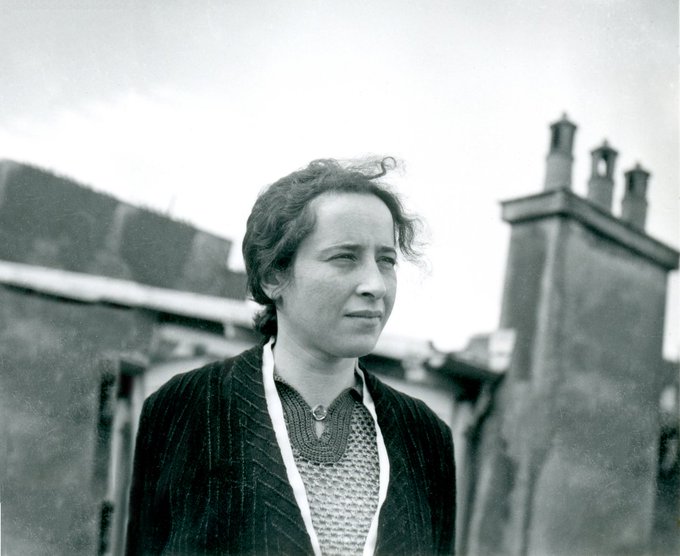
"What is most difficult is to love the world as it is, with all the evil and suffering in it."

— Hannah Arendt
Image

Specifically there are universal natural preferences at the physiological level for harmony over dissonance.

"We received this world as an inheritance from past generations, but also as a loan from future generations, to whom we will have to return it!"

@Pontifex/Pope Francis
(courtesy of Timothy Snyder)

But another important reason for the feeling of loneliness arises from the fact that our society lays such a great emphasis on being socially accepted. It is our chief way of allaying anxiety, and our chief mark of prestige. Thus we always have to prove we are a “social success” by being forever sought after and by never being alone.
And for the deeper dive, from Hannah Arendt:
The distinction between the citizen and the individual becomes a problem as soon as we become aware of the discrepancy between public life, in which I am a citizen like all other citizens, and personal life, in which I am an individual unlike anybody else. Equality before the law is not only the distinguishing feature of modern republics, but also, in a deeper sense, prevails in constitutional governments as such, in that all people living under a constitution must equally receive from it what is rightfully theirs. The law in all constitutional forms of government determines and provides suum cuique: through it everybody comes into his own. The rule of suum cuique, however, never extends to all spheres of life. There is no suum cuique which could be determined and handed to individuals in their personal lives. Arendt, Hannah. Essays in Understanding, 1930-1954 (pp. 333-334). Knopf Doubleday Publishing Group. Kindle Edition.


Wednesday, October 7, 2020

Thoughts of the Day: Wednesday 7 October 2020


At a common sense level, anyone who is irreverent about his or her own well-being cannot be charged with any other responsibility, and certainly not with important matters of state.


The difference between the Gnostics and the Hermeticists is that Hermetic man doesn't want to escape from the world, but to realize his full potential within it, in order to embrace his obligations, so that, as Hermes tells Asclepius, he can 'raise his sight to heaven while he takes care of the earth'.
To reiterate, the spiritual and political realms are necessarily governed by different moral codes, meaning that absolute standards cannot be applied to politics. Like Jesus, who rendered unto Caesar what was Caesar’s, the Buddha therefore left worldly affairs to the civil authorities. So it may be that the best and noblest political act is to forget politics and to devote ourselves primarily to training our minds in wisdom and our hearts in compassion, even as we continue to live as householders. The above is not a call to apathy or passivity. But the Buddha’s way is to be clearly aware of the world as it actually is—not as we conceive it to be or would like it to be—and then to respond accordingly.

And for the deeper dive, back to Hannah Arendt's Essays in Understanding and in particular, her "On the Nature of Totalitarianism: An Essay in Understanding."
Montesquieu was the last to inquire into the nature of government; that is, to ask what makes it what it is (“sa nature est ce qui le fait être tel,” L’Esprit des Lois, Book III, ch. 1). But Montesquieu added to this a second and entirely original question: What makes a government act as it acts?
....
What is it that makes a state recognizable as a republic, a monarchy, or a tyranny? After giving the traditional answer to the traditional question—affirming that a republic is a constitutional government with the sovereign power in the hands of the people; a monarchy, a lawful government with sovereign power in the hands of one man; and a tyranny, a lawless government where power is exercised by one man according to his arbitrary will—Montesquieu adds that in a republic the principle of action is virtue, which, psychologically, he equates with love of equality; in a monarchy, the principle of action is honor, whose psychological expression is a passion for distinction; and in a tyranny, the principle of action is fear.
Arendt, Hannah. Essays in Understanding, 1930-1954 (p. 330). Knopf Doubleday Publishing Group. Kindle Edition. 

Monday, October 5, 2020

Thoughts for the Day: Monday 5 October 2020


Writing of the literary influences over the French Revolution, Tocqueville marveled at ‘the most unusual historical situation – in which the entire political education of a great nation was carried out by men of letters’: Under their lengthy discipline, in the absence of other leaders, and given the profound ignorance of practice from which all suffered, the nation read their works and acquired the instincts, the cast of mind, the tastes, and even the peculiarities of those who wrote. So that when the nation finally had to act, it carried over into politics all the habits of literature.
We suffer because we cannot spontaneously master the ingredients of fulfillment.
“There is a role for carrots and sticks, but to rely on carrots and sticks alone is effective only when we employ donkeys and we are sure exactly what we want the donkeys to do.”
IN ORDER TO fight totalitarianism, one need understand only one thing: Totalitarianism is the most radical denial of freedom.


Andrew Sulivan on Trump the Tyrant

This essay by self-described conservative Andrew Sullivan, an Oxford-trained Ph.D. in politics, prompted my first blog about Trump in May 2016. It was based on Sullivan's essay about Trump the demagogue published around that time.(https://sngthoughts.blogspot.com/.../andrew-sullivan...). Sulivan here updates his analysis using Shakespeare's Richard III and Stephen Greenblatt's book TYRANT as the touchstone of his analysis. His analysis of our situation with this tyrant is well worth your time. We need to understand what we're dealing with!

Sunday, October 4, 2020

Thoughts for the Day: Sunday 4 October 2020


We study history in order to see more clearly the situation in which we are called on to act. Hence the plane on which, ultimately, all problems arise is the plane of ‘real’ life: that to which they are referred for their solution is history.

But why are so many people nowadays so afraid? What is it about the rising stresses in our world that so scares us? Part of the answer, of course, is that countless people have strong material cause to be afraid— their employment is more precarious, the political power of their social groups is waning, their medical costs are rising (especially in the United States), their social support networks are fraying, and on and on. But another key part of the answer, I believe, lies in how the stresses threaten vital elements of our worldviews. Because our worldviews satisfy some of our most fundamental psychological needs, when they’re seriously threatened, we can get very scared.
“hope that,” which is a passive and timid locution, and “hope to,” which is active and bold— a difference that bears crucially on the issue of our agency as we try to deal with humanity’s problems.
Step one in your search for happiness is to continually work toward having control of your schedule.
No one can see the future, you might think, but as Philip Tetlock and Dan Gardner have shown, some people really are “superforecasters”; they have an uncanny ability to predict what’s going to happen. Notably, these particular Jedi tend to agree with statements like these, which might be taken as part of a real-world Jedi Code:       
1.  Nothing is inevitable.       
2.  Even major events like World War II or 9/11 could have turned out very differently.      
3.  People should take into consideration evidence that goes against their beliefs.       
4.  It is more useful to pay attention to those who disagree with you than to pay attention to those who agree.

Studies of food webs or trade networks, electrical systems and stock markets, find that as they become more densely linked they also become less resilient; networks, after all, propagate and even amplify disturbances. Worse, the more efficient these networks are, the faster they spread those dangers.

Long periods of peace and prosperity often provide the conditions for spreading capture by elites, which can lead to political crisis if followed by an economic downturn or external political shock.