Showing posts with label Mark Sisson. Show all posts

Thursday, August 25, 2016

Wherein I Take the @nntaleb IYI Test & Fail

Your image of this writer
Herr Doktor Professor: stern master
I’m going to take the Nassim Nicholas Taleb (NNT) test to determine if I am an IYI (“intellectual yet idiot”). Of course, right off the bat you can see I’m trying to play chess with Washington Square hustlers or a pick-up game with NBA studs—I’m out of my league here. I’m not an intellectual, I’m not an academic, and I don’t write for a living outside of legal briefs and memos. I’m just a practicing lawyer. But I do have an abiding interest in ideas. I’ve always been fascinated by how the world works, how it came to this point, and how we might tinker with it. I've enjoyed and believe that I've benefited from reading NNT's books (Bed of Procrustes excepted). But I must emphasize, unlike NNT, I’m an amateur, not a flâneur.

So with my disqualifications in place, let me go through the NNT test, line-by-line, to obtain my ranking. Taleb’s criteria are in plain type followed by my responses in italics.

What's IYI?

 Intellectual Yet Idiot:  [I just said, I’m not an intellectual. Whether I’m an idiot or not is open to further discussion. I imagine—nay, know—there are compelling arguments in the affirmative for this conclusion]

semi-erudite bureaucrat [I am not now nor have I ever been a member of the bureaucratic party. I’ve been either in a partnership or self-employed for about 30 years]

who thinks he is an erudite [I aspire to erudition, I do not claim it];

pathologizes others for doing things he doesn't understand not realizing it is his understanding that may be limited [Maybe, sometimes. Who hasn’t made this error?];

imparts normative ideas to others [Like NNT?]:

thinks people should act according to their best interests [A question of definition here: narrowly or broadly defined? And note “should”, not “do”]

*and* he knows their interests, particularly if they are uneducated "red necks" or English non-crisp-vowel class. [Well, to some extent, yes. I’ve had people pay me for my advice & opinions for over 30 years. On the other hand, I hope I have some sense of humility. Do you know this word, “humility”?]

More socially
subscribes to the New Yorker [Yes, I do. Are you suggesting Paris Match instead? In the New Yorker I skip the ads and focus more than I should on the cartoons; indeed, we have a whole book of New Yorker cartoons—quite fun. Is there a penalty for having a New Yorker book--or two?];

never curses on twitter [Although known on occasion to use profane, scatological, or crude language in person, I abjure it in public discourse. There’s already enough vulgarity out there—plus someone would always out do me.  I do, however, admit to excessive snark on Twitter. Perhaps there’s a New Year’s resolution in there]; 

speaks of "equality of races" and "economic equality" but never went out drinking with a minority cab driver [We’ll I’ve lived and hung with people of different races, and I’m in favor of a greater degree of economic equality than what we currently experience. I grew up middle-class in a small Iowa town where rich kids (by local standards) pretty much had to mingle in school with poorer ones because there was only one school and too few of us to avoid some mingling. As to drinking with a cab driver, no; but with my fellow road construction workers? Oh, yeah. It was, you may say, satisfactory]; 

has considered voting for Tony Blair [N/A. I’m not a Brit! But I did vote for Bill Clinton 2x & will for HRC (see below)];

has attended more than 1 TEDx talks and watched more than 2 TED talks [Never been to a TED Talk, but I’ve watched more than two. I rather like them on the whole. I’ve also watched NNT on YouTube at festivals (presumably not literary and not in the UK). How does that score? BTW, some of my favorite peeps have given a TED Talk]; 

will vote for Hillary Monsanto-Malmaison because she seems electable [Deferred to the finale];

has The Black Swan on his shelves [I have two copies: one hardcover in storage & one on my Kindle. Do I get extra credit?]

but mistakes absence of evidence for evidence of absence [It’s a catchy slogan but I have to bone up to determine if the converse is also true: absence of evidence may be evidence of absence. In which case, how do we distinguish the two instances? I will say this from my humble perch as a practicing attorney: try convincing a judge or a jury that X exists when you have no evidence (an absence of evidence) that X exists—a case not to take on a contingent fee. If I find no evidence of tigers in my yard (sightings, paw prints, scats, animal carcasses, etc.), then it's highly likely—although not certain—that there are no tigers in my yard. Despite appropriate and convincing examples in The Black Swan, NNT tries to skate too far with this slogan];

is member of a club to get traveling privileges [no, just credit card miles; no clubs. I wouldn’t want to belong to any club that would have me as a member!];

if social scientist uses statistics without knowing how they are derived [Not a social scientist. I’m respectful but wary of statistics, suspicious that they may conceal lies and damned lies];

when in the UK goes to literary festivals [I’ve never been to a literary festival in the UK, but when in India I go to the Jaipur Literature Festival. How did you like your sojourn there, NNT?];

drinks red wine with steak (never white) [Usually red, but then I’m from the Midwest and care more about the steak anyway];

used to believe that fat was harmful and has now completely reversed [True--after learning about Art DeVany in NNT’s Fooled By Randomness (read in 2007), and then on to Gary Taubes, Mark Sisson and other others of their ilk];

takes statins because his doctor told him so [No, not necessary. Good cholesterol profile because of good fats; see the previous answer];

fails to understand ergodicity and when explained forgets about it soon later [Got me! I’ll check it on Wikipedia later. Allowed?];

doesn't use Yiddish words [Only a schmuck wouldn’t!];

studies grammar before speaking a language [no, my wife—an ESL teacher—wouldn’t let me be so foolish. Besides I need to eat and use the restroom];

has a cousin who worked with someone who knows the Queen [Really? Come on, are all your readers from the UK? I don’t have a Queen];

has never read Frederic Dard [Who? Okay, you got me. But have you read Hammett, Chandler, McDonald, Elmore, Greenleaf—you know, authors that others read? Okay, the last name was a plug for my cousin],

Michael Oakeshott [no, on my list to read, but you’ve read Collingwood & rate him ahead of Oakeshott, correct?],

 John Gray [short pieces only],

or Joseph De Maistre [read about him in the autumn of 1975 in Shklar’s After Utopia & he didn’t seem worth my time; on review, he still doesn’t. Time better spent on Burke. Yes, I know, but Burke is Anglo-Irish and writes in English]; 

has never gotten drunk with Russians and went breaking glasses [Guilty, but I don’t feel guilty];

doesn't know the difference between Hecate and Hecuba [Not off the top of my head, no]; 

doesn't know that there is no difference between "pseudointellectual" and "intellectual" [I’m not sure, but you’ll tell me]; 

has mentioned quantum mechanics at least twice in the past 5 years [No, I don’t understand it, although from what I know, it is intriguing];

knows at any point in time what his words or actions are doing to his reputation [I follow GW (for non-Americans, George Washington) do attempt to maintain a good reputation. I don’t buy the Trumpian notion that any publicity is good publicity.]

But a much easier marker: doesn't deadlift. [I do, but not as often as I should. Do you get credit for kettlebell swings and standing presses? Pavel would give me credit]

The IYI, Taleb adds, look down at the great unwashed Plebes who haven't read Foucault in college [Mme neither, I’m too old, he wasn’t a big deal then]

and treat them like crap - as if they were inferior forms of life incapable of directing their own affairs. [Nope, I don’t truck with that attitude].

But when you make them feel uncultured, lacking in intellect, and unlearned, like all bureaucrao-journalists, being all tawk, they get very queasy: hit them where it hurts.

They are arrogant down, they will be arrogantified from up.

Speaking of arrogance, back to my deferred answer about “will vote for Hillary Monsanto-Malmaison because she seems electable.” A few words:

NNT is using—what is to his mind—guilt by association. Perhaps it’s my attorney-mind or perhaps my wishful thinking that reason can ultimately trump [irony] innuendo, but I have to call “baloney!” on this. (I concede demerits here for not swearing.) Maybe NNT has a good argument about Monsanto and GMOs. As a matter of personality and pragmatics, I give a lot of credence to the precautionary principle. But a lot of those who’ve given these issues serious thought disagree with NNT about the safety of GMOs. I don’t claim to have a definitive answer. Nor does Hillary Clinton, I suspect. (Neither on her campaign website nor in an issues Wikipedia entry could I find anything about GMOs.)  The meme NNT wants to draw upon is that HRC is an insider and therefore in cahoots with multi-national corporations who want to mess with our food while lining their pockets. (Can I get credit for “cahoots” as exotic, albeit not Yiddish?)  Well, okay, the part about the corporations is probably true, but it assumes a naïve understanding of what a person—even a president—knows or can do about any particular issue, especially one not likely to affect the outcome of an election.

The other point is that I support Hillary Clinton for president. I don’t do so because she’s “electable”, I do so because she is the best choice for my vote, and has been since the beginning of the primary season. An unusually large number of people want to kvetch (award Yiddish use points please) about the candidates this year, and if it makes them feel better, go ahead. As Clay Shirky has so persuasively explained, in the end, one of two persons will be elected the next president. One is an experienced prototypical politician with insider experience and credentials—thank goodness! (Non-swearing demerit acknowledged.)  The other is a demagogue. Each election tests a voter’s political intelligence and savvy in deciding whom to vote for or (if politically active), whom to support. But this year it isn’t just a test of political judgment, it’s a test of character and of fundamental issues of political morality. To suggest otherwise is reprehensible.


And if supporting Hillary Clinton means I fail the test, then screw the test! (Can I get half-credit for this last phrase, Herr Doktor Professor?)

Monday, August 17, 2015

Fat Chance by Dr. Robert Lustig, M.D.


Few topics are as fraught with controversy as diet. Everyone has one (whether recognized as such or
not), and most everyone has a high degree of confidence that their chosen diet is The Right One. However, most everyone knows that we’re suffering from a pandemic of obesity that continues to grow (literally) and that threatens to shorten life expectancy in the next generation. If you don’t trust statistics about this burgeoning problem, then fly around the world and see for yourself. At airports, it’s easy to spot people likely to be Americans: we’re No. 1—in waist girth and fat fannies. And to make matters worse, the rest of the world is catching up quickly. While most Indians and Chinese remain slender, the younger and wealthier among them are getting bigger and puffier, including more and more kids.

So what do we do about it? We can safely say that we don’t lack for advice. Diet and health books and articles abound. And they all seem to contradict one another. From vegan to Primal/Paleo, from low-fat to low-carb, from Pritikin to Ornish to Atkins we’ve been told, “This is the true path”. We’ve seen villains come and go: fat, salt, meat, carbs—just about everything edible will either kills us or save us. (Which is probably true, but that’s diving to a really deep level.) So what’s a person to do? Keep inquiring.

I’ve been reading books of fitness and nutrition for a long time. I’ve always been interested in how the human body works, how to improve performance, and I aspire to die young when I’m old. Thus, I’ve tried diet experiments of all sorts, including a stint as a vegetarian and fasting. The vegetarian thing was too boring to continue (I love a good steak), but occasional fasting remains a part of my repertoire, albeit not used enough. I’ve read John Robbins of Healthy at 100 (vegan-ish), Colin Campbell of The China Study (meat is the culprit), and Pritikin and Ornish pieces (very low fat—fat bad). I’ve also read in the Paleo/Primal world of Art De Vany and Mark Sisson (among others), and I’ve read Gary Taubes (Good Calories, Bad Calories), who comes down close to the Paleo/Primal perspective. (Taubes's perspective comes mostly from scientific studies for the last two centuries and anthropologic data more than from an evolutionary viewpoint.) I’ve also learned from bio-hacker Dave Asprey (The Bulletproof Diet) and Dr. Peter Atilla, an N=1 student of a ketogenic diet.

I don’t follow any one lead strictly, although the Paleo/Primal, and lower-carb perspectives guide my current train of thought and practice (with some grains and some dairy—who’s perfect?). And I live in China, home of rice and of wheat noodles. Yet, for some reason, I couldn’t resist reading Lustig’s book, although I feared it would only add to my uncertainty and create a risk of dietary nihilism. 

I’m happy to report that I’m glad I read the book and that as a result, I’ve altered my diet. 

Dr. Lustig. Note the cup.
Some may recognize Lustig’s name for his viral YouTube video, "Sugar: The Bitter Truth". (Viral by health and diet standards, anyway. We’re talking 5,856,147 viewings; we’re not talking “Gangnam Style” (239,582,696 viewings) or “What Does the Fox Say?” (537,697,900 viewings) —priorities, right?) Or perhaps you’ve seen or heard about his “60 Minutes” interview. But now he’s written a book, and it’s the most comprehensive look at the obesity epidemic that I’ve seen or could imagine.  

Let me warn you if you’re going to read this book: it covers everything from biochemistry to public policy—and rightly so, because it’s all a part of the understanding the challenge of rampant obesity. So brush off your Krebs cycle cobwebs and put on your political scientist hat to read this. Just kidding! Don’t panic. Dr. Lustig, aiming at a general audience, doesn’t presume you know the process of the Krebs cycle or that you have your degree in biochemistry. He explains it all very well for the lay person. Ditto with the public policy. It’s a matter of clear conceptual thinking and understanding the incentives, and he does just as well in this field as he does with the biochemistry and endocrinology.

In making the rounds with Dr. Lustig, the first thing that you learn is that a calorie is not just a calorie, something that I’d learned earlier from Gary Taubes’s brilliant Good Calories, Bad Calories. A gram of protein, of fat, or of carbohydrate is not just a measure of energy (calorie), but a complex chemical that serves as a signal to the body. In other words, the body responds differently to fats than to proteins than to carbs. Put simply, based on evolution and the uncertain and often sparse food environment in which humans evolved, we developed the capability to store sugars (as in fruit) as fat when it exceeded our immediate energy needs. Insulin, which regulates sugars, prompts the body to store excess sugars as fat. Essential for survival in the wild. A killer in the convenience store. 

The other key biochemical and physiological fact is that fructose (the sweetness in any sugar) is a potential problem. It’s found in any fruit off the vine or tree, honey, processed cane sugar (table sugar), high-fructose corn syrup, and every other natural sweetener. As Dr. Lustig writes: “Finally, we come to the Voldemort of the dietary hit list: the sweet molecule in sugar. If it’s sweet, and it’s caloric, it’s fructose.” Lustig, Robert H. (2012-12-27). Fat Chance: Beating the Odds Against Sugar, Processed Food, Obesity, and Disease (p. 100). Penguin Publishing Group. Kindle Edition. And what’s so bad about fructose? When we consume fructose, especially in large quantities as we are wont to do today, and it isn’t needed right away for energy, it's stored as fat (via insulin, the fat-storage hormone). The more sugar we eat, the more fat we create. (Starches, glucose without fructose, do something similar, but as Lustig puts it, starches will make you fat, but they won’t make you sick.) 

Here’s where a difficult problem that has long perplexed me (and I imagine others) becomes resolved. As I mentioned above, there are all sorts of diets, including some that have survived the test of time (i.e., not just fads) that seem to contract one another, but they have one common trait. Lustig decodes the dietary Rosetta Stone: 

Can low-fat and low-carb diets both be right? Or both wrong? What do the Atkins diet (protein and fat), the Ornish diet (vegetables and whole grains), and the traditional Japanese diet (carbohydrate and protein) have in common? On the surface they seem to be diametrically opposite. But they all have one thing in common: they restrict sugar. Every successful diet in history restricts sugar. Sugar is, bar none, the most successful food additive known to man. When the food industry adds it for “palatability,” we buy more. And because it’s cheap, some version of sugar appears in virtually every processed foodstuff now manufactured in the world. Sugar, and specifically fructose, is the Lex Luthor of this story.
Id. 117-118

By the way, if you thinking “Oh, damn! No fruit?” you’re like me. But Lustig points out that fruit—real fruit—always comes with fiber. And fiber prevents all that fructose from flooding into the body. But beware! Orange juice and other fruit drinks—even 100% fruit—along with “juiced” fruits that destroy the fiber, can provide a fructose jolt even greater than a can of Coke. 

There’s much, much more about the physiology of food and the biochemistry of obesity and its evil off-spring, metabolic syndrome, but I want to skip over that here to share another aspect of the book that proved compelling. 

Lustig emphasizes that obesity is not a matter of sloth and gluttony, as we’re often inclined to think. Lustig notes that we have a number of seats at what he terms “the table of blame” for obesity, with different “guests” having different degrees of culpability. While gluttony and sloth are usually seated at the head of the table commensurate with our individualistic culture and cult of “personal responsibility”, seats are also provided for:
  • the health insurance industry (“obesity is not a disease”); 
  • the medical profession (simple: eat less and exercise more);
  •  the “obesity profiteers” (selling diet books and plans); 
  • “fat activists” (it’s okay to be fat, “make bigger seats”); 
  • the commercial food industry (more food, more profits); and
  •  the federal government (keep crop prices high to please farmers; recommend a diet with lots of cheap carbs). 

Quite a list of suspects.  And all guilty in some measure, but not in the order that you may think. 

Lustig discounts sloth and gluttony as factors. This seems based on the fact that he’s a pediatrician and he can’t see blaming kids for their obesity. In fact, some obesity is the result of purely physiological defects in the body, such as a congenital lack of a hormone. But whatever the source, Lustig emphasizes that hormones drive behavior. And our outside environment shapes our hormonal environment (inside our body). “Biochemistry and hormones drive our behavior”. Id. 34. (If you doubt this, please consider a near-by teenager.) Lustig then expands our horizon: “The obesity pandemic is due to our altered biochemistry, which is a result of our altered environment.” Id. 30.

In the second part of the book especially, Lustig comes to grip with the fact that the worldwide obesity pandemic is a public health problem that screams for public policy remedies, but these remedies encounter the reality of political economics. Lustig discards the still-reigning paradigm of the rational, freely choosing individual as the model of decision-making. As Lustig notes, have you ever met a rational addict? Instead, he focuses on the larger environment of the political economy. (His insights reinforce my maxim that all economics is really political economy; that is, all decisions arise from within a framework shaped by political decisions and social habits created outside of market mechanisms.) Think about it: farmers are paid to grow corn and beans to supply all kinds of processed food (especially after the advent of high-fructose corn syrup). Food companies don’t make money selling raw fruits and veggies. They sell convenient, “tasty”, “low-fat” (extra sugar) foods at almost every street corner (including where we live in China). How do we continually say “no” in this environment? One can (I’m on it now), but it takes energy to say “no” to constant temptation. It’s the way of contemporary consumer capitalism. Lustig identifies the political and economic pressures that make eating healthy (i.e., real food) so challenging. He acknowledges that poor neighborhoods often only have access to a “convenience store” and a McDonald’s. When a mom arrives home late from work and the kids are hungry and cranky, what’s she going to do? Lustig sorts all of these issues out very well, and he isn’t afraid to mark sacred cows for extermination, although he’s enough of a realist to know that change will only come slowly. 

The depth and breadth of this book is truly amazing. It’s written by someone who writes as a scientist for non-scientists, combing the two registers with ease. For your own well-being and that of your loved ones, as well as to satisfy your scientific curiosity, I can’t recommend this book highly enough. 

And I have to admit—with some shame—that I’m glad that I read this book after our trip to Italy and all that delicious gelato. I’m on the sugar wagon now, but—Oh!—what a sweet farewell!

P.S. If you don't have time now to read the book, you might read "Is Sugar Toxic" by Gary Taubes. The article opens with a consideration of Lustig's work. 

Wednesday, May 21, 2014

The Primal Blueprint by Mark Sisson


Some books of the Bible are full of “begats”, such as “Abraham begat Isaac who begat Jacob” and so on. The genealogy of a family or of an idea can tell us a lot about the nature of a family member or an idea and how members of the linage have changed through time. Thus, Nietzsche investigated The Genealogy of Morals. Darwin understood the whole of life on earth as a genealogy. The same can be said of ideas. 

As someone who is been interested in health and wellness for the most selfish of reasons—I like being healthy and well—I’ve read and tried a lot in that field for a long time. My current line of thinking is most prominently influenced by the paleo/primal lineage. For me, that lineage began when I read Nassim Taleb’s Fooled by Randomness. In that book, he cited the economics work of Art De Vany, and as an aside, he also mentioned De Vany’s work on nutrition and fitness This led me to art De Vany’s website, which was a treasure trove of information about how the developmental environment of human beings, especially during pre-agricultural times, shaped how our bodies function. This is especially true in areas of nutrition and exercise. De Vany pointed me to Mark Sisson’s blog, Mark’s Daily Apple. While Taleb comments on these issues from within his larger project, and De Vany has written an excellent book summarizing his thinking (The New Evolution Diet and reviewed again here), it’s been Mark Sisson at Mark’s Daily Apple and in his books who has provided the most continuous update of information and encouragement along this line of thinking.

If you’re new to primal (or paleo) thinking, it’s based on the idea that since human beings evolved in an environment that involved great variation in the availability of nutrition and demands for exercise, the re-creation of a pre-agricultural way of life—insomuch as that is possible within the contemporary context—is the best road to health. Most thinkers and writers in this tradition agree that this involves avoiding grains, which really came into human use only about 10,000 to 12,000 years ago during the Agricultural Revolution that allowed for civilization (cities) to exist. Grains provide a lot of carbohydrate and some proteins, but some of those proteins, like gluten, can cause serious problems. In addition, other forms of simple carbohydrates, especially immense amounts of sugar, are bad because of the insulin load they place on the body. In pre-agricultural times, food was often scarce, and when human beings came upon sources of sweet items, our bodies told us to eat up and our insulin signaled for us to store this source of calories. In our contemporary world, where calories are almost as easily available as the air we breathe, we just get fat. In addition to this type of nutritional advice, intense exercise comes as a standard recommendation, but not “chronic cardio” (long slog runs done repetively).  Lots of sleep, mental stimulation, and other changes are standard recommendations as well.

Sisson’s book outlines all of these factors and presents them clearly. Sisson does good job of mixing the science with practical recommendations. Sisson understands that being a purist isn’t likely to work for many people, so he underlines the importance of the 80/20 rule for persons attempting to follow the primal way of life.

I have been trying with varying degrees success to follow this regimen for health and wellness for several years. It hasn’t been easy in India, where it’s hard to get a clean piece of meat or a decent salad. Many persons here are vegetarian, but vegetarianism isn’t primal and probably isn’t all that healthy. If you don’t order a chapatti (flatbread) or rice with a meal, waiters will look at you with stunned silence waiting you for you to come to your senses. Similarly, sweets are big thing here. (And so is type II diabetes.) It’s hard to resist the mangoes (my goodness, they are sweet!) and so on. Let’s be honest, I suffer from a certain weakness of will in these areas, but when I saw myself tipping the scale too far, I got back on the wagon and used the occasion to read Sisson’s book (again). There couldn’t have been a better coach and advisor.

If you are interested in developing an effective, fun, and healthy way of life, I don’t think I could suggest a better blueprint. In the popular press and in nutritional literature, advice about nutrition and eating is freely given and poorly supported. It’s easy (I know because I’ve done it) to try to alter your eating habits with every new article you read in the press, but the more I consider it, the more I think it’s so much nonsense created by poorly designed studies, confirmational or pecuniary biases, and a failure to appreciate how the complexity of the human body and the human environment. The primal way seems to work for me, to work for others, and to make a great deal of sense when looked at within the context of evolutionary biology. Of course, I think any of the primal/paleo thinkers that I mentioned here would recommend empirical verification of what they’re talking about. In other words, try it seriously and see if it doesn’t work for you. I think it’s worked for me reasonably well, the only limits I found so far are that I don’t adhere to the recommendations as well as I should. But with the likes of Mark Sisson behind me at Mark’s Daily Apple and in his books, I still hold out some hope.

Saturday, January 7, 2012

Gary Taubes on Best Diet Books

Anyone who reads this blog knows of my admiration for the work Taubes has done in the field of diet and health. He is to contemporary journalism what a Lincoln Steffens or Upton Sinclair were at the beginning of the 20th century, only this time the target is a set of misplaced scientific paradigms instead of slums or slaughter houses. The list of books Taubes provides is interesting, with most of the books older, revealing some of the extensive historical work he performed in Good Calories, Bad Calories. The most recent book he cited, Sisson's Primal Blueprint, is an excellent choice (and on my 2011 reading list). If you want to consider how to lose weight (in particular, excess fat) to improve your health and fitness, then this would be a great place to start, and then read Taubes's books in reverse order (i.e., Why We Get Fat and then Good Calories,Bad Calories). And another shout out to Five Books, a great site.

Sunday, November 6, 2011

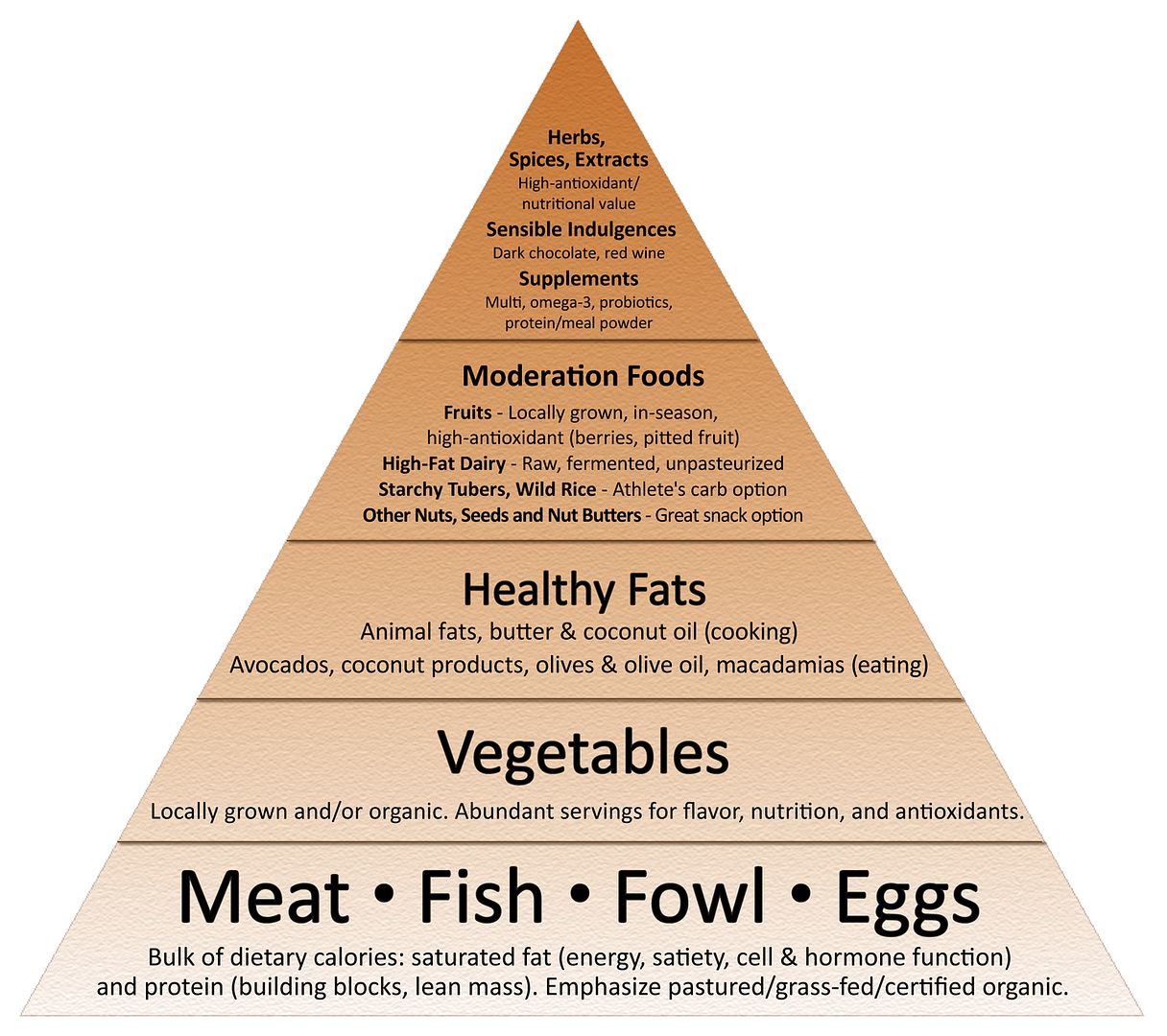
QT: A Better Food Pyramid

Although I'm an imperfect practitioner (hell, I'm pretty imperfect at about everything), I do think that Mark Sisson has the best all-around advice on health and nutrition. (He's a bit less draconian than Art DeVany, so maybe that's why he gets my nod by a nose.) Anyway, here's his (and my perfect) food pyramid. Yea, that's right. Try it, and I'll bet you like it (i.e., feel better & test better.)

Monday, April 25, 2011

The Best Exercise

In the same issue wherein Gary Taubes discussed the evils of sugar, the Times ran a couple of other interesting articles on fitness and health. One was on sleep (get enough) and the other on the best form of exercise. The linked article discusses the best form of exercise. The winner: HIT or High Intensity Training. In other words, go hard, very hard, for brief spurts and lightly in between, whether you talking intervals of minutes or days. If you've read Art De Vany, Dr. Doug McGraw, Mark Sisson, or others in the Primal Community, the answer will come as no surprise. Even before this article I'd incorporated this regimen into my time on the stationary bike, and when weight training (high weight, low reps). Also, think of basketball, a form of play with constant movement punctuated by brief intense spurts. Are any athletes more fit that basketball players? It kept me reasonably fit for many years.

The runner up? The squat. "Air squats" as Tim Ferris calls them. They do well in a pinch.

Tuesday, April 5, 2011

11 Short Pieces of Wisdom on Health & Nutrician

Courtesy of Art De Vany, I came to this site. De Vany contributed to this piece. Also, Mark Sisson and Frank Forencich, whom I read regularly contributed.I'm an occasional acquaintance of some of the contributors, so some of this is not new, but it packs a lot of good advice in a small space. With the return of warmer weather, the get out in Nature advice sounds even better!

Wednesday, March 2, 2011

Art De Vany, Robb Wolff, and the Cave Man Life

Only network television could take a really cutting edge and interesting perspective like that held by De Vany & Wolff and turn it into something cutesy. On the other hand, while I didn't learn anything really new in this piece, I hope that others will. I think De Vany, Wolff, along with Sisson, Cordain, Taubes, and our own local Dr. Terry Wahls, are really on to something very important. While I am not a perfect convert (I confess to a birthday celebration cupcake today), and therefore my sinfulness notwithstanding, I think that this way of living--eating "paleo" or "primal" and working out this way--really is the right way to go. I've become more diligent in my adherence to these principles, and as a result, I'm looking better (Iowa Guru says so, it's not just my usual vanity) and feeling better.

I might also note that despite all of the cuteness and lack of substance contained in this segment, the authors that I list above all provide very well researched and considered proof supporting their positions. De Vany, for instance, a retired economics professor, uses his knowledge of complex systems and economics models to understand the human body. Taubes is a science writer from Harvard, Stanford, and Columbia. Of course, these degrees don't guaranty that he's correct, but he's not ignorant. (However, I think that he is mostly correct.) The others have similarly impressive credentials, and most importantly, commitment to seeking what is true and useful.

Okay, I gotta go home & eat me some meat (or fish) & greens!

Tuesday, February 1, 2011

Frank Bruni on Jack LaLanne: A Dour Take

Both Iowa Guru & I thought that this was a dour take on Jack LaLanne's legacy. For me, living in the body brings great delight (for the most part). Exercise is second only to sex for physical delight (although a great meal or fine wine has many sensual delights). In any event, to think that exercise is something that we must do out of a sense of guilt or vanity is a truly sad and unnecessary take on the experience. While sometimes I moan and groan about going to yoga or going to lift, when I've done it, I inevitably feel better about everything. And I love games: basketball was a form of meditation and recreation for me for decades, and now I meet some of that need for the delight of competition by playing volleyball. I do agree that too many forms of exercise appear to be a matter of drudgery. How many runners have I seen that look genuinely pained? And treadmills--well, they do remind me a bit of hamsters. I now prefer a bit of stationary bike with faux countryside to give the ride some interest. Also, thanks to the likes of Art De Vany and Mark Sisson, I keep workouts relatively short & intense. For play on the other hand, I can take as much time as I want (although my body now limits me). Also, Frank Forencich of Exuberant Animal and Erwan Le Corre of MovNat show us how we can use and enjoy our bodies in the most primal and delightful ways. I wish I was young and agile enough to learn parkour or gymnastics like Damien Walters, but the yoga has been a true delight--and think what one might do there. So, Mr. Bruni, get out of your chair and smell the sweat. I like to read and watch more than the next person, but sometimes you got to go shake it, and you'll love it.

Mark Sisson on Jack LaLanne

This a wonderful celebration of Jack LaLanne, someone whom everyone in our generation remembers. Iowa Guru swears by him (I mean in praise of him). The fact that he was full of vim and vigor up to the time of his death at age 96 is quite a deal. Could he have done better? Perhaps. I think some of the folks that I read, like De Vany and Sisson certainly would recommend some different practices (on diet and variety of exercise), but it's hard to argue with his success. I'm going to follow-up with a different post, but let me be clear: here's to you Jack!

Tuesday, January 11, 2011

Mark Sisson with an inspirational photo

I had to post this link just for the photo. I can't do that (planche in gymnastics parlance, I believe). I can do some arm balances in yoga class, but not this. Well, something to aspire to besides all white hair. I hope I'm closer to the planche than the all white mane.

Sunday, January 2, 2011

Art De Vany: The New Evolution Diet

Reading Nassim Taleb's Fooled by Randomness in the spring of 2007, I came across the name of Art De Vany, the author of Hollywood Economics. Taleb mentioned it in his book because it addressed the issue of the difficulty of predicting winning movies. De Vany, an academic economist, talks about power laws, stochastic events, complexity, etc. in that academic work. Taleb noted in passing that De Vany also applied these principles to fitness. I checked it out on the web and discovered De Vany's web site, which I've read off and on since that time. Now, he has out his book. It was worth the wait.

De Vany argues that we will benefit greatly from aspects of the environment that human beings evolved in during the paleolithic age. Put most simply, a diet of meat, nuts, vegetables, and not much else. No grain or dairy, not to mention sugar. And as for exercise: brief bursts of intense exercise with lots of rest in between. Now mind you, De Vany isn't a cave man--he writes a blog and is a retired academic! Indeed, his back story provides an interesting lead up to his recommendations. He was a minor league baseball player before becoming an academic economist. His son and then his wife developed type 1 diabetes (so-called juvenile diabetes), which led him to learn all that he could about the physiology of insulin and how it affects the body. He applied his know-how as an economist to consider the body, and he drew on evolutionary studies to get a sense of how the body evolved. This places him in the lead of the growing area of Paleolithic fitness,diet, and health thinking (with others such as Mark Sisson, Rob Wolff, Erwan Le Corre, etc.)

This is an excellent and thought-provoking book. The guy knows whereof he speaks (as an academic he can read the professional literature, but since it's not his professional field, he doesn't have to kow-tow to anyone.)

BTW, Nassim Taleb, who has since adopted a De Vany-like fitness regimen, authored an Afterward for the book.

To your health!

Wednesday, December 22, 2010

Mark's Daily Apple: Great Source on Health & Nutrition

For no particular reason other than it popped up in my Google Reader, I want to give a shout-out to Sisson's site, which is an excellent source for health and nutrition information. Sisson is "primal", with loads of well considered and accessible information and advice. I'm gotten part way through his book The Primal Blueprint, which is a fun and interesting read. I'd be finished, but new books by Art De Vany & Tim Ferriss have created a reading backlog in the health and fitness category (all quite exciting). Anyway, this site is a good place to get a wide-ranging sample of Sisson's work. Enjoy. Health and fitness to you!