Saturday, May 25, 2013

President Obama's Speech on National Security and My Comments Upon It


Friday morning I was delighted, or perhaps just relieved, to read of President Obama’s speech about national security. I believe the Obama takes seriously political ideas, especially the ideas that support and maintain our Republic. His actions, however, don’t always reflect the values that I think he understands and appreciates. I think that like all presidents, he’s concerned about the limits of his political power. Yes, even an FDR or an LBJ, consummate political dealers (which Obama is not), pursued political goals when they thought that they could succeed or when even failure was worth the prize. Clinton, I think, operated in the same manner. We witness the tug between what a president wants to do and what he (so far) thinks that he can do. Obama, having staked out a saner, more constitutionally grounded policy, will probably not back-off this course. He’s stayed far too close to the Bush era policies thus far in his presidency, and he’s kept us in Afghanistan too long. However, now I think that he feels the strength to break free of the inertia and the fear all Democrats seem to have (unjustified) of being “soft on national security”. Following the example of James Fallows (a highly trustworthy commentator), I will add my comments to Obama’s speech below. (Portions of Obama’s speech are in italics.) The President began his speech with a history of America, the Cold War, and then our post-9/11 conflicts. Upon concluding his brief history, he quickly came to what I consider the heart of his speech:

So America is at a crossroads. We must define the nature and scope of this struggle, or else it will define us. We have to be mindful of James Madison’s warning that no nation could preserve its freedom in the midst of continual warfare. Neither I nor any president can promise the total defeat of terror. We will never erase the evil that lies in the hearts of some human beings nor stamp out every danger to our open society.

I’m afraid that this struggle has defined us, and we will have to work to free ourselves from its embrace. Some Republicans (see comments by Senator Chambliss for a disturbing example: "The President’s speech today will be viewed by terrorists as a victory") don’t want to see an end to it, but I think that most Americans will appreciate what Obama is saying here. 

The quote of Madison is perfect. It makes a point that needs repeating over and over. It should become our mantra. 

The final statement in this portion of the speech is for “the grown-ups” as James Fallows put it quite aptly. The insight is worthy of Niebuhr, whom Obama says he admires. It shows through in this sentence in particular.

Whether it’s a shooter at a Sikh temple in Wisconsin, a plane flying into a building in Texas, or the extremists who killed 168 people at the Federal Building in Oklahoma City, America’s confronted many forms of violent extremism in our history. Deranged or alienated individuals, often U.S. citizens or legal residents, can do enormous damage, particularly when inspired by larger notions of violent jihad. And that pull towards extremism appears to have led to the shooting at Fort Hood and the bombing of the Boston Marathon.

This is a crucial point: it’s not Islam or “Muslim radicals” or “jihadists” that we have to fear. Alas, it’s a much broader spectrum of alienated and violent individuals and organizations. Some have explicitly political agendas, often vaguely formed ideas, and some none at all. While shooters at Newtown, Aurora, or the Giffords speech may not have had a political agenda, I think that they share some underlying motivations with overtly ideological jihadists and the radical American political right. (See my previous post for more on this topic.) 

America’s actions are legal. We were attacked on 9/11. Within a week, Congress overwhelmingly authorized the use of force. Under domestic law and international law, the United States is at war with al-Qaida, the Taliban, and their associated forces. We are at war with an organization that right now would kill as many Americans as they could if we did not stop them first. So this is a just war, a war waged proportionally, in last resort and in self-defense.

Obama has an argument, but one that weakens with each day that has passed since 9/11. The Iraq war was not justified, and our continued efforts in Afghanistan may no longer have justification, the undoubted good that we do (e.g., education of girls and women) notwithstanding. We must always weigh the benefit of any good against the harm that we do. Certainly, in the eyes of much of the world our continued actions in the Muslim world are no longer justified and cause too much “collateral damage”, our euphemism for killing innocents.  

And yet as our fight enters a new phase, America’s legitimate claim of self-defense cannot be the end of the discussion. To say a military tactic is legal, or even effective, is not to say it is wise or moral in every instance, for the same progress that gives us the technology to strike half a world away also demands the discipline to constrain that power, or risk abusing it.

The discussion and judgments that justify death and destruction can never prove final and must receive constant review and consideration. It’s also of extreme importance that military effectiveness not ever serve as the sole benchmark of a policy. At best, it may serve as a factor, but the underlying moral and legal justification for an action must never become subordinate to military expediency. 

Obama hits a note that needs repeating: self-restraint in the exercise of power is the most important use of a power. One of the reasons that the infant American Republic succeeded as a political entity comes from the model that George Washington established by abjuring power. His action complimented the constraints of power written into the Constitution and Bill of Rights. (See Garry Wills, Cincinnatus: George Washington & the Enlightenment.) 

For the record, I do not believe it would be constitutional for the government to target and kill any U.S. citizen – with a drone or with a shotgun – without due process. Nor should any president deploy armed drones over U.S. soil.

Obama shouldn’t have needed to say this, but he did need to. Now we have to attend to the details. 

But the high threshold that we’ve set for taking lethal action applies to all potential terrorist targets, regardless of whether or not they are American citizens. This threshold respects the inherent dignity of every human life.

An important point: it’s not just about us. The line between government as a legitimate political organization and a criminal organization is finer than we’d like to think (see St. Augustine on this subject). Governments, to maintain morality (and therefore legitimacy on the world stage) must recognize human rights, not just citizen rights. 

I believe, however, that the use of force must be seen as part of a larger discussion we need to have about a comprehensive counterterrorism strategy, because for all the focus on the use of force, force alone cannot make us safe. We cannot use force everywhere that a radical ideology takes root. And in the absence of a strategy that reduces the wellspring of extremism, a perpetual war through drones or special forces or troop deployments will prove self- defeating and alter our country in troubling ways.

No, mere force can’t assure our safety, and as he suggests later in our speech, nothing can. We can reduce risk, but we can’t eliminate it. He also recognizes that continued random, secret, and unbridled use of force “will prove self-defeating and alter our country in troubling ways”. Ever one of us should ponder the significance of these words. 

[T]he next element of our strategy involves addressing the underlying grievances and conflicts that feed extremism, from North Africa to South Asia. As we’ve learned this past decade, this is a vast and complex undertaking. We must be humble in our expectation that we can quickly resolve deep-rooted problems like poverty and sectarian hatred. And moreover, no two countries are alike, and some will undergo chaotic change before things get better. But our security and our values demand that we make the effort.

This is a “vast and complex undertaking”, and therefore one that we should approach with unwavering humility. Reducing the threat of terrorism is not simply a matter of addressing poverty or of dealing with a particular religion or any one issue. It’s a matter of responding to a deep, complex fabric of social realities and ideas. Indeed, in mentioning “poverty and sectarian hatred” I think that President Obama has only identified the tip of the iceberg. The last sentence of this portion of the speech begs a question: how much of this should be a matter of “we make the effort”? Perhaps the wisest course is to let these nations and peoples find their own course without much participation from the U.S. I’m no isolationist, but I consider myself a realist who appreciates the limits of power and knowing when to limit loses and void bad bets. 

The original premise for opening Gitmo, that detainees would not be able to challenge their detention, was found unconstitutional five years ago. In the meantime, Gitmo has become a symbol around the world for an America that flouts the rule of law. Our allies won’t cooperate with us if they think a terrorist will end up at Gitmo. During a time of budget cuts, we spend $150 million each year to imprison 166 people, almost a million dollars per prisoner. And the Department of Defense estimates that we must spend another 200 million (dollars) to keep Gitmo open at a time when we are cutting investments in education and research here at home and when the Pentagon is struggling is struggling with sequester and budget cuts.

Gitmo is the albatross that we wear around our necks as a nation. It has become a symbol around the world for an America that flouts the rule of law.” What an awful truth to have to acknowledge! It’s happened before. War does that, for instance, the internment of Japanese-American during WWII. Other examples abound during the Cold War as well. (See Garry Wills, Bomb Power: The Modern Presidency & the National Security State.

The President also remarks about the irony of spending on obscene amount of money to keep prisoners there. We cut millions of dollars of government expenditures that could have been used to help Americans in order to accomplish . . . what? To maintain a shameful thing? To display our fear? (For, I believe, Gitmo could have been closed long ago if fear of maintaining prisoners hadn’t stopped the process from going forward.) Another shameful truth. 

As president, I have tried to close Gitmo. I transferred 67 detainees to other countries before Congress imposed restrictions to effectively prevent us from either transferring detainees to other countries or imprisoning them here in the United States. These restrictions make no sense. After all, under President Bush, some 530 detainees were transferred from Gitmo with Congress’ support. When I ran for president the first time, John McCain supported closing Gitmo. This was a bipartisan issue.

Is there such a thing anymore as a “bi-partisan issue”? Frankly, both parties can place electoral advantage over the greater good, but the current group that refers to itself as the Republican Party (I’m now thinking that they’re really illegitimate imposters) has taken the preference for partisan advantage over the greater good and principled reasoning to new lows. 

No person has ever escaped one of our super-max or military prisons here in the United States – ever. Our courts have convicted hundreds of people for terrorism or terrorism-related offenses, including some folks who are more dangerous than most Gitmo detainees there in our prisons. And given my administration’s relentless pursuit of al-Qaida’s leadership, there is no justification beyond politics for Congress to prevent us from closing a facility that it should – should have never been opened.

Amen. 

Today I once again call on Congress to lift the restrictions on detainee transfers from Gitmo. I have asked -- (applause) -- I have asked the Department of Defense to designate a site in the United States where we can hold military commissions.

Now, even after we take these steps, one issue will remain, which is how to deal with those Gitmo detainees who we know have participated in dangerous plots or attacks but who cannot be prosecuted, for example, because the evidence against them has been compromise or is inadmissible in a court of law. But once we commit to a process of closing Gitmo, I am confident that this legacy problem can be resolved, consistent with our commitment to the rule of law.

This sounds good but it’s going to be hard. Any self-incriminating statements are excluded from evidence when gained under torture, and we have tortured. I’m all for finding a way, but what I think will happen is that a lot of dirty laundry will get aired in such a process. Perhaps this is what we need to do to cure and purge ourselves of such acts of barbarism. 

And I know the politics are hard. But history will cast a harsh judgment on this aspect of our fight against terrorism and those of us who fail to end it. Imagine a future 10 years from now or 20 years from now when the United States of America is still holding people who have been charged with no crime on a piece of land that is not a part of our country.

Look at the current situation, where we are force-feeding detainees who are being held on a hunger strike. I’m willing to cut the young lady who interrupted me [more about her later] some slack because it’s worth being passionate about. Is this who we are? Is that something our founders foresaw? Is that the America we want to leave our children?

Why is “the politics hard”? 

I like the way Obama has us consider this issue from the future: what kind of mess, what kind of pile of crap, do we want to leave to the future because we didn’t have the fortitude to face-up to our actions and their consequences? Do we want to leave this to our children? I don’t. 

And now we need a strategy and a politics that reflects this resilient spirit. Our victory against terrorism won’t be measured in a surrender ceremony at a battleship or a statue being pulled to the ground. Victory will be measured in parents taking their kids to school, immigrants coming to our shores, fans taking in a ballgame, a veteran starting a business, a bustling city street, a citizen shouting her concerns at a president. The quiet determination, that strength of character and bond of fellowship, that refutation of fear -- that is both our sword and our shield.

An admirable goal. Can we realize it? The last sentence hits the bull’s eye, but I don’t know that we’re there. Closing Gitmo will serve as one indicator. 

And long after the current messengers of hate have faded from the world’s memory, alongside the brutal despots and deranged madmen and ruthless demagogues who litter history, the flag of the United States will still wave from small-town cemeteries, to national monuments, to distant outposts abroad. And that flag will still stand for freedom.

Thank you very much, everybody. God bless you. May God bless the United States of America. 

This peroration is strong, but I have some reservations. Should our flag stand for “freedom”? Isn’t freedom an instrumental value, one that only serves other ends? Isn’t worship of freedom idolatry? Perhaps we should say that our flag stands for the United States of America, where people live in freedom under law in order to pursue the good things in life. It’s not as catchy, but I hope that it’s more accurate and avoids the idolatry of freedom alone. 

The following is the inter-change between Obama and a protester during the course of the speech. 

AUDIENCE MEMBER: Excuse me, President Obama, you are the commander in chief -- (off mic) -- (applause) --
PRESIDENT OBAMA: Today -- so -- (sustained applause) -- so let me finish, ma’am. So today -- so today, once again, today --
AUDIENCE MEMBER: (Off mic) -- for (102 ?) people -- (off mic) -- people’s rights, these desperate people -- (off mic) --
PRESIDENT OBAMA: I’m about to address, ma’am, but you got -- you got to let me speak. I’m about to address it.
AUDIENCE MEMBER: -- (off mic) -- our commander in chief --
PRESIDENT OBAMA: Let me address it.
AUDIENCE MEMBER: Our commander in chief -- (off mic) -- Guantanamo Bay --
PRESIDENT OBAMA: Why don’t you let me address it, ma’am.
AUDIENCE MEMBER: (Off mic.)
PRESIDENT OBAMA: Why don’t you sit down and I’ll tell you exactly what I’m going to do.
AUDIENCE MEMBER: (Off mic.)
PRESIDENT OBAMA: Thank you, ma’am. Thank you. Thank you. (Applause.) Ma’am -- thank you. You should let me finish my sentence.
. . . .
AUDIENCE MEMBER: How about Abdulrahman al-Awlaki, 16-year-old -- (inaudible) --
PRESIDENT OBAMA: -- when we --
AUDIENCE MEMBER: -- killed by you?
PRESIDENT OBAMA: -- we went --
AUDIENCE MEMBER: Is that the way we treat a 16-year-old -- (inaudible)?
PRESIDENT OBAMA: He -- he -- he went on to --
AUDIENCE MEMBER: Why was he killed?
PRESIDENT OBAMA: -- we went --
AUDIENCE MEMBER: Can you tell us why Abdulrahman al-Awlaki was killed? Can you tell the Muslim people their lives are as precious as our lives? Can you take the drones out of the hands of the CIA? Can you stop the signature strikes that are killing people on the basis of suspicious activities?
PRESIDENT OBAMA: We’re addressing that, ma’am.
AUDIENCE MEMBER: (Inaudible) -- apologize to the thousands of Muslims that you have killed? Will you compensate the innocent family victims? That will make us safer here at home.
I love my country! I love the rule of law! The drones are making us less safe.
And keeping people in indefinite detention in Guantanamo is making us less safe. Abide by the rule of law -- (inaudible) --
PRESIDENT OBAMA: You know, I think that the -- and I’m going off script, as you might expect, here. (Laughter, applause.) The -- the voice of that woman is worth paying attention to. (Applause.) Obviously -- obviously I do not agree with much of what she said, and obviously she wasn’t listening to me in much of what I said.

I think that President Obama handled this exchange well, and I have to compliment him for his statement (as the Secret Service hustled her from the hall) that “the voice of that woman is worth paying attention to.” Yes. She asked some very legitimate questions and raised some very legitimate points, although I also think that he’s correct that she wasn’t listening and she instead played the prepared tape that she had in her mind. She raises these issues in a way that’s not socially polite or acceptable to most persons, but this raises an even more important issue. Have these issues been appropriately raised and addressed in our political discourse? I fear the answer is “no”. We have not entered into a full-scale debate on these issues, and this is the great benefit of the President’s speech: he’s put the issues on the table for political discussion. In an ideal republic, this dialogue would have begun at the start and continued until the matter resolved. But we live far from an ideal discourse community. While we have more media than ever and little legal restriction on speech, I still sense that we have a conspiracy of silence on too many issues. Such conspiracies are probably old as democracy, if not older, so it’s not new, so it’s a battle I think that we have to fight constantly. Following Hannah Arendt, I believe the essence of politics (and law) is speech, and I subscribe to the ideal of Jürgen Habermas of creating an environment of free, uninhibited discourse, but we’re far from that. Sometimes we have to shout to receive a hearing, while some resort to violence, the failure of politics and law. To the extent that we have to shout at one another, not to mention resorting to violence, we suffer a failure of politics and receive instead an exhibition of force. We need to have more seats at the table for those who question, and that’s something that all of should insist upon.

Thursday, May 23, 2013

A Review of the Film "The Reluctant Fundamentalist" and a Consideration of the Ideas of Liah Greenfeld


The Reluctant Fundamentalist (2012) PosterThe Reluctant Fundamentalist, a film by Mira Nair, attempts to accomplish a great deal. Fundamentalism, which trails behind it the threat of terror and violence, is a crucial issue in our age. Nair’s film attempts to deal with issues surrounding fundamentalism by following the life of a young Pakistani. In doing so, the film attempts to pack a great deal into a two-hour story. Essentially, a young, bright Pakistani comes to the US to attend Princeton University. He graduates with honors, and is hired by a McKinsey-like company in New York City. He meets and beds a young artist, and then when it, when it seems like he’s on top of the world, 9/11 happens.

After 9/11, of course, things change drastically for him. He becomes the subject of airport searches and an unjustified arrest and interrogation. (The facts of the arrest and interrogation scenes struck me as over the top—or am I naïve?—given the utter lack of probable cause  and the sophistication of the protagonist depicted in the film, but this is endemic to the film itself). Returning to Pakistan, the young man begins to teach at Lahore University and becomes identified with radical views in the eyes the local CIA contingent. In the end, (spoiler alert), our young man rejects two types of fundamentalism: both the religious fundamentalism that leads to terrorism and violence, and the fundamentalism that the CIA and others deploy in their own Manichean worldview.
The film as well acted, well directed, and as I mentioned, except for perhaps trying to pack too much into the script, it was a decent storyline that explored some of the difficulties and challenges that such a young man would face.

Liah GreenfeldImmediately before seeing this movie, I happened to read a blog entry by Liah Greenfeld. She’s a professor of Sociology, Political Science, and Anthropology at Boston University. (I found her piece on the website for Project Syndicate, which carries blogs by a wide variety of academics and intellectuals across a broad spectrum of issues.) In her entry, Prof. Greenfeld talks about the Boston bombers and their motivations in terms of her recently published book Mind, Modernity, Madness: The Impact of Culture on Human Experience (Harvard University Press, 2013) that argues an interesting hypothesis about not only the roots of terrorism, but also how the entire Modern Age affects us all. After reading the blog entry, I discovered and reviewed her personal website, her blog, and the blog she writes for Psychology Today. Her Psychology Today blog sets out the premises of her book in a continuing series of entries.
Greenfeld’s initial hypothesis starts with the growth of nationalism beginning in Tudor England in the 1500s, when the death and disruption caused by the War of the Roses created opportunities for unprecedented social mobility. This social mobility, along with new understanding of sovereignty, led to the rise of nationalism. From England, the idea passed to France, Germany, Russia, Japan, and around the world. Her second book, The Spirit of Capitalism: Nationalism and Economic Growth (2003) argues that capitalism arose not because of the Protestant Ethic (Weber) or some unique event or asset in the West, but because the idea of economic growth, as opposed to the mere accumulation of wealth, became a touchstone of nationalist thinking in the rivalry between the nation-states of Europe. 

Her most recently published book (Mind, Modernity, Madness) argues that the views of Emile Durkheim and Max Weber, two of the pillars of sociology and political economy, give us insight into what has happened in our modern world. From Durkheim, she pulls the concept of anomie, the idea that modern society cuts us loose and leaves us adrift from many of the traditional ties that moor our identity and self-concept, leaving us adrift in the modern world. From Weber, although she dismisses, as do most scholars now, his thesis that the Protestant Ethic was the guiding idea of capitalism, she nevertheless takes the premise that an idea or ideas were in fact the motive force behind this world-changing events that led to capitalism and modernity. (In this regard, she seems very close to what Deirdre McCloskey is arguing in her books, including The Bourgeois Dignity, although McCloskey apparently differs to some extent based upon the brief references to Greenfeld's work in Bourgeois Dignity.) 

In Mind, Modernity, Madness, Greenfeld argues that the most difficult and intractable of modern mental illnesses, schizophrenia, bipolar disorder, and major depression, are primarily diseases of the mind and not of the brain, contrary to the current trend of contemporary thinking. She believes that individuals thrown into the modern condition often cannot cope with the challenges foisted upon them, and as a result, some suffer these illnesses. This thesis attracts me because I believe that for a long time now that we can’t account for all mental illnesses through biology alone. Some mental illness is without question solely of biological origin, but others have too much of a social-cultural component among antecedents and symptoms to allow us to look at biology alone. 

Let me share an example. Suppose someone is around the corner and you’re not aware that the other person is there. You turn the corner and confront the person. If you are not expecting that person, you are startled. If you thought you were alone in a house, for instance, you are likely quite frightened. The moment you see the person and react, we can record a number of biological changes that occur almost instantaneously. Your face reveals a startled expression, your shoulders hunch, your hands raise, while internally, your body is immediately flooded with adrenaline. Now, for our little thought experiment, let’s assume that we have a medical team present to draw a blood sample and do a quick check of your body. They report that you have extraordinarily high adrenaline in your blood, and your muscles are strongly flexed. So what to do? “Well, we can prescribe a medication to help you relax to counter-act the flood of adrenaline, and while we’re at it, a muscle relaxant”, says the good doctor standing by. So what was your diagnosis? Excess adrenaline in the blood and tight muscles, some would say. True. In addition, our medical team tells you that the excess adrenaline can be treated with prescription medication X. “Your problem,” they say, “is excess adrenaline”. You need to get that under control and you’ll be just fine”. Of course, there’s an alternative way to look at the diagnosis and an alternative way to look at the cause. I say, “Your mind has deceived you; the figure that you feared was your husband, who had been working quietly in the other room unbeknownst to you”. It’s a matter much like the story of the rope mistaken for a snake in a dark room. Our mind deludes us and causes us anxiety. Both of the explanations are true from their unique perspectives, but one, unless you’re into Big Pharma, presents a lower cost, more effective way to deal with the problem: let Mother Nature run her course and put a bell around your husband’s neck. 

All of the above is a long-winded way of saying that I find Greenfeld’s perspective very persuasive with many practical applications. Whether schizophrenia, bi-polar disorder, and major depression are in fact essentially one disease, diseases of the mind unique to the Modern Age, I can’t posit with authority since this type of conclusion remains far above my pay grade. However, to take a side, I’d take hers. People who do and say things while hallucinating that we consider “weird” or “crazy” do so within their language and culture. Someone may believe himself to be Jesus or Napoleon if he lives in Europe, but probably not in India, where perhaps one would imagine oneself as Rama, or some other god. People may say or do “crazy” things, but they do so within a language and a culture. Per Greenfeld and me (for what the latter is worth), even the “crazy” behavior and its cause is at least in part because of culture and society. 

I’m eager to explore Greenfeld’s trilogy in more detail when I can get the books (too big to enjoy reading on the Kindle). I’m eager to continue exploring fundamentalism and the Modern Age. I think more than one scholar (Karen Armstrong pops to mind) has argued persuasively that fundamentalism is a disorder of modernity. I suspect that religion is a carrier of the real disorder and not the cause: like rats and fleas spreading the Black Death, the root cause is anomie and a feeling of social uncertainty and belittlement that latches on to religion (Judaism Christianity, Islam, Hindu, etc.) to serve as a carrier. A particular religion provides a ready-made story that can be bent to justify the feeling of a need to change the world and to right the injustices and wrongs experienced, even if the change requires wanton violence. (See this review of Reza Aslan’s How to Win a Cosmic War about how this virus ranges across the three great monotheistic religions.) 

I think that Greenfeld’s hypothesis as it applies to terrorism as we just witnessed it in Boston fits with the ideas of Scott Atran as well (see my review here). Before learning of Greenfeld’s work, I found Atran the most persuasive writer that I’d read on this topic, but I think that Greenfeld provides a more comprehensive perspective, which, by the way, also apples to acts of domestic terror (if we don’t limit terrorism to random violence that purports to have some political motive). Atran is good at identifying how small social groups reinforce norms that lead to acts of terror, but he doesn’t as effectively address what I think are the underlying issues of social or status dislocation that are behind these acts. I think Greenfields’s work gives us the more comprehensive viewpoint. Thus, the way I currently understand Greenfeld, she would not see a significant underlying difference between the Boston bombers, or the Newtown shooter; between jihadist acts of terror or those of the Oklahoma City bombers or the Branch Davidians.

The question I have for Greenfeld is that violent apocalyptic movements have been around for a very long time, certainly going back to biblical times; the Middle Ages are full of millennial movements. How do we distinguish such actions in the Modern Age from their pre-modern precursors?

Understanding how social and cultural factors influence and create acts of violence or dislocation is crucial for our ability to try to counteract these trends. Understanding the pressures as portrayed in a film like The Reluctant Fundamentalist, or as analyzed in Greenfeld’s book, are both sources that we must use to try to come to a deeper understanding. In my own opinion, in a society so concerned with economics and economic growth, we tend to focus far too much on material incentives as the primary driver of human action. While certainly significant, a deeper understanding of human motivations is called for. The passions are probably more important than the interests. People like René Girard are among those who try to take a deeper look at what is going on. Even going back to Thucydides, we see a more complex understanding of human motivation than what many of us have come to believe of late. Simple pain and pleasure are insufficient to understand the complexity of human motives. The human individual, by herself or himself, makes no sense unless we take into account the mirrors of society and culture. (This concluding metaphor comes from the serendipity of currently re-reading Robert Pirsig’s Lila.)
 

Tuesday, May 21, 2013

Rep. Loebsack Response re Campaign Finance Reform

David Loebsack
2nd District, Iowa

Committees:
Armed Services
Subcommittees:
Military Personnel
Readiness

Education and the Workforce
Subcommittees:
Health, Employment, Labor,
and Pensions
Higher Education and
Workforce Training


Congress of the United States // House of Representatives // Washington, DC 20515


Washington Office:
1527 Longworth House Office Building
Washington, DC 20515
(202) 225-6576


District Offices:
125 South Dubuque Street
Iowa City, IA 52240
(319) 351-0789

209 West 4th Street, #104
Davenport, IA 52801
(563) 323-5988

May 17, 2013
May 17, 2013
Mr. Steve Greenleaf
345 Magowan Avenue
Iowa City, IA 52246-3515

Dear Mr. Greenleaf,

Thank you for contacting me about the Supreme Court's Decision in Citizens United v. Federal Elections Commission.  I'm honored to represent you. Your opinion is very important to me and my priority is to provide Iowa's Second District with the best representation possible.

On January 21, 2009 the Supreme Court ruled in a 5-4 decision that corporate funding in elections cannot be limited under the First Amendment. In this decision, the Court struck down a provision of the McCain-Feingold Act that prevented corporations, both for profit and not for profit, from directly funding political communication.  I share your concerns about the potential influence of large corporate campaign contributions, and I strongly believe that we must ensure that the only voices that determine the outcome of elections are those of the American people.

As someone who grew up in poverty struggling to make ends meet, I never thought I would see the day when the Supreme Court would rule in favor of special interests over the interests of hard working Iowans who want and deserve to have their voices heard in Washington. As your Representative in Congress, I will do all I can to ensure that power is put back in the hands of Iowans, not corporate interests, and that your concerns are heard in our nation's capital.

In response to the Supreme Court's decision, The Democracy is Strengthened by Casting Light on Spending in Elections Act (DISCLOSE), H.R. 148, was introduced on January 3, 2013.  The DISCLOSE Act would increase disclosure requirements for campaign-related spending by corporations, unions, and tax-exempt organizations.  I am a proud cosponsor of this bill, which has been referred to the House Committees on Administration, the Judiciary and Ways and Means.

In addition, I am a proud cosponsor of the Fair Elections Now Act, H.R. 269, which was introduced by Representative John Yarmuth on January 15, 2013. This bill would establish the option of publicly funded campaigns and would reduce the influence of special interest groups on elections.  H.R. 269 has been referred to the House Committee on Administration for further consideration.

Please be assured that I will continue to keep your views regarding campaign finance reform in mind and will continue to work diligently to ensure that the American people, not monied interests, are the ones who decide the outcome of our elections.  Thank you again for contacting me about this important issue. My office is here to assist you with any and all concerns you have, so please do not hesitate to contact me whenever you feel that I can be of assistance.  I encourage you to visit my website at www.loebsack.house.gov and sign up for my e-newsletters to stay informed of the work I'm doing for you. I am proud to serve the Second District, and I am committed to working hard for Iowans.
Sincerely,
(signed)
Dave Loebsack
Iowa's Second District
DL/AK    

Monday, May 20, 2013

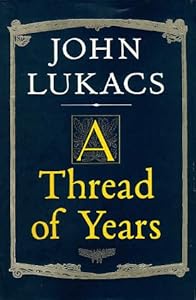
A Review of A Thread of Years by John Lukacs


There are a couple of things that might help you to understand and appreciate John Lukacs. First, his career goal was to be a writer, not a historian. One can say that history, viewed from the wide lens of the Modern Age, to a close-up in Five Days in London: May 1940, to a microscopic view in vignettes as short as a brief imagined conversation, mark the range of his writing. Fortunately, for history as a discipline, and we as readers, he chose modern history as his subject matter. 

Second, you should know that one reviewer labeled Lukacs a “conservative polymath”, but Lukacs rejects the “conservative” designation because of his rejection of so much of American political conservatism. Instead, he considers himself a “reactionary impressionist”. What is that? Here’s Lukacs in an interview discussing the “reactionary” portion of his self-designation: 


“a remnant reactionary, a remnant bourgeois, a remnant admirer of the civilization and culture of the past five hundred years, European and Western." [Quoting his description of himself in his “auto-history”, Last Rites.] I say this even though I consider many of the dominant ideas and achievements of the past 500 years—for example, objectivity, progress, and materialism—to be insufficient, and I strongly resist these categorical formulations as absolutes.


Thus, Lukacs, by this self-designation as a “reactionary”, signals his unique political and historical perspective. But what about the “impressionist” portion of “reactionary impressionist”? For understanding this designation, we have no better guide than A Thread of Years

A Thread of Years has been labeled an “experimental work”, and Lukacs himself says that it’s neither literature nor history. I think, it’s both, with a good deal of essay and dialogue thrown in. In this work, using most of the years between 1900 and 1969, Lukacs writes short vignettes involving fictional characters within different settings in Europe and the U.S. He then comments upon and discusses the vignettes with his “alter ego”. The subjects of these vignettes vary, although a few characters appear in several of the vignettes. His locales and characters include Philadelphia and its environs (where Lukacs settled and taught), Catholic Churches, its priests and laity (Lukacs is Catholic and taught many years at a small Catholic college in Philadelphia), and Hungarians (Lukacs is a native of Hungry), along with other assorted characters and locales. Even those characters and locales with which he seems to have no direct connection are quite convincing. Any Lukacs reader quickly recognizes his erudition and his writer’s eye for character and place. 

The format of vignettes allows Lukacs to write in the manner of a novelist, a form which I have no doubt he could have mastered if he’d have chosen that path. By taking different years and settings, he gives us a sense of the ordinary human lives that co-existed with great historical events. He also demonstrates how culture and civilization have changed in the course of the first 70 years of the 20th century (although published in 1998, Lukacs stopped his vignettes at 1969). For instance, he addresses the decline of the Anglo-Saxon elite in the U.S. and rising tide of a form of populism. The intriguing thing about this project is his ability to create these brief sketches, these impressionistic word pictures of persons and places. In this he's similar to what we experience in the great impressionistic painters. I consider him a verbal Renoir, Manet, Monet, or Degas, but not one not limited to the fin-de-siècle. Instead, he uses a large chunk of the 20th century to locate his verbal canvasses.

The dialogues are more challenging. Like native European intellectuals that I’ve read, he alludes to sources and experiences that often elude me. The dialogues also seem to allow him to acknowledge his biases and prejudices (for instance, he does not like the film Casablanca), thereby both airing them and letting them stand or fall as the reader deems appropriate. Sometimes I felt as if I was overhearing a conversation in a foreign language that I knew a bit of. I could pick-up bits and pieces, but I still felt as though I missed the greater whole. On the other hand, we learn from listening to the adults, so the benefit far outweighs any frustration. 

In preparing for this review and blog, I found that I’d labeled 21 earlier blog entries as mentioning, if not focused upon, John Lukacs. This entry makes 22, and assuming my good fortune to keep on reading and learning, you can expect many more. After all, while out of the U.S., he’s published another book. In addition, with Lukacs, I’ve found I can re-read with continued benefit and enjoyment. What better recommendation for an author?