This interview with lead actor Gary Oldman, who plays George Smiley, is very interesting. I will say, the Brits do take there acting very seriously. In addition, consult this Atlantic article about the incarnations of Le Carre characters. Anyone who knows me, or who has had to sit through some spare time with me, will know of my passion for the two BBC productions starring Alec Guinness as Smiley (along with a superb supporting cast). However, I do like Oldman's take on doing a role that Guinness so made his own: classical roles, such as Hamlet, require actors to step into a prior great's shoes all the time. Who's your favorite Hamlet? Gielgud, Olivier, Burton, Jacobi, Branagh? Just to name a few. And while LeCarre isn't Shakespeare, these characters are rich. So, yes, I'll go, although Iowa Guru threatens a boycott. It can be tough, my beloved James Mason played Smiley in Sidney Lumet's A Deadly Affair, an alteration of the first Smiley book, A Call for the Dead, but it really didn't work all that well. No, it's a tough role to fill.
Here's the link to the movie site. Save me a seat.
Sunday, December 4, 2011


Saturday, December 3, 2011
Garry Wills, Rome & Rhetoric: Shakespeare's Julius Caesar
Garry Wills has struck again, this time with his book Rome and Rhetoric: Shakespeare's Julius Caesar. In this slender volume Wills explores how Shakespeare, via Plutarch, grasped the essence of Rome at the time of the transition from republic to empire. Specifically, Wills explores the rhetoric of the leading characters. Of course, Antony's funeral oration is the best known of the set pieces in this play. (My continued apologies to Mrs. Vaughn for having complained about having to memorize this in sophomore English class). However, Antony's funeral oration is not the only example of rhetoric in the play. Before Antony speaks, Brutus addressed the crowd. Wills contrasts the rhetoric of Brutus, which centers upon "mine honor", against the more nuanced speech given by Antony. Antony responds to his audience, whereas Brutus expects his audience to respond to him.
Wills's love of Shakespeare is not new. His previous book on Macbeth demonstrates the care with which has explicates these texts. In addition, he has recently published a book on Shakespeare and Verdi, the great Italian opera composer who composed operas on some of Shakespeare's plays. I haven't read that book yet, but I have a hard time imagining that it could be better than this book. Wills is trained as a classicist and the opportunity to merge his love of theater (and Shakespeare in particular), along with his classical learning, provides us a real treat in humanistic learning.
I always enjoyed Julius Caesar (my complaints and sophomore English notwithstanding), and I think that it is an easily accessible play. In addition, there are a couple of good film productions of it that are well worth seeing, including one with Marlon Brando as Anthony. If you have an opportunity to see these productions or to read this play, Wills's book out would be an excellent introduction and perspective on the play.
Wills's love of Shakespeare is not new. His previous book on Macbeth demonstrates the care with which has explicates these texts. In addition, he has recently published a book on Shakespeare and Verdi, the great Italian opera composer who composed operas on some of Shakespeare's plays. I haven't read that book yet, but I have a hard time imagining that it could be better than this book. Wills is trained as a classicist and the opportunity to merge his love of theater (and Shakespeare in particular), along with his classical learning, provides us a real treat in humanistic learning.
I always enjoyed Julius Caesar (my complaints and sophomore English notwithstanding), and I think that it is an easily accessible play. In addition, there are a couple of good film productions of it that are well worth seeing, including one with Marlon Brando as Anthony. If you have an opportunity to see these productions or to read this play, Wills's book out would be an excellent introduction and perspective on the play.
Niall Ferguson on the Western Canon & Sequay to the Next Post
From Ferguson's Civilization: The West & the Rest:
Id. 324.
As you will learn from my next post, the admiration of Shakespeare as the author at the heart of the Western tradition--at least since the Renaissance--is not unusual.
What other books, since the advent of modernity, might Ferguson have cited?
What makes a civilization real to its inhabitants, in the end, is not just splendid edifices at its center, nor even the smooth functioning of the institutions they house. At its core, a civilization is the texts that are taught in schools, learned by its students and recollected in times of tribulation. The civilization of China was once built on the teachings of Confucius. The civilization of Islam -- of the cult of submission -- is still built on the Koran. But what are the foundational texts of Western civilization, that can bolster our belief in the almost boundless power of the free individual human being?
I would suggest the King James Bible, Isaac Newton's Principia, John Locke's Two Treatises of Government, Adam Smith's Moral Sentiments and Wealth of Nations, Edmund Burke's Recollections of the Revolution in France and Charles Darwin's Origin of Species -- to which should be added to William Shakespeare's's plays selected speeches of Abraham Lincoln and Winston Churchill. If I had to select a single volume as Koran, it would be Shakespeare's complete works.
Id. 324.
As you will learn from my next post, the admiration of Shakespeare as the author at the heart of the Western tradition--at least since the Renaissance--is not unusual.
What other books, since the advent of modernity, might Ferguson have cited?
David Brooks: The Social Animal
David Brooks is a socialist.
Okay, he’s not a socialist in the sense that you and I might think of as socialist. In fact, David Brooks has never made such a statement about himself that I know of. However in his book, The Social Animal, he describes his alter ego as a socialist. However, his alter ego is the strangest and perhaps most unique socialist that you've ever heard of. The kind of socialist that Brooks is speaking about is not of the Marxist-Leninist variety, nor of the Maoist variety, or of any other off-the-shelf varieties. Instead, his alter ego is what most of us would think of it as a well, an Aristotelian, or a Burkean, or, in more contemporary terms, a communitarian. In other words, Brooks thinks that most folks who describe themselves as socialists today are in fact statists.
The above gives you a sense politically of where Brooks is coming from, which should come as no surprise to anyone who has read his columns in the New York Times regularly. The Brooks alter ego in The Social Animal is someone who admires the politics of Hamilton, Lincoln, and Theodore Roosevelt. He believes that the state should be useful and is necessary, but is should not be dominant. He stands between free-market libertarians and the statists (i.e., whom everyone else thinks of it as socialists).
I listened to The Social Animal with a great deal of enjoyment. Brooks brings valuable perspectives to this book. First, Brooks is a keen observer of contemporary social mores. He can be satirical, but always with a light and humorous touch. Secondly, he’s deeply taken with the neuro-psychological revolution that is ongoing. Only a small portion of the book is really dedicated to Brooks pithy observations about the society around us, and more of it is centered on what we have learned about humans as social animals. Of course, this perspective is as old as men and women have been thinking about society. Names like Aristotle, Augustine, Aquinas, Locke, Burke, and Toqueville pop to mind. Brooks brings contemporary scientific (especially brain) research and contemporary social science research to the table. Brooks does this by using the conceit borrowed from Rousseau’s Emile, wherein the education (not just schooling) of individuals serves as a vehicle to expostulate about his perspectives on learning and behavior. (I think it's safe to say Brooks would be very critical of Rousseau's political thinking.)
I enjoyed this book very much. It was fun to listen to. Brooks did well to choose the stories of individuals to draw us into a narrative that provides doses of contemporary scientific thinking that become relevant and easily palatable. Of course, I have to also have to say that I'm easily sold on this book because I agree with most of his perspectives. If anyone has read this blog before, they know that I often have cited my agreements with Brooks. While I don't consider myself as politically conservative as he considers himself, I think the differences are those of shades and not of absolutes. I, too, admire the tradition of Hamilton, Lincoln, and Theodore Roosevelt. However, I do believe that the contribution of FDR is one is crucial for modern America. Indeed, the second Roosevelt's political program and economic program is vital to our well-being and extremely relevant today. Obama probably could not find a better role model than Franklin Delano Roosevelt. Theodore lived in an earlier, less industrialized age. We need the likes of FDR and Keynes more than ever.
In the end, a highly enjoyable and recommend a book
Okay, he’s not a socialist in the sense that you and I might think of as socialist. In fact, David Brooks has never made such a statement about himself that I know of. However in his book, The Social Animal, he describes his alter ego as a socialist. However, his alter ego is the strangest and perhaps most unique socialist that you've ever heard of. The kind of socialist that Brooks is speaking about is not of the Marxist-Leninist variety, nor of the Maoist variety, or of any other off-the-shelf varieties. Instead, his alter ego is what most of us would think of it as a well, an Aristotelian, or a Burkean, or, in more contemporary terms, a communitarian. In other words, Brooks thinks that most folks who describe themselves as socialists today are in fact statists.
The above gives you a sense politically of where Brooks is coming from, which should come as no surprise to anyone who has read his columns in the New York Times regularly. The Brooks alter ego in The Social Animal is someone who admires the politics of Hamilton, Lincoln, and Theodore Roosevelt. He believes that the state should be useful and is necessary, but is should not be dominant. He stands between free-market libertarians and the statists (i.e., whom everyone else thinks of it as socialists).
I listened to The Social Animal with a great deal of enjoyment. Brooks brings valuable perspectives to this book. First, Brooks is a keen observer of contemporary social mores. He can be satirical, but always with a light and humorous touch. Secondly, he’s deeply taken with the neuro-psychological revolution that is ongoing. Only a small portion of the book is really dedicated to Brooks pithy observations about the society around us, and more of it is centered on what we have learned about humans as social animals. Of course, this perspective is as old as men and women have been thinking about society. Names like Aristotle, Augustine, Aquinas, Locke, Burke, and Toqueville pop to mind. Brooks brings contemporary scientific (especially brain) research and contemporary social science research to the table. Brooks does this by using the conceit borrowed from Rousseau’s Emile, wherein the education (not just schooling) of individuals serves as a vehicle to expostulate about his perspectives on learning and behavior. (I think it's safe to say Brooks would be very critical of Rousseau's political thinking.)
I enjoyed this book very much. It was fun to listen to. Brooks did well to choose the stories of individuals to draw us into a narrative that provides doses of contemporary scientific thinking that become relevant and easily palatable. Of course, I have to also have to say that I'm easily sold on this book because I agree with most of his perspectives. If anyone has read this blog before, they know that I often have cited my agreements with Brooks. While I don't consider myself as politically conservative as he considers himself, I think the differences are those of shades and not of absolutes. I, too, admire the tradition of Hamilton, Lincoln, and Theodore Roosevelt. However, I do believe that the contribution of FDR is one is crucial for modern America. Indeed, the second Roosevelt's political program and economic program is vital to our well-being and extremely relevant today. Obama probably could not find a better role model than Franklin Delano Roosevelt. Theodore lived in an earlier, less industrialized age. We need the likes of FDR and Keynes more than ever.
In the end, a highly enjoyable and recommend a book
Monday, November 28, 2011
Now Reading: Wills on Shakespeare & Rome and Gaddis on Kennan
Niall Ferguson's Civilization: The West & the Rest
Niall Ferguson's Civilization: The West and the Rest (2011) describes six "killer apps" that defined Western civilization and led to its preeminence in the 500 years between 1500 and 2000. Ferguson is a lively and engaging writer who steps into the sweep of a 500-year history with verve and flair. Ferguson is not adverse to controversy, and he doesn't shy away from making judgments. This has made him a controversial figure within the ranks of some historians. In addition, he moonlights as a commentator on current events. Nevertheless, I think we can disagree with him and still find him very persuasive.
Ferguson argues that competition, property rights and liberty, modern medicine, the Scientific Revolution, consumer goods, and the work (or word) ethic distinguished Europe and its progeny (North America and Australasia) from its rivals in the Ottoman empire and China, both of which were surely were more advanced than most of Europe as of 1500. Indeed, the "great divergence" begins about 1800.
Some have criticized Ferguson for underplaying the detrimental aspects of European colonial empires. However, I find these criticisms unpersuasive. Ferguson, who certainly has a combative streak in him, argues that colonialism, for all its downsides, nevertheless has some good sides. In some sense, this is simply a truism. Ferguson certainly notes some of the horrors associated with colonial rule. He does not spend much time dealing with the day-to-day indignities that colonialism entailed. Nevertheless, his critics seem to miss the point. That point is that Western civilization brought cultural, scientific, and industrial advances to portions of the world where they would not have arisen or where they would only have arisen much later.
Perhaps Ferguson is most interesting in this work when he talks about where we go from today. Has he argues in his book, Japan was the first of the Asian nations to take up and apply the "killer apps" of the West. Other Asian nations have done so quite successfully, and China is now in the midst of making an incredible transformation. Ferguson notes, however, that few of the Asian nations have "downloaded" all of the apps. For instance, China has only a limited sense of private property and no real democracy. Russia has some vestige of democracy, but no real sense of property rights. Ferguson suggests that in order for any nation to get all of the benefits of this heritage, all of the "apps" must be downloaded and run.
Ferguson also delves into where we might head from here. His greatest concern is that empires in the past have often collapsed quite suddenly. Rome, the Soviet Union, and numerous other examples show a sudden and drastic collapse as opposed to the stereotype of a slow decline. He ponders the possibility that current Western nations may suffer the same fate. Knowing that it is very difficult to predict the future (a point about which I think that he would agree), one can only speak conditionally; nonetheless, this prior pattern causes some concern. By the way, Ferguson delves into complexity theory and sudden tipping points that might cause collapse, an important and fruitful perspective.
This book makes a fine companion to Ian Morris's book. Both deal with the transition that distinguished Western Europe and its offspring from the remainder of the world. This is one of the great historical phenomena. It is the dominant narrative of the past 500 years, and Ferguson conversation in an engaging and worthwhile manner.
In sum, I highly recommend this book, and I enjoyed a great deal. If you're looking for a good overview of what happened and why, this is it an excellent place to start.
Ferguson argues that competition, property rights and liberty, modern medicine, the Scientific Revolution, consumer goods, and the work (or word) ethic distinguished Europe and its progeny (North America and Australasia) from its rivals in the Ottoman empire and China, both of which were surely were more advanced than most of Europe as of 1500. Indeed, the "great divergence" begins about 1800.
Some have criticized Ferguson for underplaying the detrimental aspects of European colonial empires. However, I find these criticisms unpersuasive. Ferguson, who certainly has a combative streak in him, argues that colonialism, for all its downsides, nevertheless has some good sides. In some sense, this is simply a truism. Ferguson certainly notes some of the horrors associated with colonial rule. He does not spend much time dealing with the day-to-day indignities that colonialism entailed. Nevertheless, his critics seem to miss the point. That point is that Western civilization brought cultural, scientific, and industrial advances to portions of the world where they would not have arisen or where they would only have arisen much later.
Perhaps Ferguson is most interesting in this work when he talks about where we go from today. Has he argues in his book, Japan was the first of the Asian nations to take up and apply the "killer apps" of the West. Other Asian nations have done so quite successfully, and China is now in the midst of making an incredible transformation. Ferguson notes, however, that few of the Asian nations have "downloaded" all of the apps. For instance, China has only a limited sense of private property and no real democracy. Russia has some vestige of democracy, but no real sense of property rights. Ferguson suggests that in order for any nation to get all of the benefits of this heritage, all of the "apps" must be downloaded and run.
Ferguson also delves into where we might head from here. His greatest concern is that empires in the past have often collapsed quite suddenly. Rome, the Soviet Union, and numerous other examples show a sudden and drastic collapse as opposed to the stereotype of a slow decline. He ponders the possibility that current Western nations may suffer the same fate. Knowing that it is very difficult to predict the future (a point about which I think that he would agree), one can only speak conditionally; nonetheless, this prior pattern causes some concern. By the way, Ferguson delves into complexity theory and sudden tipping points that might cause collapse, an important and fruitful perspective.
This book makes a fine companion to Ian Morris's book. Both deal with the transition that distinguished Western Europe and its offspring from the remainder of the world. This is one of the great historical phenomena. It is the dominant narrative of the past 500 years, and Ferguson conversation in an engaging and worthwhile manner.
In sum, I highly recommend this book, and I enjoyed a great deal. If you're looking for a good overview of what happened and why, this is it an excellent place to start.
Tuesday, November 22, 2011
QT: Niall Ferguson on Debt, the EU & the US
We are in a hard place. Yes, we need to reduce debt, and yes, we need stimulus. We have to put the petal to the metal and then drive like granny. Not an easy course to successfully follow. No, I don't think that Washington is quite like Athens or Rome, but we do need to be careful. Sticky wicket, I say.
QT: Jack Goldstone Gets It Right on the Supercommittee
Goldstone posts his comment from back in August and I must say, he seems to have nailed it from the beginning. President Obama needs to step up vigorously on these issues.
Thursday, November 17, 2011
QT: Drew Weston Again on Obama
I don't want to belabor a point, but I think that Drew Weston has again found a serious weakness in President Obama's decision-making regime. One senses a lack of strong, forceful leadership from the president. My hopes were buoyed by his adoption of a new stimulus program to go to Congress, but everything seems to be languishing. I do believe that the American electorate, as it so often does, foisted its hopes onto Obama in a way that he never justified, nor did he discourage. Indeed, every politician has to hope for such a magical time. However, the downside is that difficult decisions need to be made, and those difficult decisions define the decision-maker at each turn. Thus, a blank slate can no longer remain blank, and some hopes can no longer be projected onto that person. Obama is bright and has good instincts, but I share a sense that he lacks the fighting characteristics that made someone like FDR a great president.
Wednesday, November 16, 2011
Johan Huizinga on History
I'm listening to David Brooks's The Social Animal (quite fun), and he throws in this quote from the great Dutch historian Johan Huizinga about the feeling he received from engaging history:
In my own modest way, I understand what Huizinga says. The stories of history often engross me, and they have since I was a little guy. Not just "what happened?" but more a matter of "what's going on here?", something deeper than--although dependent on--narrative. Perhaps call it narrative plus. I think great novelists can capture it, and I suspect that great novelists and great historians have much in common (hat tip to John Lukacs). Anyway, an interesting quote (found @ p. 233 of Brooks book).
A feeling of immediate contact with the past is a sensation as deep as the present enjoyment of art; it is an almost ecstatic sensation of no longer being myself, of overflowing into the world around me, of touching the essence of things, of through history experiencing the truth.
In my own modest way, I understand what Huizinga says. The stories of history often engross me, and they have since I was a little guy. Not just "what happened?" but more a matter of "what's going on here?", something deeper than--although dependent on--narrative. Perhaps call it narrative plus. I think great novelists can capture it, and I suspect that great novelists and great historians have much in common (hat tip to John Lukacs). Anyway, an interesting quote (found @ p. 233 of Brooks book).
Sunday, November 13, 2011
Henry Kissinger on George Kennan
Yesterday I posted an entry about Henry Kissinger, and in doing so I noted that he, along with George Kennan, are probably the two most important figures in American foreign policy outside of some presidents (and more important than some presidents). In the New York Times today, Kissinger reviews the new biography of George Kennan by John Lewis Gaddis. Kissinger's review is lengthy and thorough. Kennan is a complex figure, and Kissinger argues that Kennan would offer both realist and idealist visions that often contradicted each other. This trait limited Kennan's work as a policymaker, but it contributed to the deep insights that he could provide to those in power. As John Lukacs also notes, Kissinger remarks that Kennan is a superb prose stylist.
This new book is going to near the top of my reading list. As readers of this blog may recall, Lukacs has written about his friend can in a short biography and Lukacs published a selection of the letters that they exchanged over the course of around 40 years. It will be interesting to compare perspectives of the authorized biographer Gaddis with those of the friend Lukacs.
Kennan is an intriguing figure, who, like many number of great persons, he is at once contradictory, vexing, and inspiring. Full of very human foibles, but full of striking insights and accomplishments as well, I'm sure that this book will prove worthwhile. I look forward reporting on further in the future blog post.
This new book is going to near the top of my reading list. As readers of this blog may recall, Lukacs has written about his friend can in a short biography and Lukacs published a selection of the letters that they exchanged over the course of around 40 years. It will be interesting to compare perspectives of the authorized biographer Gaddis with those of the friend Lukacs.
Kennan is an intriguing figure, who, like many number of great persons, he is at once contradictory, vexing, and inspiring. Full of very human foibles, but full of striking insights and accomplishments as well, I'm sure that this book will prove worthwhile. I look forward reporting on further in the future blog post.
Saturday, November 12, 2011
Kissinger: National Geographic Documentary
Along with George Kennan, probably no other other American in the 20th century--excluding some presidents--has had such a profound (and controversial) influence on American foreign policy than Henry Kissinger. Love him or hate him (and he's been the subject of strong emotional reactions for a long time), this recent interview, which runs about an hour and a half, takes us into his world. Still quite sharp into his 80's, he reflects on his time as national security adviser and has Secretary of State. His interviewer, Niall Ferguson, who's undertaking an authorized biography of Kissinger, is barely heard in this interview, as the words come almost exclusively from Kissinger. Because of his incredible role in relations with the Soviet Union, China, the Middle East, and Viet Nam, his reflections on these events and situations is bound to hold interest.
On the other hand, the interview doesn't hold the pathos, sense of revelation, and soul-baring that Robert McNamara's interview in Errol Morris's film, The Fog of War, displayed. Perhaps it's the Irish-American McNamara's personality vs. that of the German-Jewish immigrant Kissinger's that accounts for the differences. In any event, if you're interested in recent history and American foreign policy, it's well worth the time to view this.
I found this to take a moment say again what I fine collection our public library (ICPL) holds. Another gem!
On the other hand, the interview doesn't hold the pathos, sense of revelation, and soul-baring that Robert McNamara's interview in Errol Morris's film, The Fog of War, displayed. Perhaps it's the Irish-American McNamara's personality vs. that of the German-Jewish immigrant Kissinger's that accounts for the differences. In any event, if you're interested in recent history and American foreign policy, it's well worth the time to view this.
I found this to take a moment say again what I fine collection our public library (ICPL) holds. Another gem!
Sunday, November 6, 2011
QT: A Better Food Pyramid
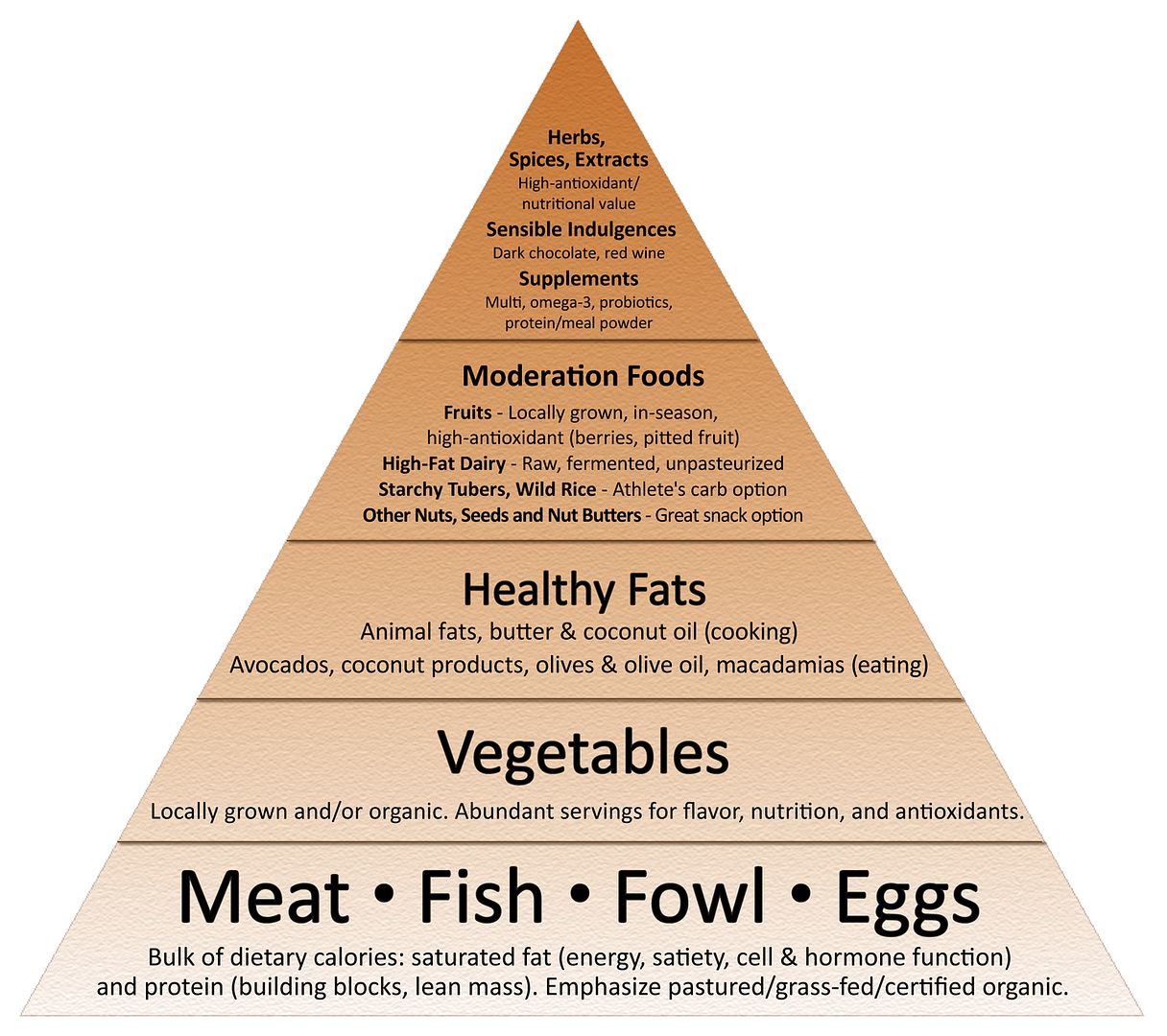
Although I'm an imperfect practitioner (hell, I'm pretty imperfect at about everything), I do think that Mark Sisson has the best all-around advice on health and nutrition. (He's a bit less draconian than Art DeVany, so maybe that's why he gets my nod by a nose.) Anyway, here's his (and my perfect) food pyramid. Yea, that's right. Try it, and I'll bet you like it (i.e., feel better & test better.)
QT: More Chris McDougall on Running
If anyone could convince me to run, it would be Chris McDougall. I joke that I only want to run if I'm chasing or being chased. But more likely, it just wasn't ever comfortable, whatever that means. Anyone, here is more McDougall (of Born to Run fame) on the latest in barefoot running. Don' miss this video, either. I just might try it!
Thursday, November 3, 2011
Austerity vs. Stimulus: The False Dichotomy
This conversation highlights a big problem, well, maybe a couple.
The press promotes the idea of a dichotomy of thinking where I think none exists. Ferguson agrees that some stimulus further could prove useful (and that it did keep us from going over the cliff), and Krugman acknowledges that in the long-term that we need to get our fiscal house in order by dealing with debt. The press does us a disservice when they promote this either-or thinking. Of course, Ferguson, who seems to relish verbal brawls, may make matters appear starker than they are. His point, that things could crumble quickly, seems worth heeding, but Krugman's worry of a slow crumble (slow growth, high unemployment) also presents dangers. We're in a tight spot, and sound thinkers need to navigate between the extremes.
I might note that this video piece by Ferguson supports my point, although his endorsement of tax reform as a third way strikes me as misguided at best (more below). Not that we couldn't stand to improve our tax code (see Robert Franks & Richard Thaler for some really innovative ideas), but how does this really help us? On the other hand, putting people into meaningful work--read infrastructure upgrades--seems very doable and worthwhile.
Note to Ferguson: You're right that we're always fighting the last war (see his comments on Milton Friedman and Keynes), but he fails to say that history NEVER repeats itself. Of course, "this depression is different", but how different? I think we are seeing some new wrinkles (as Ferguson notes re inequality). So, he's right to suggest new answers, but I doubt the tax system. Also, corporate taxes may not work in principle, but then they are "persons" (NOT "people"). (Persons is a legal term in this context.) Anyway, new thinking and updated perspective are always needed, but the tax code business seems quite lame.
Ferguson loves to pick a fight, I think.
My motto, Keynes in crisis; Hayek day-to-day.
Sunday, October 30, 2011
On China by Henry Kissinger
When I was an undergraduate in my class on 19th Century Europe with David Schoenbaum, he assigned us to read A World Restored, Kissinger’s work on the Congress of Vienna that created the post-Napoleonic European state system that lasted until the First World War. Of course, we knew who Kissinger was, as he was then serving as Secretary of State, and before then he served as Nixon’s national security adviser. Since then, I’ve read a big chunk of his book Diplomacy (very interesting, but I got distracted, by another book project. I’m definitely going back). Thus, as you can discern, Dr. K has some credentials with me. But, I thought, isn’t he really an expert on the European state system, you know, Westphalia, Vienna, Versailles, etc.? What does he know about China? I know that he went there to pave the way for the rapprochement led by Nixon, but just another stop on a busy itinerary, right?
Wrong, wrong, wrong. At age 88, he’s published a very engaging, nuanced book about China’s relation to the world that provides a fascinating and lasting impression. In fact, Dr. K has been to China on over 50 occasions, and he continued to meet with Chinese leaders well after he left office. Thus, we get the insights and thoroughness of a great scholar as well as the insights of a statesman who lived and contributed to much of the history that he discusses.
Dr. K understands Chinese strategic thinking. For instance, think of the Japanese game called “go” as the eastern counterpart to chess in the West. These two games display different perspectives on strategic thinking. After this foray into culture, Kissinger goes deeply into Chinese history in the 19th century, as China comes under domination by the Western powers. He recounts how China begins its long march back to great power status (where certainly it is today). Kissinger documents the Chinese perspective very well (at least from my limited knowledge). Of course, when he becomes a player, things begin to get more interesting in the book and in the world. The great Chinese leaders now come alive under first-hand observation. What a treat!
The final part of the book allows Kissinger to analyze how the future might unfold in light of the past. The historical example most often cited as a precedent for U.S.—Chinese relations is the rise of Germany in the second half of the 19th century and how that challenged Great Britain, the dominant power. Of course, we know that these two leading powers collided in WWI, a huge calamity. Are the U.S. and China destined for a violent encounter as China rises relative to the U.S.? Kissinger gives hope that this precedent need not prove the case. In this discussion, Kissinger shows himself the true statesman and diplomat. Careful and nuanced considerations of national interests, strategic, economic, and cultural (including human rights issues)—all must be carefully weighed, valued, and applied. No, there are not quick and easy answers, but answers, he believes, can be found.
A terrific book (best of the year)? I should also add that I listened to it, and the narrator, who sounded quite American most of the time, pronounced Chinese names as I would expect 1HP to have pronounced them, so this lent an air of authenticity to the reading.
1HP: After you’ve read this book, I would be delighted to share a guest post.
Wrong, wrong, wrong. At age 88, he’s published a very engaging, nuanced book about China’s relation to the world that provides a fascinating and lasting impression. In fact, Dr. K has been to China on over 50 occasions, and he continued to meet with Chinese leaders well after he left office. Thus, we get the insights and thoroughness of a great scholar as well as the insights of a statesman who lived and contributed to much of the history that he discusses.
Dr. K understands Chinese strategic thinking. For instance, think of the Japanese game called “go” as the eastern counterpart to chess in the West. These two games display different perspectives on strategic thinking. After this foray into culture, Kissinger goes deeply into Chinese history in the 19th century, as China comes under domination by the Western powers. He recounts how China begins its long march back to great power status (where certainly it is today). Kissinger documents the Chinese perspective very well (at least from my limited knowledge). Of course, when he becomes a player, things begin to get more interesting in the book and in the world. The great Chinese leaders now come alive under first-hand observation. What a treat!
The final part of the book allows Kissinger to analyze how the future might unfold in light of the past. The historical example most often cited as a precedent for U.S.—Chinese relations is the rise of Germany in the second half of the 19th century and how that challenged Great Britain, the dominant power. Of course, we know that these two leading powers collided in WWI, a huge calamity. Are the U.S. and China destined for a violent encounter as China rises relative to the U.S.? Kissinger gives hope that this precedent need not prove the case. In this discussion, Kissinger shows himself the true statesman and diplomat. Careful and nuanced considerations of national interests, strategic, economic, and cultural (including human rights issues)—all must be carefully weighed, valued, and applied. No, there are not quick and easy answers, but answers, he believes, can be found.
A terrific book (best of the year)? I should also add that I listened to it, and the narrator, who sounded quite American most of the time, pronounced Chinese names as I would expect 1HP to have pronounced them, so this lent an air of authenticity to the reading.
1HP: After you’ve read this book, I would be delighted to share a guest post.
Willpower: Rediscovering the Greatest Human Strength by Roy Baumeister & John Tierney
Social psychologist Baumeister and science journalist Tierney have teamed up to provide a popular account of type of academic work that Baumeister and his colleagues have conducted. This body of research has given us a new perspective on the age-old problem of the will. Actually, as scholars as diverse as Hannah Arendt and Garry Wills have written about the fact that St. Augustine developed the idea of the will in Western culture, a concept that the Greeks never really developed (although they were quite concerned with issues of self-control and self-regulation). Augustine was trying to understand why he didn’t always do as he would have himself do, a problem explored in Greek culture (witness Odysseus binding himself to the mast, Aristotle on habit, and St. Paul on why he does what he would not), but never directly addressed. No writer until Augustine addressed this topic head-on. In any event, having perceived myself as suffering a weak will, I’ve certainly read on the topic, and I find this book a welcome and useful addition to this literature.
The authors do a good job of mixing the findings of academic research with reports on contemporary and historical individuals as exemplars of willpower. David Blaine, the magician and stunt artist (which I do not intend as a derogatory term), David Allen (of GTD fame), Eric Clapton (recovering alcoholic), Oprah (dieting victim), and Stanley (of “Dr. Livingstone, I presume” fame), all provide true stories of individuals dealing with particular problems of will. This mix of reporting academic research with real-life examples works well (although how their findings and conclusions fit with Victorian willpower isn’t as completely explored as I would like).
The takeaway: we have a certain amount of willpower (which can increase with training), but which declines with use (thus drawing on the some ideas of Freud as the ego as a fixed reserve). Interestingly, researchers have found that a dose of sugar (energy) works to increase willpower when it begins to flag. In addition, dieting, as the “perfect storm” for challenging willpower, gets an interesting chapter to itself. Think about it: you’re exerting extra willpower and you’re short on energy, so the brain orders (loudly) “eat!”. That’s why it’s important to develop life-long good habits.
One other area that they don’t explore is the Buddhist mindfulness tradition and other traditions (Gurdjieff, for instance) and how the academic research might fit with spiritual and philosophical ideas of willpower. Indeed, many religious traditions contain examples of extraordinary self-control and awareness. How does this all fit in? I suggest that we have to write that chapter ourselves.
In the end: a fun, interesting, and useful book. Recommended.
The authors do a good job of mixing the findings of academic research with reports on contemporary and historical individuals as exemplars of willpower. David Blaine, the magician and stunt artist (which I do not intend as a derogatory term), David Allen (of GTD fame), Eric Clapton (recovering alcoholic), Oprah (dieting victim), and Stanley (of “Dr. Livingstone, I presume” fame), all provide true stories of individuals dealing with particular problems of will. This mix of reporting academic research with real-life examples works well (although how their findings and conclusions fit with Victorian willpower isn’t as completely explored as I would like).
The takeaway: we have a certain amount of willpower (which can increase with training), but which declines with use (thus drawing on the some ideas of Freud as the ego as a fixed reserve). Interestingly, researchers have found that a dose of sugar (energy) works to increase willpower when it begins to flag. In addition, dieting, as the “perfect storm” for challenging willpower, gets an interesting chapter to itself. Think about it: you’re exerting extra willpower and you’re short on energy, so the brain orders (loudly) “eat!”. That’s why it’s important to develop life-long good habits.
One other area that they don’t explore is the Buddhist mindfulness tradition and other traditions (Gurdjieff, for instance) and how the academic research might fit with spiritual and philosophical ideas of willpower. Indeed, many religious traditions contain examples of extraordinary self-control and awareness. How does this all fit in? I suggest that we have to write that chapter ourselves.
In the end: a fun, interesting, and useful book. Recommended.
Sunday, October 2, 2011
QT: Niall Ferguson TED Talk on the Great Divergence
Niall Ferguson provides a TED talk summary of his forthcoming Civilization: The West and the Rest (2011). In this talk and book (I've read reviews of its publication in the UK this spring), he provides an account of why China, especially, fell back from the West (Europe, U.S./Canada/and Autral-asia) at the beginning of the 19th century, and how China, other Asian nations, and perhaps Latin America, have closed that gap and will likely soon end it. An intriguing and important issue. Ferguson does a fine job of making his points.
QT: Tyler Cowen on Republican Confusion
Tyler Cowen argues persuasively that Republican no-tax ideology (or should we say zealotry) will lead to higher taxes and a worse fiscal position for the U.S. government. Ironic, yes, like a lot in life. Getting through it requires thought, which the Republicans are woefully short of. So sad.
QT: NNT on Taxes
I think that he has a very good point here. Of course, some investors, say Warren Buffett & Charlie Munger, have exercised significant skills (including self-restraint), but a fair amount of success in this area is a matter of luck. Add Robert Frank's suggestion of a progressive tax on expenditure (if this is the right term), we'd probably all be better off.
Sunday, September 25, 2011
QT: Jack Goldstone on Why the Deer in the Headlights
Jack Goldstone, a scholar, asks a very direct and important question that has motivated much of his career research and that proves very relevant today: why do government officials, with all of the experts and resources that one could hope to muster, make such poor decisions? His answer, they are politicians concerned about holding office first, and leaders only second. One's first thought might be, well, they ought not to be concerned about reelection. But even if we could convince someone to leave a prestigious, good-paying job, a second reason should compel caution. Without holding office, one cannot do anything in terms of enacting a political agenda . So, caution, and kicking problems down the road. I predicted that Obama would be on the receiving end of some real time bombs, and this has proven true. He has to deal with some of them; others, such as global climate change, he (and most of the rest of the world) seem willing to kick further down the road. So, do we have weakness of will in societies?
QT: David Frum on What Obama Did Wrong
Not the usual Republican hatchet job. Instead, a thoughtful and useful critique. Query: can Obama learn from these mistakes?
Saturday, September 24, 2011
QT: Was the Bomb Necessary?
New scholarship about the Japanese and how WWII came to an end in the Pacific. Maybe the A-bomb wasn't the key factor, in which case . . . . Such constant probing and questioning really can challenge our conventional thinking, and that's a very good thing. An intriguing article.
QT: About Collective Violence & Rioting
As I'm afraid that we're likely to see more unrest around the world, for good (Arab Spring?) or ill (London riots), this is a pertinent piece. Jack Goldstone on revolutions is a good source also.
QT: On my "to read" list: A.S. Byatt on a Norse myth
This sounds like a very interesting read. And as a LeGuin fan, and knowing of Byatt by reputation, it all seems like a good idea. However, I don't find it in bookstores or libraries here.
QT: Dr. Kurt Harris on What to Eat (and not to eat)
Here's an interesting summary of a primal perspective from a doc that trained here in Iowa City. Now he works in the area of primal (my term, not his) nutritian. He seems quite sensible in his recommendations. Within this general train of thought you can find a lot of very thoughtful and useful recommendations about how to improve your physical being.
QT: Jack Goldstone on Why Growth is Gone
Sad, but likely true. Of course, policy-makers aren't helping.
QT: Tony Judt on Contemporary Politics
Only shortly before his untimely death did I become acquainted with the work of historian Tony Judt. This piece is a timely meditation on what we're losing, on how the post-WWII consensus worked well in the U.S. and Europe. This piece is an elegy for what we're losing, if not for what we've lost. Like most of the pieces I've now read for him, he appears to have great insight.
QT: Paul Krugman on Economic Quackery
Krugman ponders the last one of the questions that I posed earlier. He can't seem to figure it out, either.
QT: Jack Goldstone on Failing to Learn from History
Jack Goldstone makes a similar point to John Juddis noted in the previous post. Isn't this a fascinating subject? Are we repeating the mistakes of the past? I know Bernacke doesn't want to, and I doubt many others do, but many politicians and many in the electorate seem hell bent on the deficit issue when we're teetering on the edge of a depression. BTW, who is John Maynard Keynes, anyway?
QT: John Juddis on Economic Doom
John Judis has written a fascinating article on our economic predicament. Alas, so few seem to know history, not just Mitt Romney suffers this shortcoming. Why do we want to repeat the 1930's? Okay, we can't ever exactly, but we can make it way too similar if we continue down our current path.
Check out Paul Krugman's comment on the article (and where I first learned of it).
Check out Paul Krugman's comment on the article (and where I first learned of it).
QT: Jack Goldstone on the Econ Crisis Redux
Goldstone sounds a lot like Krugman, although Goldstone is a historian and social scientist who has written about revolutions, the coming of early modern Europe, etc. Worthwhile, because in these times, history is our best guide.
QT: David Frum on the Great Recession
QT = Quick Takes. I'm going to cite some interesting reading that I've encountered and have been meaning to post. Here favorite Republican thinker (not an oxymoron) David Frum has a worthwhile take on America's troubles given to a Canadian audience. If more Republicans were like Frum, we'd have a much better result. Anyway, I find many of his contentions quite worthwhile and convincing.
June 1941: Hitler & Stalin by John Lukacs
 Published in 2006 and weighing in at only 164 pages, this is another John Lukacs gem. While in a recent post I pondered the incredible evil of these two totalitarian dictators and how difficult it would be to weigh the relative evils of themselves and their systems, this book provides a different perspective. Lukacs notes that both men were "statesmen," not in a laudatory sense, but in the sense that each of them ran great states that had goals of securing and aggrandizing their positions. They each had goals, and they cooperated in dividing Poland between them in 1939. Then, in June 1941, Hitler launched Operation Barbarossa, invading the Soviet Union. Stalin, who had received numerous warnings from varied sources, refused to believe the warnings. He nearly suffered a nervous breakdown when the invasion began and German forces cut through the Soviet defenses like a hot knife through warm butter.
Lukacs recounts the events with his usual skill, and he draws upon recently released Soviet archives. The relationship between the two leaders and their regimes is a complex one. Of course, Hitler's National Socialism was vehemently anti-Communist (and garnered some support from abroad for this), and Stalin's regime was anti-fascist (a term they used loosely). But in 1939, rather hastily, the two regimes entered into a "friendship" pact that promoted trade, mostly raw materials flowing into Germany to help meet its economic needs. Another pact, secret, was also agreed to at that time that divided Poland and other parts of Eastern Europe between the two regimes. The Second World War broke out a few days after the pact was signed. The pact shocked partisans of each regime as well as embassies around the globe. Stalin was delighted. He believed that the Red Army, which he'd recently decimated with purges, wouldn't be ready to fight the Germans until 1943, so peace, for now, was welcome, in addition to gaining the cash from trade and some territory. Hitler, on his part, slapped his thigh in delight upon learning that the pact had been approved. Hitler had his eye on the territories of the Soviet Union, but his immediate aim was Poland, and this gave him a virtual cart blanche. (Great Britain and France protested and went to war against the Nazi regime's conquest of Poland, but to no effect on the invasion and division of Poland or the Nazi-Soviet relationship.)
As the war proceeded, very much in favor of Hitler's regime, events came to the point, after the relatively easy conquest of France, that only Churchill-led Britain stood against Nazi domination of Europe. Hitler knew that the Soviet Union was a British hope, along with America, for finding an ally to counter the Germans. This, along with Hitler's obsession with lebensraum (living room) allowed Hitler to turn his attention to attacking the Soviet Union after it became clear that he could not successfully conquer Britain by an invasion. In mid-1940 Hitler informed his generals of his intention to invade the Soviet Union, and plans were shaped near the end of that year. Originally planned for May 1941, the invasion began on 22 June of that year.
But one can't plan and stage a major invasion without others noticing, and many did. Warnings were sent to Stalin by his own spies and by foreign nations, including G.B. and the U.S. But Stalin refused to heed these warnings, always finding an excuse to discount them. Even as German reconnaissance flights into Soviet territory increased in frequency and intrusiveness, Stalin told his commanders to do nothing to provoke the Germans.
Lukacs does not directly answer the question of why Stalin refused all of the warnings. Perhaps no one can. It seems a matter of wishful thinking more than rational calculation. Stalin didn't believe that Hitler would begin a two-front war, which has some reason behind it, but it pales in comparison to all of the growing evidence to the contrary that was provided to him. But the failure to find a definitive explanation is one that is likely to elude historians forever. Who can truly fathom the workings of another's mind, especially one as dark and secretive as that of Stalin?
This is a compelling account of the two leaders who cooperated and then crossed one another as told by a master historian. Hitler's decision to invade the Soviet Union led to his eventual downfall. What if he had succeeded? He came close to winning the Second World War. On the other hand, Stalin succeeded eventually (with the aid of G.B. and the U.S.) and ended up controlling virtually all of Eastern Europe for nearly 36 years. Great forces may set the stage for history, but individual human decisions still create the action.
NB: This review was originally posted on 24 September 2011 after I first (?) read the book. I have edited and expanded it a bit after reading it again in April 2017. While discussing local history, C asked why Hitler invaded the Soviet Union. This sent me back to this book and Ian Kershaw's excellent Fateful Choices: Ten Decisions That Changed the World 1940-1941 and its chapter on the formulation of Hitler's plan to invade the Soviet Union and another about Stalin's response to reports of an upcoming attack.

Friday, September 23, 2011
Norman Davies: No Simple Victory: WWII in Europe 1939-1945
We can think of WWII as well picked-over territory. Persons my age grew up with it in books, films, and television. If, like me, you're a history buff, it makes for easy pickings. However, I think that there's more to this event than simply easy access and relatively recent memory. Less than 10 years before I was born, when my parents were in the prime of their youth, the world was a hell in large measure. Why and how this could be? How leaders deal with the stark facts of the age? These questions are not easily answered, and their continuing consideration by historians remains an area of fascination. Anyway, this is just a prelude to why I listened to this book and read others like it.
This particular book is fascinating because Norman Davies, is primarily a historian of Eastern Europe, and he places his emphasis on events that occurred on the eastern front. WWII, in Europe, was decided in the east, with the Americans and the Brits and their allies in the west playing an ancillary role. The Soviet army, with guns at their backs from the commissars, as well as in their faces from the Nazi's, defeated the Third Reich. Davies makes all of this clear. In addition, he raised in my mind a further question: was Hitler worse than Stalin, our ally? I'm not so sure, and that's not because I think any less of the Nazi regime. The art of comparative terror and evil is perhaps beyond comprehension, but if we attempt it, we see that we did indeed "supp with the devil" (Churchill on the alliance with Stalin). We did not know the full extent of Stalin's evils at the time, but now we do. Davies makes all of this clear. That politics--and war--makes strange bedfellows is a truism, but for all of it's truth, when one stops and examines it, it nonetheless boggles the mind.
If your looking for a history of WWII (excluding the Pacific theater), you would certainly do well with this effort. I know that there are some newer ones and more comprehensive histories, but this does open one's eyes to the horror and craziness of it all. I recommend it highly.
This particular book is fascinating because Norman Davies, is primarily a historian of Eastern Europe, and he places his emphasis on events that occurred on the eastern front. WWII, in Europe, was decided in the east, with the Americans and the Brits and their allies in the west playing an ancillary role. The Soviet army, with guns at their backs from the commissars, as well as in their faces from the Nazi's, defeated the Third Reich. Davies makes all of this clear. In addition, he raised in my mind a further question: was Hitler worse than Stalin, our ally? I'm not so sure, and that's not because I think any less of the Nazi regime. The art of comparative terror and evil is perhaps beyond comprehension, but if we attempt it, we see that we did indeed "supp with the devil" (Churchill on the alliance with Stalin). We did not know the full extent of Stalin's evils at the time, but now we do. Davies makes all of this clear. That politics--and war--makes strange bedfellows is a truism, but for all of it's truth, when one stops and examines it, it nonetheless boggles the mind.
If your looking for a history of WWII (excluding the Pacific theater), you would certainly do well with this effort. I know that there are some newer ones and more comprehensive histories, but this does open one's eyes to the horror and craziness of it all. I recommend it highly.
Friday, September 9, 2011
E. Dionne: If He's Happy, I'm Happy
I missed the President's big speech last night since I was traveling and meeting with clients. However, if Dionne's report is accurate--and from the snippets I saw in TV, it is--then Obama has done what I believe he should do: not only propose a new jobs program, but also lay down the smack to the Republicans. He did both. Bully for him! And good for all of the rest of us!
I spoke to a local Democratic legislator Wednesday night after we both heard former Labor Secretary Robert Reich speak @ the IMU, and I shared these concerns. As she pointed out, Obama has to compromise because the Republicans were putting a gun to our heads with the politics of threat. However, I argued, and still do, that Obama has to rally his troops and show the nation who wants to do what. Protect the very wealthiest from tax cuts? Allow joblessness to linger? Pick up the failed policies of the 1930's? Not for me buddy, and not without going down with a fight. You go Obama!
I spoke to a local Democratic legislator Wednesday night after we both heard former Labor Secretary Robert Reich speak @ the IMU, and I shared these concerns. As she pointed out, Obama has to compromise because the Republicans were putting a gun to our heads with the politics of threat. However, I argued, and still do, that Obama has to rally his troops and show the nation who wants to do what. Protect the very wealthiest from tax cuts? Allow joblessness to linger? Pick up the failed policies of the 1930's? Not for me buddy, and not without going down with a fight. You go Obama!
Wednesday, August 24, 2011
David Frum: What Inflation?
David Frum continues to amaze me because he keeps pointing out that the emperor has no clothes. In this case, that we don't have an inflation problem, we have a deflation problem. We are in a depression. It's refreshing to read and consider thoughts of someone who considers himself a conservative but who has an open mind. It shouldn't be that way. What we call conservative thought (free market, limited government, etc.) isn't crazy, it has some sound points. But the current crop of Republican presidential candidates are like Stepford wives, all parroting the same contra-factual mantras. It's really crazy, and really sad. Frum should run!
Sunday, August 21, 2011
Alexander McCall Smith: The Sunday Philosophy Club
On whim I picked this up @ ICPL, and I found it a delightful read (and it has nothing to do with WWII). If you know Smith from the No. 1 Ladies Detective Agency, you'll find that his manner transforms well to his native Scotland. Ms. Dalhousie, the protagonist, is a rather appealing character. She edits the Journal of Applied Ethics, having studied philosophy at Cambridge, and her comments on life, philosophy, and any manner of subjects are light and engaging. You rather feel that you'd enjoy knowing this woman (and feel badly that the love of her life--who hardly seems worthy in retrospect--passed her by). Smith has a way of making his characters engage you, much like Precious Ramotswe does in the No. Ladies Detective Agency series. (Does Smith have some special insight into women?). Anyway, an engaging and fun read. No action packed adventure, just lots of careful people assessment, hypothesis development and testing (and discarding), and appreciation of this small slice of humanity. I'll read another one!
John Lukacs: The Hitler of History
After reading about the events of 1938 leading up to the Munich Conference of that year that gave the world "appeasement", I went back to the great historian John Lukacs's consideration of Hitler in this book. (I'd read it about a decade ago on a trip to Montreal with Iowa Guru & Africa Girl. Memories associate well with places.) As with virtually all of Lukacs's work, it bore re-reading. Lukacs treats Hitler for what he was: a human being, a politician, and even--perhaps--a statesman. After all, Hitler had political aims in his war (and WWII was his war, Lukacs argues). As with most of Lukacs's work, it's hard to summarize because he throws out nuggets of insight here and there like he's blithely sowing seeds along a garden path. This is a book about other books and historians as much as Hitler himself, and this, too, makes it different, interesting, and well worthwhile.
Friday, August 19, 2011
Am I Smitten? More on Rick Perry
Am I smitten with Rick Perry, or what? This guy intrigues me, and as this post by Michael Tomasky contends, he makes George W. Bush look wise, intelligent, and informed. Wow--now that's a talent! Whereas W used to whisper some of his nonsense, Perry uses a bullhorn to advertise his ignorance and prejudice. If you think about it, from George H.W. Bush to George W. Bush to Rick Perry: isn't this a strong argument for devolution? Darwin in reverse?
The other point of this article is another call to arms for President Obama. As a fellow b-ball player, I understand that Obama doesn't want to get into an elbow swinging match with his opponents, that's sucker stuff. Obama, however, shouldn't want not get even, but to get ahead (thanks Walter "Clyde" Frazier). The greats, like Jordan, Magic, Bird, West, Robertson--they didn't put elbows into opponents mouths, they put stilettos between their ribs. Obama is a cool guy (in more ways than one), but he has to coolly put it to his political opponents, with just a touch of fire. Maybe Obama needs to spend some time watching NBA Classics.
The other point of this article is another call to arms for President Obama. As a fellow b-ball player, I understand that Obama doesn't want to get into an elbow swinging match with his opponents, that's sucker stuff. Obama, however, shouldn't want not get even, but to get ahead (thanks Walter "Clyde" Frazier). The greats, like Jordan, Magic, Bird, West, Robertson--they didn't put elbows into opponents mouths, they put stilettos between their ribs. Obama is a cool guy (in more ways than one), but he has to coolly put it to his political opponents, with just a touch of fire. Maybe Obama needs to spend some time watching NBA Classics.
Thursday, August 18, 2011
David Frum on Sarah Palin & The Lesson We Should Learn
David Frum is lining up as my second favorite conservative writer behind David Brooks. We might disagree about a number of things, but I imagine that I would have a very enjoyable conversation with the guy if we sat down to talk shop. In this particular article, he tells us the brains are important in choosing presidential canidates, character and not demographics are important in choosing presidential candidates, and that women weren't fooled by Sarah Palin, but men, apparently going all instinctual, were. Three points that make a lot of sense to me. His asides in the column about Mitt Romney and Rick Perry are right on point as well.
Tuesday, August 16, 2011
I Told You So Edition--Thank you, Christina Romer
In follow up to this post, I can't help but point out this article by former Obama administration economist Christina Romer (and now Berkley econ prof) about FDR's administration and its errors, including the budget-balancing business of 1937 (along with Fed money restrictions). I guess great minds think alike. I'm glad that I posted before her article appeared. :)
If Karl Rove thinks this . . . . ?
My goodness, if Karl Rove thinks that Perry is off his rocker, what should the rest of us think? This adds to my sense that Republicans are utterly bankrupt when it comes to compelling leadership, and the rank-and-file are dominated by the Christian Right (which out to be an oxymoron, but sadly isn't). How sad! How different from the British Conservatives. David Cameron strikes me as intelligent and reasonable, albeit misguided with his current austerity program. Do the Republicans have anyone in that league? If they do, they're hiding for fear of the Tea Party types. Sad and scary.
Monday, August 15, 2011
Et Tu, China? Niall Ferguson's Assessment
Courtesy of Walter Russell Mead's blog: Ferguson seems not so sure that China won't hit the same problems that we did with a real estate bubble of its own. Very interesting! Bubbles, everywhere, all ready to pop!
Rick Perry: Could This Guy Become President With These Views?
I thought that George W. Bush was one of the least qualified and least capable individuals to have been nominated or elected president. Events, I contend, bore me out. Now we have this guy Perry. Why on earth would we vote him into office? If his views that Yglesias quotes from his book aren't enough, note this Krugman analysis of his supposed big selling point. Are we as a country really going off the deep end?
Saturday, August 13, 2011
Munich, 1938: Appeasement & WWII by David Faber
David Faber's book (2008, 437 p.) focuses on the events leading up to the Munich Conference of 1937 wherein Neville Chamberlain and the French (with Mussolini looking on) bargained away parts of Czechoslovakia to Hitler in return for "peace in our time". Well, it didn't work. In fact, Faber's book, which focuses primarily on Hitler's actions (and luck) and British diplomatic efforts, shows how Hitler ran the table of Austria and most of Czechoslovakia without firing a shot. Chamberlain does seem clueless in the face of Hitler. Faber's narrative is detailed and interesting, but I would have appreciated more background on the primary players, like Chamberlain & Halifax, and those in the Foreign Office, in addition to Eden, who questioned appeasement. The diplomatic efforts were intense, but no one in power was willing to call Hitler's bluff, if it was a bluff (an interesting historical question). An interesting book, but not one to approach without a firm background knowledge. (I believe my background knowledge to have been adequate but I would have benefited, as I mentioned, from more scene and character setting.)
Friday, August 12, 2011
1937: Deja Vu All Over Again?
I've been saying (even if no one is listening) that FDR took us into a severe downturn in 1937 with his budget-balancing mania (Keynes apparently didn't get his message across in time), and it looks like the Obama administration is doing the same thing. Of course history doesn't repeat itself (exactly), but sometimes you can see the same pattern.
Krugman: A Sense of Humor Amid the Wreckage
Krugman's sense of humor today is worthwhile, one post on "academia nuts" and this cartoon. Krugman, one senses, has an appreciation of the "animal spirits". Anyway, I read him for laughs as well as insights.
Tuesday, August 9, 2011
E.J. Dionne in London on London (and the other cities)
Interesting follow-up to the last post (on Goldstone). Here we have Dionne talking the politics of all of this (in GB). We (democracies) have a problem having an adult debate. Yes, condemn, arrest, and punish. Stop rioting, but riots don't just grow on trees, they grow out of bad conditions. No rioting here on Magowan Ave. Wonder why not? We can't condone or reward, but we (and I say "we" because it can happen here) or the Brits would be dumb not to address causes. We'll see.
Goldstone on London
Jack Goldstone's New Population Bomb, certainly a great new blog, has another interesting post today, and it's about London. Simply put, we only describe the situation when we say that people (some) are acting reprehensibly, criminally, etc. Of course, but the question we really need to ask is "why?". How do we explain this outbreak of violence? Goldstone has the credentials, and as his recent post on the French Revolution demonstrates, we can (in some measure) learn from history. I believe that his conjectures about London (and Greece earlier) are very persuasive. The police shooting in London was just the match: without fuel, the match doesn't do much of anything. Compare London today to the Rodney King riots in LA: another match in a blighted area. With increasing economic volatility, if not outright downturn, expect to see more of this type of social unrest. (BTW, consider similar underlying conditions in the Arab Spring.)
Sunday, August 7, 2011
Krugma on Weston on Obama
Okay, if you've ever read this blog more than a few times you know that I think that Paul Krugman is usually right. I think that events have born him out on most significant issues. And, if like me, you read him in 2008 when Obama was running, you know that he was skeptical, and his skepticism has been born out. I suggest that you not only read this post, but the post he wrote at the time of the inaugural. Also, as an added treat, he gives a shout-out to Keynes that leads me to a new Keynes insight that I thought was original to me: that a depression or severe recession, then, as now, isn't marked or caused by some natural catastrophe (unlike, say the effects of the Japanese earthquake and tsunami), but by a faulty system. Damn, I think this Keynes guy was pretty smart!
Jack Goldstone on the Tea Party
Jack Goldstone offers a very perceptive appreciation of what's going on with the Tea party phenomena. In essence, he's saying that folks have reasons to be unhappy, but that their unhappiness is being funneled into an old Republican agenda that really doesn't address the reasons for their unhappiness very well. His attitude and perceptions judging the U.S. government and how it ought to work--and had worked successfully in the past--is on mark for my money. Like me, he understands that limits on government and on government regulation are important considerations, but that government and government regulation are often quite good. It's not an either/or proposition, but a balance. A fine piece for grasping the dynamics of our changing world.
Jack Goldstone's Advice to Obama
Jack Goldstone, a social scientist @ George Mason, has started a blog & today I note that he referenced the Drew Weston article in my previous post. But he does one better, in the linked-post, he explains what Obama could have and should have done in response to the Republican bargaining tactics. He's making some sound suggestions here that we all can wish that Obama would have pursued. For right now, the U.S. is getting the reputation of a deadbeat nation (with the rating downgrade), but we're still paying our bills.
Drew Weston on Obama
Drew Weston's lead article in the NYT today really hits on some important points in general and about Obama in particular:
1. The importance of narrative (the fancy word for story). As a trial lawyer, this important mode--the most important mode of conveying information--has been drilled into my head by communications experts and fellow trial lawyers. Weston makes the point:
Obama was elected--in very large measure--on his story: the story of a bi-racial kid raised by a single mother in exotic locales, but he maintains close contact with his Midwestern grandparents,and those he learns to bridge multiple worlds and makes good, moving away from divides of race, etc. A great story. But what is his story now?
2. Weston contrasts Obama with the two Roosevelts, and Obama lacks in comparison. Both were fighters, both willing to take on "the bad guys". Now really, there are bad guys (not many, but some), and there are always those (virtually all of us) who will not give up the advantages and privileges that we have (a/k/a greed). If you want to take something away from say, Wall Street, or the rich, or seniors, or whomever, you're going to get a fight. You must fight. Fight and then negotiate. I do it every day. Obama only seems to want to negotiate. Weston contrasts Obama's lack of a fighting story with the attitude exhibited by the "Happy Warrior":
3. Weston notes that Obama took many of his bearings from the work of Martin Luther King, Jr., surely a strong and relevant choice, but as Weston notes, King, too, fought--in the streets as well as with his moving oratory--for the cause that he championed. Obama seems to lack a cause and the will to champion it. Weston writes:
4. Weston goes on to argue that mere "centrist" positions are not enough, and that Obama may be bewitched by this siren song that seems to pull many Democrats, and then he goes on the raise potentially more fundamental flaws that Obama may suffer:
This is a troubling perspective. For all his gifts, he was (and largely is) a young man. He has not led a fight like this before. As a fellow lawyer, I have to note that he was a law professor (obviously very capable), but never (I think) a practicing lawyer, never an advocate. Lawyers who represent clients in court have to deal with real issues, take stands, make arguments--fight (compete) within the rules of the game. Often no one is happier to settle a case than me, as I know the risks of failure, but as I never tire of telling clients, the best settlement comes from the best trial preparation. You need to let the other side know that you'll fight and risk loss than settle cheap. (Sometimes you settle cheap if you have no case, but that's a different story.)
5. Having said all this, and expressed my reservations, I will of course support Obama's reelection. At his worst he's better than anyone that the Republicans will nominate. The Republican party is reverting to it's no-nothing roots of the 1840's. It is not the party of Lincoln, TR, Ike, or even Reagan. But to make his reelection count, Obama must stand up and push back.
1. The importance of narrative (the fancy word for story). As a trial lawyer, this important mode--the most important mode of conveying information--has been drilled into my head by communications experts and fellow trial lawyers. Weston makes the point:
Stories were the primary way our ancestors transmitted knowledge and values. Today we seek movies, novels and “news stories” that put the events of the day in a form that our brains evolved to find compelling and memorable. Children crave bedtime stories; the holy books of the three great monotheistic religions are written in parables; and as research in cognitive science has shown, lawyers whose closing arguments tell a story win jury trials against their legal adversaries who just lay out “the facts of the case.”
Obama was elected--in very large measure--on his story: the story of a bi-racial kid raised by a single mother in exotic locales, but he maintains close contact with his Midwestern grandparents,and those he learns to bridge multiple worlds and makes good, moving away from divides of race, etc. A great story. But what is his story now?
2. Weston contrasts Obama with the two Roosevelts, and Obama lacks in comparison. Both were fighters, both willing to take on "the bad guys". Now really, there are bad guys (not many, but some), and there are always those (virtually all of us) who will not give up the advantages and privileges that we have (a/k/a greed). If you want to take something away from say, Wall Street, or the rich, or seniors, or whomever, you're going to get a fight. You must fight. Fight and then negotiate. I do it every day. Obama only seems to want to negotiate. Weston contrasts Obama's lack of a fighting story with the attitude exhibited by the "Happy Warrior":
In a 1936 speech at Madison Square Garden, he [FDR] thundered, “Never before in all our history have these forces been so united against one candidate as they stand today. They are unanimous in their hate for me — and I welcome their hatred.”
3. Weston notes that Obama took many of his bearings from the work of Martin Luther King, Jr., surely a strong and relevant choice, but as Weston notes, King, too, fought--in the streets as well as with his moving oratory--for the cause that he championed. Obama seems to lack a cause and the will to champion it. Weston writes:
Those [Roosevelts'] were the shoes — that was the historic role — that Americans elected Barack Obama to fill. The president is fond of referring to “the arc of history,” paraphrasing the Rev. Dr. Martin Luther King Jr.’s famous statement that “the arc of the moral universe is long, but it bends toward justice.” But with his deep-seated aversion to conflict and his profound failure to understand bully dynamics — in which conciliation is always the wrong course of action, because bullies perceive it as weakness and just punch harder the next time — he has broken that arc and has likely bent it backward for at least a generation.
4. Weston goes on to argue that mere "centrist" positions are not enough, and that Obama may be bewitched by this siren song that seems to pull many Democrats, and then he goes on the raise potentially more fundamental flaws that Obama may suffer:
A second possibility is that he is simply not up to the task by virtue of his lack of experience and a character defect that might not have been so debilitating at some other time in history. Those of us who were bewitched by his eloquence on the campaign trail chose to ignore some disquieting aspects of his biography: that he had accomplished very little before he ran for president, having never run a business or a state; that he had a singularly unremarkable career as a law professor, publishing nothing in 12 years at the University of Chicago other than an autobiography; and that, before joining the United States Senate, he had voted "present" (instead of "yea" or "nay") 130 times, sometimes dodging difficult issues.
This is a troubling perspective. For all his gifts, he was (and largely is) a young man. He has not led a fight like this before. As a fellow lawyer, I have to note that he was a law professor (obviously very capable), but never (I think) a practicing lawyer, never an advocate. Lawyers who represent clients in court have to deal with real issues, take stands, make arguments--fight (compete) within the rules of the game. Often no one is happier to settle a case than me, as I know the risks of failure, but as I never tire of telling clients, the best settlement comes from the best trial preparation. You need to let the other side know that you'll fight and risk loss than settle cheap. (Sometimes you settle cheap if you have no case, but that's a different story.)
5. Having said all this, and expressed my reservations, I will of course support Obama's reelection. At his worst he's better than anyone that the Republicans will nominate. The Republican party is reverting to it's no-nothing roots of the 1840's. It is not the party of Lincoln, TR, Ike, or even Reagan. But to make his reelection count, Obama must stand up and push back.
Friday, August 5, 2011
The Perils of Openess
I'm posting this because I think Zakaria has a some good points, but mainly because he highlights the dangers of "openness" and "transparency". Yes, these can be good, but not always. A law professor of mind, who Arthur'd the Iowa Administrative Procedure Act,wrote some time ago in our local paper recommending further openness in state government. I didn't write a response, but I should have. In fact, sometimes you need the quiet of closed meetings to entertain matters, to float trial balloons and the like. He argued that "mold grows in the dark recesses", but I would counter with a different metaphor: seeds need the dark, damp hidden recesses of the soil to grow and sprout. Expose a plant to the sun too soon and it will shrivel-up and die. A good example of this is the constitutional convention of 1787: it was closed. Did it create a perfect constitution? No (for instance, it condoned slavery), but the convention probably would have failed if it had been open and transparent. Of course, the constitution did eventually go through an extremely detailed vetting before adoption (thus giving us the Federalist papers). Contrast this with the French convention in 1789 (or thereabouts): it was open, and its creation could not last. (Thanks to Jon Elster for this insight.) Anyway, openness and transparency have their downsides. Beware of reformers bearing gifts!
Fareed Zakaria on Defense Spending
I knew that military ("defense") spending has always been out of control, but I didn't realize by how much until I read this article. Incredible. While now might not be the time to take the ax to this overgrown tree, we should start trimming now with the thought of a whole new look over time.
Thursday, July 28, 2011
David Leonhardt on the Economy
A very good article on the U.S. economy and current concerns. Like the article on Krugman that I just posted and my comments on that post, Leonhardt takes a modest view of economic knowledge--that a lot is known that is mostly correct--but that we still have a good deal of uncertainty. That having been said, some ideas and practices are surely true, and some policies manifestly better bets that others. To this I say, Amen!
Krugman: A Short But Perceptive Take on What's Wrong
This is almost too cute, the Keynes must be spinning in his grave remark ("in the long run we're all dead", right?), but Krugman's point is serious and reminds me of my thought about the Great Depression. Why, when we had factories, workers, no natural catastrophes of an unusual sort, not natural cataclysm, did the material world go into such a funk with people wanting? If it's not a natural disaster, then it's a man-made disaster (I would say human now, but then we can blame almost exclusively men!). And if we made it, we should be able to fix it, right? We're having an awfully hard time of it. Perhaps it all is way out of our grasp because of the complexity of it all, but certainly some course of action would prove better than others, such as fiscal stimulus, monetary policy, deficit reduction--they can't be all equally good or bad for our well-being. So, modesty, yes, but choices must be made. This isn't like plagues of old or climate change (yet) that changed the course of civilizations in the past.
Wednesday, July 27, 2011
Bruce Bartlett: Obama as Conservative
This interesting article from Bruce Bartlett (via Paul Krugman) has some interesting history. Having just mentioned Bartlett in a comment posted on Roscommon to Imogene, I followed Krugman's lead to this article. Of course, liberals who go conservative or vice versa can be a good thing (I like Ike), but I'm not sure of Obama's game here. Right now, more spending by the government is in order, I think. I follow those who say that inflating demand (not the currency) and getting more back to work is most important. Thus, why repeat FDR's mistake in 1937 of pursuing budget trimming mania? Obama seems to me to be making the same mistake. Plus, the Republicans are now driven by a real fringe group. What happened to Wall Street & Main Street Republicans?
Sunday, July 17, 2011
Why Niebuhr Now? by John Patrick Diggins

Today American's political and business leaders typically announce that "freedom" is the touchstone of all their efforts, the benchmark against which we are to measure their accomplishments. The term is our national creed. Centuries ago freedom was considered a passion to be controlled; today it is a principle to be celebrated. Educators teach it, poets chant it, philosophers define it, moralists preach it, politicians swear by it, the retired enjoy it, immigrants dream of it, and the poor strive for it.
The cult of freedom is so ubiquitous in American history that it continually erodes the biding force of authority, a concept carrying weight mainly in the Supreme Court rulings and the tenants of religious sects. Many Americans regard authority as inheritly alien and illegitimate and on this the extremes meet. . . . Preoccupied with the fetish of freedom, few Americans dwell on its riddles and paradoxes. We readily assume that to be free is to do what we wish. But are not our wishes often subject to passions that affect our actions? Genuine freedom consists in self-mastery, escape from external restrains and inner compulsions. Niebuhr would not forget Saint Augustine’s warning that the mind may control the body but cannot control itself. But in American life few question that freedom is anything but a self-evident truth, eternally subject to rebirth and reaffirmation.
Reinhold Niebuhr was no enemy of human freedom, but he tried to make us aware of the ironies inherent in the concept. Where there is freedom, he observed, there is also power, and where there is power, there is sin and the temptation to sin. Rarely does America see itself solely in terms of power. Instead, we over estimate our dedication to freedom and forget that we are as much creatures of history as its creators.(110-111).
Well, enough for now. If you care about freedom, power, sin, pride, and self-knowledge, then these two thinkers have a lot to share with you.
Teach Us to Sit Still: A Skeptic's Search for Health & Healing by Tim Parks
 The title, from a favorite poem, caught my eye, and a favorable review led me to grab this book when I saw it at the library. Mr. Parks, an Englishman who lives in Italy with his family and who as a career as a successful novelist (he's made it the Booker-Mann short list), developed severe problems with his plumbing, the the central culprit appearing to be his prostrate. N.B. Hear me knocking on wood, but the similar symptoms did not prompt my choice of this book. So far, so good. But as breast cancer seems a real threat to most woman, so the prostrate for men. Thus, some personal concern--but I digress. His prostrate, however, wasn't cancerous. It was . . . well, doctors weren't quite sure what was wrong. Urologists, in any event, recommended a roto-rooter of the nether regions. He didn't cotton to this idea. He searched, and then he came upon a book. Not to spoil the ending, but he ends up performing exercises and attending a mindfulness meditation retreat. All the while it seems, he protests, but it works.
 I won't say more, but if you're interested in a very tell-told story of health and its elusiveness, of how our bodies and minds interact (or ignore each other), and how we can, if we open ourselves to experiences that the mind, a priori, wants to reject, we can experience some really amazing changes. A very good book and thought-provoking.
Donald Kaul & Obama
Two important things about this article: First, I think it marks that third week in a row that Donald Kaul has appeared again the Des Moines Register. Frankly, the P-C I get for local news, but the DMR is a mere shadow of its former self, across the board. Picking up the man who wrote for it going back in into the early 1970's (at least that's when I picked up the habit from my dad), is a great choice for a paper that hasn't made many great choices over the years.
As to this piece, Kaul expresses my sense of Obama to a T. I'm prepared to give Obama a lot of slack, but I do wonder why he is not more assertive. Every politician, even FDR, for example, is cautious and can't get too far out in front of the selectorate (thank Bruce Bueno de Mesquita for the term). But if you're negotiating, and trying to build your base (which politicians must do constantly), you have to bluff a bit. BTW, note that Kaul describes Republicans as "mad"--nothing like a poignant double-entendre. I don't have an answer to Kaul's question, but we need help. As he pointed out in an earlier Kaulumn, Michelle Bachmann and her ilk are positively daft, part of a growing group of know-nothings (my term, not his). I really do wish that I had an answer.
As to this piece, Kaul expresses my sense of Obama to a T. I'm prepared to give Obama a lot of slack, but I do wonder why he is not more assertive. Every politician, even FDR, for example, is cautious and can't get too far out in front of the selectorate (thank Bruce Bueno de Mesquita for the term). But if you're negotiating, and trying to build your base (which politicians must do constantly), you have to bluff a bit. BTW, note that Kaul describes Republicans as "mad"--nothing like a poignant double-entendre. I don't have an answer to Kaul's question, but we need help. As he pointed out in an earlier Kaulumn, Michelle Bachmann and her ilk are positively daft, part of a growing group of know-nothings (my term, not his). I really do wish that I had an answer.
Sunday, July 10, 2011
Donld Rumsfeld: Right on One Thing
Recently I've been reading more and more about the detriments--serious detriments--of sitting on your hind-end too much. Iowa Guru, in fact, purchased a computer stand for me that now replaces the pile of books that I had on my desk to allow me to stand at my computer, so I'm moving forward. (I have to yet to do something along those lines at my office, which presents greater logistical problems.) So, when I saw this article, I have to give a shout-out to Donald Rumsfeld in an "you've got to give the devil his due" moment. (Okay, he's not the devil, but he strikes me as the epitome of arrogance and hubris.)Rummy has a good idea, and one that we'd all probably do well to emulate. Sometimes, you just don't know where good ideas will come from!
Crazy Republicans
Dave Brooks gets it right when he calls the failure of the Republicans to make a deal on the debt ceiling with debt reduction "the mother of all no-brainers". Others have caught it as well, including the Rational Optimist (from a more minimal government, less taxes perspective) as well as economics commentators. (Of course, Krugman is going nuts over this, as I think he should, but best read him directly.) Certainly we need to reduce long term debt, big time. I'm galled that Republicans get religion about debt reduction after they've been on a spending spree (e.g., Reagan's large deficit and then W's). Also, unless we address entitlements and military spending, we're dealing with chicken feed.
All of this leads to deeper questions: is the political culture really more warped than in past years? The Tea Party element, so far as I can see, really has no grip on policy matters. I suspect its run by more subterranean influences. N.B. I am not saying that we shouldn't reduce our huge deficit. We should. However, doing it too drastically and too fast could lead to disaster, as could a default by the U.S. government. Think Uncle Sam as dead-beat--no good. As for President Obama, he needs a deal, but I'm thinking that he might need more of a Truman-esque pose ("give 'em hell, Barack"), which, unfortunately, seems inimical to him. In the end, we can't allow know-nothings to run the country. And while the Dems are far from perfect, this isn't an equal "a pox on both your houses" situation: the Dems are more responsible even if far from perfect. Enough said, for now.
All of this leads to deeper questions: is the political culture really more warped than in past years? The Tea Party element, so far as I can see, really has no grip on policy matters. I suspect its run by more subterranean influences. N.B. I am not saying that we shouldn't reduce our huge deficit. We should. However, doing it too drastically and too fast could lead to disaster, as could a default by the U.S. government. Think Uncle Sam as dead-beat--no good. As for President Obama, he needs a deal, but I'm thinking that he might need more of a Truman-esque pose ("give 'em hell, Barack"), which, unfortunately, seems inimical to him. In the end, we can't allow know-nothings to run the country. And while the Dems are far from perfect, this isn't an equal "a pox on both your houses" situation: the Dems are more responsible even if far from perfect. Enough said, for now.
Monday, July 4, 2011
Another to Celebrate our Nation: Franklin Foer on Liberalism
The wonderful Five Books site from the UK is a great source for interviews with reading recommendation. I saved this from a couple of days ago, and it works as we celebrate our nation. What is a liberal? Foer's answer to this question, quoting Herbert Croly,that it is "the use of Hamiltonian means to accomplish Jefersonian aims" is probably as good as it gets. We have to compare this with the classical liberalism of John Stuart Mill and, for instance, the Austrian school of Von Mises and Hayek. An interesting interview & a good choice of books. And, no, liberalism isn't a cuss word.
Jack Rakove on the Constitution
This brief piece by Stanford historian Jack Ravoke is a great 4th of July piece, even if its talking about the Constitution and not the Declaration (the former is more important than the latter in my mind). Great recommendations for reading this most important document.
Sunday, July 3, 2011
For the Fourth: John Patrick Diggins's Eugene O'Neill's America: Desire Under Democracy
My custom is to pick a work of American history to read in celebration of the 4th. This year, I decided on a work by John Patrick Diggins (who edged out John Lukac's A New Republic: A History of the United States in the Twentieth Century). Diggins final book was published on June 30, and while I still mourn his passing, I was pleased to learn that his final work, Why Niebuhr Now, would make it to press. I eagerly await its arrival @ PL. Fortunately, I had on hand his next most recent book, a book on Eugene O'Neill, which I'd only dipped into. I haven't seen a great deal of O'Neill, but what I have--oh, my! I had the experience of seeing a film production of The Iceman Cometh by the American Film Theater, starring Frederic March, Robert Ryan, and Lee Marvin as Hickey. What a great Bijou Theater experience. Then, in 1999 (I think), I saw Broadway production with the lovely One Hungary Panda, who graciously accompanied me to this. The production starred Kevin Spacey, and I thought it superb. O'Neill is not easy. Two factors greatly influence his drama: his Irish-American family and his reading of Schopenhauer, Nietzsche, and Spengler. This odd coupling doesn't make for much comedy (but try "Ah, Wilderness"), but it's great stuff. (BTW, O'Neill won a Nobel prize and four Pulitzer prizes for his work.)
So why Diggins? Because his work, on American political thought,Herman Melville, John Adams, on the pragmatists and their critics, Weber (his visit to America), Lincoln & Reagan (yes, I've started this one): all focus on the vicissitudes of democracy and power and how it all fits--or doesn't. No one, but perhaps the late Christopher Lasch, combines the intensity of analysis with deep historical understanding. He's certainly one of my favorite American historians.
Happy Independence Day!
So why Diggins? Because his work, on American political thought,Herman Melville, John Adams, on the pragmatists and their critics, Weber (his visit to America), Lincoln & Reagan (yes, I've started this one): all focus on the vicissitudes of democracy and power and how it all fits--or doesn't. No one, but perhaps the late Christopher Lasch, combines the intensity of analysis with deep historical understanding. He's certainly one of my favorite American historians.
Happy Independence Day!
Book List from Financial Times
I haven't seen a summer reading list from the NYT (perhaps they don't run it anymore?). In any event, the Financial Times from GB has a list, and the recommendations cover a wide variety of topics. I'm currently reading (among other things) Tim Harford's book Adopt of the list.
Jeffrey Sachs @ 5 Books
Five Books is a great site, and this interview with Jeff Sachs is a good source of perspective on global development goals. This man is an optimist despite seeing a lot of hardship. But most importantly, I'm impressed that he realizes that alleviating extreme poverty depends a lot on the good will of persons with the resources to help. In the end, economics depends, or is built upon, ethics.
Sunday, June 26, 2011
Joseph Tainter: The Collapse of Complex Societies
While on my trip I decided to tackle Joseph Tainter’s The Collapse of Complex Societies. I learned of this book from Thomas Homer-Dixon’s excellent The Upside of Down. Since we were once again headed to see some ruins, I thought this an appropriate time to approach this book, although in the case of the Incas, we can easily identify “Guns, Germs, and Steel” (and perhaps horses) as the proximate causes of collapse. But other cases, like the Maya, the Western Roman Empire, and Easter Island, are among those situations that do not provide easy explanations. Tainter reviews virtually all of the prevailing theories. He identifies the prevailing theory in popular thinking and among some historians (Toynbee, for instance) as “mystical” explanations, a poor choice of words to my mind. Toynbee, following a long pedigree, thinks in terms of biological analogies, with birth, youth, maturity, decline, and death the pattern for “civilizations” as well as individuals. This, Tainter argues, provides a false and rather misleading or unhelpful analogy. The other theory, of “decadence”, seems more literary and moral than causative. So what is Tainter’s alternative? Declining marginal returns on complexity (complexity being a term of art in this instance). In short, he bases his theory upon a fundamental economic law (if you will suffer the dubious term here). His analysis and application of his theory to the Western Roman Empire argues that it was not barbarians, Christians, or plagues that brought down Rome, but a limitation on the value of complexity. He applies a similar analysis to the Mayans and to the Chaco Canyon civilization in North America. If he’s right, and I think that he makes a very strong argument (but see Peter Turchin’s War and Peace and War for an excellent competing theory), it has to be taken quite seriously, and if he’s right, then we have to think very carefully about our current predicament. Can we innovate our way out of the inevitable decline of petroleum? Can we get out from under excessive demands for complexity?
I highly recommend this book, and I count it an excellent part of my Big History reading project.
I highly recommend this book, and I count it an excellent part of my Big History reading project.
Peru 2011
I should reflect a bit on the great trip that Iowa Guru, One Hungary Panda, and I had to Peru. (Africa Girl was, of course, in Africa, Benin to be exact, alas.) I will share some random thoughts about the trip & my experience there. Of course, for a great photo tour, see One Hungary Panda’s photos.
For a guy from the flat Midwest, the Andes provide a starkly contrasting, three-dimensional world. They look not only front and back, right and left, but by necessity, up and down. Distance and perspectives really vary from our daily experience here on the Midwest. Distances, for instance, mean little, given the (literal) ups and downs and arounds of travel. Sometimes I felt almost claustrophobic with sheer mountainsides towering above me.
Machu Pichu is all that it’s cracked up to be. In the train from Cuzco that follows the river valley (a tributary of the Amazon), one suddenly realizes that you’ve traveled low enough to enter the jungle. Mountainsides once brown are now green and marked by trees. When one arrives at the heights of Machu Pichu you can see this verdant (even in winter) environment, steep and lush. Machu Pichu itself is a testament to engineering. It stands on this mountaintop (and side) as it has for about 600 years. I quickly learned that if an earthquake were to strike, I’d want to be in some Incan (popular, not accurate name for the civilization) ruins. If you have the chance, visit.
The people of Cuzco love to dance. You see many persons who are obviously from pretty pure indigenous genetic stock, as well as many of mixed ancestry. All seem to love to dance, pre-schoolers to college kids. While we were in Cuzco there seemed to be a dance festival about every day circling the square. Just for the tourists? I don’t think so. This seems to be a genuine vehicle of popular solidarity.
How the present relates the past always fascinates me. There, one sees a lot of reference to the Incan history (okay, Tahuantinsuyo history). The Spaniards, real bastards as far as I can tell, or at least the initial wave, really attempted to stomp on the native culture, but this always proves difficult, perhaps always impossible. Even in colonial churches one sees how Incan motifs sneak into the Christianity grafted over it (literally often, as churches often have Incan ruins for foundations). For instance, statues of the Virgin have her clothed the shape of a mountain. I thought it merely to cover some unseemly weight gain, but no, it was because mountains were sacred to the Incans. Also, in paintings of the Last Supper, we see Jesus and the disciples about the enjoy the last supper with cuy (guinea pig) as the main course. Christianity, like almost every religion, is extremely syncretistic.
Well, perhaps more later. If you have the chance, I highly recommend Peru for a trip. BTW, the people were very friendly, and multi-lingual (1HP was virtually challenged to a linguistic duel!).
For a guy from the flat Midwest, the Andes provide a starkly contrasting, three-dimensional world. They look not only front and back, right and left, but by necessity, up and down. Distance and perspectives really vary from our daily experience here on the Midwest. Distances, for instance, mean little, given the (literal) ups and downs and arounds of travel. Sometimes I felt almost claustrophobic with sheer mountainsides towering above me.
Machu Pichu is all that it’s cracked up to be. In the train from Cuzco that follows the river valley (a tributary of the Amazon), one suddenly realizes that you’ve traveled low enough to enter the jungle. Mountainsides once brown are now green and marked by trees. When one arrives at the heights of Machu Pichu you can see this verdant (even in winter) environment, steep and lush. Machu Pichu itself is a testament to engineering. It stands on this mountaintop (and side) as it has for about 600 years. I quickly learned that if an earthquake were to strike, I’d want to be in some Incan (popular, not accurate name for the civilization) ruins. If you have the chance, visit.
The people of Cuzco love to dance. You see many persons who are obviously from pretty pure indigenous genetic stock, as well as many of mixed ancestry. All seem to love to dance, pre-schoolers to college kids. While we were in Cuzco there seemed to be a dance festival about every day circling the square. Just for the tourists? I don’t think so. This seems to be a genuine vehicle of popular solidarity.
How the present relates the past always fascinates me. There, one sees a lot of reference to the Incan history (okay, Tahuantinsuyo history). The Spaniards, real bastards as far as I can tell, or at least the initial wave, really attempted to stomp on the native culture, but this always proves difficult, perhaps always impossible. Even in colonial churches one sees how Incan motifs sneak into the Christianity grafted over it (literally often, as churches often have Incan ruins for foundations). For instance, statues of the Virgin have her clothed the shape of a mountain. I thought it merely to cover some unseemly weight gain, but no, it was because mountains were sacred to the Incans. Also, in paintings of the Last Supper, we see Jesus and the disciples about the enjoy the last supper with cuy (guinea pig) as the main course. Christianity, like almost every religion, is extremely syncretistic.
Well, perhaps more later. If you have the chance, I highly recommend Peru for a trip. BTW, the people were very friendly, and multi-lingual (1HP was virtually challenged to a linguistic duel!).
Niall Ferguson on The Pity of War
I don't know how this just came to my attention, but this is an interview from about 10 years ago, shortly after Ferguson published his The Pity of War, which is about the First World War. Listening to him, you realize why he is a first-rate historian. This is good, because as a current events commentator, where he is quite active currently, I find him less persuasive. Indeed, I have a growing skepticism of all such commentators, but he's been more irksome to me than some. However, because of his interesting work as a historian, I listen.
Monday, May 30, 2011
Adam Kirsch on Morality in the Histories of WWII
A quote worth repeating from the article cited in my previous post. He expresses a perspective that I agree with.
[T]he patriotism, sacrifice and bravery we read about in a book like “Band of Brothers” cannot be nullified by knowing more about the war in which they flourished. Indeed, the best of the new World War II histories can be seen as attempts to give us, in the year 2011, a more authentic and complete sense of what the war was actually like to those fighting it.
After all, the present is always lived in ambiguity. To those who fought World War II, it was plain enough that Allied bombs were killing huge numbers of German civilians, that Churchill was fighting to preserve imperialism as well as democracy, and that the bulk of the dying in Europe was being done by the Red Army at the service of Stalin. It is only in retrospect that we begin to simplify experience into myth — because we need stories to live by, because we want to honor our ancestors and our country instead of doubting them. In this way, a necessary but terrible war is simplified into a “good war,” and we start to feel shy or guilty at any reminder of the moral compromises and outright betrayals that are inseparable from every combat.
The best history writing reverses this process, restoring complexity to our sense of the past. Indeed, its most important lesson may be that the awareness of ambiguity must not lead to detachment and paralysis — or to pacifism and isolationism, as Nicholson Baker and Pat Buchanan would have it. On the contrary, the more we learn about the history of World War II, the stronger the case becomes that it was the irresolution and military weakness of the democracies that allowed Nazi Germany to provoke a world war, with all the ensuing horrors and moral compromises that these recent books expose. The fact that we can still be instructed by the war, that we are still proud of our forefathers’ virtues and pained by their sufferings and sins, is the best proof that World War II is still living history — just as the Civil War is still alive, long after the last veteran was laid to rest.
Memorial Day Reflections
On Memorial Day it is good and right to remember those who served in our armed forces and sacrificed on behalf of our country. As I watch some of the non-stop war movies that parade across the television screens, I appreciate the sacrifices made, the horrors suffered, and the burdens borne. Of course, not everyone who served was “a hero”; some, over the course of our nation’s history, have committed horrible crimes in the name of our country or while in uniform.
I suggest that on Memorial Day, in addition to honoring those who served, we should turn ourselves to a wider reflection, to reflect on where we, as a nation, have been and where we might be headed. Our story is not without blemish, but if it is correct that “the truth shall set you free”, then we must face the good and the bad and the indifferent in our history. This is not always easy or pleasant. Some recent reading has brought all of this to mind. In the NYT yesterday, a review article by Adam Kirsch entitled “Is World War II Still the Good War?” The “good war”—an oxymoron if there ever was one—and yet not all wars are equal in their moral repugnance and some are justified. Kirsch rightly points out some of the moral failings of the Allied Powers, such as the fire-bombing of German (and Japanese) cities, which rightly raises the issue of war crimes. In the end, neither Kirsch nor I nor many of the authors of the books that he discusses, believe that one finds any equivalency between the evils of Hitler’s Nazi Germany and the Allied Powers. Even the question of allies raises moral clouds, such as Hitler’s one-time ally and then ours, Stalin, who perhaps can rival and arguably even excel Hitler in evil, yet we danced with him in order to defeat Hitler. These are not easy questions, and Kirsch addresses them forthrightly but not naively.
I also listened to a portion of Simon Schama’s The American Future: A History. This morning I listened to the story of the treatment of the Cherokee Nation by Andrew Jackson, Schama describes Jackson’s actions as a terrible low in American political morality. Congress (including Davey Crockett) almost defeated Jackson’s theft and ethnic cleansing (for this is what it was, and often treatment of American Indians became genocide). Yet, it happened. Yes, we must remember this, too. Not to beat ourselves up with useless guilt, but to understand how we got there and to consider our own actions and how they may compare to those of our ancestors, heroic, ordinary, and shameful.
I suggest that on Memorial Day, in addition to honoring those who served, we should turn ourselves to a wider reflection, to reflect on where we, as a nation, have been and where we might be headed. Our story is not without blemish, but if it is correct that “the truth shall set you free”, then we must face the good and the bad and the indifferent in our history. This is not always easy or pleasant. Some recent reading has brought all of this to mind. In the NYT yesterday, a review article by Adam Kirsch entitled “Is World War II Still the Good War?” The “good war”—an oxymoron if there ever was one—and yet not all wars are equal in their moral repugnance and some are justified. Kirsch rightly points out some of the moral failings of the Allied Powers, such as the fire-bombing of German (and Japanese) cities, which rightly raises the issue of war crimes. In the end, neither Kirsch nor I nor many of the authors of the books that he discusses, believe that one finds any equivalency between the evils of Hitler’s Nazi Germany and the Allied Powers. Even the question of allies raises moral clouds, such as Hitler’s one-time ally and then ours, Stalin, who perhaps can rival and arguably even excel Hitler in evil, yet we danced with him in order to defeat Hitler. These are not easy questions, and Kirsch addresses them forthrightly but not naively.
I also listened to a portion of Simon Schama’s The American Future: A History. This morning I listened to the story of the treatment of the Cherokee Nation by Andrew Jackson, Schama describes Jackson’s actions as a terrible low in American political morality. Congress (including Davey Crockett) almost defeated Jackson’s theft and ethnic cleansing (for this is what it was, and often treatment of American Indians became genocide). Yet, it happened. Yes, we must remember this, too. Not to beat ourselves up with useless guilt, but to understand how we got there and to consider our own actions and how they may compare to those of our ancestors, heroic, ordinary, and shameful.
Sunday, May 22, 2011
Walter Russell Mead on Clausewitz
A good, brief introduction to Clausewitz. Mead's course, like the Grand Strategy course at Yale under John Lewis Gaddis, Paul Kennedy, and Charles Hill, seems like an excellent exercise. Mead makes a good point: we won't make war go away by ignoring it, and we're wise to prepare for it. We are foolish to hope war will go away even with all of the good will and new institutions we can create. We can't bet on it. Mead, and Clausewitz, make us face these unpleasant thoughts.
Friday, May 20, 2011
Tim Ferriss on Stocism, Life-Hacking, Language Learning, etc.
I like Tim Ferriss because he's an experimentor, testing ideas (Stocism), his body, his skills (here in some degree about language learning), and he brings a Pareto-based attitude to learning new skills. He seems pretty adept @ it, so I pay some attention to what he has to say. This is a good, relatively short introduction to some of his main ideas & perspectives. Of course, his two books, The Four-Hour Work Week & The Four-Hour Body are chock-full of these ideas and more.
Thursday, May 19, 2011
Nicholas Phillipson: Adam Smith
Adam Smith, an odd, somewhat ungainly man from Scotland who lived and wrote in the 18th century is one of the great minds. The poor fellow seems destined to remain in the popular mind as the mand with the invisible hand. But in addition to this keep perception and his invention of modern economic thought, he is the author of another equally great work, The Theory of the Moral Sentiments. This book gives us the "impartial spectator", an ideal that a Buddhist would recognize.
This birthday gift one 1HP (thanks again!) reinforced what I already believed: Smith is a greaet mind with keen insight. Yes, he invented modern economics, but it was all a part of his project for a "science of man". He is essentially humane, careful, and worthy of all of the consideration that we can give him.
This birthday gift one 1HP (thanks again!) reinforced what I already believed: Smith is a greaet mind with keen insight. Yes, he invented modern economics, but it was all a part of his project for a "science of man". He is essentially humane, careful, and worthy of all of the consideration that we can give him.
Tuesday, May 17, 2011
Sunday, May 15, 2011
Paul Krugman on the "Al Gore Problem"
I liked Al Gore and I thought he got a bad rap. Krugman's article explores this. I think that we, as a nation of readers, are often the victims of journalistic malpractice. There is no defense, no lawsuit that can remedy this inequity. One must simply have one's crap-detector on 24-7. Thanks to Krugman for running his at a consistent high speed.
Garry Wills: Augustine in Brief
While I reviewed Garry Wills's "biography" of Augustine's Confessions a short while ago, I understand you may not have read the book yet. This article highlights some of the key points. Enjoy.
Sitting Too Much?
As one who sits a great deal @ work in front of a computer, often reads sitting, watches television, and who writes blogs, I do more than my share of sitting. Alas, it's a bad practice in excess. However, as I write this,I'm standing up. As a temporary fix, I've simply piled some books (of which I have a few, delightfully fat and therefore appropriate for this ancillary use) to build a platform upon which to rest my computer. One project that I've begun looking into is some type of podium or platform to allow standing reading and writing at work and at home (think Bob Crachitt). Nothing yet, but I'm on the lookout. As the link suggests, the sooner the better!
Saturday, May 14, 2011
John Lukacs: The Future of History
John Lukacs has written another reflection on history as a discipline and as a cultural phenomena. Regular readers of Lukacs will not find a great deal new here, as he's addressed many of these issues in the past. On the other hand, I do not tire of reading Lukacs on this topic. Indeed, given his style, it's almost as if he's sitting by the fire speaking informally to a gathering of confidants on a topic about which his mind has been quite fertile for many decades. While the topics have been addressed in the past, the fertility of his mind keeps the topic fresh and relevant. Topics like how historical consciousness has risen in modernity, how history relates to literature, how we think of what constitutes history: all of these are topics deserving of careful and repeated consideration, and Lukacs provides us with another take on these topics that makes this book worthwhile. For someone new to this master, reading this book will provide a brief introduction to the fertility of his thought on these topics. Now into his 80's, one has to consider each of these books as a real treasure.
Ursula LeGuin: The Lathe of Heaven
A recent trip to the Pacific Northwest to help 1HP celebrate her birthday included a trip to Portland. Portland gave us fun food carts, beautiful gardens, interesting restaurants, some local brews and Powell’s Bookstore. The later is famous and proved fun. In honor of the person I consider Portland’s most famous author (and one of my personal favorites), I purchased Ursula K Le Guin’s The Lathe of Heaven. (Darned, she was on the marquee for making an appearance shortly after our trip there.)
The Lathe of Heaven isn’t just by Portland’s most famous author, it’s also set in Portland. From this rather mundane setting (Portland isn’t all beautiful scenery), Le Guin tells her tale of the young protagonist who experiences “effective dreaming”; in other words, his dreams come true, in a very literal and often disturbing way. As one would expect in our society, he tries to stop this weird occurrence with drugs, and he ends up with a psychiatrist. The psychiatrist, once aware of this unusual gift (if one can call it that), tries to harness this power to the good of humanity. From this premise, Le Guin spins yarns of alternative and dystopian futures, as rationality cannot master the world of the dream. Le Guin, however, masters a blend of the contemporary quotidian, current politics, reigning zeitgeist, and the fantastic, weaving them together so that one hardly blinks at the juxtaposition of the fantastic and the ordinary.
Le Guin’s book was a delight to read while visiting Portland (although finished in Seattle). I never leave one of her stories without a sense of having been caught up in a compelling story, well told, yet I also find myself continuing to ponder what I've just read because she offers a perspective on the world that always challenges us and the reality that we live in. In this case, she challenges us with the world of dreams; not just the dream world of Freud or Jung, with their sometimes too easy interpretations, but the world of dreams suggested by the Tao Te Ching (of which she has written a translation), Chuang Tsu, Victor Hugo, and others.
A trip to Portland for those of us in the Midwest doesn’t happen very often, but you can read The Lathe of Heaven to take a virtual trip to Portland and far beyond.
The Lathe of Heaven isn’t just by Portland’s most famous author, it’s also set in Portland. From this rather mundane setting (Portland isn’t all beautiful scenery), Le Guin tells her tale of the young protagonist who experiences “effective dreaming”; in other words, his dreams come true, in a very literal and often disturbing way. As one would expect in our society, he tries to stop this weird occurrence with drugs, and he ends up with a psychiatrist. The psychiatrist, once aware of this unusual gift (if one can call it that), tries to harness this power to the good of humanity. From this premise, Le Guin spins yarns of alternative and dystopian futures, as rationality cannot master the world of the dream. Le Guin, however, masters a blend of the contemporary quotidian, current politics, reigning zeitgeist, and the fantastic, weaving them together so that one hardly blinks at the juxtaposition of the fantastic and the ordinary.
Le Guin’s book was a delight to read while visiting Portland (although finished in Seattle). I never leave one of her stories without a sense of having been caught up in a compelling story, well told, yet I also find myself continuing to ponder what I've just read because she offers a perspective on the world that always challenges us and the reality that we live in. In this case, she challenges us with the world of dreams; not just the dream world of Freud or Jung, with their sometimes too easy interpretations, but the world of dreams suggested by the Tao Te Ching (of which she has written a translation), Chuang Tsu, Victor Hugo, and others.
A trip to Portland for those of us in the Midwest doesn’t happen very often, but you can read The Lathe of Heaven to take a virtual trip to Portland and far beyond.
Karen Armstrong
Karen Armstrong’s The Spiral Staircase: My Climb Out of Darkness (2004, 306 p.) is an extraordinarily engaging memoir. Ms. Armstrong recounts the time from when she left a Roman Catholic convent in about 1969 to her transformation into one of the leading writers about religion. However, this is not a story all filled with grace and light. In fact, she tells a story of struggle, hurt, and misfortune, although I would say it is one of ultimate success, and I believe that in the end, she must appreciate the immense contribution that she has made to religious understanding.
Armstrong left the convent feeling a bit of a failure as a religious, never having found God has she had hoped and expected. She left Oxford without a Ph.D., thus never having qualified for the academic career that she had pursued, and she was eased out of a secondary teaching career without any apparent alternative available to her. Along the way, hide-bound and insensitive nuns, dull-witted psychiatrists, arrogant professors, and penny-pinching administrators contributed to her woes. She does not berate them, and in the end, despite obvious cruelty and arrogance, one almost secretly rejoices that these impediments led to so many misfortunes, since she might not have turned to the career that I’ve found so enriching.
Only by chance and not really by choice (intentional, anyway) did she turn to religion as a subject for her career as a writer. With her book, A History of God: The 4,000 Year Quest of Judaism, Christianity and Islam, in which she writes a parallel history (so much as history allows) of the three great monotheistic religions she turns again. (I use this phrase because she the first portion of Eliot’s “Ash Wednesday” serves as the epigram for the book and names the chapter titles.) She comes to the conclusion that religion is not about belief, but about practice; not about conflict, but about compassion; that self-emptying (kenosis in the Greek) comes through compassion as much as through meditation; and understanding comes from the inside, from making myth into ritual, and not from a mere recital of facts or creeds. In the end, this book is like a grail quest, altered, of course, by the age in which we live and that Eliot reflects in much of his work.
I’ve put off reviewing The Case for God (2009, 390 p.), so I’ll do that now as well briefly. First of all, although I have a hardback of this book, I listened to it on audio, with Armstrong reading it. Her reading added delight. Even though I had not yet read The Spiral Staircase, one gets a sense of her from her books, and that is enhanced by her reading, which is quite good. (One of her careers, after secondary school teaching and before full time writing, was as a television presenter.) Her firm authorial voice reveals itself fleetingly in print, but clearly in her reading.
This book takes us from the earliest cave art to the present, suggesting ways of understanding God that I mentioned above. She does not pretend to prove or disprove God’s existence; instead, she seeks to understand what all of this God-talk can be about and how it might all go astray or lead us to a better life. Modernity, which brought so many benefits into the world, also made us terribly literal-minded. Religion, as myth and ritual giving shape and substance to lives, went astray (for the most part) because of this mindset. She, like me, believes that the mystics, those who find God a paradox and elusive (not magical), have the deepest insights, but they are a minority in any religious culture.
These two books, like others of hers that I have read, give us a profound insight into what religion can and should be. I highly recommend both of these books.
Armstrong left the convent feeling a bit of a failure as a religious, never having found God has she had hoped and expected. She left Oxford without a Ph.D., thus never having qualified for the academic career that she had pursued, and she was eased out of a secondary teaching career without any apparent alternative available to her. Along the way, hide-bound and insensitive nuns, dull-witted psychiatrists, arrogant professors, and penny-pinching administrators contributed to her woes. She does not berate them, and in the end, despite obvious cruelty and arrogance, one almost secretly rejoices that these impediments led to so many misfortunes, since she might not have turned to the career that I’ve found so enriching.
Only by chance and not really by choice (intentional, anyway) did she turn to religion as a subject for her career as a writer. With her book, A History of God: The 4,000 Year Quest of Judaism, Christianity and Islam, in which she writes a parallel history (so much as history allows) of the three great monotheistic religions she turns again. (I use this phrase because she the first portion of Eliot’s “Ash Wednesday” serves as the epigram for the book and names the chapter titles.) She comes to the conclusion that religion is not about belief, but about practice; not about conflict, but about compassion; that self-emptying (kenosis in the Greek) comes through compassion as much as through meditation; and understanding comes from the inside, from making myth into ritual, and not from a mere recital of facts or creeds. In the end, this book is like a grail quest, altered, of course, by the age in which we live and that Eliot reflects in much of his work.
I’ve put off reviewing The Case for God (2009, 390 p.), so I’ll do that now as well briefly. First of all, although I have a hardback of this book, I listened to it on audio, with Armstrong reading it. Her reading added delight. Even though I had not yet read The Spiral Staircase, one gets a sense of her from her books, and that is enhanced by her reading, which is quite good. (One of her careers, after secondary school teaching and before full time writing, was as a television presenter.) Her firm authorial voice reveals itself fleetingly in print, but clearly in her reading.
This book takes us from the earliest cave art to the present, suggesting ways of understanding God that I mentioned above. She does not pretend to prove or disprove God’s existence; instead, she seeks to understand what all of this God-talk can be about and how it might all go astray or lead us to a better life. Modernity, which brought so many benefits into the world, also made us terribly literal-minded. Religion, as myth and ritual giving shape and substance to lives, went astray (for the most part) because of this mindset. She, like me, believes that the mystics, those who find God a paradox and elusive (not magical), have the deepest insights, but they are a minority in any religious culture.
These two books, like others of hers that I have read, give us a profound insight into what religion can and should be. I highly recommend both of these books.
Subscribe to:
Posts (Atom)