Showing posts with label 2nd Trump impeachment. Show all posts

Monday, February 15, 2021

Senators Grassley, Ernst, & McConnell Attempt to Justify Their "Not Guilty" Votes

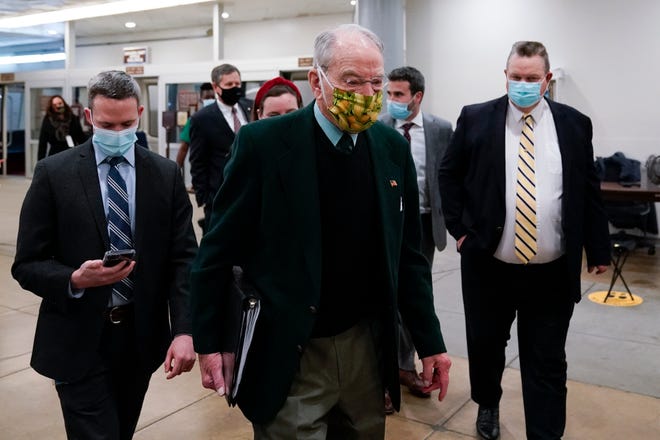
Sen. Chuck Grassley, R-Iowa, walks on Capitol Hill in Washington, Saturday, Feb. 13, 2021, on the fifth day of the second impeachment trial of former President Donald Trump. (AP Photo/Alex Brandon)


"We do not have the authority to try a private citizen like former President Trump. Even if we did, he should have been accorded the protections of due process of law in his trial. And even if we assume he has been, the House Managers still did not prove that he committed incitement to insurrection, the specific crime of which he stands accused. This does not excuse President Trump’s conduct on and around January 6th of this year," Grassley said in a statement. "It satisfies my oath as a U.S. Senator in this court of impeachment. I therefore voted to acquit."--Sen. Charles Grassley

https://www.desmoinesregister.com/story/news/politics/2021/02/13/senate-what-does-impeachment-mean-trump-2024-election-how-iowa-voted/4477250001/

Senator Grassley's contentions above (and those of Senator Ernst below) attempt to provide a figleaf to cover their brazen political partisanship in voting to acquit Trump. Although its  a post-morten inquiry (the case is dead), I believe the the inquiry worthwhile not for the understanding it brings to the case, but the revalation it provides about the individuals who passed this judgement, in particular Grassley, Ernst, McConnell, and the remainder of the Republicans senators who voted against conviction. I will go through both Grassley's statement (above) and Ernst's (below). 

1. "We do not have the authority to try a private citizen like former President Trump." (Ernst and McConnell make similar contentions, see below.). This contention is wrong. The Senate has the authority under the Constitution. It has established  precedent. (The Senate has exercised its impeachment power after an office-holder (albeit not a president) has left office.) And the Senate voted to approve this procedure in this case. (N.B. Trump was not tried earlier because McConnell refused to allow it while he remained Senate majority leader, which was until after the Biden-Harris inauguration). The Supreme Court has not ruled on this issue, and in the absence of a Court decision, the Senate has the power and responsibility to interpret the Constitution and its application in the present case. Also, the lop-sided weight of scholarly supports the exercise this power under these circumstances. But why? The ulitimate authority is the text of the Constitution itself, something that "conservatives" who probably fancy themselves "originalists" or "textualists" might try reading. Here's what the relevant text of the Constitution provides: 

Judgment in Cases of Impeachment shall not extend further than to removal from Office, and disqualification to hold and enjoy any Office of honor, Trust or Profit under the United States: but the Party convicted shall nevertheless be liable and subject to Indictment, Trial, Judgment and Punishment, according to Law. [Emphasis added.]

          Article 1, sec. 3.  

The word is "and"--"removal from office, and disqualification to hold and enjoy any Office of honr, Trust, or Profit under the United States . . . ." Both are penalities, and that one penalty can no longer apply (removal) does not entail that the second aspect of the penalty cannot or should not apply. This argument, that the Senate had not the power and authority to try Trump is pure hokum. 

2. "Even if we did, he should have been accorded the protections of due process of law in his trial." What failure of "due process" (the requirement of a fair proceeding conducted by established rules) does Grassley refer to? Did anyone prevent Trump from coming to testify? Was the trial not conducted according to Senate rules? Was not an agreement about scheduling not reached by Leaders Schumer and McConnell? What utter horse hockey this allegation is! 

3. "And even if we assume he has been [given due process], the House Managers still did not prove that he committed incitement to insurrection, the specific crime of which he stands accused." First all Senator, really, you've been in Congress since 1975--you're an insider and ought to have read and understood with Constitution better than this. The accusasion of "incitement to riot" is not a "crime"in this instance; it's an impeachable offense. Trump could still be charged and convicted of this crimes (see the Article 1 quote above). And you can claim that the House managers didn't prove their case, but in what particulars? Fifty-seven senators disagreed with you, seven of which were your Republican colleagues, with the result of the most lopsided conviction vote on record for a Presidential impeachment vote. (We've now had four impeachment votes regarding a president, two of them generated by Trump's actions, the first arose from his attempt to shake-down the Ukraine to get them to aid his re-election campaign; and the second for his big lie about the election, attempting to influence the count in Georgia, and inciting the violence at the Capital (again, using the big lie of the "stolen" elelction.) 

4. "This does not excuse President Trump’s conduct on and around January 6th of this year." Yes, it does. To borrow from my wife the teacher: for misdeeds to provide lessons for future behavior, applicable to the perp and others who may come after him, there must be "consequences." Or, in the legal terms, punishment, even beyond the natural consequences of the act (such as a loss of prestige, honor, and so on--which of course has never influenced Trump's behavior). No, the 43 Republicans who voted against conviction (thus the failure to reach the required 2/3 vote) gives Trump and all who come after him a free pass for such rank and obvious misdeeds as we saw in this case.  So much for Grassley (or Ernst) ever saying anything about "law and order" or "legal technicalities" ever again. 

The one thing that I can say for Ernst is that she didn't attempt to put lipstick on her pig. She didn't vote to allow Trump's actions to go without reckoning and then attempt to condemn them, as did Grassley ("This does not excuse President Trump's conduct") nor the statements by McConnell and other Republicans who voted to give Trump a pass and then claim to have given him the equivalent of a dirty look. McConnell, along with Lindsey Graham, have moved political hypocrisy from a venial political sin to one worthy of the lowest rungs of Dante's hell, down with the fraudulant and the treacherous. (See below for McConell's finger-wagging at Trump after he acquited him.) Of course, McConnell is worried because the big Republican donors turned-off the money spiggots after the attack.The big donors realized that a majority of the Republican party would  follow their Pied-Piper and tear down the government of the United States. This drastic action didn't sit well with the moneyed interests that call the shots for the party on the issues that the party unites around: taxes and regulations. McConnell, as he is so wont to do, speaks out of both sides of his mouth. Grassley parrots him; Ernst, who seems to drink the Kool-Aid without a king's-x held behind her back, has no desire to provide even a cursory condemnation of Trump after this exoneration by the Senate. This honey-badger of a senator just don't give a @#$%. 


Ernst released a statement on Twitter saying in part: "The bottom line for this impeachment trial: Donald Trump is no longer in office, he is a private citizen."

Hypocrisy taken to new heights:  

At least five Republican senators suggested that Trump was indeed culpable for the Capitol riots, while voting to acquit him on constitutional grounds:

  • Senate Minority Leader Mitch McConnell (R-Ky.) excoriated Trump’s conduct in a speech after the vote and even suggested that the former president might be held criminally liable.
  • The No. 2-ranking Senate Republican, Sen. John Thune (S.D.), said explicitly: “My vote to acquit should not be viewed as exoneration for his conduct on January 6, 2021, or in the days and weeks leading up to it. What former president Trump did to undermine faith in our election system and disrupt the peaceful transfer of power is inexcusable.”
  • Sen. Shelley Moore Capito (R-W.Va.) emphasized that her vote was “solely” on the constitutional question, while adding: “The actions and reactions of President Trump were disgraceful, and history will judge him harshly.”
  • Sen. Dan Sullivan (R-Alaska) said: “I condemn former president Trump’s poor judgment in calling a rally on that day, and his actions and inactions when it turned into a riot. His blatant disregard for his own Vice President, Mike Pence, who was fulfilling his constitutional duty at the Capitol, infuriates me.”
  • Sen. Rob Portman (R-Ohio) added: “I have said that what President Trump did that day was inexcusable because in his speech he encouraged the mob, and that he bears some responsibility for the tragic violence that occurred.”

Not all of these statements directly suggest a vote to convict but for the constitutional question. Republicans have often drawn a line between criticizing Trump for his actions — even quite strongly — and saying he technically incited the mob that stormed the Capitol on Jan. 6. 

But relatively few Republicans have actually vouched for or defended Trump’s conduct. Some put out statements that didn’t address the substance of the case at all, focusing instead solely on process issues or constitutionality. (This despite many legal experts saying that, because the Senate had voted affirmatively that it had jurisdiction, they had a duty to decide the case on the merits). Others faulted Trump less harshly than the above.

https://www.washingtonpost.com/politics/2021/02/14/trump-got-off-technicality/

For some additional insight, read this: 

https://www.washingtonpost.com/politics/2021/02/13/mcconnell-would-have-happily-considered-finding-trump-guilty-were-it-not-mitch-mcconnell/


Thursday, January 21, 2021

Forgive & Forget About Donald Trump--Now!--Or Not: My Thoughts

                                   Dante leads the way to a consideration of what to do with Trump
 

In Dante’s tale of his pilgrimage through the afterworld as a living man, he descends into Inferno (hell) with his guide, the shade of the great Roman poet Virgil. After plumbing the depths of hell, Dante and Virgil ascend into Purgatorio (purgatory), a mountain that Dante and any would-be entrant into Paradiso (paradise) must traverse before gaining entrance to the final heavenly reward. The journey up the mountain serves to purge the pilgrim of his sins. And in the ninth canto (section), Dante awakens from his sleep to find himself at a locked gate guarded by an angel with a flaming sword, and in front of Dante lie three steps up to the gate. The first consists of white marble polished to a reflective shine. The second step is deep, dark indigo, rough, with a deep fissure running both its length and width. The third and final step before reaching the angel with the flaming sword, is a deep red, the color of venous blood. The Mandelbaum translation: 

“Come forward, therefore, to our stairs.” 

There we approached, and the first step was white marble, so polished and so clear that I was mirrored there as I appear in life. 

The second step, made out of crumbling rock,

rough-textured, scorched, with cracks that ran across its length and width, was darker than deep purple. 

The third, resting above more massively, appeared to me to be of porphyry, as flaming red as blood that spurts from veins. 

And on this upper step, God’s angel— seated upon the threshold, which appeared to me to be of adamant— kept his feet planted.


Alighieri, Dante. Purgatorio (La Divina Commedia) (Kindle Locations 3634-3663). Random House Publishing Group. Kindle Edition. 


Each step allows the pilgrim Dante to continue on the path to purging his sins, and each step represents an essential element required to continue the path. Translator Michael Mandelbaum’s notes explain the process and the symbolism: 


This first of the three steps corresponds to the first of the three parts of the sacrament of penance-confession— contrition of the heart. The clear polish of the marble reflects the sinner’s true image, so that he can recognize his sinfulness. The second, made out of dark crumbling rock, corresponds to the emotional upheaval that comes with confession by the lips, the second part of penance; and the third step of “porphyry, / as flaming red as blood that spurts from veins” corresponds to satisfaction by works, the third stage of penance. The bloodred color suggests both the blood Christ shed to redeem the sins of mankind and the zeal needed to shun future sins.


Id., Kindle Locations 24696-24701. 


So what relation does a snippet of text from a long medieval poem have to do with whether to pursue the removal and disqualification process against Donald Trump? Bear with me. 


These few lines from Dante’s masterpiece came to mind from reading and hearing opinions pro and con about pursuing the case against Trump for his role in the attack on the Capitol.  I realized that much of my reaction and analysis of this issue stems from what I’d experienced hundreds of times in my decades as a lawyer involved in hundreds of criminal cases, from traffic tickets to serious felonies. And as you may know, most criminal cases that get beyond the preliminary stages are resolved by a guilty plea or a guilty verdict, either to the original charge or to a related charge. And what does a guilty plea entail? First, an admission by the defendant that he or she (but a lot more “he”) has in fact committed a crime. This often requires the defendant to describe the crime committed. And, in the hope of receiving a more favorable sentence--less of a fine, less probation time, less jail time, or even less prison time-- the defendant is given an opportunity, preferably in-person, to address the judge directly and express remorse for his actions and make assurances that any leniency will not be abused by further violations. The sentence passed by the court will often not only include a prescribed form of punishment (which is the prerogative of the state), but also some form of satisfaction or atonement. For instance, the payment of restitution (similar money damages in a civil case) to the victim of a crime who suffered a measurable monetary loss, or perhaps some form of community service. Sincerely expressed apologies to the Court and to victims also can play a role. There is all manner of variations on this outline according to the varying practice of each jurisdiction, but in general,  this is how it works. (I’ve experienced this process in four different jurisdictions, Federal, Iowa, Illinois, and Maryland--as an attorney!) 


I hadn't realized it before now, but all of these instances were variations on a theme described by Dante, who wrote from medieval Italy!


I’ve heard from a variety of sources--some highly partisan (Republicans) and some definitely not Trump supporters--that we should not pursue the impeachment process against Trump because it will continue and perhaps worsen partisan divisions (the primary Republican argument) or that we should immediately put Trump in the rearview mirror and concentrate on the future. In fact, it’s a post by a friend on Facebook that has led me to record these thoughts. My friend wrote: 


No one is happier with the personnel change in our federal government . . . that took place today than I am.  HOWEVER, it is time to stop the anti-DJT, et al, rhetoric and focus on working to ease the unrest he showed us is there.  It is time to put the words peaceful, respectful dialogue into our political vocabulary and to understand that the answers to most issues are in the term, moderate, (versus far-left or far-right).


On one hand, I couldn’t agree more with this sentiment. Politics in a democracy requires a commitment to certain principles, some formal and written, as in the Constitution, and some informal, such as norms of courtesy and civility in public discourse. Those who don’t share a commitment to democracy and liberty--in the sense of freedom of speech and the ability to participate in the public square--take themselves outside of politics as such when they violate these norms and resort to violence (threatened or actual). Speech that leads to action taken by a political body after due deliberation is the essence of politics. (In this train of thought I follow the insights of Hannah Arendt.) And the goal of a democratic polity should be to bring as many possible persons into the decision-making realm as possible, persons who are willing and capable of engaging in civil discourse. We can also imagine our nation as a “society” in the sense of a group of persons coming together for a joint undertaking. In doing so, we seek to transform areas of “non-agreement” into areas of “agreement” via a “dialectical process” that’s based upon persuasion and led by a spirit of cooperation. Conversely, society should work to minimize areas of “disagreement” that are reinforced by an “eristic process;” to wit, the use of arguments in which one side or the other prevails.  I’m taking this line of thought from R.G. Collingwood, the early 20th-century British philosopher. It’s worthwhile to quote Collingwood’s words at some length below to appreciate his perspective that I’m endorsing and using: 


24. 58. What Plato calls an eristic discussion is one in which each party tries to prove that he was right and the other wrong.


24. 59. In a dialectical discussion you aim at showing that your own view is one with which your opponent really agrees, even if at one time he denied it; or conversely that it was yourself and not your opponent who began by denying a view with which you really agree. 


24. 6. The essence of dialectical discussion is to discuss in the hope of finding that both parties to the discussion are right, and that this discovery puts an end to the debate. Where they ‘agree to differ’, as the saying is, there is nothing on which they have really agreed.


27. 92. In a dialectical system it is essential that the representatives of each opposing view should understand why the other view must be represented. If one fails to understand this, it ceases to be a party ‘and becomes a faction, that is, a combatant in an eristical process instead of a partner in a dialectical process.


28. 17. An ‘eristic’ (24. 58) political process can go on without discussion. Aiming as they do at victory, the parties to it may very well use force (20. 5) or attempts at force; for each tries to crush the rest, and this is best done not by discussion but by violence: that is, by civil war among the rulers. 


28. 18. A ‘dialectical’ (24. 59) political process, aiming not at victory but at agreement, might certainly go on without discussion in words, if a language of gesture or other nonverbal language was once fairly established; but, as it is, verbal discussion is the only kind which men can extensively use for political purposes.


29. 52. Dialectic is not between contraries but between contradictories (24. 68). The process leading to agreement begins not from disagreement but from non-agreement. 


29. 53. Non-agreement may be hardened into disagreement; in that case the stage is set for an eristic in which each party tries to vanquish the other; or, remaining mere non-agreement, it may set the stage for a dialectic in which each party tries to discover that the difference of view between them conceals a fundamental agreement.


29. 6. Granted that these ‘conflicts’ (non-agreements, not disagreements) are inevitable, how are they to be dealt with? 


29. 61. There are two possibilities. They may be dealt with dialectically: that is by a process leading from non-agreement to agreement; or they may be dealt with eristically, that is, by hardening non-agreement into disagreement and settling the disagreement by a victory of one party over the other. 


29. 62. To adopt the second alternative is to make war. To regard the second alternative as the only one available in such cases is to think of war as the only possible relation between bodies politic; to think that every body politic is permanently at war with every other.


29. 63. War is a state of mind. It does not consist in the actual employment of military force. It consists in believing that differences between bodies politic have to be settled by one giving way to the other and the second triumphing over the first.


Collingwood, R. G.. The New Leviathan. Read Books Ltd.. Kindle Edition. 


In short, we can either attempt to work together or go to war. Of course, in some circumstances, “war” in the guise of an eristic argument may be justified. For instance, in a judicial setting, a trial is a forum where eristic arguments are the norm and the parties may be said to be involved in a “war of words.” But note that the law courts and legal process quite different from legislatures and the political process. The courts of law resolve disputes within parameters established by the Constitution (or “constitutions,” as each state has its own constitution) and the laws adopted by the legislature. Thus, fights are contained and constrained when they reach the courts. For instance, if the legislature passes--and the executive branch approves--a law against inciting a riot, that law will be enforced by the courts. The eristic element is constrained by the parameters of the law adopted. Thus, in this example, the issue isn’t whether one should be allowed to incite a riot, but whether a person intentionally did in fact incite a riot. 


All this is to say that while we should seek agreement wherever we can, we will still have disputes and differences that entail argument and not simply efforts at accommodation. 


Now to the orange elephant in the room--or more accurately, in Mar-a-Lago. I cannot agree more with President Biden (and my friend quoted above) about addressing our differences and healing our divisions. We can disagree about policies: the role and effectiveness of government, the most appropriate level of immigration to allow; the most appropriate form and level of taxation; the best way to address climate change; and so on. These policy issues, and about every other policy issue, appropriately give rise to differing opinions. Also, interests vary. Values vary. This is why a commitment to values of process is so crucial in a democracy, values such as a commitment to the peaceful resolution of conflicts and the peaceful transfer of power. 


But where a serious allegation of wrong-doing against anyone, even a president, is based upon good-faith evidence that meets the standard of probable cause that a crime has been committed, that allegation must be addressed, even if it raises the specter of further partisan division. (This also applies to “high crime or misdemeanors,” although such allegations need not necessarily constitute a violation of the criminal law.) 


To walk away now from the issue of former President Trump’s culpability for the January 6 attack on Congress would prove an egregious mistake. Perhaps more than a third of the Senate will not find Trump culpable for inciting an insurrection. Perhaps there will be enough senators who will doubt that Trump formed any requisite intent or that “incitement” is too vague a term. And some senators will certainly make a decision based solely on their sense of how their vote will play with their home-state voters. But to allow Trump to hold this highest office ever again and to allow him to reap the rewards of post-presidency without any reckoning-- without any confession or contrition for his actions--is an insult to we the victims of his wrongdoing. (Yes, I’m claiming wrongdoing on his part--his lies, his sowing of dissension, his attempt to corruptly influence election officials,  his refusal to honor the democratic process--even if some do not believe that his actions rise to the level of high crimes and misdemeanors.) 


We, the American people, as much as the institution of Congress, are the victims of the January 6 attack. We should not expect or request that the American people simply forgive and forget the assault promoted by Trump, (as I contend it was). We should not ask the American people to simply forgive and forget any more than we should expect the victim of an assault--a spouse, a child, a friend, or even a stranger--to pretend that they should simply “forgive and forget” the actions of an utterly unrepentant, utterly remorseless perpetrator. The Senate must pass judgment for us to achieve a sense of justice and an opportunity for reconciliation. It may seem harsh, it will likely prove divisive, but without it, we won’t achieve the reckoning and reconciliation that we want and need. And finally, if we fail to act by giving this matter the full consideration and judgment that it deserves, will fail those to whom we are passing on this democratic republic. As President Biden noted in his inaugural address, “We have learned again that democracy is precious. Democracy is fragile. And at this hour, my friends, democracy has prevailed.” But “this hour” alone should not satisfy us. How we act--or fail to act--will echo deep into the future and will define the course of our nation for the decades to come. We mustn’t do the convenient thing, we must do what the times require of us. We must leave the legacy that will allow future generations to enjoy the fruits of a democratic republic. 


Thursday, January 14, 2021

Letter of Rep. Doug Lamborn (R-CO5) Opposing Impeachment & My Response

 Below is a letter that I received from our Congressional Representative Doug Lamborn (R-CO-5) in response to my email to him urging him to support the impeachment of President Trump. Below is his reply and my response to his reply, which I'm posting here and which I will send to his office as well. 


Dear Mr. Greenleaf,

Thank you for contacting me regarding impeachment. Their resolution has broken all precedent by bypassing Judiciary hearings and debate- instead being rushed to the full House of Representatives for a vote. In the President’s own words, he called for people to march to the Capitol building to “peacefully and patriotically” make their voices heard. This is House Democrats second impeachment of President Trump. 

The impeachment vote is a travesty. In the Democrats' hasty desire to impeach the President, they are willing to trample the Constitution and our political institutions. I condemn the actions of the individuals who stormed the Capitol. However, it is clear that President Trump did not incite this violence. He clearly called for individuals to peacefully and patriotically make their voices heard. This is yet another political ploy by House Democrats who hate the President and will do everything in their power to silence the voices of millions of Americans who voted for him. I hope we can move forward together in unity, but the Democrats’ impeachment is an obstacle to that effort. I will not vote to impeach the President. 

For more information about my efforts on behalf of Colorado, please visit my website at Lamborn.house.gov. Additionally, stay up to date by visiting my Twitter, Facebook, and Instagram pages. You can also sign up for my e-Newsletter for the latest updates. It is an honor and privilege to serve you in Congress.

Sincerely,

Doug Lamborn
Member of Congress

As I posted my email urging him to support impeachment on Facebook, I want to give Representative Lamborn a forum for his reply. And I believe it's important and useful to carefully and thoroughly review his arguments, so I have. Let's look carefully at his contentions. 

"Their resolution has broken all precedent by bypassing Judiciary hearings and debate- instead being rushed to the full House of Representatives for a vote." 

You have no antecedent for "their," but I assume you're referring to House Democrats. And you are certainly correct that this impeachment effort is "rushed." You, however, don't address here (or in any previous statements that I can find) the circumstances for this impeachment effort: the attack on Congress and the Capitol building by the mob on 6 January. You don't comment on what triggered this disgraceful attack on the institution of which you are a member, nor have you offered an account of the cause of this attack. All of the House Democrats, 10 of your Republican colleagues (including your caucus leader, Rep. Cheney (R-WY)), and most Americans believe that President Trump is responsible for the words of provocation and incitement made at the rally immediately preceding the attack and throughout the election process. Let me ask you an (admittedly far-fetched) hypothetical: If the president who made had made the same statements as did President Trump throughout this election cycle and on January 6 had been a Democrat, you would not have joined as a sponsor of the resolution of impeachment? If you answer differently than you've answered by your actions (opposing impeachment), then you're admitting that your position is motivated solely by your allegiance to Trump and his faction of the Republican Party. Of course, you realize that you'd be derelict in your duty if you didn't act to impeach the Democrat in my hypothetical.

"In the President’s own words, he called for people to march to the Capitol building to “peacefully and patriotically” make their voices heard." 

Is this all that President Trump said at the rally? Is this the whole truth? Do you consider the context of his remarks at the preceding rally in light of his numerous preceding statements and actions that lied about the integrity and legitimacy of the election? I think not. In fact, you can read a transcript of what President Trump said at the rally as reported by U.S. News & World Report. After you've read his entire harangue (is "harangue" unfairly pejorative?), please confirm that you still contend that President Trump simply "called for the people to march to the Capitol building to 'peacefully & patriotically' make their voices heard." (Warning: President Trump's remarks (?) at the rally are long-winded, rambling, and disjunct. But you really should read it in its entirety given the seriousness of the attack and the significance of impeachment.) 

"The impeachment vote is a travesty." 

As your composition teacher would have written on this paper: you've stated your conclusion; now you must support it. 

"In the Democrats' hasty desire to impeach the President, they are willing to trample the Constitution and our political institutions."

The Democrats, with the support of a few Republicans and the weight of public opinion, have acted expeditiously. In what particulars have "the Constitution and our political institutions" been "trampled?" Please be specific. Mustn't the Senate still hold a trial? Might they actually solicit evidence and call witnesses if they chose to do so? (They didn't for President Trump's first impeachment.) But the conduct of the trial remains the prerogative of the Senate under the Consitution.

And why do--why would--the Democrats and those Republicans who support impeachment want to pursue this impeachment? Trump will be gone on January 20th, so removal will become a moot issue. Why would they want to burden Congress with addressing this issue when our nation is suffering unprecedented death tolls because of our ineffectual response to the pandemic and while so many in our society are suffering severe harm to their well-being--economic and personal? It better be a darned good reason. Representative Cheney's (R-WY) statement captures as succinctly as any the justification for this impeachment: 

“The President of the United States summoned this mob, assembled the mob, and lit the flame of this attack,” she said in a statement. “Everything that followed was his doing. None of this would have happened without the president. The president could have immediately and forcefully intervened to stop the violence. He did not. There has never been a greater betrayal by a president of the United States of his office and his oath to the Constitution.” (NYT)

If, as the evidence continues to mount, we receive convincing evidence (even evidence beyond a reasonable doubt) of Trump's culpability in this attack, should such "high crimes and misdemeanors" and statutory crimes go unaddressed and unpunished?  Is this your contention? 

"I condemn the actions of the individuals who stormed the Capitol." 

Good! We agree on this point. 

"[I]t is clear that President Trump did not incite this violence. He clearly called for individuals to peacefully and patriotically make their voices heard."

If it is "clear" that "President Trump did not incite this violence," then how could all of the House Democrats and ten Republicans (plus House Minority Leader McCarthy in his statement, although not his vote), and a majority of Americans conclude that President Trump incited this riot? It certainly doesn't seem "clear" to most of the rest of us. You need to go beyond mere assertions to making cogent arguments based on factual statements. (And again, read President's full transcript of his January 6 talk at the "rally.") 

Question: Can one absolve oneself from criminal liability for inciting a crowd to transform into a rioting mob by sprinkling in a few words of peace in an otherwise belligerent harangue? Can one call a crowd to action because of a false claim of a horrible wrong (a "stolen election" and degradation of the Constitutional order) without consequence? (The Mark Antony defense: "I only came to bury Caesar, not to praise him--or to rile up the crowd against the conspirators.") Or, as the law states, should we assume that an actor intends the "natural and probable consequences of his actions" when judging his intent? (In other words, should we discourage the "play dumb" defense.) Does Trump by having uttered the words "peacefully and patriotically" in the course of his harangue provide himself with a get out of jail free card? Your implicit suggestion is that words don't matter and that words spoken by a public figure should receive absolute immunity under First Amendment free speech provisions. I don't agree with what your position suggests. I don't accept that First Amendment protections for speech are absolute and without exception (and here I agree with President Trump, although I disagree in the particulars).

"This is yet another political ploy by House Democrats who hate the President and will do everything in their power to silence the voices of millions of Americans who voted for him."

How does this "ploy" work? On what basis do you allege that the Democrats "will do everything in their power to silence the voices of millions of Americans who voted for him." Are you confused? Didn't you just vote not to certify the Electoral College vote and negate the votes of millions of Americans? (Yes, you did. On January 6, no less.)  Is the "him" you're talking about, for whom "millions of Americans voted for," not Joe Biden? Are you acquainted with the psychological concept of projection?

As to "hating" Trump, I can only speak for myself. Do I hate him? As a person, I find him pathetic, a man plagued by demons and out-of-control; a man of unconstrained appetites. For this, I pity him. But as a public figure, we must judge him and his performance. I do "hate" very much of what he's done, especially the lies and the fomenting of hatred and division and his degradation of norms of decency, civility, and the rule of law. And then there are his policies, to the extent that we can call them that, which were in large measure odious and foolish, to put it as kindly as possible. Thus, you're correct that I and most Democrats loath President Trump, and I believe that he's earned this level of disdain. We can pity him, but we can't trust him or forget his deeds. If at some point he confesses, repents, and atones for his wrongs, he can perhaps put himself straight with the Almighty and those close to him. But we the citizens of the United States can never forget his transgressions, and we should trust him with any public office ever again. 

"I hope we can move forward together in unity, but the Democrats’ impeachment is an obstacle to that effort."

Can--should--a victim of a crime--including "high crimes and misdemeanors"--simply "move forward together in unity" with the perpetrator without a judicial accounting of the wrongs committed and without some penalty imposed for those wrongs? I contend not. President Trump remains utterly unrepentant for his wrongdoing. And if there is no admission of guilt--as would be required in any criminal sentencing based on a plea agreement (when a defendant receives the benefit of a plea bargain), then there can be no receipt of a more lenient sentence. President Trump should be punished for his wrongdoing if found guilty of any "high crimes and misdemeanors" or statutory crimes after a fair trial (or trials) based on due process of law. And those who have suborned and enabled his wrongdoing should be called into account in the court of public opinion and in the election booth (unless a justified criminal case can be brought). 

I'm all in favor of "moving forward together in unity" as a nation after we have comes to grips with our national ailments. I don't believe that we can afford to sweep the events of January 6 under the rug nor can we simply ignore the complicity of the President and his supporters in this attack on our democracy. Before reconciliation must come accountability. I sincerely desire that we can bring folks together by honest and forthright dialogue. We need a government that addresses the legitimate needs and aspirations of all Americans. We need to come to grips with the realities that we face--a pandemic, economic inequities, climate change--and a host of other festering problems. So, yes, we need to get beyond this impeachment and act to take positive steps toward improving our national well-being. But until we face the wrongs, the wrongs of our nation, we won't make any real progress. 

"I will not vote to impeach the President."

And you didn't. 

Thank you for your consideration of these matters. I'm happy to carry on this dialogue so long as you desire. 

Stephen N. Greenleaf