Showing posts with label Joni Ernst. Show all posts

Monday, February 15, 2021

Senators Grassley, Ernst, & McConnell Attempt to Justify Their "Not Guilty" Votes

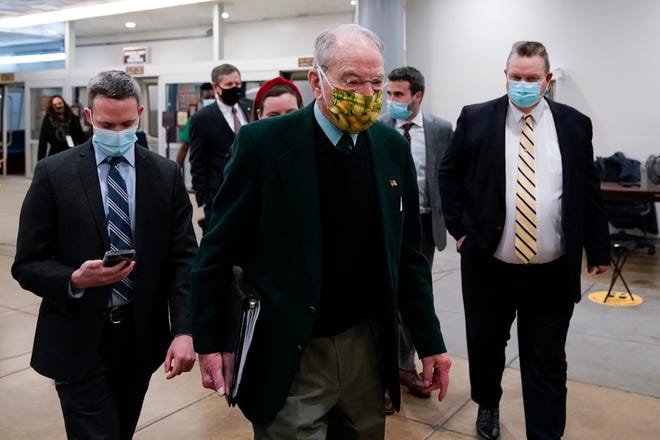
Sen. Chuck Grassley, R-Iowa, walks on Capitol Hill in Washington, Saturday, Feb. 13, 2021, on the fifth day of the second impeachment trial of former President Donald Trump. (AP Photo/Alex Brandon)


"We do not have the authority to try a private citizen like former President Trump. Even if we did, he should have been accorded the protections of due process of law in his trial. And even if we assume he has been, the House Managers still did not prove that he committed incitement to insurrection, the specific crime of which he stands accused. This does not excuse President Trump’s conduct on and around January 6th of this year," Grassley said in a statement. "It satisfies my oath as a U.S. Senator in this court of impeachment. I therefore voted to acquit."--Sen. Charles Grassley

https://www.desmoinesregister.com/story/news/politics/2021/02/13/senate-what-does-impeachment-mean-trump-2024-election-how-iowa-voted/4477250001/

Senator Grassley's contentions above (and those of Senator Ernst below) attempt to provide a figleaf to cover their brazen political partisanship in voting to acquit Trump. Although its  a post-morten inquiry (the case is dead), I believe the the inquiry worthwhile not for the understanding it brings to the case, but the revalation it provides about the individuals who passed this judgement, in particular Grassley, Ernst, McConnell, and the remainder of the Republicans senators who voted against conviction. I will go through both Grassley's statement (above) and Ernst's (below). 

1. "We do not have the authority to try a private citizen like former President Trump." (Ernst and McConnell make similar contentions, see below.). This contention is wrong. The Senate has the authority under the Constitution. It has established  precedent. (The Senate has exercised its impeachment power after an office-holder (albeit not a president) has left office.) And the Senate voted to approve this procedure in this case. (N.B. Trump was not tried earlier because McConnell refused to allow it while he remained Senate majority leader, which was until after the Biden-Harris inauguration). The Supreme Court has not ruled on this issue, and in the absence of a Court decision, the Senate has the power and responsibility to interpret the Constitution and its application in the present case. Also, the lop-sided weight of scholarly supports the exercise this power under these circumstances. But why? The ulitimate authority is the text of the Constitution itself, something that "conservatives" who probably fancy themselves "originalists" or "textualists" might try reading. Here's what the relevant text of the Constitution provides: 

Judgment in Cases of Impeachment shall not extend further than to removal from Office, and disqualification to hold and enjoy any Office of honor, Trust or Profit under the United States: but the Party convicted shall nevertheless be liable and subject to Indictment, Trial, Judgment and Punishment, according to Law. [Emphasis added.]

          Article 1, sec. 3.  

The word is "and"--"removal from office, and disqualification to hold and enjoy any Office of honr, Trust, or Profit under the United States . . . ." Both are penalities, and that one penalty can no longer apply (removal) does not entail that the second aspect of the penalty cannot or should not apply. This argument, that the Senate had not the power and authority to try Trump is pure hokum. 

2. "Even if we did, he should have been accorded the protections of due process of law in his trial." What failure of "due process" (the requirement of a fair proceeding conducted by established rules) does Grassley refer to? Did anyone prevent Trump from coming to testify? Was the trial not conducted according to Senate rules? Was not an agreement about scheduling not reached by Leaders Schumer and McConnell? What utter horse hockey this allegation is! 

3. "And even if we assume he has been [given due process], the House Managers still did not prove that he committed incitement to insurrection, the specific crime of which he stands accused." First all Senator, really, you've been in Congress since 1975--you're an insider and ought to have read and understood with Constitution better than this. The accusasion of "incitement to riot" is not a "crime"in this instance; it's an impeachable offense. Trump could still be charged and convicted of this crimes (see the Article 1 quote above). And you can claim that the House managers didn't prove their case, but in what particulars? Fifty-seven senators disagreed with you, seven of which were your Republican colleagues, with the result of the most lopsided conviction vote on record for a Presidential impeachment vote. (We've now had four impeachment votes regarding a president, two of them generated by Trump's actions, the first arose from his attempt to shake-down the Ukraine to get them to aid his re-election campaign; and the second for his big lie about the election, attempting to influence the count in Georgia, and inciting the violence at the Capital (again, using the big lie of the "stolen" elelction.) 

4. "This does not excuse President Trump’s conduct on and around January 6th of this year." Yes, it does. To borrow from my wife the teacher: for misdeeds to provide lessons for future behavior, applicable to the perp and others who may come after him, there must be "consequences." Or, in the legal terms, punishment, even beyond the natural consequences of the act (such as a loss of prestige, honor, and so on--which of course has never influenced Trump's behavior). No, the 43 Republicans who voted against conviction (thus the failure to reach the required 2/3 vote) gives Trump and all who come after him a free pass for such rank and obvious misdeeds as we saw in this case.  So much for Grassley (or Ernst) ever saying anything about "law and order" or "legal technicalities" ever again. 

The one thing that I can say for Ernst is that she didn't attempt to put lipstick on her pig. She didn't vote to allow Trump's actions to go without reckoning and then attempt to condemn them, as did Grassley ("This does not excuse President Trump's conduct") nor the statements by McConnell and other Republicans who voted to give Trump a pass and then claim to have given him the equivalent of a dirty look. McConnell, along with Lindsey Graham, have moved political hypocrisy from a venial political sin to one worthy of the lowest rungs of Dante's hell, down with the fraudulant and the treacherous. (See below for McConell's finger-wagging at Trump after he acquited him.) Of course, McConnell is worried because the big Republican donors turned-off the money spiggots after the attack.The big donors realized that a majority of the Republican party would  follow their Pied-Piper and tear down the government of the United States. This drastic action didn't sit well with the moneyed interests that call the shots for the party on the issues that the party unites around: taxes and regulations. McConnell, as he is so wont to do, speaks out of both sides of his mouth. Grassley parrots him; Ernst, who seems to drink the Kool-Aid without a king's-x held behind her back, has no desire to provide even a cursory condemnation of Trump after this exoneration by the Senate. This honey-badger of a senator just don't give a @#$%. 


Ernst released a statement on Twitter saying in part: "The bottom line for this impeachment trial: Donald Trump is no longer in office, he is a private citizen."

Hypocrisy taken to new heights:  

At least five Republican senators suggested that Trump was indeed culpable for the Capitol riots, while voting to acquit him on constitutional grounds:

  • Senate Minority Leader Mitch McConnell (R-Ky.) excoriated Trump’s conduct in a speech after the vote and even suggested that the former president might be held criminally liable.
  • The No. 2-ranking Senate Republican, Sen. John Thune (S.D.), said explicitly: “My vote to acquit should not be viewed as exoneration for his conduct on January 6, 2021, or in the days and weeks leading up to it. What former president Trump did to undermine faith in our election system and disrupt the peaceful transfer of power is inexcusable.”
  • Sen. Shelley Moore Capito (R-W.Va.) emphasized that her vote was “solely” on the constitutional question, while adding: “The actions and reactions of President Trump were disgraceful, and history will judge him harshly.”
  • Sen. Dan Sullivan (R-Alaska) said: “I condemn former president Trump’s poor judgment in calling a rally on that day, and his actions and inactions when it turned into a riot. His blatant disregard for his own Vice President, Mike Pence, who was fulfilling his constitutional duty at the Capitol, infuriates me.”
  • Sen. Rob Portman (R-Ohio) added: “I have said that what President Trump did that day was inexcusable because in his speech he encouraged the mob, and that he bears some responsibility for the tragic violence that occurred.”

Not all of these statements directly suggest a vote to convict but for the constitutional question. Republicans have often drawn a line between criticizing Trump for his actions — even quite strongly — and saying he technically incited the mob that stormed the Capitol on Jan. 6. 

But relatively few Republicans have actually vouched for or defended Trump’s conduct. Some put out statements that didn’t address the substance of the case at all, focusing instead solely on process issues or constitutionality. (This despite many legal experts saying that, because the Senate had voted affirmatively that it had jurisdiction, they had a duty to decide the case on the merits). Others faulted Trump less harshly than the above.

https://www.washingtonpost.com/politics/2021/02/14/trump-got-off-technicality/

For some additional insight, read this: 

https://www.washingtonpost.com/politics/2021/02/13/mcconnell-would-have-happily-considered-finding-trump-guilty-were-it-not-mitch-mcconnell/


Sunday, September 20, 2020

Iowa Senators Charles Grassley & Joni Ernst on Filling the Vacant Supreme Court Seat Before the Next Inauguration

 Iowans & All:

We have at issue the idea of FAIR PLAY with the current vacancy on the Supreme Court. I hope to address the issues of politics, fair play, hypocrisy, virtue, & legitimacy in a separate post. But first I want to share what I know of the positions of Iowa's two senators about attempting to fill the vacancy before the next administration, whether it be Biden or Trump 2. I'm linking to a letter that I received from Senator Grassley dated 7 March 2016 about his refusal to consider President Obama's nomination of Merrick Garland to fill the seat of Justice Scalia. As you will see from reading the Senator's letter, he provides a response based on precedent and other not-outrageous contentions. As you can see if you read my response, I didn't find those arguments persuasive, but he did attempt to provide a principled argument for his position.
Does he still adhere to his principles? It appears that he may. The Washington Post (https://www.washingtonpost.com/.../gop-senators-who-will.../) states the following about Grassley in its article regarding the position of some Republican senators about filling the seat until after the next presidential inauguration:
"Charles E. Grassley
[Senator Lindsey] Graham’s predecessor as Judiciary Committee chairman has also staked out a principled stand that would seem to preclude supporting a nominee in an election year.
Grassley, in defending the Garland gambit in 2018, cited precedent, saying that “it was very legitimate that you can’t have one rule for Democratic presidents and another rule for Republican presidents.”
Grassley also told NBC News last month that he “couldn’t move forward with it” if he were in charge of the Judiciary Committee like he was for Trump’s first two Supreme Court nominees."
Thus, it appears that Grassley is sticking by his principles and holds a position consistent with his actions in the Garland nomination, unlike, for instance, the blatant hypocrisy of Senator Lyndsey Graham, who offers only the tiniest figleaf of principle to in an attempt to cover his lack of manhood.
But here's the real issue: will @Grassley act on his principles? Principles look great framed on a wall or stated in a speech, but when push comes to shove, principles are worthless as tits on boar (I had to use a real Iowa farm simile) if they aren't ENACTED. One (me) always hope that Grassley, who's been in Congress since 1975 (and the Senate since 1980) and who's been held in some esteem by his colleagues, observers, and voters, would stand-up to the ire of Trump and McConnell that he will no doubt incur if acts upon his stated principles. This is my hope, my wish. I've been let down by Grassley many times, but at this stage of his career, maybe he'll start to consider his legacy, whether he acts to reduce the fever now raging in American politics or instead stand-by and watch the continued decline of American democracy.
As to
Senator Joni Ernst
the same Washington Post article I cited above about Grassley also makes note of Ernst. The article reports:
"Joni Ernst
The Iowa senator also faces a tough reelection battle this year, and despite in 2016 promoting the idea that the new president would make that pick, she said in July that she’d support voting on a nominee — even in a lame duck.
“[If] it is a lame-duck session, I would support going ahead with any hearings that we might have,” Ernst said. “And if it comes to an appointment prior to the end of the year, I would be supportive of that.”
SNG: This is not surprising. While hope springs eternal with me about Grassley, with Ernst it's perpetual winter. She speaks out both sides of her mouth on this, and she'd do cartwheels on the Senate floor if Trump and McConnell so much as gave her a stern look. She's locked in a death-match over her Senate seat currently and must do her master's bidding.

Saturday, January 25, 2020

Judging Impeachment: A Third Oath and a Criterion for Judgment--or "What of the Shoe Was on the Other Foot?"

I'm been thinking about how we could set a standard to allow Senators to return an appropriate judgment at the conclusion of the current impeachment trial. To begin, let's start with the oath that each senator takes when beginning their term of office. (See Below)
At the beginning of the current trial, each senator took this oath as well.
(See below)


Now, perhaps before returning a decision, each senator should take another oath. However, the oath would not be the same for each senator. Each senator would take the following oath before announcing the senator's judgment:

"I swear (or affirm) that the decision I make today is the same decision I would make if the president in question would have been Barack Obama, Bill Clinton, or any other Democrat. I have not been moved by partisan favor or any motive other than to uphold and defend the Constitution of the United States of America, so help me God."


So New York Senators Chuck Schumer and Kristin Gillibrand should take it as well as Senator Chuck Grassley and Senator Joni Ernst. All of them. And then the voters will determine if each one upheld the oath.
Of course, this isn't going to happen, but is it a bad idea? Moreover, isn't this the criteria--regardless of any oath--by which each of the 100 senators should be making her or his decision?
I welcome suggestions or rebuttals.

Wednesday, May 10, 2017

An Open Letter to Senators Grassley & Ernst to Urge Appointment of a Special Prosecutor


10 May 2017

Hon. Charles Grassley, U.S. Senate, Iowa
Hon. Joni Ernst, U.S. Senate, Iowa

Dear Senators:

I want to join your Republican colleagues Senators McCain and Burr who are calling for a special prosecutor to investigate the issue of whether the Trump campaign and administration has had any illegal or compromising contacts with Russian interests. I know that the Senate has a committee investigating these matters chaired by Senator Burr, but with the firing of FBI Director Comey, I have no faith that any successor will have the credibility to fully and fairly pursue this vital investigation.

Senator Grassley, as chairman of the Senate Judiciary Committee and one of the longest-serving senators, I call on you, in particular, to speak out openly and directly on this issue. The White House should hear from you in no uncertain terms that the appointment of a special prosecutor is necessary to making sure that these matters are fairly and completely resolved. I trust that you share my deep concern for the integrity of our legal system. I've been an Iowa lawyer even longer than you've been a U.S. senator, and I shudder to see the compromise of our constitutional system and a weakening of the faith of the people in that system that the Comey firing creates. This wound to the justice and national security systems is a grave threat to our Republic. I urge you to act and become a leader of this cause.

Senator Ernst, there's no time like the present to stand up for the indispensable American value of the rule of law. Leadership goes to those who display it, not those who play it safe to please party or to pander to some voters.

Senators, we look to you to stand up for our values.

Thank you for your consideration.


Stephen N. Greenleaf


Tuesday, October 7, 2014

In Defense of Politics: An Essay


Hannah Arendt: Not referenced in the essay, but a guiding light
I spent time this morning agitated after reading about Iowa Tea Party (Republican) candidate Joni Ernst’s positions that struck me as wrong and reckless. I wasn’t going to vote for her, but she might win, the thought of which only causes me greater agitation—and after such a nice morning meditation! Why do I bother? 

Despite all of our celebration of democracy and professed desire to export to around the world, few people in the U.S. engage in politics. Most are indifferent, some lazy, others scared. Some are too harried by life’s other demands to donate time and energy to what appears so confusing and so remote. And those who do vote often do so for appallingly shallow and naïve reasons. Some justify their lassitude as caused by disgust with the process of politics. I understand that sentiment. The attention paid in Iowa to chickens, games of telephone, motorcycles, and hog castration can influence one to walk away with a sense of sour amusement of the ridiculous of it all. And this is just the Iowa Senate race. 

In the United States, the level of our political discourse has declined. I say this with some sense of reluctance: the level has never been that high. Read about the political campaign of Jefferson vs. Adams, which can claim to be the start of electoral mudslinging, mendacity, and inanity in American election campaigns. But even recognizing that the bar hasn’t ever been set high, we still perceive that the level of reasonable and productive political discourse remains near a record low. Even behind closed doors, where dialogue might prove fruitful, we see little engagement. Whether one calls it “political decay” following the recent work of political scientistFrancis Fukuyama, an “iron age” as did Hesiod and Ovid in Greek and Roman times, or the “Age of Kali” in Hindu tradition, we can sense that something is amiss with our time. One has to be careful not to project a fantasy onto a past that never existed, but accounts of trustworthy observers and measured studies of various indicators support the contentions of those who agree with Fukuyama that the U.S. is in a period of political decay. So what is to be done? 

One can fiddle while Washington burns, following the Roman precedent (otherwise so valued by the Founders). One can retreat into the insularity of the home, enjoying the bread and circuses that consumer capitalism spreads before us with alluring ease. Or one might retreat—to Montana or to a monastery—and seek to ride out the storm. Yet each of these paths marks surrender, an unwillingness to engage. Even if one believes that any hope for a re-vitalized political discourse is a chimera, one must still recognize that the contest continues, and our world may get worse unless we inject some measure of sanity and goodwill into it. The arena of political decisions, of decisions made about our common world, is the sea upon which our private lives float, sometimes soothingly with gentle, lapping waves, but other times subject to tsunamis of war, economic depression, and other calamities. Together, we have some power over the waters, the ability to calm the waters, if we use our power wisely.

What is politics “about”? In a New Yorker article, Tim Kreider discusses science fiction as a political genre, but what he says about S-F as a genre applies to politics as a whole. He writes: 

Science fiction is an inherently political genre, in that any future or alternate history it imagines is a wish about How Things Should Be (even if it’s reflected darkly in a warning about how they might turn out). And How Things Should Be is the central question and struggle of politics. . . .  The meta-premise of all science fiction is that nothing can be taken for granted. That it’s still anybody’s ballgame. [Emphasis added.]

It is still “anybody’s ball game” even if historical patterns, the deadweight of inertia, or a “sub-optimal equilibrium” remain stacked against us. There are trends that we can’t simply negate at will and neither can we flee them or wish them away. We must stand and fight.
Having said all this, the type of political warrior we must become matters greatly. We must not scorch the earth upon which are opponents stand: this is inimical to democracy (the worst form of government except all of the others that have been tried from time to time--Churchill). Do I dislike Joni Ernest? How can I? I don’t know her. However, I know her ideas and have some sense of what she’d do as a U.S. Senator, and I find those ideas very bad (foolish, ill-founded, & probably harmful). Whether she’s a nice person, rides a motorcycle, shoots guns, or smiles warmly matters not at all to me. Conversely, I’d say that even if Bruce Braley was found to have kicked a puppy, I’d vote for him based on what he’d do in the Senate. 

I know this essay represents an almost utopian (nowhere) line of thinking, but even tiny differences in perceptions and behaviors, in words spoken and shared, can change things for the better. I believe so. Politics may—in fleeting moments— allow an expression of dignity and heroism, an opportunity to share in service of one another with the intention of creating a good for everyone. Political debate may exhibit the contention of perceptive minds attempting to sculpt a future out of the stubborn rock of humanity with the hope of one day winning the praise of posterity. That doesn’t happen often, but it can. The power created by the speech of politics is only alternative of the force of violence. We have a Republic, if we can keep it. Remember that.