Big Announcement! (Sort of): I'm moving my blogging to Substack. This review & my review immediately preceding that--plus any occasional essays or whatever--will be posted on Substack. You can find me here. I'll keep this site open, but soon I won't post anything here. And, although I didn't necessarily intend it, everything (so far as I can tell) that I've ever posted there is now on my Substack feed. But for old-time's sake, here's my review of Brad DeLong's Slouching Towards Utopia. Enjoy here now; then subscribe at Substack.
Slouching Towards Utopia: An Economic History of the Twentieth Century
By J. Bradford DeLong

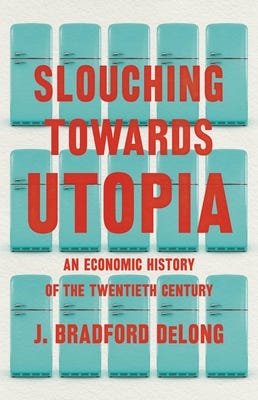
This book provides a comprehensive narrative of a “long twentieth century” (1870-2010) that further informed my thinking about this era. An outstanding work of narrative history should work like a strong magnet among iron filings, pulling diverse pieces (facts) into a coherent pattern without distorting the given shape (reality) of those diverse pieces. And this is what DeLong has accomplished in this work. He draws together into a discernible pattern (to wit, a story) about the intersection of unprecedented economic realities (improvements, mostly) and their effect on national and international politics, and how various thinkers and political leaders responded to these new realities.
Back (well, way back) in the day when I was a political science and history major, I learned a lot about nineteenth and twentieth-century history from some fine professors and reading prominent historians writing about this era. But I realize now that economic history as a sub-discipline and political-economy as a whole were mostly overlooked. The economics of this period of extraordinary economic development and innovation was more or less taken for granted as the backdrop for the political and social history that dominated my curriculum. Until now, has there been a book that has filled this void? If so, I missed it. Columbia historian Adam Tooze has addressed several big chunks of this period quite admirably, but again, no one that I’ve read provides such an informed, comprehensive narrative of the economic and political-economic history of this era.
Another merit of this book comes from a point that DeLong makes about himself; that is, he considers himself both an economist and a historian. I assumed his merits as an economist; he’s worked in the Treasury Department and as a professor of economics at Berkley. And at the beginning of the book, there are facts and figures about economic development over the course of human history and about how economic development skyrocketed beginning about 1870 with the advent of business corporations, modern research labs, and cheaper, more efficient transportation and communication systems. But on the whole, the book is surprisingly light on figures, tables, charts, and formulas; you know, the stuff you’d expect to see from an economist. The flip side (the historian side, if you will) of this is DeLong’s narrative skill in recounting the course of events and thinking of this period. DeLong’s prose has a light touch that avoids economics jargon and avoids falling into ponderous academic prose. Indeed, DeLong’s prose includes a certain playfulness, such as his repeated touch phrase “the market giveth, the market taketh away, blessed be the name of the market.” Another instance of this light touch is his seemingly alternating designation of Hayek as both “genius” and “idiot” and as a Jekyll and Hyde. (Designations that seem spot-on from my perspective in the cheap seats. ) DeLong also frames much of his history as a yin and yang between Hayek’s market mania and Karl Polanyi’s emphasis on traditional rights and communities. And while these two deities of modern political-economic thought and their acolytes receive a lot of attention, John Maynard Keynes—the appropriate reverence seems to demand the full name—presides like Zeus or Thor over these two lesser gods. And as the high-god, Keynes seeks to impose order on the economic universe in the course of a continuing struggle against economic chaos left in the wake of the lesser gods (including old Marx). DeLong describes Keynes as brokering a marriage of the insights of Hayek and Polyani. If it’s a marriage that could be made to last, it will no doubt remain fruitful, but in these times, nothing seems stable. And, I should note that not only has DeLong confirmed by priors about Hayek (and the market in general), he has also confirmed my priors about Keynes as one of the great figures of the twentieth century. (My assessment was established after reading Zachery Carter’s work on Keynes, The Price of Peace: Money, Democracy, and the Life of John Maynard Keynes (2020).)
I want to also note that I’m impressed with DeLong the historian. Not only does he write an engaging and informed narrative, but he also displays insights into the nature of the historical enterprise. For instance, toward the end of the book, while discussing the Great Recession of 2008, he compares his take with that of Adam Tooze in Tooze’s book, Crashed: How a Decade of Financial Crises Changed the World (2018). DeLong considers how events in that era (as an example) balance between contingency and necessity; choice and structure. Tooze is more a proponent of structure and necessity; DeLong of contingency and choice. DeLong, however, concedes that future historians may come down closer to Team Structure-Necessity. Perhaps, but then we always wonder, don’t we: what if the Archduke had not been assassinated?
I could go on further at great length about the contents of this book, perhaps in a later essay. But I might find such an exercise futile and genuinely counter-productive. I can’t write as authoritatively or with as much felicity as DeLong about these events. Ergo, you should go immediately to his book and read it. I’m confident that you’ll find it well worth your time and enjoyably spent.