Showing posts with label political economy. Show all posts

Wednesday, September 14, 2022

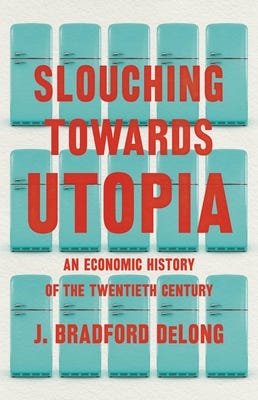
Slouching Towards Utopia: An Economic History of the Twentieth Century by Brad DeLong (and a Big Change)

 Big Announcement! (Sort of): I'm moving my blogging to Substack. This review & my review immediately preceding that--plus any occasional essays or whatever--will be posted on Substack. You can find me here. I'll keep this site open, but soon I won't post anything here. And, although I didn't necessarily intend it, everything (so far as I can tell) that I've ever posted there is now on my Substack feed. But for old-time's sake, here's my review of Brad DeLong's Slouching Towards Utopia. Enjoy here now; then subscribe at Substack. 

Slouching Towards Utopia: An Economic History of the Twentieth Century

By J. Bradford DeLong


This book provides a comprehensive narrative of a “long twentieth century” (1870-2010) that further informed my thinking about this era. An outstanding work of narrative history should work like a strong magnet among iron filings, pulling diverse pieces (facts) into a coherent pattern without distorting the given shape (reality) of those diverse pieces. And this is what DeLong has accomplished in this work. He draws together into a discernible pattern (to wit, a story) about the intersection of unprecedented economic realities (improvements, mostly) and their effect on national and international politics, and how various thinkers and political leaders responded to these new realities.


Back (well, way back) in the day when I was a political science and history major, I learned a lot about nineteenth and twentieth-century history from some fine professors and reading prominent historians writing about this era. But I realize now that economic history as a sub-discipline and political-economy as a whole were mostly overlooked. The economics of this period of extraordinary economic development and innovation was more or less taken for granted as the backdrop for the political and social history that dominated my curriculum. Until now, has there been a book that has filled this void? If so, I missed it. Columbia historian Adam Tooze has addressed several big chunks of this period quite admirably, but again, no one that I’ve read provides such an informed, comprehensive narrative of the economic and political-economic history of this era.
Another merit of this book comes from a point that DeLong makes about himself; that is, he considers himself both an economist and a historian. I assumed his merits as an economist; he’s worked in the Treasury Department and as a professor of economics at Berkley. And at the beginning of the book, there are facts and figures about economic development over the course of human history and about how economic development skyrocketed beginning about 1870 with the advent of business corporations, modern research labs, and cheaper, more efficient transportation and communication systems. But on the whole, the book is surprisingly light on figures, tables, charts, and formulas; you know, the stuff you’d expect to see from an economist. The flip side (the historian side, if you will) of this is DeLong’s narrative skill in recounting the course of events and thinking of this period. DeLong’s prose has a light touch that avoids economics jargon and avoids falling into ponderous academic prose. Indeed, DeLong’s prose includes a certain playfulness, such as his repeated touch phrase “the market giveth, the market taketh away, blessed be the name of the market.” Another instance of this light touch is his seemingly alternating designation of Hayek as both “genius” and “idiot” and as a Jekyll and Hyde. (Designations that seem spot-on from my perspective in the cheap seats. ) DeLong also frames much of his history as a yin and yang between Hayek’s market mania and Karl Polanyi’s emphasis on traditional rights and communities. And while these two deities of modern political-economic thought and their acolytes receive a lot of attention, John Maynard Keynes—the appropriate reverence seems to demand the full name—presides like Zeus or Thor over these two lesser gods. And as the high-god, Keynes seeks to impose order on the economic universe in the course of a continuing struggle against economic chaos left in the wake of the lesser gods (including old Marx). DeLong describes Keynes as brokering a marriage of the insights of Hayek and Polyani. If it’s a marriage that could be made to last, it will no doubt remain fruitful, but in these times, nothing seems stable. And, I should note that not only has DeLong confirmed by priors about Hayek (and the market in general), he has also confirmed my priors about Keynes as one of the great figures of the twentieth century. (My assessment was established after reading Zachery Carter’s work on Keynes, The Price of Peace: Money, Democracy, and the Life of John Maynard Keynes (2020).)

I want to also note that I’m impressed with DeLong the historian. Not only does he write an engaging and informed narrative, but he also displays insights into the nature of the historical enterprise. For instance, toward the end of the book, while discussing the Great Recession of 2008, he compares his take with that of Adam Tooze in Tooze’s book, Crashed: How a Decade of Financial Crises Changed the World (2018). DeLong considers how events in that era (as an example) balance between contingency and necessity; choice and structure. Tooze is more a proponent of structure and necessity; DeLong of contingency and choice. DeLong, however, concedes that future historians may come down closer to Team Structure-Necessity. Perhaps, but then we always wonder, don’t we: what if the Archduke had not been assassinated?

I could go on further at great length about the contents of this book, perhaps in a later essay. But I might find such an exercise futile and genuinely counter-productive. I can’t write as authoritatively or with as much felicity as DeLong about these events. Ergo, you should go immediately to his book and read it. I’m confident that you’ll find it well worth your time and enjoyably spent.


Thursday, September 15, 2016

The Deluge: The Great War, America & the Remaking of the Global Order, 1916-1931 by Adam Tooze

Published 2014, 518 pages of text
Just a century ago, Europe was reeling from the destruction of the First World War. In the summer of 1916, the British initiated with Battle of the Somme with great aspirations and an immense artillery barrage. The results of their efforts included an astronomical number of casualties and no strategic gain. The course and eventual outcome of the war remained in doubt, but one thing no longer remained in question: neither of the two conflicting sides could maintain the level of dedication of manpower and resources to the conflict without threatening the very basis of their state and society. From this point forward, the states and maps of Eurasia would change, and a new, non-Eurasian power—the United States—would step into the forefront of leading world powers.


The story of these changes have been told before, of course, but Tooze’s book does an outstanding job of tracking the shifting players and constraints upon those players. As the war eventually came to a stop—I think that “conclusion” would prove too strong a word—the parties had to establish a new world order while in the midst of political and social revolutions, extremes of inflation and deflation, and continuing security concerns. Students of international relations will find evidence for every theory of IR, including realism, balance-of-power, institutionalism, geopolitics, political economy, and domestic effects. That many policies were tried and failed seems easier to understand when one has a survey of all of the conflicting demands and considerations placed on policy-makers during this period.


The U.S., Great Britain, France, Germany, Russia/Soviet Union, China, and Japan are the major players in this drama. Each of these nation-states was affected by a variety of ideologies, perceptions, and needs. The U.S., under Woodrow Wilson, wanted to stay out of the fray and reap the eventual rewards of having done so, but events—German U-boat attacks—dragged the U.S. into the war. But before that time the U.S. had already become a major actor by financing much of the Allied war effort. With the coming of the Armistice, Wilson’s mix of liberal internationalism and self-righteousness made for significant changes in everything except direct U.S. participation in the new order. The British saw their financial leadership slip away while they fretted over the viability of their Empire, especially given events in Ireland and India. France came out of the war deeply crippled by physical destruction and with an unresolved concern of its security vis-a-vi Germany. Germany, meanwhile, suffered threats of violent revolution and civil war, with Communists and Hitler’s efforts first after the war, only to survive these and then enter into an economic roller-coaster. Russia in the form of the Romanov dynasty collapsed, and out of it came the Bolshevik Revolution and the Soviet Union. The new regime led by Lenin had to sue for peace and attempt to establish internal order and secure borders while establishing and maintaining a working government and ideology. China hoped to gain freedom from Western domination and a place at the table while it still lacked a viable national government. And Japan teetered back and forth between liberal internationalists and military imperialists.


 I could go on; my list is a sample, but it should give some sense of the complexity and magnitude of change in which governments were operating. Tooze’s account, a chronological narrative, sometimes seems to lurch from one crisis to the next, but that’s how events unfolded. Imagine the problems perceived by decision-makers operating in real time!


You have no doubt noted that the nations that I mentioned above and upon which Tooze’s account focuses, are still the predominant players on the world stage today. This is all the more fascinating given the forces of change that are yet to come after Tooze’s account ends in 1931. Of course, the relative power and influence of the players have changed, Britain declining and China sharply rising, but we know that there will no longer be a British or Hapsburg empire. (Russian? There are certainly some aspirations there.)


In reading the 518 pages of Tooze’s account, I felt a bit like I was reading a potboiler, with a new plot twist arising with the turn of each page. But that’s the way the world was. And although I had some familiarity with the events, I certainly learned a lot and gained a much deeper knowledge and understanding of how events unfolded. For instance, Wilson’s problems in the U.S. were not so much a matter of isolationism as it was a more nationalistic sense of its proper international role held by those such as Henry Cabot Lodge. Also, the peace treaties and arms limitations agreements negotiated during the 1920s were not just wishful thinking. Also, Tooze, an economic historian by training, mixes realities of political economy with diplomatic negotiations to provide a more comprehensive sense of the dynamics behind the political maneuvering.


Tooze: Not your tweedy professor
This is an excellent book for understanding the effort to construct a new international order in the wake of the First World War. It ultimately failed with the dislocation caused by the Great Depression (leaders take note!) and the rise of aggressive dictatorships based on lethal cocktails of nationalism, militarism, and racism, which led to an even greater, wider conflagration. If history ever needed to establish its cash value (which it shouldn’t have to do), this work would provide a compelling exhibit to help prove the proposition of history’s value. Any leader in a major nation-state would benefit from appreciating the experiences of these leaders who tried to shape the contemporary world. 

Monday, August 3, 2015

A Toast to Capitalism--And Now Junk It


David Brooks: defender of capitalism & yet conservative

I want to take up David Brooks’s challenge set forth in his column “Two Cheers for Capitalism”. But let me first state my opening position:

Capitalism is the best form of economic system—ever. And it needs to be replaced. Starting now.

Brooks argues in defense of capitalism that its better than socialism. He doesn’t use the word “socialism”, but it’s implied when he writes “government planners are not smart enough to plan complex systems”. True but trivial. Centralized planning as an alternative to markets lost long ago. No serious commentator wants to restore central planning.

Brooks ignores the extent that business and government are  intertwined in early 21st century consumer capitalism. We delude ourselves in believing that mainstream economics, which provides the intellectual infrastructure for capitalism, could ever escape political economics. An economy is always nested within political and cultural systems. The most important intertwining of politics and government in the U.S. today has to do with regulatory capture, not regulatory restraint. Big government today is controlled by Big Money. Big Money includes individuals (yes, think Koch) and aggregates (trade organizations, corporations, etc.). Adam Smith, the intellectual godfather of capitalism, pegged it when he observed that when two or more merchants meet, the conversation would inevitably turn to restraint of trade. We could add "politicians" to any merchant or private interest, and we'd get the same effect. This happens--often--and we ordinary folks suffer for it. (For an enlightening—and frightening—discussion of regulatory capture and flaws in economic thinking, read Dr. Robert H. Lustig’s Fat Chance: Beating the Odds Against Suger, Processed Food, Obesity and Disease (2012) (review forthcoming)).

Brooks is correct that capitalism has lifted more people out of poverty than any time in history. As one currently living in China, I see proof everywhere of the power of consumer, market capitalism (for good and ill). But will it last?

Here I come to my greatest critique of contemporary capitalism: can this ride last? I do not (now) fear the backlash of resentment that growing inequality can spawn. Only a little of this has occurred yet. Humans are not the biggest challenge to the system, although this could change quickly. Rather, Mother Nature is the ultimate judge of capitalism.

I know that you’re thinking, “Yea, yea, and you forget the Ehrlich-Simon bet and how Ehrlich lost it—big time.” No, I don’t. Ehrlich lost within the time frame set for the debate, but Mother Nature doesn't recognize such puny time frames.

Every economic system extracts energy from the environment and returns entropic waste. Contemporary capitalism and its civilization do this more effectively than any other civilization. According to Dr. Joseph Trainer, Dr. Thomas Homer-Dixon, Dr. Jared Diamond, and Dr. William (Patrick) Ophuls, among others, no civilization has escaped the limits of the environment and entropy. It’s a social and environmental-economic challenge that capitalism has met better than any other system by using industrialization, rationalization, and technology. But no system—not even contemporary capitalism—can negate these limits. We’ve known about these limits in the form of global warming from dumping waste into our environment for over 20 years, but we've attempted to ignore it. Even the Pope, head of an organization not known for its embrace of cutting-edge science, has recognized the problem. (Pope Francis and his predecessors have long-recognized the corrosive social costs of capitalism.)

John Stuart Mill wrote about the need for a steady-state economy in the mid-19th century, well ahead of his time. We need to address these issues now. Endless acquisition and endless growth don’t square with the limits placed upon us by the natural world—the world of our atmosphere, our oceans, our lands, and our societies.

The hope I have is not for a revolution (or  rather only one seen only in the rearview mirror in slow motion). Nor am I a Luddite. Rather, we need to improve our lives by using what we have, consolidating our gains, and re-thinking some of our fundamental beliefs. This will be an immense challenge, but it’s a project that conservatives, like David Brooks (to the extent he’s really a conservative), should embrace. Not the factory, but the garden should serve as our guiding metaphor: we prune and graft and cultivate with the seasons, we don’t lay waste and move on. This is how capitalism must become something new. If grafted and cultivated along with democracy—real democracy—it could become something of lasting value. 

Wednesday, August 13, 2014

A Bone to Pick with Professor McCloskey re Inequality


Professor McCloskey discussing some of her ideas

Professor Deirdre McCloskey gets a lot right. Her “Bourgeois trilogy” (the third volume will soon be published) is an important contribution to current thinking about economics. Indeed, her academic career, including a stint at the high temple of market economics at the University of Chicago, now centers on re-thinking economic discourse and perspective.* Her project of developing “humanomics” (as she has dubbed it) adds another voice to those attempting to bring a new reality to the subject of economics. In this, she joins the likes of Diane Coyle, Eric Beinhocker, and Nick Hanauer and Eric Liu among those whom I’ve read recently that want to change our understanding of the fundamentals of economics. McCloskey’s project in this area merits the highest praise and encouragement.

But I have a bone to pick. In a recent Financial Times article, McCloskey dismisses current concerns over inequality. Diane Coyle (Enlightenment Economics blog) and Evan Davis in The Spectator describe her as taking an anti-Picketty position. McCloskey argues that “the Great Enrichment”, the tide of economic development that has lifted all boats, counts more than any resulting inequality. This Great Enrichment, which comes as a result of changing ideas and practices and not so much as a result of the accumulation of capital, has created the greatest era of human dignity and liberty that the world has ever known. I don’t disagree. I have enough of a sense of history to know that as a Baby-Boomer American I have lived in a unique, golden era of general prosperity and even relative peace. (I was just young enough—and lucky enough—not to have to go to Vietnam or even get drafted.) McCloskey provides a compelling explanation and defense of the engine of material and human well-being that we call “capitalism”. (She and I both have reservations about the usefulness of the loaded word.) People around the world have benefited immensely since thinking about economics and the bourgeois life began to change in the 1600s. (As I write this now living in China, it boggles the mind to consider the speed of change this country has undergone since I first visited in 2004, not to mention since 1979.) She argues that reducing the wealth of “the rich” (however you define them) doesn’t increase the wealth of the poor. It’s not a zero-sum game. Innovation in ideas and institutions create wealth, not exploitation. Thousands of years of exploitation increased the wealth between warrior classes in a zero-sum game involving lands and peoples with per capita incomes that hovered at about $3 a day for about as long humans have lived in civilizations. Nor does economic growth come from mere investment, so we have no incentive—in fact a disincentive—to choke off investment by the rich.

McCloskey argues that the current concern with inequality stems from envy, and to the extent her perception is correct (as it is in some measure), she has a valid concern. Envy is a mental poison. It’s ugly. It’s despicable. Perhaps Rene Girard is correct in identifying it (under his designation of “mimetic desire”) as the root of evil. But perhaps most obvious to me, entertaining envy of the rich is stupid. Why should we envy the rich, the 1%? All the money in the world doesn’t buy you love, respect, admiration, or other things that we value (although it can buy expensive imitations). Do I admire Jay Gatsby or The Wolf of Wall Street? Who admired the lead character in Wolf? I found the movie—centered on this narcissistic, money-intoxicated jerk—too boring to finish. Having a great deal of money and earning respect (for something other than having a great deal of money) are unrelated. Perhaps there’s even a negative correlation. Don’t get me wrong: all things being equal, I’d rather have more money than less. But all things are never equal, are they? For me to have big money—I wasn’t born rich—I would have needed to have been very lucky and willing to trade more of my time, my energy, and my values (family, friends, leisure, community service) to get more dollars. At some point, the marginal cost exceeds the marginal benefit. We all draw that line at different points, as individuals and as cultures, but a healthy individual does draw it. I’m somewhere between Henry David Thoreau and Donald Trump, but I sure as hell hope that I’m closer to Thoreau!^

So what’s my beef with inequality if I don’t think envy worth the coin and the rich don’t create poverty? It’s political. First, in our American political system with its legalized corruption, money buys influence. And lots of money buys lots of influence. Money isn’t speech. The U.S. Supreme Court made a monumental and disastrous blunder in equating speech with money. Money can coerce and seduce, but it does not reason. And with a lot of money, such as Koch brothers-size money or Sheldon Adelson-size money, you can buy a whole lot of scare time (sometimes referred to by the euphemism “air time”). The same is, of course, true of more liberal millionaires, say a George Soros. But either way, allowing any one person or group of individuals to dominate our political discourse (if we can give such low talk a hifalutin name) is anathema to reasoned, democratic discourse.

I realize that my referring to “reasoned, democratic discourse” I have referenced (what can most kindly be labeled) a Platonic ideal. But some conversations are more reasoned than others. It’s an ideal to which we can aspire. I understand what most strongly motivates humans: fear, greed, power, prestige, and sex. These are our base motives. But we want to hide our motives in attempting to convince others. Perhaps we have an innate shame of such animal instincts. So instead, we use reason; that is, public arguments based on shared criteria relevant to the subject. In other words, what should convince a disinterested audience of decision-makers? I realize this is an ideal and not a reality. After over 30 years of practicing law, I know the motivations that lead people into litigation: greed and an aggrieved sense of dignity—although most persons don’t appreciate the prominence of the later. I understand the challenge of trying to convince (what you hope is) a disinterested judge or jury. Of course, they too have their built-in biases and motives, but like democracy as a political system, it’s the worst way of deciding things except when compared with all the others. (Thanks, Churchill).

When we concede the bulk of public discourse to the super-rich, they set the agenda in their favor. They dominate the conversation (to the extent we can call still call our democracy a conversation), and they win the support of the populace by repeating their message over and over again with no practical way to limit or challenge their assertions. (A lie told often enough and sincerely enough becomes true.) Make no mistake: Republicans and Democrats are both beholden to money. Individuals and organizations with big dollars to contribute to campaigns for or against a candidate control the agenda. Fear and resentment (and to a lesser extent seduction) are the current hallmarks of mass-media political advertising. To allow this type of communication to go unchecked, subject only to the checkbooks (and whims) of the wealthiest, is an error of judgment that will long haunt us. Politics is about the future, and a poisoned polity creates a poisoned future.

My other concern with inequality stems from living almost two years in India. Corruption in India isn’t legalized and winked at as it is in the U.S. In fact, I believe it’s comparable to the corruption experienced in the U.S. during the Gilded Age and the era of Tammany Hall. But an even greater problem in India stems from the pervasive and crippling social inequality that has such deep roots there. The caste system is legally abolished, but the social, economic, and political inequality remains. Upon exiting the Rambaugh Palace in Jaipur, once a home to the local maja raja and now a five-star hotel adjoining Jaipur Polo Club grounds, you can walk across the road and find a shantytown slum of the deepest poverty. Between venues in India, one finds an impoverished public space with poor infrastructure and little concern for the shared environment. The rich, as they tend to do around the world, think that they can retreat into their gated homes, their luxury cars, and their guarded, air-conditioned buildings. But each day they have to experience “the real India” of poor infrastructure, poor politics, and poor public spaces. I come from a small town in Iowa where even the kid reputed to have been born a millionaire had to attend the same schools and hang out at the same places as the rest of us, the kids of the encompassing middle class. Based on that experience growing up, I found the staggering inequality of India one of the most shocking aspects of that culture. To the extent that the U.S. moves to increasing levels of inequality—as I believe we are—we move in a way that will denigrate the well-being of all, even the richest among us. If we in the U.S. mimic the inequality found in India, we invite not only an impoverished public space, but also social upheaval. While the poor can suffer from a relative lack of money, no one willingly or happily suffers from denigration of their dignity. This is the repeated lesson of civil rights and human rights movements. Do we want to create a class of second-class citizens? Or rather, perpetuate and enlarge it? I hope not.

Professor McCloskey, who has gotten so much right in her analysis and defense of the innovation economy, the importance of ideas, and the relative usefulness of markets (i.e., capitalism), understates the importance of the growing inequality in America. This growing inequality, as seen in stagnated wages and the decline of much of the white middle class, had given rise an increasing politics of resentment and desperation. The Tea Party and kindred groups, in the weird world of American politics, ally with the plutocrats and free-market ideologues who denigrate government and any intervention that limits business profits and prerogatives. It’s not rational, but it’s real. We don’t have to soak the rich—let them keep their money. I’m not happy when I pay taxes, but I’ve seen what happens without an effective tax and public finance system. I don’t believe that I can buy a private world that will insulate me from the poor, nor would I want that even if I could afford it. I only argue that we not allow the super-rich to skew our system in a way that warps out polity. We need to ponder the inequality that affects liberal, capitalist democracies and not just celebrate the wealth that this system has created.

*McCloskey also held appointments in economics and history at the University of Iowa from 1980 to 1999. I don't believe that we ever met.

^Having said this, I must report that I’m not retired or independently wealthy and that anyone knowing of remunerative work in Suzhou, China that doesn’t involve me teaching English should contact me immediately! Ditto if you know a lawyer who could benefit from my freelance lawyering service (www.GreenleafAdvocacy.com).