A reader's journal sharing the insights of various authors and my take on a variety of topics, most often philosophy, religion & spirituality, politics, history, economics, and works of literature. Come to think of it, diet and health, too!
There’s just such a vast array of mistakes human minds can make that if you rejected every argument that looks like it could maybe be guilty of some fallacy, you’d be left with nothing at all. It often just doesn’t mean very much when we find that a line of argument can be made to look “suspiciously like” some fallacious argument. Or rather: being suspicious is one thing, and being so suspicious that relevant evidence cannot realistically overcome a suspicion is another.
Collingwood may well be right to say that there can be no history of nature, but this surely applies to biography, too. What gives biography its structure – what determines its particular aspect, if you like – are not natural facts, but the individual’s perspective on their life understood as a whole. The skilled biographer not only relives the life of his subject, he enhances it through the telling. In the biographer’s hands, events in life which his subject made too little of or repressed can be induced to say more.
This is a significant argument given Collingwoods rather dour remarks about biography as a genre. But I agree with Johnson.
By this process of re-enactment history is brought into the closest possible relationship with life, or, to put this in Collingwood’s language, it is necessarily linked to self-knowledge.
The world lies between people, and this in-between—much more than (as is often thought) men or even man—is today the object of the greatest concern and the most obvious upheaval in almost all the countries of the globe. Even where the world is still halfway in order, or is kept halfway in order, the public realm has lost the power of illumination which was originally part of its very nature.
Think of the macrophage—and, for that matter, the entire diverse assembly of immune cells—as a pack of friendly wolves patrolling the area inside our skin, attacking the things that might hurt us. What happens when those wolves no longer have regular prey? They go stir-crazy. They get bored. And they might turn on themselves.
The following polling figures from WTF JHT website.
poll/ 58% of American believe Trump should have been convicted. 61% said Trump’s conduct warranted him being impeached and put on trial. (ABC News)
poll/ 75% of Republicans say they’d like to see Trump play a prominent role in the Republican Party. Overall, 60% of Americans do not want Trump to play a prominent role in the party. (Quinnipiac)
poll/ 62% of Americans say a third political party is needed – up from 57% in September. 33% of Americans say the two major parties are doing an adequate job representing the public. (Gallup)
The Senate trial also gave powerful proof of just how undemocratic the Senate has become. Voting rights journalist Ari Berman noted that the “57 senators who voted to convict Trump represent 76.7 MILLION more Americans than 43 senators who voted to acquit.”
Read this whole Tweet chain by Berman: eye-opening.
Washington Post columnist E.J. Dionne noted that the adherence of all but seven senators to Trump “should end the absurd talk that there is a burden on President Biden to achieve a bipartisan nirvana in Washington. If most Republicans can’t even admit that what Trump did is worthy of impeachment, how can anyone imagine that they would be willing and trustworthy governing partners?”
And a couple of other outstanding one-liners from Dionne in his column:
"Trump will prove to be even more of an albatross than [Herbert] Hoover, who, after all, had a moral core."
"You can tell how worried Republicans are that they are now the Trump Party by the contortions of Senate Minority Leader Mitch McConnell of Kentucky, who aided Trump almost to the end. Rarely has a politician been more blatant in attempting the impossible feat of running with the foxes and hunting with the hounds."
The French Revolution and the American Revolution are two of the most important and enduring legacies of the Enlightenment. As [Isaiah] Berlin says, they have almost nothing to do with Romanticism:
…the principles in the name of which the French Revolution was fought were principles of universal reason, of order, of justice, not at all connected with the sense of uniqueness, the profound emotional introspection, the sense of the differences of things, dissimilarities rather than similarities, with which the Romantic movement is usually associated.
(However, as I hope to show later, there is a track that leads direct from the Enlightenment to Romanticism – another case of there being a smooth transition from one hemisphere's agenda to the (in reality quite opposed) agenda of the other hemisphere, which I have argued for in the case of the Reformation.)
After the Revolution and the Napoleonic Wars, the first conservatives asked themselves whether the turmoil, suffering, and criminal excess had been due to liberty or to its perversion. Burke mildly and Maistre savagely had blamed modern liberty, that is, liberty understood in the wrong way.
In order that there should be chronicle, there must first be history: for chronicle is the body of history from which the spirit has gone; the corpse of history.
By 1969, the year Johnson left office, the poverty rate was down to 12.1 percent—a reduction of more than 12 million people and more than one-third of the impoverished population at the time Johnson had taken office.
Start by considering the end. Visualise both the road to personal fulfilment and the destination. Consider what behaviour would thwart that fulfilment and do the opposite. Thinking about the route to avoid helps reveal the more rewarding road.
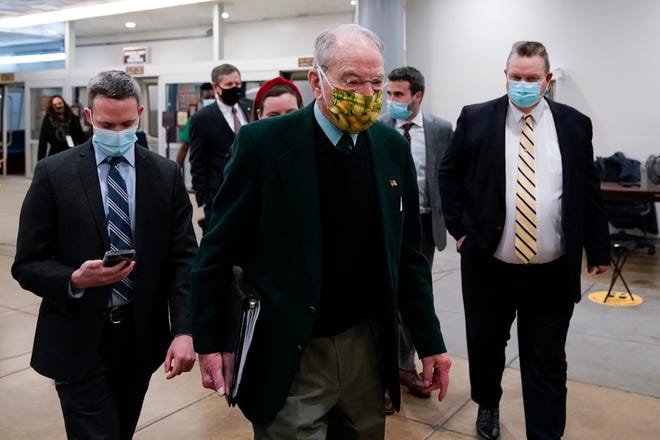
"We do not have the authority to try a private citizen like former President Trump. Even if we did, he should have been accorded the protections of due process of law in his trial. And even if we assume he has been, the House Managers still did not prove that he committed incitement to insurrection, the specific crime of which he stands accused. This does not excuse President Trump’s conduct on and around January 6th of this year," Grassley said in a statement. "It satisfies my oath as a U.S. Senator in this court of impeachment. I therefore voted to acquit."--Sen. Charles Grassley
Senator Grassley's contentions above (and those of Senator Ernst below) attempt to provide a figleaf to cover their brazen political partisanship in voting to acquit Trump. Although its a post-morten inquiry (the case is dead), I believe the the inquiry worthwhile not for the understanding it brings to the case, but the revalation it provides about the individuals who passed this judgement, in particular Grassley, Ernst, McConnell, and the remainder of the Republicans senators who voted against conviction. I will go through both Grassley's statement (above) and Ernst's (below).
1. "We do not have the authority to try a private citizen like former President Trump." (Ernst and McConnell make similar contentions, see below.). This contention is wrong. The Senate has the authority under the Constitution. It has established precedent. (The Senate has exercised its impeachment power after an office-holder (albeit not a president) has left office.) And the Senate voted to approve this procedure in this case. (N.B. Trump was not tried earlier because McConnell refused to allow it while he remained Senate majority leader, which was until after the Biden-Harris inauguration). The Supreme Court has not ruled on this issue, and in the absence of a Court decision, the Senate has the power and responsibility to interpret the Constitution and its application in the present case. Also, the lop-sided weight of scholarly supports the exercise this power under these circumstances. But why? The ulitimate authority is the text of the Constitution itself, something that "conservatives" who probably fancy themselves "originalists" or "textualists" might try reading. Here's what the relevant text of the Constitution provides:
Judgment in Cases of Impeachment shall not extend further than to removal from Office, and disqualification to hold and enjoy any Office of honor, Trust or Profit under the United States: but the Party convicted shall nevertheless be liable and subject to Indictment, Trial, Judgment and Punishment, according to Law. [Emphasis added.]
Article 1, sec. 3.
The word is "and"--"removal from office, and disqualification to hold and enjoy any Office of honr, Trust, or Profit under the United States . . . ." Both are penalities, and that one penalty can no longer apply (removal) does not entail that the second aspect of the penalty cannot or should not apply. This argument, that the Senate had not the power and authority to try Trump is pure hokum.
2. "Even if we did, he should have been accorded the protections of due process of law in his trial." What failure of "due process" (the requirement of a fair proceeding conducted by established rules) does Grassley refer to? Did anyone prevent Trump from coming to testify? Was the trial not conducted according to Senate rules? Was not an agreement about scheduling not reached by Leaders Schumer and McConnell? What utter horse hockey this allegation is!
3. "And even if we assume he has been [given due process], the House Managers still did not prove that he committed incitement to insurrection, the specific crime of which he stands accused." First all Senator, really, you've been in Congress since 1975--you're an insider and ought to have read and understood with Constitution better than this. The accusasion of "incitement to riot" is not a "crime"in this instance; it's an impeachable offense. Trump could still be charged and convicted of this crimes (see the Article 1 quote above). And you can claim that the House managers didn't prove their case, but in what particulars? Fifty-seven senators disagreed with you, seven of which were your Republican colleagues, with the result of the most lopsided conviction vote on record for a Presidential impeachment vote. (We've now had four impeachment votes regarding a president, two of them generated by Trump's actions, the first arose from his attempt to shake-down the Ukraine to get them to aid his re-election campaign; and the second for his big lie about the election, attempting to influence the count in Georgia, and inciting the violence at the Capital (again, using the big lie of the "stolen" elelction.)
4. "This does not excuse President Trump’s conduct on and around January 6th of this year." Yes, it does. To borrow from my wife the teacher: for misdeeds to provide lessons for future behavior, applicable to the perp and others who may come after him, there must be "consequences." Or, in the legal terms, punishment, even beyond the natural consequences of the act (such as a loss of prestige, honor, and so on--which of course has never influenced Trump's behavior). No, the 43 Republicans who voted against conviction (thus the failure to reach the required 2/3 vote) gives Trump and all who come after him a free pass for such rank and obvious misdeeds as we saw in this case. So much for Grassley (or Ernst) ever saying anything about "law and order" or "legal technicalities" ever again.
The one thing that I can say for Ernst is that she didn't attempt to put lipstick on her pig. She didn't vote to allow Trump's actions to go without reckoning and then attempt to condemn them, as did Grassley ("This does not excuse President Trump's conduct") nor the statements by McConnell and other Republicans who voted to give Trump a pass and then claim to have given him the equivalent of a dirty look. McConnell, along with Lindsey Graham, have moved political hypocrisy from a venial political sin to one worthy of the lowest rungs of Dante's hell, down with the fraudulant and the treacherous. (See below for McConell's finger-wagging at Trump after he acquited him.) Of course, McConnell is worried because the big Republican donors turned-off the money spiggots after the attack.The big donors realized that a majority of the Republican party would follow their Pied-Piper and tear down the government of the United States. This drastic action didn't sit well with the moneyed interests that call the shots for the party on the issues that the party unites around: taxes and regulations. McConnell, as he is so wont to do, speaks out of both sides of his mouth. Grassley parrots him; Ernst, who seems to drink the Kool-Aid without a king's-x held behind her back, has no desire to provide even a cursory condemnation of Trump after this exoneration by the Senate. This honey-badger of a senator just don't give a @#$%.
Ernst released a statement on Twitter saying in part: "The bottom line for this impeachment trial: Donald Trump is no longer in office, he is a private citizen."
Hypocrisy taken to new heights:
At least five Republican senators suggested that Trump was indeed culpable for the Capitol riots, while voting to acquit him on constitutional grounds:
Senate Minority Leader Mitch McConnell (R-Ky.) excoriated Trump’s conduct in a speech after the vote and even suggested that the former president might be held criminally liable.
The No. 2-ranking Senate Republican, Sen. John Thune (S.D.), said explicitly: “My vote to acquit should not be viewed as exoneration for his conduct on January 6, 2021, or in the days and weeks leading up to it. What former president Trump did to undermine faith in our election system and disrupt the peaceful transfer of power is inexcusable.”
Sen. Shelley Moore Capito (R-W.Va.) emphasized that her vote was “solely” on the constitutional question, while adding: “The actions and reactions of President Trump were disgraceful, and history will judge him harshly.”
Sen. Dan Sullivan (R-Alaska) said: “I condemn former president Trump’s poor judgment in calling a rally on that day, and his actions and inactions when it turned into a riot. His blatant disregard for his own Vice President, Mike Pence, who was fulfilling his constitutional duty at the Capitol, infuriates me.”
Sen. Rob Portman (R-Ohio) added: “I have said that what President Trump did that day was inexcusable because in his speech he encouraged the mob, and that he bears some responsibility for the tragic violence that occurred.”
Not all of these statements directly suggest a vote to convict but for the constitutional question. Republicans have often drawn a line between criticizing Trump for his actions — even quite strongly — and saying he technically incited the mob that stormed the Capitol on Jan. 6.
But relatively few Republicans have actually vouched for or defended Trump’s conduct. Some put out statements that didn’t address the substance of the case at all, focusing instead solely on process issues or constitutionality. (This despite many legal experts saying that, because the Senate had voted affirmatively that it had jurisdiction, they had a duty to decide the case on the merits). Others faulted Trump less harshly than the above.
It is important not to overestimate our understanding even of simple agrarian societies. Applying history’s lessons to the present day presents even more difficulties because we live in a different world from the one of the Assyrians, the Romans, and the Mongols. Abundant food and energy, rapidly developing technology and science, mass media, the World Wide Web, and the mobile phone make any direct comparisons between historical agrarian empires and the modern industrial states problematic. On the other hand, modernity did not remake human nature.
As the late, renowned American psychologist Charles R. Snyder summarized, even on a personal basis, “high-hope persons consistently fare better than their low-hope counterparts in the arenas of academics, athletics, physical health, psychological adjustment, and psychotherapy.”
What undermined Kant’s greatest discovery, the distinction between knowledge, which uses thinking as a means to an end, and thinking itself as it arises out of “the very nature of our reason” and is done for its own sake, was that he constantly compared the two with each other. Only if truth (in Kant, intuition), and not meaning, is the ultimate criterion of man’s mental activities does it make sense in this context to speak of deception and illusion at all.
Of course a danger is a potentiality, not an actuality. Of course some of these developments may not happen. The road to hell may be paved with good intentions, but the road to heaven may be paved with bad intentions that have not matured into acts. That is our saving grace, our hope. But we must recognize that the source of the new and enormous danger is not outside but inside this world, inside the minds of men, including scientists and those who support and cheer them on.
From the ecological perspective, elevating the individual over the community makes no sense, intellectually or practically. Individuals should have civil rights, but civic duties and responsibilities must have at least equal weight if we wish to preserve the integrity of the system over the long term.
We must reinvent civilization so that it once again rests on a moral foundation by discovering a new “rule of life” that moderates, rather than magnifies, the five great ills.
While we can’t simply decide when to slow or speed up our heart or digestion, or to move blood from one organ to another, we can choose how and when to breathe.
The tricky thing about understanding the Wedge, and what makes it so incredibly difficult to explain, is that you—or rather, your ego—is not always the thing in charge. Remember, there is no self. All the parts of an individual and environment work together to generate an illusion of a self. Ego is just a perspective on the reality that we’re part of a superorganism.
To do that [compete in democracy], conservatives would have to accept a politics of contested authority and endless argument. They would have to fight for control within a framework of government that liberals favored. That liberal framework included parliamentary sovereignty, wider franchise, and civic equality. It gave body to the core liberal ideals of limited power and equal respect.
Something else, however, which became fully manifest only in the decades after [George] Sorel’s and [Alfredo] Pareto’s death, was incomparably more disastrous to this view. The enormous growth of productivity in the modern world was by no means due to an increase in the workers’ productivity, but exclusively the development of technology, and this depended neither on the working class nor on the bourgeoisie, but on the scientists. The “intellectuals,” much despised by Sorel and Pareto, suddenly ceased to be a marginal social group and emerged as a new elite, whose work, having changed the conditions of human life almost beyond recognition in a few decades, has remained essential for the functioning of society.
In the aleatory compositions of John Cage, the ‘active confusion’ of the intellectual demagogue, Marshall McLuhan, who abandoned meaningful content with his dictum that the ‘medium was the message’, and the sensory barrage of ‘multi-media’ overload – siphoning off aspects of ‘Scientism’ for artistic purposes – [Erich] Kahler saw at work a deliberate attempt to undermine the whole conception of coherence in a misguided movement to break free of what it considered the restrictions of outworn, outmoded sensibilities. One of the main driving forces behind this demolition work, Kahler believed, was the increasing technological character of modern life.
The core accusation that [Walter] Benjamin levels at the tragedy of the whole of the modern age and its philosophy is “objectification”—of nature and, in particular, of humanity.
Self-organizing systems are therefore relatively autonomous, stable, and enduring, whereas artificial systems are intrinsically dependant, unstable, and transient.
So three processes produce greater complexity in our world: competition and interdependence among entities creates niches that new entities can fill; this competitive environment also encourages individual entities to breach performance limits by adding new subsystems; and large systems of entities can capture or task simpler systems, adapting and building on the grammar of these simpler systems to boost performance.
Of course a danger is a potentiality, not an actuality. Of course some of these developments may not happen. The road to hell may be paved with good intentions, but the road to heaven may be paved with bad intentions that have not matured into acts. That is our saving grace, our hope. But we must recognize that the source of the new and enormous danger is not outside but inside this world, inside the minds of men, including scientists and those who support and cheer them on.
Sadness, depression, frustration, upset, and anxiety can only be produced by seeing a situation and then producing an interpretation of it and then believing that interpretation.
Thinking, as Arendt experiences it, is an inner silent dialogue, which may reach conditional conclusions but whose real result is a proliferation of distinctions made by conversing with a thinking partner. To be conscious of thought as a conversation is rare, due both to its silence and its lightning-like speed, but to Arendt the dialogic character of the activity of thinking is what human consciousness (con-scientia) is.
All modern scientific work rests on the absolute presupposition that nature is one and that science is one: that the different realms of nature are in part governed by one and the same code of absolutely identical laws, the laws of mathematics, and in part by special codes which do not differ radically among themselves but are so linked together by analogies and similarities that they may be regarded as so many local variants of laws which in spite of these variations can still be called ‘laws of nature’; while the various sciences that investigate the various realms of nature are not independent sciences but only modifications of one and the same thing, a single thing which we call by the single name of natural science.
Walter Benjamin wrote, the self-alienation of humankind ‘has reached such a degree that it can experience its own destruction as an aesthetic pleasure of the first order’.
A nonplussed Hayek told an interviewer, “Milton [Friedman's] monetarism and Keynesianism have more in common with each other than I have with either.” For Hayek, who believed that depressions simply had to burn themselves out, even monetary therapy was dangerous.
I say to some extent, because although (theoretical physicist John Archibald] Wheeler and the scientists who follow his lead use the term ‘participation’ they do not share [Owen] Barfield’s, [Colin] Wilson’s and others’ belief that our own volition – our will – can increase our participation. Theirs is a ‘participatory universe’ but, like earlier scientific models, it is a passive one. That our consciousness participates in the universe is for them as much a ‘law’ as is gravity. For people like Barfield, the idea is to consciously increase our participation, and hence freedom. And by consciously increasing our participation, we do not then gain greater control over the things that make up our world, but of our picture of that world, just as while I cannot control what takes place in a television programme I am watching, I can control the quality of the picture on the screen; i.e., increase or decrease the focus, clarity, and so on.