Wednesday, February 17, 2021

Reading The Human Condition: Part 2 "The Vita Activa"


SNG Synopsis (my comments in italics):

I. The Human Condition

1. Vita Activa and the Human Condition

The three fundamental human activities are labor, work, and action, all are fundamental to life on earth. Labor addresses the biological processes necessary to maintain life. Work concerns the "unnaturalness of human existence" that creates the "artificial world of things" and establishes "worldliness." Action is the "only activity that goes on directly between men [plural of Man] without the intermediary of things or matter and corresponds to the human condition of plurality."

All three aspects of the human condition "are somehow related to politics." (Here's one of many places where I wish Arendt had been more specific or elucidated her statement. As I read her book as whole, I come away with the belief that politics--or at least "real" poltics--involves only action. Work and labor don't and shouldn't have a role in politics, at least as Arendt idealizes politics based on Athenian democracy.)

Natality (birth) and mortality (death) are two characteristics of the human condition, along with plurality. Arendt cites Genesis for the image of "male and female he created them." 

A polity (political body) establishes a framework for history as remembrance. 

Labor, work, and action all relate to natality, the fact that there are constant newcomers to the world. And these newcomers represent the start of something new. (Arendt draws on St. Augustine here; he's one of the key influences upon her work.

"Since action is the political activity par excellence, natality, and not mortality, may be the central activity of political, as opposed to metaphysical, thought. (9) 

Men are "conditioned beings." The things we make condition us as well as the general conditions of human life (e.g., natality, plurality, mortality, equality). 

The "human condition" is not the same as human nature. The most radical change in the human condition would be travel (and life) on another planet. Arendt cites Augustine: "A question have I become to myself." Augustine (and Arendt) contend we can't know our own nature. It's a matter of "who am I?" versus "what am I?" Arendt also seems to doubt that the human condition gives us a complete view of ourselves. She asserts "conditions of human existence--life itself, natality and mortality, worldliness, plurality, and the earth--can never explain what we are or answer the question of who we are for the simple reason that they never condition us absolutely." (10) And she notes that we now see ourselves differently than previously because we can now see ourselves from the perspective outside the earth, even as we (then) remained earthbound. 

2. The Term Vita Activa

The tradition of political thought in the West arises from the trial of Socrates and the difference between philosophy and politics. This tradition ends with Marx. Aristotle gives us the bios politikos, Augustine the via negotiosa (or actiosa) as designations of a life devoted to public-political matters. Aristotle sees three paths in life for freedom, all of which exclude labor and work. All three of the "free" paths involve a concern for the "beautiful:" 1) concern for beautiful bodily pleasures, 2) concern for beautiful deeds in the polis, and 3) contemplation of the beautiful eternal entities of philosophy. 

We need action (praxis) to sustain the world of human affairs. Thus, the despot, acting essentially alone, is not free. The world of the city-state populated by political actors--citizen--was last observed by Augustine. (14) After Augustine, politics became involved with necessity. 

All three aspects of the vita activa (labor, work, and action) are "unquiet" in both the Greek and Christian worldviews. The "Truth of Being" (Greek) or of God (Christian) can be appreciated only in stillness. The Greeks make a distinction between physei (existing of themselves; "natural") and nomo (man-made). All exists in the kosmos. Theoria equates with contemplation and is different from thought and reasoning. (How do these distinctions fit with Arendt's ideas about "thinking," especially as she explores this concept in her final work, The Life of the Mind?)

The Greek and Christian emphasis on the value of contemplation relegated the vita activa to an inferior undertaking. Marx and Nietzche reversed this tradition. Arendt refuses to take a position upon the issue of the relative value of the vita contempletiva versus the vita activa or on the issue of truth as revelation versus truth of coming from what Man has made himself. 

3. Eternity vs. Immortality

"Immortality" is "deathless, timeless on earth," the prerogative of the gods. (18) Mortality of the hallmark of the Greeks. See the line of the individual human life against the cycles of nature. Humans produce "works and deeds and words." (19) The aristoi (elites) "prefer immortal fame to moral things. (Heraclitus)." 

Socrates-Plato established the "eternal" as the center of philosophical thought. Arendt, citing the example of Socrates, contends that anyone who writes their thoughts is not concerned with eternity. (She might also have cited Jesus for this proposition. Why not?)

Plato emphasized the difference between concern with immortality as opposed to eternity. Philosophy became associated with death because of its focus on eternity. There is no activity in eternity. After the fall of Rome established the falsehood of claims of immortality. Christianity filled this void with a concern for the eternal and made the vita activa and bios politikos handmaids to the life of contemplation. Even the modern reversal of the labor-work-action triad by Marx and Nietzche was not enough to save the value of striving for immortality, which had once been the driving motive of the vita activa


Thoughts for the Day: Wednesday 17 February 2021


Thus if the quantity or quality of available energy declines significantly—either because of supply problems or because more energy is required to achieve the same ends—the civilization is in trouble.
This one seems especially pertinent today, especially if I have any readers in Texas or Nebraska.

This book completes the task I set myself many years ago—to find a humane and effective political response to the challenge of ecological scarcity.

For all its disregard for human rights, China is more fully part of the international order than the Soviet Union ever was.


In a different vein, but like Polanyi, Stephen Toulmin judged formal logic to be a misleading and inadequate representation of how humans acquire knowledge, and he proposed a gradualist Darwinian model for conceptual advance in the sciences. [From the Forward by Mary Jo Nye.]

From what impression, as Hume asks, is this idea [causation] derived? I answer, from impressions received in our social life, in the practical relations of man to man; specifically, from the impression of causing (in sense I) some other man to do something when, by argument or command or threat or the like, we place him in a situation in which he can only carry out his intentions by doing that thing; and conversely, from the impression of being caused to do something. Why, then, did people think it appropriate to apply this idea to the case of actions in which we achieve our ends by means, not of other human beings, but of things in nature?

The utilitarian view of action, since its essence is to be abstract, results not only in the false abstraction of the will from the intellect, but in the inevitable consequence of this false abstraction, the arbitrary distinction of men of thought from men of action.

Tuesday, February 16, 2021

Thoughts for the Day: Tuesday 16 February 2021


There’s just such a vast array of mistakes human minds can make that if you rejected every argument that looks like it could maybe be guilty of some fallacy, you’d be left with nothing at all. It often just doesn’t mean very much when we find that a line of argument can be made to look “suspiciously like” some fallacious argument. Or rather: being suspicious is one thing, and being so suspicious that relevant evidence cannot realistically overcome a suspicion is another.

Collingwood may well be right to say that there can be no history of nature, but this surely applies to biography, too. What gives biography its structure – what determines its particular aspect, if you like – are not natural facts, but the individual’s perspective on their life understood as a whole. The skilled biographer not only relives the life of his subject, he enhances it through the telling. In the biographer’s hands, events in life which his subject made too little of or repressed can be induced to say more.
This is a significant argument given Collingwoods rather dour remarks about biography as a genre. But I agree with Johnson.


By this process of re-enactment history is brought into the closest possible relationship with life, or, to put this in Collingwood’s language, it is necessarily linked to self-knowledge.

The world lies between people, and this in-between—much more than (as is often thought) men or even man—is today the object of the greatest concern and the most obvious upheaval in almost all the countries of the globe. Even where the world is still halfway in order, or is kept halfway in order, the public realm has lost the power of illumination which was originally part of its very nature.

Think of the macrophage—and, for that matter, the entire diverse assembly of immune cells—as a pack of friendly wolves patrolling the area inside our skin, attacking the things that might hurt us. What happens when those wolves no longer have regular prey? They go stir-crazy. They get bored. And they might turn on themselves.


The following polling figures from WTF JHT website. 

poll/ 58% of American believe Trump should have been convicted. 61% said Trump’s conduct warranted him being impeached and put on trial. (ABC News)

poll/ 75% of Republicans say they’d like to see Trump play a prominent role in the Republican Party. Overall, 60% of Americans do not want Trump to play a prominent role in the party. (Quinnipiac)

poll/ 62% of Americans say a third political party is needed – up from 57% in September. 33% of Americans say the two major parties are doing an adequate job representing the public. (Gallup)

The following courtesy of Heather Cox Richardson's Substack feed. 

The Senate trial also gave powerful proof of just how undemocratic the Senate has become. Voting rights journalist Ari Berman noted that the “57 senators who voted to convict Trump represent 76.7 MILLION more Americans than 43 senators who voted to acquit.”

Read this whole Tweet chain by Berman: eye-opening. 

https://twitter.com/AriBerman/status/1360703942255067137?s=20

Washington Post columnist E.J. Dionne noted that the adherence of all but seven senators to Trump “should end the absurd talk that there is a burden on President Biden to achieve a bipartisan nirvana in Washington. If most Republicans can’t even admit that what Trump did is worthy of impeachment, how can anyone imagine that they would be willing and trustworthy governing partners?” 

And a couple of other outstanding one-liners from Dionne in his column: 

"Trump will prove to be even more of an albatross than [Herbert] Hoover, who, after all, had a moral core."

"You can tell how worried Republicans are that they are now the Trump Party by the contortions of Senate Minority Leader Mitch McConnell of Kentucky, who aided Trump almost to the end. Rarely has a politician been more blatant in attempting the impossible feat of running with the foxes and hunting with the hounds."

https://www.washingtonpost.com/opinions/the-beginning-of-the-end-of-trumpism/2021/02/14/17037b70-6f02-11eb-93be-c10813e358a2_story.html


Monday, February 15, 2021

Thoughts for the Day: Monday 15 February 2021


The French Revolution and the American Revolution are two of the most important and enduring legacies of the Enlightenment. As [Isaiah] Berlin says, they have almost nothing to do with Romanticism:
…the principles in the name of which the French Revolution was fought were principles of universal reason, of order, of justice, not at all connected with the sense of uniqueness, the profound emotional introspection, the sense of the differences of things, dissimilarities rather than similarities, with which the Romantic movement is usually associated.
(However, as I hope to show later, there is a track that leads direct from the Enlightenment to Romanticism – another case of there being a smooth transition from one hemisphere's agenda to the (in reality quite opposed) agenda of the other hemisphere, which I have argued for in the case of the Reformation.)


After the Revolution and the Napoleonic Wars, the first conservatives asked themselves whether the turmoil, suffering, and criminal excess had been due to liberty or to its perversion. Burke mildly and Maistre savagely had blamed modern liberty, that is, liberty understood in the wrong way.


In order that there should be chronicle, there must first be history: for chronicle is the body of history from which the spirit has gone; the corpse of history.


By 1969, the year Johnson left office, the poverty rate was down to 12.1 percent—a reduction of more than 12 million people and more than one-third of the impoverished population at the time Johnson had taken office.

Start by considering the end. Visualise both the road to personal fulfilment and the destination. Consider what  behaviour  would thwart that fulfilment and do the opposite. Thinking about the route to avoid helps reveal the more rewarding road.

Senators Grassley, Ernst, & McConnell Attempt to Justify Their "Not Guilty" Votes

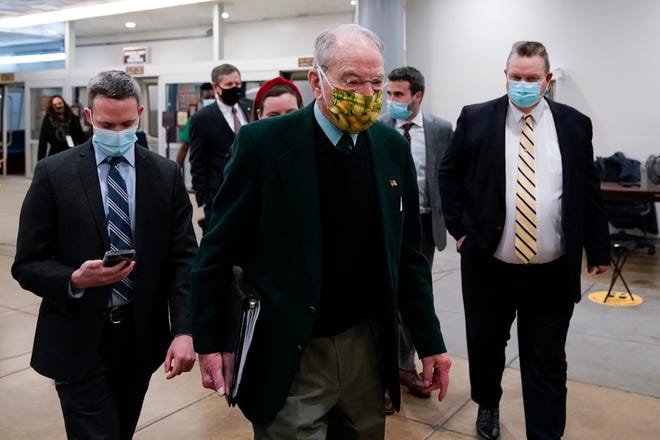
Sen. Chuck Grassley, R-Iowa, walks on Capitol Hill in Washington, Saturday, Feb. 13, 2021, on the fifth day of the second impeachment trial of former President Donald Trump. (AP Photo/Alex Brandon)


"We do not have the authority to try a private citizen like former President Trump. Even if we did, he should have been accorded the protections of due process of law in his trial. And even if we assume he has been, the House Managers still did not prove that he committed incitement to insurrection, the specific crime of which he stands accused. This does not excuse President Trump’s conduct on and around January 6th of this year," Grassley said in a statement. "It satisfies my oath as a U.S. Senator in this court of impeachment. I therefore voted to acquit."--Sen. Charles Grassley

https://www.desmoinesregister.com/story/news/politics/2021/02/13/senate-what-does-impeachment-mean-trump-2024-election-how-iowa-voted/4477250001/

Senator Grassley's contentions above (and those of Senator Ernst below) attempt to provide a figleaf to cover their brazen political partisanship in voting to acquit Trump. Although its  a post-morten inquiry (the case is dead), I believe the the inquiry worthwhile not for the understanding it brings to the case, but the revalation it provides about the individuals who passed this judgement, in particular Grassley, Ernst, McConnell, and the remainder of the Republicans senators who voted against conviction. I will go through both Grassley's statement (above) and Ernst's (below). 

1. "We do not have the authority to try a private citizen like former President Trump." (Ernst and McConnell make similar contentions, see below.). This contention is wrong. The Senate has the authority under the Constitution. It has established  precedent. (The Senate has exercised its impeachment power after an office-holder (albeit not a president) has left office.) And the Senate voted to approve this procedure in this case. (N.B. Trump was not tried earlier because McConnell refused to allow it while he remained Senate majority leader, which was until after the Biden-Harris inauguration). The Supreme Court has not ruled on this issue, and in the absence of a Court decision, the Senate has the power and responsibility to interpret the Constitution and its application in the present case. Also, the lop-sided weight of scholarly supports the exercise this power under these circumstances. But why? The ulitimate authority is the text of the Constitution itself, something that "conservatives" who probably fancy themselves "originalists" or "textualists" might try reading. Here's what the relevant text of the Constitution provides: 

Judgment in Cases of Impeachment shall not extend further than to removal from Office, and disqualification to hold and enjoy any Office of honor, Trust or Profit under the United States: but the Party convicted shall nevertheless be liable and subject to Indictment, Trial, Judgment and Punishment, according to Law. [Emphasis added.]

          Article 1, sec. 3.  

The word is "and"--"removal from office, and disqualification to hold and enjoy any Office of honr, Trust, or Profit under the United States . . . ." Both are penalities, and that one penalty can no longer apply (removal) does not entail that the second aspect of the penalty cannot or should not apply. This argument, that the Senate had not the power and authority to try Trump is pure hokum. 

2. "Even if we did, he should have been accorded the protections of due process of law in his trial." What failure of "due process" (the requirement of a fair proceeding conducted by established rules) does Grassley refer to? Did anyone prevent Trump from coming to testify? Was the trial not conducted according to Senate rules? Was not an agreement about scheduling not reached by Leaders Schumer and McConnell? What utter horse hockey this allegation is! 

3. "And even if we assume he has been [given due process], the House Managers still did not prove that he committed incitement to insurrection, the specific crime of which he stands accused." First all Senator, really, you've been in Congress since 1975--you're an insider and ought to have read and understood with Constitution better than this. The accusasion of "incitement to riot" is not a "crime"in this instance; it's an impeachable offense. Trump could still be charged and convicted of this crimes (see the Article 1 quote above). And you can claim that the House managers didn't prove their case, but in what particulars? Fifty-seven senators disagreed with you, seven of which were your Republican colleagues, with the result of the most lopsided conviction vote on record for a Presidential impeachment vote. (We've now had four impeachment votes regarding a president, two of them generated by Trump's actions, the first arose from his attempt to shake-down the Ukraine to get them to aid his re-election campaign; and the second for his big lie about the election, attempting to influence the count in Georgia, and inciting the violence at the Capital (again, using the big lie of the "stolen" elelction.) 

4. "This does not excuse President Trump’s conduct on and around January 6th of this year." Yes, it does. To borrow from my wife the teacher: for misdeeds to provide lessons for future behavior, applicable to the perp and others who may come after him, there must be "consequences." Or, in the legal terms, punishment, even beyond the natural consequences of the act (such as a loss of prestige, honor, and so on--which of course has never influenced Trump's behavior). No, the 43 Republicans who voted against conviction (thus the failure to reach the required 2/3 vote) gives Trump and all who come after him a free pass for such rank and obvious misdeeds as we saw in this case.  So much for Grassley (or Ernst) ever saying anything about "law and order" or "legal technicalities" ever again. 

The one thing that I can say for Ernst is that she didn't attempt to put lipstick on her pig. She didn't vote to allow Trump's actions to go without reckoning and then attempt to condemn them, as did Grassley ("This does not excuse President Trump's conduct") nor the statements by McConnell and other Republicans who voted to give Trump a pass and then claim to have given him the equivalent of a dirty look. McConnell, along with Lindsey Graham, have moved political hypocrisy from a venial political sin to one worthy of the lowest rungs of Dante's hell, down with the fraudulant and the treacherous. (See below for McConell's finger-wagging at Trump after he acquited him.) Of course, McConnell is worried because the big Republican donors turned-off the money spiggots after the attack.The big donors realized that a majority of the Republican party would  follow their Pied-Piper and tear down the government of the United States. This drastic action didn't sit well with the moneyed interests that call the shots for the party on the issues that the party unites around: taxes and regulations. McConnell, as he is so wont to do, speaks out of both sides of his mouth. Grassley parrots him; Ernst, who seems to drink the Kool-Aid without a king's-x held behind her back, has no desire to provide even a cursory condemnation of Trump after this exoneration by the Senate. This honey-badger of a senator just don't give a @#$%. 


Ernst released a statement on Twitter saying in part: "The bottom line for this impeachment trial: Donald Trump is no longer in office, he is a private citizen."

Hypocrisy taken to new heights:  

At least five Republican senators suggested that Trump was indeed culpable for the Capitol riots, while voting to acquit him on constitutional grounds:

  • Senate Minority Leader Mitch McConnell (R-Ky.) excoriated Trump’s conduct in a speech after the vote and even suggested that the former president might be held criminally liable.
  • The No. 2-ranking Senate Republican, Sen. John Thune (S.D.), said explicitly: “My vote to acquit should not be viewed as exoneration for his conduct on January 6, 2021, or in the days and weeks leading up to it. What former president Trump did to undermine faith in our election system and disrupt the peaceful transfer of power is inexcusable.”
  • Sen. Shelley Moore Capito (R-W.Va.) emphasized that her vote was “solely” on the constitutional question, while adding: “The actions and reactions of President Trump were disgraceful, and history will judge him harshly.”
  • Sen. Dan Sullivan (R-Alaska) said: “I condemn former president Trump’s poor judgment in calling a rally on that day, and his actions and inactions when it turned into a riot. His blatant disregard for his own Vice President, Mike Pence, who was fulfilling his constitutional duty at the Capitol, infuriates me.”
  • Sen. Rob Portman (R-Ohio) added: “I have said that what President Trump did that day was inexcusable because in his speech he encouraged the mob, and that he bears some responsibility for the tragic violence that occurred.”

Not all of these statements directly suggest a vote to convict but for the constitutional question. Republicans have often drawn a line between criticizing Trump for his actions — even quite strongly — and saying he technically incited the mob that stormed the Capitol on Jan. 6. 

But relatively few Republicans have actually vouched for or defended Trump’s conduct. Some put out statements that didn’t address the substance of the case at all, focusing instead solely on process issues or constitutionality. (This despite many legal experts saying that, because the Senate had voted affirmatively that it had jurisdiction, they had a duty to decide the case on the merits). Others faulted Trump less harshly than the above.

https://www.washingtonpost.com/politics/2021/02/14/trump-got-off-technicality/

For some additional insight, read this: 

https://www.washingtonpost.com/politics/2021/02/13/mcconnell-would-have-happily-considered-finding-trump-guilty-were-it-not-mitch-mcconnell/


Sunday, February 14, 2021

Thoughts for the Day: Sunday 14 February 2021

2007 publication: intro to Turchin for the non-academic


It is important not to overestimate our understanding even of simple agrarian societies. Applying history’s lessons to the present day presents even more difficulties because we live in a different world from the one of the Assyrians, the Romans, and the Mongols. Abundant food and energy, rapidly developing technology and science, mass media, the World Wide Web, and the mobile phone make any direct comparisons between historical agrarian empires and the modern industrial states problematic. On the other hand, modernity did not remake human nature.

In the battle of man versus nature, nature always wins.

As the late, renowned American psychologist Charles R. Snyder summarized, even on a personal basis, “high-hope persons consistently fare better than their low-hope counterparts in the arenas of academics, athletics, physical health, psychological adjustment, and psychotherapy.”


What undermined Kant’s greatest discovery, the distinction between knowledge, which uses thinking as a means to an end, and thinking itself as it arises out of “the very nature of our reason” and is done for its own sake, was that he constantly compared the two with each other. Only if truth (in Kant, intuition), and not meaning, is the ultimate criterion of man’s mental activities does it make sense in this context to speak of deception and illusion at all.

Of course a danger is a potentiality, not an actuality. Of course some of these developments may not happen. The road to hell may be paved with good intentions, but the road to heaven may be paved with bad intentions that have not matured into acts. That is our saving grace, our hope. But we must recognize that the source of the new and enormous danger is not outside but inside this world, inside the minds of men, including scientists and those who support and cheer them on.

From the ecological perspective, elevating the individual over the community makes no sense, intellectually or practically. Individuals should have civil rights, but civic duties and responsibilities must have at least equal weight if we wish to preserve the integrity of the system over the long term.


Saturday, February 13, 2021

Thoughts for the Day: Saturday 13 February 20212


The essence of professionalism is the focus upon the work and its demands, while we are doing it, to the exclusion of all else.

We must reinvent civilization so that it once again rests on a moral foundation by discovering a new “rule of life” that moderates, rather than magnifies, the five great ills.


While we can’t simply decide when to slow or speed up our heart or digestion, or to move blood from one organ to another, we can choose how and when to breathe.

The tricky thing about understanding the Wedge, and what makes it so incredibly difficult to explain, is that you—or rather, your ego—is not always the thing in charge. Remember, there is no self. All the parts of an individual and environment work together to generate an illusion of a self. Ego is just a perspective on the reality that we’re part of a superorganism.

To do that [compete in democracy], conservatives would have to accept a politics of contested authority and endless argument. They would have to fight for control within a framework of government that liberals favored. That liberal framework included parliamentary sovereignty, wider franchise, and civic equality. It gave body to the core liberal ideals of limited power and equal respect.