Showing posts with label T.S. Eliot. Show all posts

Wednesday, January 19, 2022

Thoughts 19 Jan. 2022


The flow of the universe is always creative, though it has order, and is not random or chaotic; the world is always a matter of responsiveness, though it is equally not a free-for-all. It is a process of creative collaboration, of co-creation.

Whatever-it-is-that-exists-apart-from-ourselves creates us, but we also take part in creating whatever-it-is. By this I do not only mean the common sense view that I have an impact on the world, as the world has an impact on me: that I leave my footprints. That would lead immediately to the reflection that I am very small in relation to the world, and so effectively my impact is so small that for all intents and purposes it can be ignored. There is, it might seem, an inexpressibly vast universe and an inexpressibly tiny individual consciousness (I’d say that this is the left hemisphere’s attempt to represent spatially and quantify something that is experiential and developed in time, but I hope that will be more comprehensible when we come to the discussion of time and space in Part III). Such a reflection seems to posit an objective position – the view outside of history or geography, time or space – a view from nowhere, in which all can be measured and compared. It implies a Measurer of all the measurers, measuring the other scales and putting each part in its place according to its overall worth. But though that cannot be, the alternative is not just a merely subjective position, either: this very polarity – subjective/ objective – is misleading. In the fado, in the raga, in jazz, it is what it is because of me, and I am what I am because of it. I will have much more to say about the crucial issue of the subjective/ objective ‘divide’ throughout this book.
A people without history
Is not redeemed from time,
for history is a pattern
Of timeless moments.

[Don Beck of Spiral Dynamics fame] realized a surprising truth—one that might have seemed nonsensical to the uninitiated but represented a radically different perspective on the political tensions of the country [South Africa]. “Oh my God,” he realized. “This is not about race.” To most South Africans, the societal fault lines were clear. It was black versus white, African versus European. But for Beck, it wasn’t so simple. This struggle really masked a deeper conflict, one between value systems.


Xi’s panopticon is actually more akin to the dystopia imagined in Yevgeny Zamyatin’s 1920s novel We.

IN FACT, the entire New Deal period, lasting until the inauguration of Dwight Eisenhower in 1953, reflects an unremitting sense of fragility. From the Great Depression to the blood-filled battlefields in Korea, persistent, nearly unremitting anxiety conditioned the era’s “normal politics” of voting, public opinion, pressure groups, federalism, and the separation of powers among the executive, legislative, and judicial branches of government.

When people subconsciously begin to associate you with positive moods and emotions, you are going to be the bell that makes people smile without realizing why.


Thursday, August 26, 2021

Thoughts for the Day: Thursday 26 August 2021


T.S. Eliot: a touch of poetry today

But first a few words from Pope Francis in Laudato Si:

We can be witnesses to terrible injustices if we think that we can obtain significant benefits by making the rest of humanity, present and future, pay the extremely high costs of environmental deterioration.

(Location 500)

Let us mention, for example, those richly biodiverse lungs of our planet which are the Amazon and the Congo basins, or the great aquifers and glaciers. We know how important these are for the entire earth and for the future of humanity. The ecosystems of tropical forests possess an enormously complex biodiversity which is almost impossible to appreciate fully, yet when these forests are burned down or levelled for purposes of cultivation, within the space of a few years countless species are lost and the areas frequently become arid wastelands.

(Location 506)

Many of the world’s coral reefs are already barren or in a state of constant decline. “Who turned the wonderworld of the seas into underwater cemeteries bereft of colour and life?”

(Location 526)

Human beings too are creatures of this world, enjoying a right to life and happiness, and endowed with unique dignity.

(Location 538)


And now for other important voices: 


And right action is freedom
From past and future also.
For most of us, this is the aim
Never here to be realised;
Who are only undefeated
Because we have gone on trying;
We, content at the last
If our temporal reversion nourish
(Not too far from the yew-tree)
The life of significant soil.


Politics deals with men, nationals of many countries and heirs to many pasts; its laws are the positively established fences which hedge in, protect, and limit the space in which freedom is not a concept, but a living, political reality.

Fear, the inspiring principle of action in tyranny, is fundamentally connected to that anxiety which we experience in situations of complete loneliness. This anxiety reveals the other side of equality and corresponds to the joy of sharing the world with our equals.

[T]he enterprises produced by the individualistic energy of the European peoples presuppose physical actions directed to final causes. But the science which is employed in their development is based on a philosophy which asserts that physical causation is supreme, and which disjoins the physical cause from the final end. It is not popular to dwell on the absolute contradiction here involved. It is the fact, however you gloze it over with phrases.

The critical economists Robert Heilbroner and William Milberg write: “This inextricable entanglement of economics with capitalism appears to be the best guarded secret of the profession. . . . The failure of mainstream economics to recognize the insistent presence of this underlying social order, with its class structure, its socially determined imperatives, its technologies and organizations, and its privileges and rights, derives from its preconceptual basis in a natural rather than a social construal of economic society.” And later: “[The] universal grammar [of modern economics] does not communicate a message of any economic interest or significance, unless it applies to a society that possesses the institutional and cultural elements of capitalism: indeed, the very meaning of ‘economic’ would be unintelligible outside capitalism.” Robert Heilbroner and William Milberg, The Crisis of Vision in Modern Economic Thought (Cambridge: Cambridge University Press, 1995).

On the other side of the debate we have a diverse group of economic optimists consisting mainly of neoclassical economists, economic historians, and agricultural economists. (At some point during the last two centuries, economics transformed itself from the “dismal science” of Malthus and Ricardo to a doctrine of hope and optimism for humanity.)

Lacking a lucid set of ethics and having rejected tradition, Technopoly searches for a source of authority and finds it in the idea of statistical objectivity.

Steve Bannon, the ideologist of the Trump revolution, made clear that one of his central goals was the “deconstruction of the administrative state.” For four decades, America has largely been run by people who openly pledge to destroy the very government they lead. Is it any wonder that they have succeeded?


Sunday, June 27, 2021

Thoughts for the Day: Sunday 27 June 2021


No decision you make will ever make it possible to avoid death. Which, in a strange way, means that the whole idea of risk is something of an illusion. If avoiding death was the goal, then we’ve already lost the game. But what if the point of being alive was instead to experience the entire bounty of human emotion, failure, triumphs, love and loss?

What is a highly adaptive society? It is a nation-state that has acquired and developed a stable set of five key institutions: a representative form of government, a market-oriented economy, a growing scientific and technical enterprise, a universal system of education, and a system of religious practice which becomes progressively more disentangled from government and progressively more tolerant of diverse beliefs.
How are we doing? Oh, dear!

All of history testifies that in complex societies there must be a stable and experienced ruling class of some sort, for the alternative is chaos and anarchy, whether due to a lack of governance or to a takeover of society by ideological fanatics.

If our attention is like a hand, it can only grasp something in one way at a time.

He [Colin Wilson] may, as some critics have said, have never gotten over Shaw—listening to a radio broadcast of Man and Superman was perhaps the single most decisive event of the young Wilson’s life; and his ‘Victorian’ belief in progress and heroism may seem antiquated amidst our own cool scepticism. But, as C. S. Lewis pointed out, it’s not enough that an idea be fashionable, it should also strive for truth.

Ancient thought could not even conceive of the individual’s soul life apart from the soul of the world.

As T.S. Eliot famously wrote, “Human kind cannot bear very much reality.”


Sunday, June 13, 2021

Thoughts for the Day: Sunday 13 June 2021


Broadly speaking, working with the immune system and our inner worlds means paying more attention to the bounty of sensations that are available to us. This includes the five main senses—sight, smell, touch, taste and sound—but also the interoceptive sense that we develop when we quiet the outside world and look inward.

As T.S. Eliot famously wrote, “Human kind cannot bear very much reality.”

As industrial civilization begins to implode, we will witness an upsurge of prophecy of all kinds—fantastic, salvational, millenarian, apocalyptic, and reactionary.

Under English law, the House of Commons took the term “misdemeanor” to refer to distinctly public misconduct, including but not limited to actual crimes. Thus “high Crimes and Misdemeanors,” the standard basis for impeachment, represented “a category of political crimes against the state.”

“Undermine guerrilla cause and destroy their cohesion by demonstrating integrity and competence of government to represent and serve needs of people – rather than exploit and impoverish them for the benefit of a greedy elite.” And the footnote: “If you cannot realize such a political program, you might consider changing sides!”

When we read writing aloud it increases our chance of noticing any mismatches or friction between the outer physical experience of hearing the sound of our words and the inner mental or cognitive experience of feeling the meaning. After practicing the activity of reading aloud to revise, we begin to learn to notice when the fit is not so good between words and meaning—a sense of our feet swimming a bit in shoes that are too large—a sense of sounds sort of flapping around a bit and slightly muffling the meaning.

The image of human excellence I would like to offer as a counterweight to freedom thus understood is that of a powerful, independent mind working at full song. Such independence is won through disciplined attention, in the kind of action that joins us to the world. And-this is important-it is precisely those constraining circumstances that provide the discipline.


Monday, January 18, 2021

Thoughts for the Day: Monday 18 January 2021


Fear, the inspiring principle of action in tyranny, is fundamentally connected to that anxiety which we experience in situations of complete loneliness. This anxiety reveals the other side of equality and corresponds to the joy of sharing the world with our equals.

The chief point with respect to the “scientific attitude” seems to be that it belongs to the very essence of science, which is primarily interested in facts, that our factual information is not only limited but that the answers to the most important factual questions concerning the human condition as well as the existence of Being in general are beyond factual knowledge and experience.

You will recall Kant’s opinion that the touchstone for determining whether the difficulty of a philosophical essay is genuine or mere “vapors of cleverness” may be found in its susceptibility to popularization. And Jaspers, who in this respect, as indeed in every other, is the only successor Kant has ever had, has like Kant more than once left the academic sphere and its conceptual language to address the general reading public.

Certainly, for Collingwood, human actions take place in contexts, and reference to context is often necessary to understand and get a feel for what is going on, but the relation between action and context is not like the relation between the instance and the law which governs it.

Shame is one of the “gifts reserved for age,” according to Eliot. He goes on to describe shame as
… the rending pain of re-enactment
Of all that you have done, and been; the shame
Of motives late revealed, and the awareness
Of things ill done and done to others’ harm
Which once you took for exercise of virtue. [Eliot, Four Quartets, IV.2]

Tuesday, March 15, 2016

The Principles of Art by R. G. Collingwood

"Art is the community's medicine for the corruption of consciousness"
I decided to read R.G. Collingwood's The Principles of Art (1938) to move toward rounding out my reading of Collingwood, having recently completed his Autobiography and his The New Leviathan (reviews forthcoming on both). I started The Principles of Art thinking I might learn about beauty in music, painting, or literature and some such. Having read a good deal of Collingwood by now, I should have known better. 


Collingwood is not a systems thinker in the way of many great philosophers, such as Plato, Aquinas, Spinoza, Kant, and Hegel, to name but a few in the history of philosophy who have constructed philosophic edifices with a room for every major issue. No, Collingwood isn't a system builder, but his is a systematic thinker. When he approaches a topic, be it history (The Idea of History) or civic life (The New Leviathan) or art, he lays his foundations very deep, sufficient to support the heavy weight of argument that he places upon those foundations. For instance, in The Principles of Art, he considers the history of analyzing sensation (Hobbes to Kant) and the innate expressiveness possessed by every human being and how that innate expressiveness prompts the unique human capacity for language. 

In the first part of the book, Collingwood distinguishes art from craft, and he discusses the creations that we often refer to as art but that he excludes from the domain of art, such as amusement and magic. "Magic"? Yes, magic. But here we learn from Collingwood the archeologist and folklorist that magic isn't for the manipulation of creation by some mystical force (although some few may have believed this), but he describes it as an enactment of rituals to arouse certain emotional responses from those performing or observing the rituals. Magic uses a representation of reality to arouse emotions important for various undertakings. Collingwood's argument is an intriguing and persuasive understanding of what we would otherwise consider irrational and useless behavior. 

Collingwood's explication of magic is but one of the distinctions and definitions that Collingwood makes in the first section of the book. Early on we're introduced to the carefully drawn distinctions that he makes with his lucid prose. Indeed, I'd like to quiz Collingwood about his writing: Is it art? Or is it a craft? Is all rhetoric a craft driven by the end of exhortation? In any event, he writes engagingly (except when he drops in obscure Latin phrases), and his use of everyday examples and metaphors makes his prose not only readable but entertaining. 

But while the first part of the book is intriguing, it's only a prelude to deep dive found in Part II. In the second part of the book, he delves into issues of sensation, emotions, imagination, experience, attention, consciousness, thought, intellect--and then the foundations of language! He also discusses what he describes as "the corruption of consciousness" (shades of Aristotle, Sartre (who published later), and C. Terry Warner here). But we can follow Collingwood through this palace of complex terms because he constructs his arguments brick-by-brick on top of his deep foundations. He thereby creates a substantial work of . . . well, art, even if he would disagree with my use of the term. As readers of his work on history might not be surprised to learn, he concludes that art is found in the mind of the artist who seeks to express (not just arouse) emotions. All art--and not just literature--is an expression of emotions that uses a form of expression, a language, if you will. he argues that language grows out of expression and that art is a language of expression (whether words, music, painting, etc.). His contention strikes me as brilliant and insightful. 

In the third part of the book, Collingwood ties up some loose ends. He refers only rarely to actual works of art, although he does spend some time discussing and praising T.S. Eliot's "The Wasteland" as an exemplary work from the time Collingwood was beginning his career as an academic philosopher. 

I could go on at some length about this book, as I've only given the briefest tour of Collingwood's creation that I think merits careful study. A student of philosophy tells me that Collingwood is considered outdated in his analysis of these issues. Perhaps so. I'm not in a position to judge because I'm not widely read in this field. But even if so, I contend that Collingwood has laid down too many fundamental and fortified arguments to ignore. If there are more persuasive thinkers writing about these issues, I want to read them. In the meantime, I'll appreciate and benefit from this Collingwood masterpiece. 


Tuesday, September 1, 2015

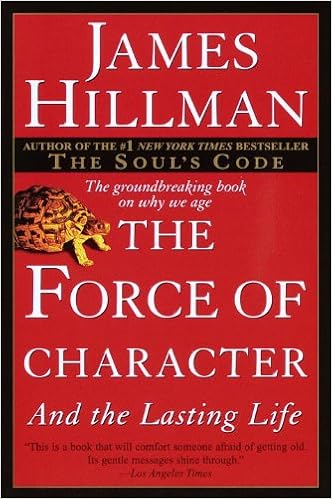
The Force of Character: And the Lasting Life by James Hillman

I’ve recently sang the praises of James Hillman in my review of Kinds of Power, so I won’t repeat that here. This book deals another big topic: aging. Like power, we sometimes wish it would go away and we try to ignore it. But remember: only the lucky get to age.

Hillman looks at aging through his unique lens, paying heed to the literal but focusing upon the figurative—the images of aging. And as he often does, he provides us with a fresh perspective on this age-old topic. In the end, it may not make you happy about aging, but you’ll realize that it has its benefits, prerogatives, and even some blessings.  

Without further fanfare, and in the style of Brain Pickings, below is an array of quotes with comments that should provide you with opportunities for reflection and a taste of the book.

It is not old age as such, but the abandonment of character that dooms later years to ugliness. We can’t imagine aging’s beauty because we look only through the eyes of physiology. As Aristotle said, “The soul’s beauty is harder to see than beauty of the body.” 
Hillman, James (2012-11-07). The Force of Character: And the Lasting Life (Kindle Locations 558-560). Random House Publishing Group. Kindle Edition.

The further back you can reach in imagination, the more extended you become. 
Id. 743-744

This, I think, is the value of history: it extends our thinking, ourselves, back in time; imagination extends us forward in time. But because of its reality, history provides the more secure anchor.

Her character must consist in several characters—“ partial personalities,” as psychology calls these figures who stir your impulses and enter your dreams, figures who would dare what you would not, who push and pull you off the beaten track, whose truth breaks through after a carafe of wine in a strange town. Character is characters; our nature is a plural complexity, a multiphasic polysemous weave, a bundle, a tangle, a sleeve. That’s why we need a long old age: to ravel out the snarls and set things straight. 
Id. 819-822

Hillman established archetypal psychology, a descendant of Jung's project, with an emphasis on images and “polytheism”. This view highlights the multiplicity of reality, including the multiplicities in us and outside of us.

Access to character comes through the study of images, not the examination of morals. 
Id. 847-848

This is why the idea of character is so needed in a culture: It nourishes imagination. Without the idea we have no perplexing, comprehensive, and long-lasting framework to ponder; instead we have mere collections of people whose quirks have no depth, whose images have no resonance, and who are distinguishable only in terms of collective categories: occupation, age, gender, religion, nationality, income, IQ, diagnosis. 
Id. 921-926

Old is one of the deepest sources of pleasure humans know. Part of the misery of disasters like floods and fires is the irrecoverable loss of the old, just as one of the causes of suburban subdivision depression— and aging and death— is the similar loss of the old, exchanged for a brand-new house and yard. 
Id. 959-961

As the owner and occupant of a house for a quarter of a century  that approached its centenary by the time we sold it, and now as the first occupant of a new apartment, I can attest to the difference, even as we’ve tried to old this apartment.

Time is not only destructive; it toughens as well as weakens. Time lasts; it keeps on going and going and going and therefore is no enemy of age or of old. But time is indeed destructive to youth, which it eats away and finally stops dead. So when we hear of the corruption caused by time, we are listening to youth speaking, not age. 
Id. 1031-1033
 Certainly you know of someone that you'd describe as a "tough old bird". 

In old age, interest shifts from information to intelligence. By this I mean that information brings news, while intelligence searches it for insight. 
Id. 1164-1165

You just have to hope that the insight doesn’t come too late.

The words describing our approach will change: instead of “explanation,” “understanding”; instead of “new studies,” “old texts”; instead of “improvement,” “necessity”; instead of “health,” “soul”; instead of “experiment” and “statistic,” “philosophy”; instead of “information,” “intelligence,” “insight,” and “vision”; and instead of “empowerment” and “entitlement,” “idiosyncrasy,” “passion,” and “folly”. 
Id. 1235-1240

I don’t believe that Hillman is a scientific Luddite—not at all—but he perceives the limits of our scientific worldview. Where most of the culture followed Descartes, Hillman hearkens us back to the alternate path pointed out by Vico (among others).

All human evil comes from this, man’s inability to sit still in a room.
Pascal 
Id. 1477-1478

Dry souls are wisest and best.
Heraclitus
 Id. 1514-1515

“It seems, as one becomes older, / That the past has another pattern, and ceases to be a mere sequence,” wrote T. S. Eliot. Four Quartets, which meditates on time, age, and memory, goes on to say, “We had the experience but missed the meaning, / And approach to the meaning restores the experience / In a different form, beyond any meaning.” 
Id. 1602-1606

Anyone quoting and appreciating Pascal, Heraclitus, and Eliot is on the right track.

The willful amnesia afflicting the sciences in general contrasts sharply with the importance given to memory by the humanities. Literature, philosophy, politics, and the visual arts, including photography and filmmaking, feed on memory. Practitioners of the humanities need memory to deepen and refine their thinking. 
Id. 1630-1632

St. Augustine (via Hannah Arendt): Sedis anima est in memoria (The seat of the mind [soul] is in the memory.) Science deludes and cripples itself when operates without an appreciation of history. It lacks depth.

Memory is always first of all imagination, secondarily qualified by time. 
Id. 1645

All the while we are losing acuity, we are intensifying Yeats’s “fantastical eye.” We can spin out from one wild strawberry a whole northern summer, from one tasty tea cake a vast French novel. 
Id. 2033-2035
 Robert Butler, the eminent researcher of old age, makes this telling point about heightened aesthetics in last years: “The elemental things in life— children, plants, nature, human touching (physical and emotional), color, shape— may assume greater significance as people sort out the more important from the less important.” Importance does not result from sensation only, or from simplicity. If it did, we would still prefer sugary childhood candies and the salty goo of fast-food pizza to the subtleties concocted by multistarred chefs. “Importance,” which Alfred North Whitehead placed among the first principles for understanding all human endeavors, governs our choices among values. “Importance is derived from the immanence of infinitude in the finite.”
 Id. 2068-2073
 
Contrition redeems no faults. It is wholly an inward act, relieving guilt to the past by reliving guilt for the past, an appeasement of ghosts. It is not the past that is tempered by contrition, but the gnawing guilt about it. 
Id. 2198-2200

I like the way my favorite philosopher, Plotinus, makes the contrast, because his metaphysical speculations are more psychological. Plotinus says that “the forward path is characteristic of the body”; “the body tend[ s] toward the straight line.” The soul, however, moves in circles. It circles “towards itself, the movement of self-concentrated awareness, of intellection, of the living of its life, reaching to all things so that nothing shall lie outside of it, nothing anywhere but [is] within its scope.” Because of these different kinds of movements, the soul “restrains” the body’s forwardness, says Plotinus. 
Id. 2244-2249

I think that this Plotinus/Hillman insight quite accurate. In my thoughts and interests, I seem to keep circling around something, something that I can’t quite make out, but which acts with a gravitational attraction.

As our bodies shrivel, we become our faces. Feet, hams, arms, and shoulders lose their shapeliness, while the face gains distinction, even beauty. The old naked body is unsightly, yet its naked face is a subject for long contemplation. 
Id.2410-2412
Image result for Image: rembrandt self-portrait
Exhibit A: Rembrandt self-portrait

Have you ever contemplated a late Rembrandt self-portrait?

“After a certain age,” said Proust, “the more one becomes oneself, the more obvious one’s family traits become.” Owning our own faces = becoming more individualized = owning our ancestry. 
Id. 2518-2519

As I’ve aged I’ve often experienced a shock of recognition the mirror. In my youth I looked a lot like my maternal grandfather in his youth, but now I glimpse myself and see more of my father in his old age. How strange and yet revealing.

To be left. This possibility haunts any intimate union, especially the close friendships that marriages often become. 
Id. 2648-2649

Yes.

I think the true agenda of the old is the agenda of the left: more fairness and less profit; more restoration and less development; community care, not more prescriptions; restoration of nature, not more harvesting from it; less wrangling over Medicare and more genuine nursing; more public transportation, fewer private enclaves; investment in schools to teach the young, not prisons that let them languish; more friendliness with people rather than user-friendly electronics; and peace, not guns. 
Id. 2694-2697
I long ago turned away from my Republican youth. And now I  have less patience with all types of nonsense. Fear drives so much of what we do and believe. Fear of loss of guns –fear of impotency? Fear of taking risks—“Iran might cheat”. Fear of changing the system even a little. Fear of reality—"climate change is irrelevant”—Republican flavor-of-the-week presidential candidate Ben Carson. How dreary!

In [character’s] place a bevy of substitutes appeared: the will, the individual, the subject, the personality, the ego. Each is a way of speaking about a characterless, unified subjective agent. This Objective Observer is what we believe to be our center of consciousness. The substitutes for character come empty. They are deliberately abstract, whereas the old idea of character presented rich and recognizable traits, a crowd of qualities. 
Id. 2760-2763

The one death that has caused so much death in the past century is the death of character. — The corpse invites an autopsy. It is hard, however, to isolate a single cause of death. 
Id. 2775-2777
This is a mighty tall statement, but one that demands careful investigation. If found true, it demands serious change. 

Current deficiencies of character, both as an idea and in behavior, result from epistemology, the study of how we know. If the character of the knower is irrelevant to knowing, or even interferes with truest knowing, then character does not belong within philosophy’s purview. Then knowledge and the methods of gaining knowledge can proceed unhampered by the character of the knower and by issues of value that are inescapably implied by the idea of character. Result: knowledge without value; valueless knowledge, which is euphemistically dubbed “objectivity.” 
Id. 2795-2799

To know the world “out there,” philosophy constructed a knowing subject “in here.” As the world was conceived to be, ultimately, a characterless abstraction of space, time, and motion, so the knower had to be equally transcendent and objectified, that is, shorn of characteristics. The method of knowing the world had to be purified; otherwise our human observations would be all-too-human, qualified by individual subjectivity, merely anecdotal, therefore unreliable, therefore untrue. The ideal human as knower of truth must be a vacant mirror of purified consciousness. 
Id. 2803-2807

Compare the last two quotes with the John Lukacs’s essay “Putting Man Before Descartes” and OwenBarfield's idea of “participation”. I think that all three thinkers are on the same (correct) page.

Adjectives and adverbs are the actual forces at work in perceiving the world and in our behavior. Our speech would return to a correspondence with the world, which does not show a sheer unqualified cloud, a shrub, a mouse, but each cloud shaped, still or moving, related to the land below and to other clouds; each shrub a species and one of a kind; that particular mouse doing its thing in its singular way. Language would be creatively imagined to equal the imagination of the creation. 
Id. 2839-2842

But Stephen King and writing software like Hemingway counsel us to junk the adverbs! Perhaps this is an instance of the (borrowed) injunction: “When you meet the Rule on the road, slay him!” Or perhaps it shows the value of knowing the history of expression. Compare the richness of language and images in Dante and Shakespeare to most contemporary authors, even knowledgeable ones like King. P.S. Brain Pickings shares a piece by Stephen King--using adverbs! 

“The most salient characteristic of most of the languages of the North American Indians is the care they take to express concrete details which our languages leave understood or unexpressed.” 
Id. 2856-2857

This thought is beautifully displayed by meditations on American Indian language contained in Robert Pirsig’s Lila: An Inquiry into Morals.

In keeping with a characteristically American priority— judgment before curiosity— we still declare a phenomenon good or bad before we become interested in it. This shelters our innocence from deeper engagement. 
Id. 2917-2919

American Innocence! When will our nation moved beyond adolescence? Not soon enough, I fear. The current election process (vastly extended out from a real election) does not bode well for maturity.

“Grandmothers empowered the human species to become the planet’s dominant animal,” writes Theodore Roszak in his exposition of the “grandmother hypothesis.”  They also carry cultural knowledge.
Id. 3090-3092

Amen.